
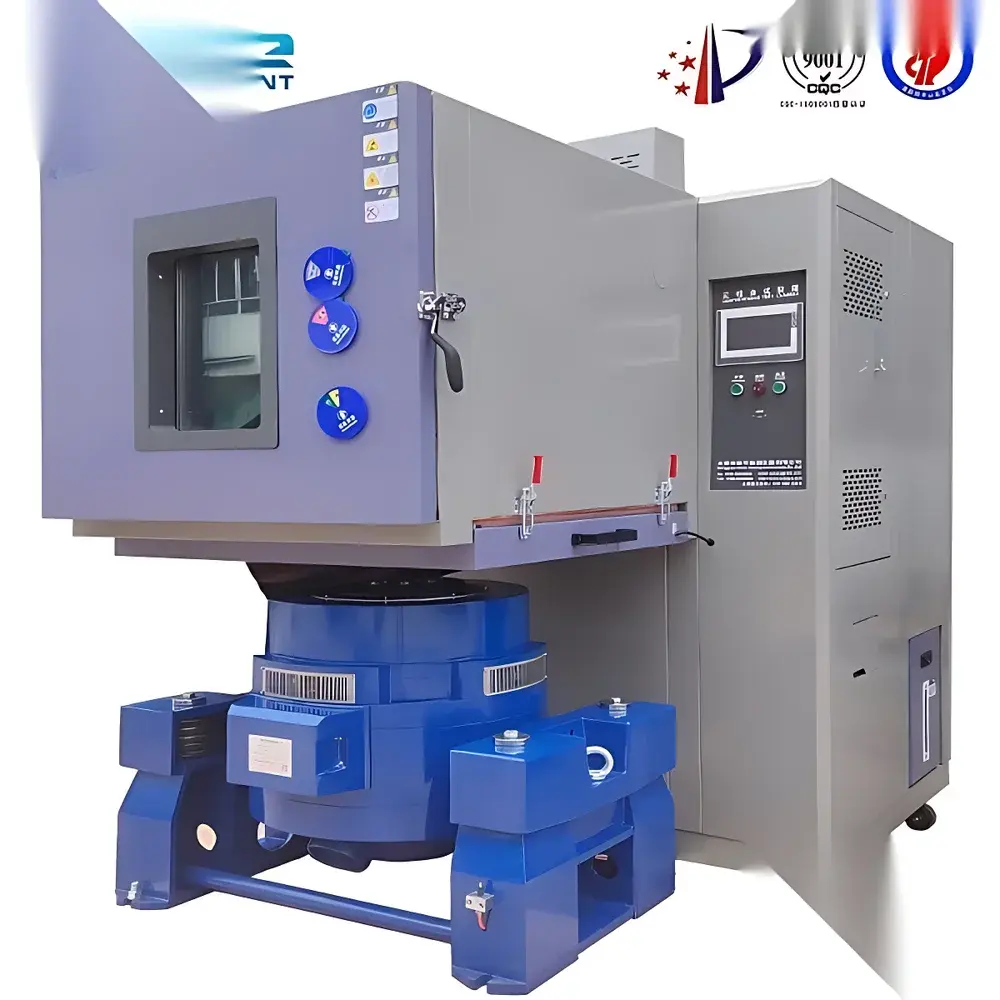
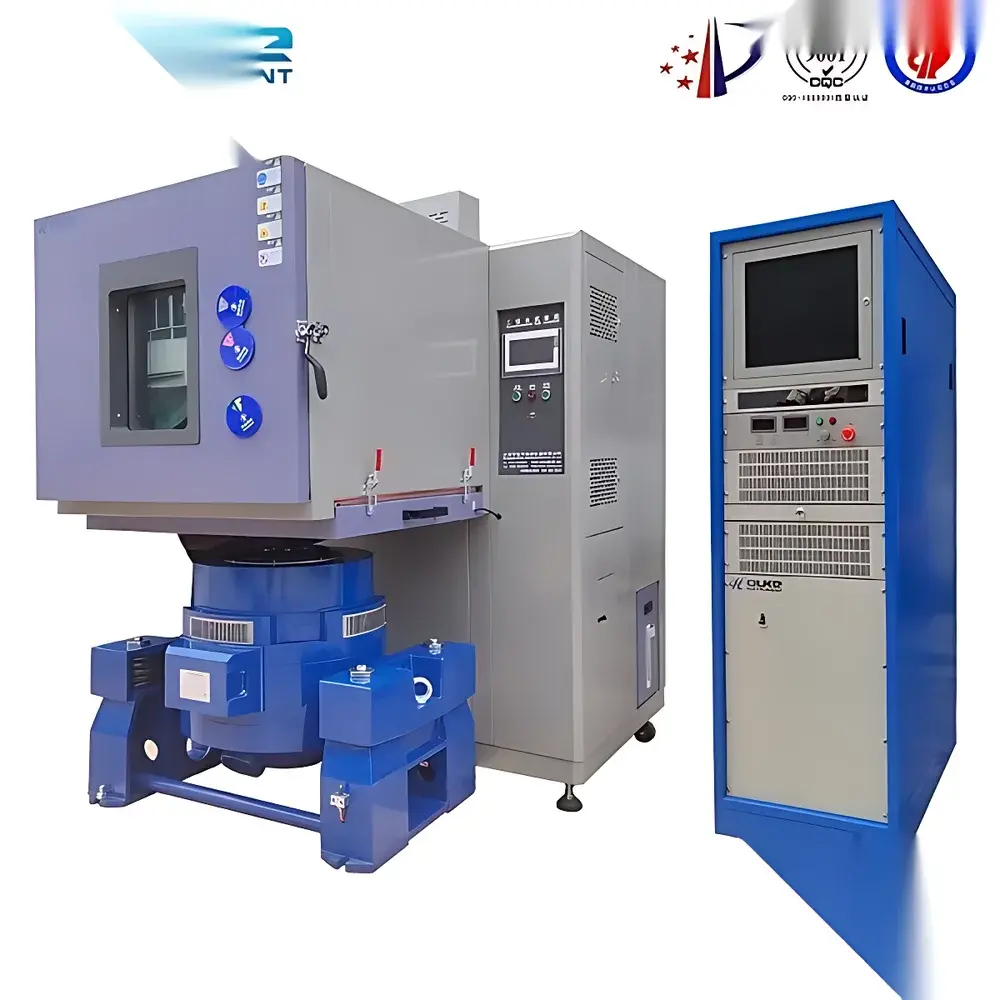
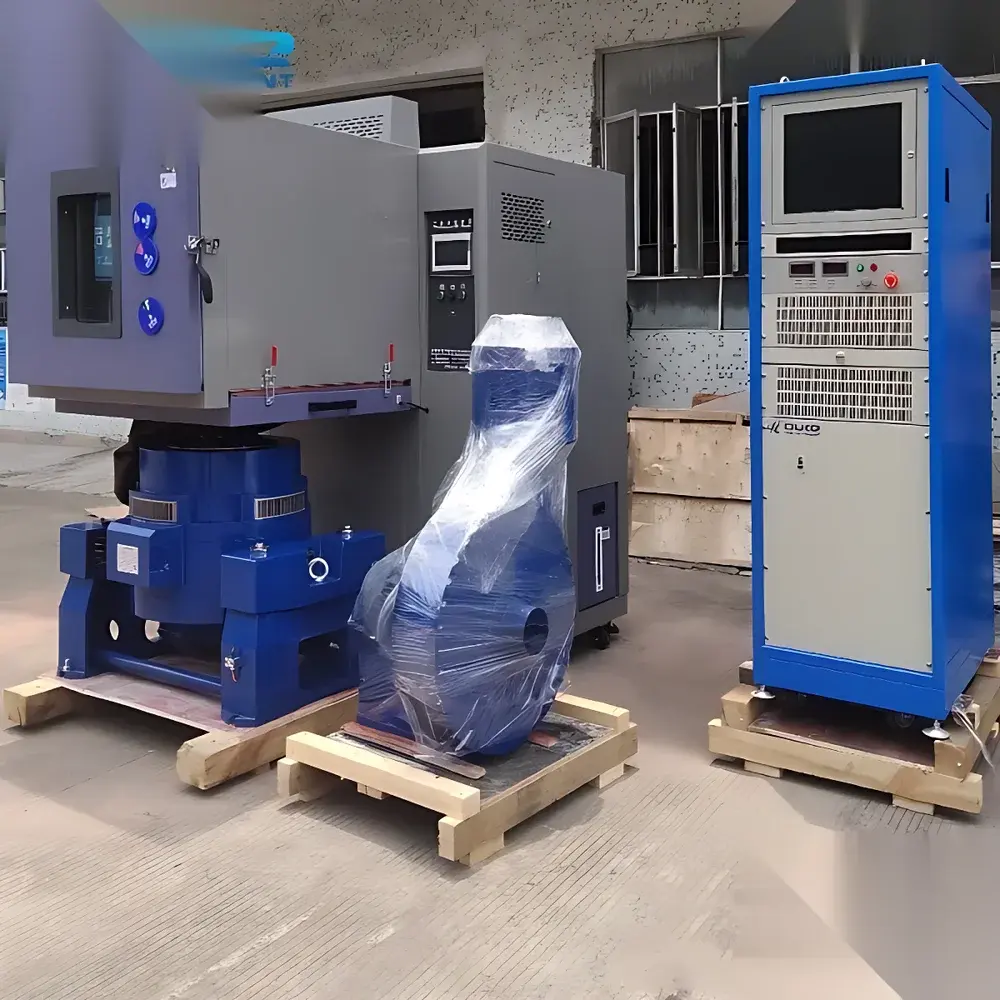
Combined Environmental Test Chamber for Temperature, Humidity, and Vibration Testing
| Brand | Other Brands |
|---|---|
| Origin | Imported |
| Manufacturer Type | Authorized Distributor |
| Temperature Range | -70°C to +150°C |
| Humidity Range | 5%–98% RH |
| Temperature Control Accuracy | ±0.5°C |
| Humidity Control Accuracy | ±2.5% RH |
| Temp. Uniformity | ±2.0°C |
| RH Uniformity | ±3.0% RH |
| Temp. Resolution | 0.1°C |
| RH Resolution | 0.1% RH |
| Heating Rate | ~4.0°C/min |
| Cooling Rate | ~1.0°C/min |
| Construction | Interior & Exterior SUS#304 Stainless Steel |
| Insulation | High-Density Polyurethane Foam (CFC-Free) |
| Refrigeration | Air-Cooled, Single-Stage Compressor (to –20°C), Two-Stage Compressor (to –70°C) |
| Safety Protections | Fuseless Circuit Breaker, Compressor Overload Protection, Refrigerant HP/LP Cut-off, Over-Temp/Over-Humidity Interlock |
Overview
The Combined Environmental Test Chamber for Temperature, Humidity, and Vibration Testing is an integrated reliability validation platform engineered for simultaneous exposure of test specimens to controlled thermal, hygroscopic, and mechanical stress environments. It operates on the principle of synchronized environmental conditioning—where a climatic chamber (capable of precise temperature and relative humidity regulation) is mechanically coupled with a high-fidelity electrodynamic or servo-hydraulic vibration shaker system via a hermetically sealed, dynamically balanced interface. This architecture enables concurrent application of ISO 16750-4, MIL-STD-810H Method 514.7 (vibration), Method 502.7 (temperature), and Method 507.6 (humidity), ensuring realistic simulation of field-deployed operational stresses in aerospace, defense, automotive electronics, and telecommunications hardware.
Key Features
- Modular integration architecture supporting interchangeable vibration exciters (e.g., 100 kgf–1000 kgf force capacity shakers) while maintaining chamber integrity under dynamic loading
- LCD color touchscreen controller with real-time graphical display of all environmental parameters and vibration profiles (acceleration, displacement, velocity)
- Hermetic feedthrough design enabling uninterrupted signal transmission (IEPE, LVDT, thermocouple, RTD) between chamber interior and external data acquisition systems
- Stainless steel (SUS#304) internal and external construction ensures corrosion resistance, long-term dimensional stability, and compatibility with cleanroom-grade maintenance protocols
- High-efficiency polyurethane insulation with zero ozone-depleting potential (ODP = 0) meets EU F-Gas Regulation (EU No. 517/2014) compliance requirements
- Dual-stage refrigeration system optimized for rapid thermal transition across extreme low-temperature setpoints (down to –70°C) without condensation-induced vibration damping anomalies
- Comprehensive safety interlock suite including refrigerant pressure monitoring, over-temperature/over-humidity cutoffs, and emergency stop integration per IEC 60204-1
Sample Compatibility & Compliance
The chamber accommodates DUTs (Devices Under Test) up to 600 mm × 600 mm × 600 mm (W×D×H) with mass load limits aligned to selected shaker specifications. All internal surfaces are electropolished to minimize particulate generation—critical for qualification testing of avionics modules, PCB assemblies, and MEMS sensors. The system supports full traceability per ISO/IEC 17025:2017 calibration requirements and includes audit-ready documentation packages compliant with FDA 21 CFR Part 11 (electronic records/signatures) when paired with validated control software. Environmental profiles adhere to ASTM D4332, IEC 60068-2-1 (cold), IEC 60068-2-2 (dry heat), IEC 60068-2-30 (damp heat cyclic), and JEDEC JESD22-A104 for semiconductor reliability screening.
Software & Data Management
Built-in RS-232 and optional Ethernet (TCP/IP) interfaces enable bidirectional communication with third-party test sequencing platforms such as NI TestStand, Keysight PathWave, or Dewesoft X. The embedded controller logs time-synchronized environmental and vibration data at ≥10 Hz sampling rate, storing timestamped CSV files with metadata (operator ID, test plan revision, chamber serial number). Optional software modules provide automated report generation per MIL-HDBK-344A Annex A, GLP-compliant electronic audit trails, and deviation alerting with configurable email/SNMP notifications. All firmware updates follow secure signed-package protocols meeting NIST SP 800-193 guidelines for firmware integrity assurance.
Applications
- Aerospace: Structural fatigue evaluation of satellite payload housings under combined thermal cycling and launch vibration spectra (e.g., random + sine-on-random profiles)
- Automotive: Validation of ADAS sensor housings against thermal shock (–40°C ↔ +85°C in ≤15 min) while subjected to road-simulation vibration (ISO 16750-3 Class C)
- Medical Devices: Accelerated aging of implantable electronics per ISO 14971 risk management framework, incorporating humidity-induced creep and thermal expansion mismatch effects
- 5G Infrastructure: Reliability assessment of mmWave RF front-end modules under high-humidity (85% RH) and elevated temperature (70°C) during broadband vibration excitation (10–2000 Hz)
- Energy Storage: Cycle-life testing of Li-ion battery packs under thermal gradient conditions (ΔT ≥ 15°C across cell array) while vibrating at resonant frequencies identified via modal analysis
FAQ
Can this chamber be retrofitted with a hydraulic shaker for high-force, low-frequency testing?
Yes—mechanical interface plates and vacuum-tight cable glands are available for integration with servo-hydraulic exciters rated up to 250 kN peak force, subject to structural reinforcement verification per ASME B31.1.
Is remote monitoring supported for 24/7 unattended operation?
Standard RS-232 allows local SCADA integration; optional industrial IoT gateway (MQTT/OPC UA) enables cloud-based dashboard visualization and predictive maintenance alerts using vibration spectral trending algorithms.
What is the maximum allowable vibration amplitude at –70°C?
Amplitude limits are temperature-dependent and defined by shaker manufacturer specifications; typical electrodynamic shakers maintain ±51 mm peak-to-peak displacement capability down to –40°C, with derating applied below that per IEEE Std 1158.
How is condensation managed during rapid humidity transitions?
The chamber employs dew-point-controlled humidification/dehumidification logic and pre-cooled air bypass to suppress transient condensation on test fixtures, verified via in-chamber RH sensor redundancy (triple-sensor voting logic).
Does the system support custom test profile scripting beyond standard MIL-STD templates?
Yes—the controller accepts user-defined .csv-based profile imports with variable ramp rates, dwell times, and conditional branching (e.g., “hold at 85°C until humidity stabilizes at 95% RH, then initiate 20 grms random vibration”)



