
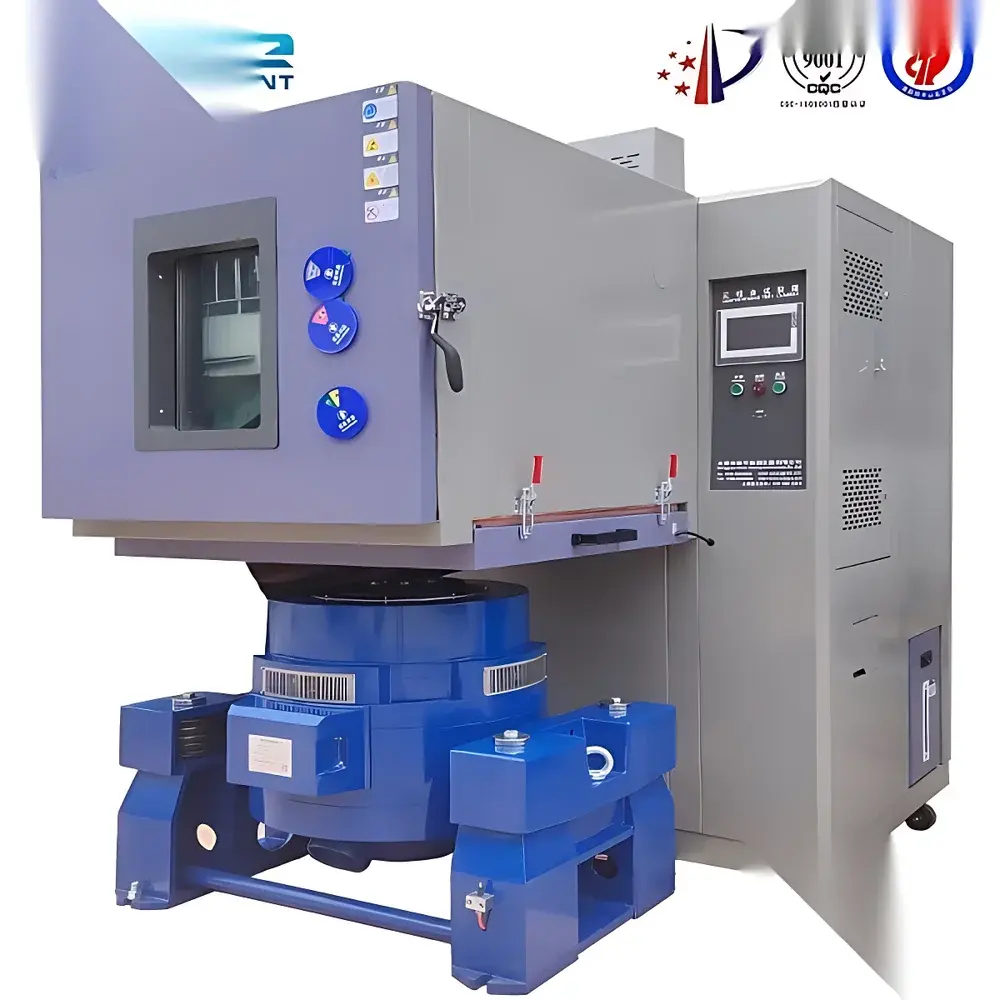
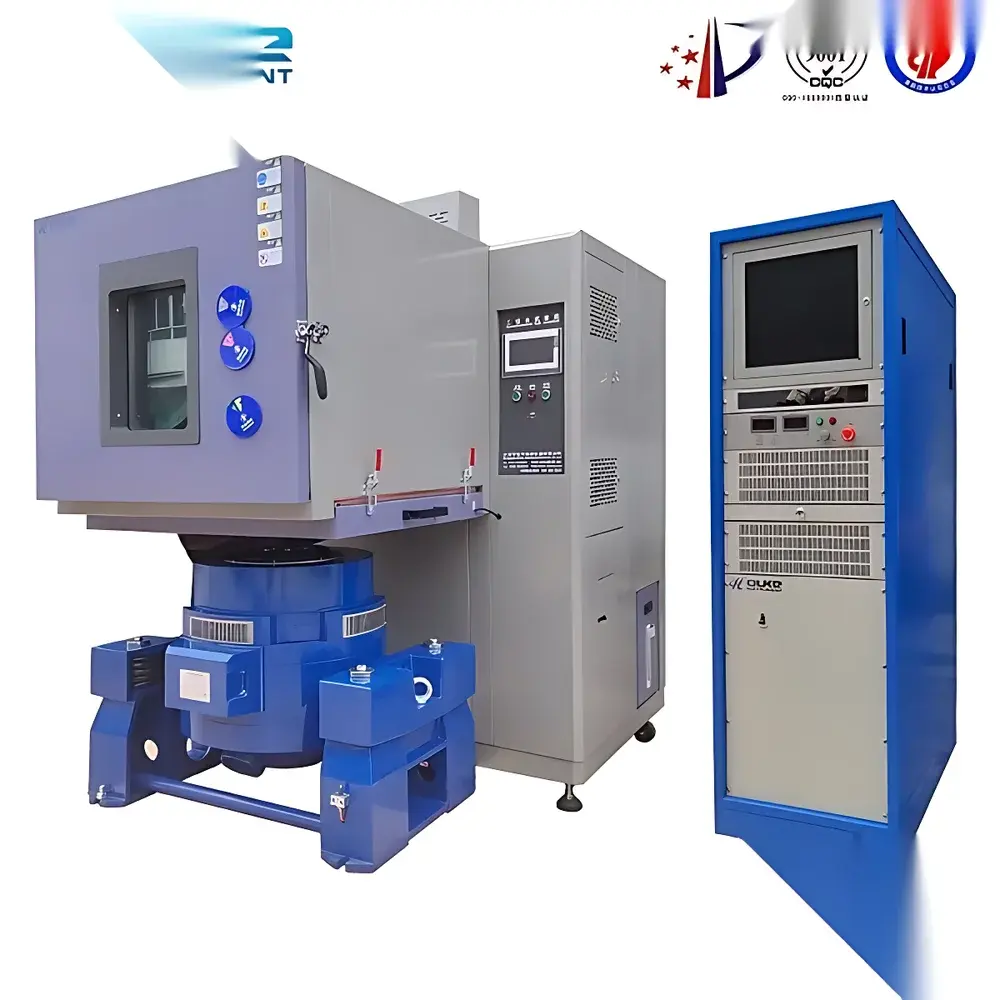
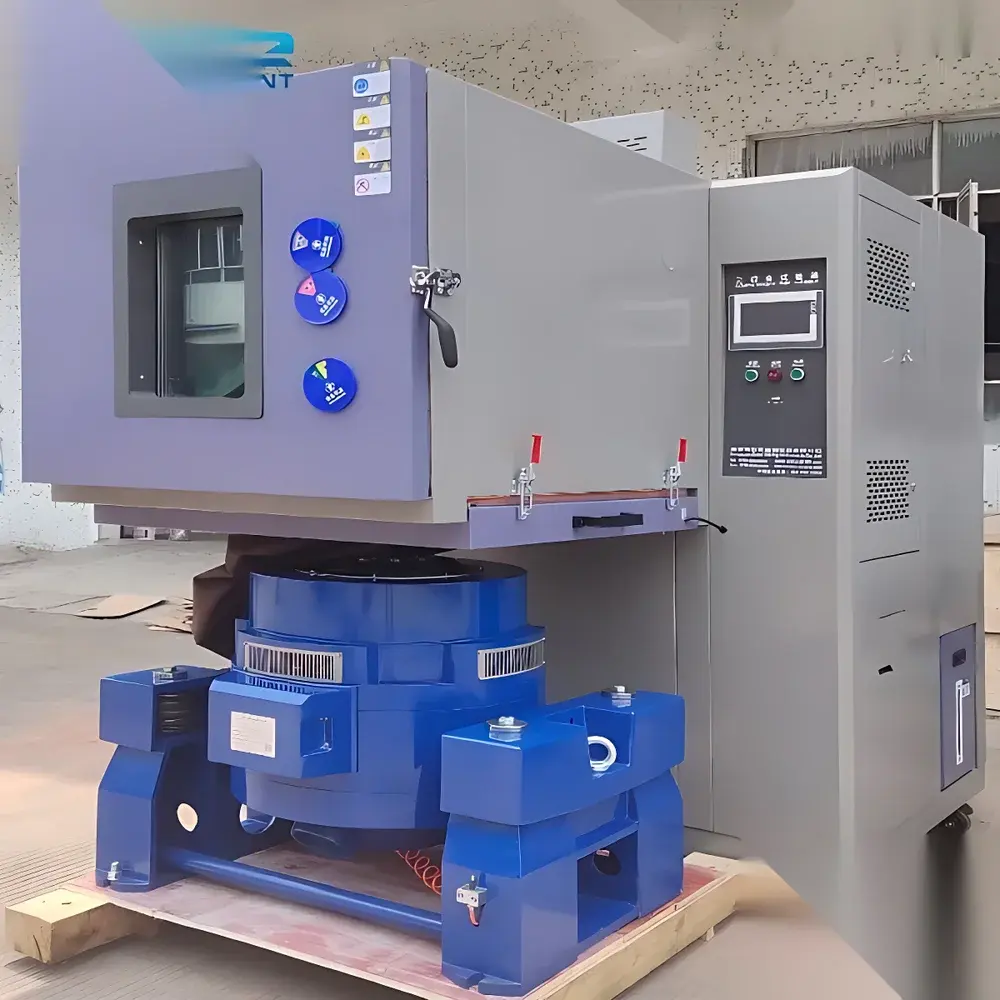
Combined Environmental Test Chamber for Temperature, Humidity, and Vibration Testing
| Brand | OEM |
|---|---|
| Origin | Imported |
| Manufacturer Type | Authorized Distributor |
| Price | USD 21,000 (FOB) |
| Internal Liner | SUS304 Stainless Steel |
| External Casing | Cold-Rolled Steel with Electrostatic Powder Coating |
| Insulation | Rigid Polyurethane Foam or Ultra-Fine Glass Wool |
| Sealing | High-Performance Silicone Gasket |
| Control Method | BTHC (Balanced Temperature & Humidity Control) |
| Controller | Korean-Made 7" Touchscreen HMI with PID Auto-Tuning, 0.1°C/0.1%RH Accuracy |
| Heating | Stainless Steel Finned Air Heater |
| Humidification | Shallow-Water Pan Steam Generator |
| Refrigeration | Hermetic Compressor, Single-Stage or Cascade Cryogenic Circuit |
| Water Purification System | Integrated Deionized Water Filter |
| Auto-Fill Function | Power-On Water Intake |
| Air Circulation | Custom Aluminum Impeller with AC Motor |
| Observation Window | Reinforced Double-Layer Tempered Glass with LED Illumination |
| Vibration Interface | Motorized Vertical Height Adjustment Mechanism (±150 mm Range) |
| Compliance | GB/T 5170.2–1996, GB/T 5170.5–1996, GB/T 2423.1–2023, GB/T 2423.2–2023, GB/T 2423.4–2023, GB/T 2423.22–2023 |
Overview
The Combined Environmental Test Chamber for Temperature, Humidity, and Vibration Testing is an integrated reliability validation platform engineered to replicate complex real-world operational stresses on electronic components, automotive modules, aerospace subsystems, and industrial control units. It simultaneously applies controlled thermal gradients (−70 °C to +180 °C), relative humidity (10–98% RH), and mechanical vibration (via external shaker table coupling) under programmable profiles—enabling accelerated life testing, HALT/HASS protocols, and qualification per IEC 60068-2 series, MIL-STD-810H, and ISO 16750-4. Its triaxial environmental simulation capability supports failure mode analysis where thermal expansion mismatches, condensation-induced corrosion, and resonant fatigue interact synergistically—a critical requirement for high-integrity systems in automotive ADAS, avionics, and medical device manufacturing.
Key Features
- Triple-environmental stimulus coordination: Independent yet synchronized control of temperature, humidity, and vibration input via unified test sequencing.
- BTHC (Balanced Temperature & Humidity Control) architecture ensures stable setpoint maintenance without overshoot, minimizing thermal lag and moisture transient errors during rapid transitions.
- SUS304 stainless steel interior chamber resists corrosion from humid and condensing conditions; cold-rolled steel exterior with epoxy-polyester coating provides structural rigidity and ESD-safe grounding.
- High-efficiency insulation using ≥100 mm rigid polyurethane foam (λ ≤ 0.022 W/m·K) or ultra-fine glass wool achieves thermal leakage < 0.8 K/h at −40 °C ambient.
- Korean-sourced 7-inch capacitive touchscreen HMI with embedded Linux OS supports up to 1000-step programs, 200 stored profiles, and real-time trend logging of all monitored parameters.
- Modular refrigeration system: selectable single-stage (−40 °C min) or cascade configuration (−70 °C min) with environmentally compliant R404A/R23 refrigerant blends and oil return management.
- Steam-based humidification with deionized water purification eliminates mineral scaling; shallow pan design enables fast RH ramp rates (up to 60% RH/min).
- Motorized vertical height adjustment mechanism (±150 mm travel) ensures precise mechanical interface alignment with industry-standard electrodynamic shakers (e.g., LDS V875, TIRA TV 51120).
Sample Compatibility & Compliance
The chamber accommodates DUTs up to 600 mm × 600 mm × 600 mm (W×D×H) with maximum payload of 50 kg on the vibration interface plate. It complies with national and international standards including GB/T 5170.2–1996 (temperature calibration), GB/T 5170.5–1996 (humidity calibration), GB/T 2423.1–2023 (cold testing), GB/T 2423.2–2023 (dry heat), GB/T 2423.4–2023 (damp heat cyclic), and GB/T 2423.22–2023 (thermal shock). Its metrological traceability aligns with ISO/IEC 17025 requirements when operated within accredited laboratory environments. The control system supports audit-ready data export (CSV/Excel) and optional 21 CFR Part 11-compliant electronic signature modules for regulated industries.
Software & Data Management
The embedded controller firmware includes a full-featured test sequencing engine supporting ramp-soak-dwell cycles, stepwise profile jumps, and conditional branching based on sensor feedback (e.g., pause on over-temperature fault). Real-time data acquisition records temperature, humidity, chamber pressure, and external vibration input channels at configurable intervals (100 ms to 10 s resolution). Exported logs include timestamped metadata, operator ID, calibration status flags, and alarm event history. Optional PC-based software (Windows 10/11 compatible) enables remote monitoring, multi-chamber fleet management, statistical process control (SPC) charting, and automated report generation per ISO 9001 Annex A.2 documentation requirements.
Applications
- Automotive: ECUs, battery management systems (BMS), radar sensors, and infotainment modules subjected to combined thermal cycling and road-simulated vibration.
- Aerospace: Avionics line-replaceable units (LRUs) undergoing DO-160 Section 24 (temperature), Section 25 (humidity), and Section 8 (vibration) qualification.
- Medical Devices: IEC 60601-1 compliance testing of diagnostic imaging subsystems under environmental stress screening (ESS).
- Consumer Electronics: Accelerated reliability assessment of smartphones, wearables, and IoT gateways across global climate zones.
- Industrial Automation: Validation of PLCs, HMIs, and motor drives operating in harsh factory or outdoor deployment scenarios.
FAQ
What vibration standards can this chamber interface with?
It supports mechanical coupling to shaker tables compliant with ISO 5344, IEC 60068-2-64, and MIL-STD-810H Method 514.7 via standardized mounting plates and height-adjustable interface rails.
Is remote monitoring supported out-of-the-box?
Yes—the controller features Ethernet (RJ45), RS485, and optional Wi-Fi connectivity with HTTP/HTTPS API access for integration into MES or SCADA platforms.
Can humidity be maintained independently during vibration tests?
Yes. The BTHC algorithm dynamically compensates for latent heat absorption from vibration-induced air turbulence, maintaining ±2% RH accuracy even at 50 g peak acceleration.
What calibration documentation is provided?
Each unit ships with NIST-traceable factory calibration certificates for temperature (−70 °C to +180 °C) and humidity (10–98% RH) sensors, valid for 12 months.
Is GLP/GMP audit support available?
Optional 21 CFR Part 11 add-on module provides role-based access control, electronic signatures, and immutable audit trails for FDA-regulated development workflows.



