
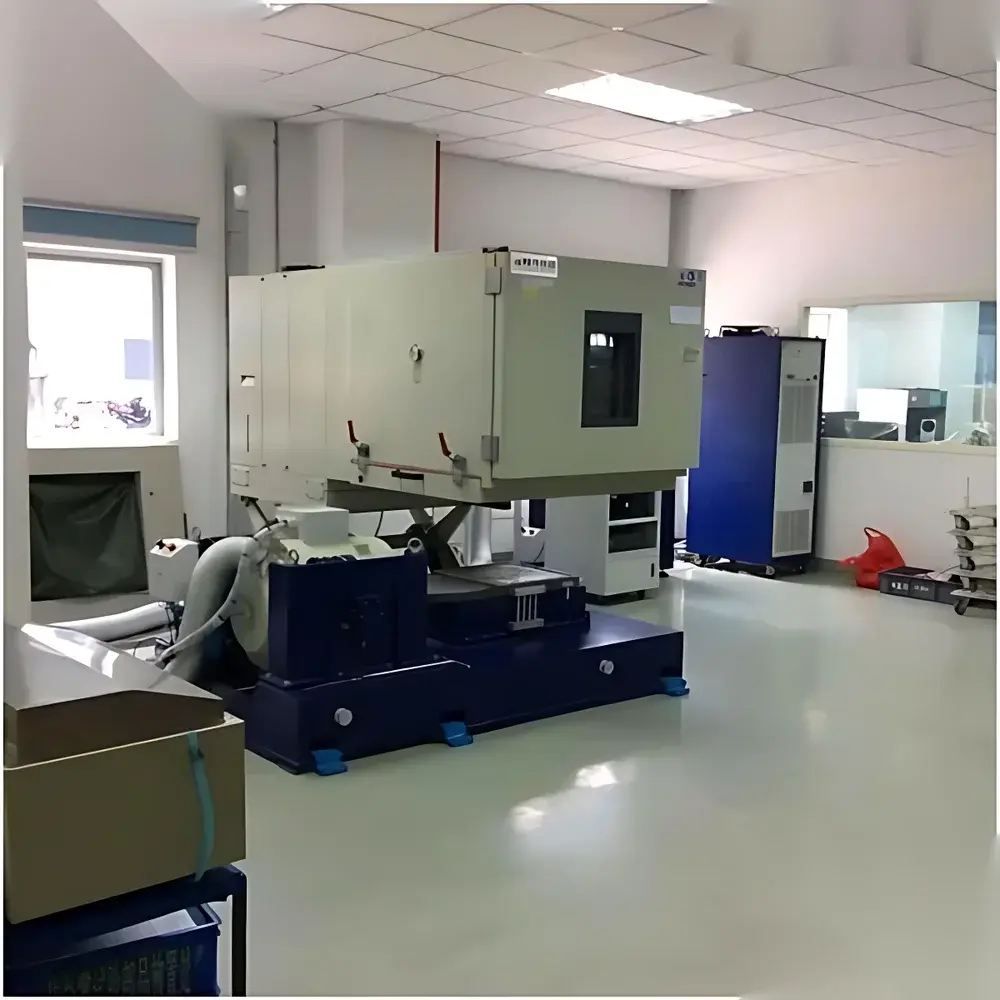
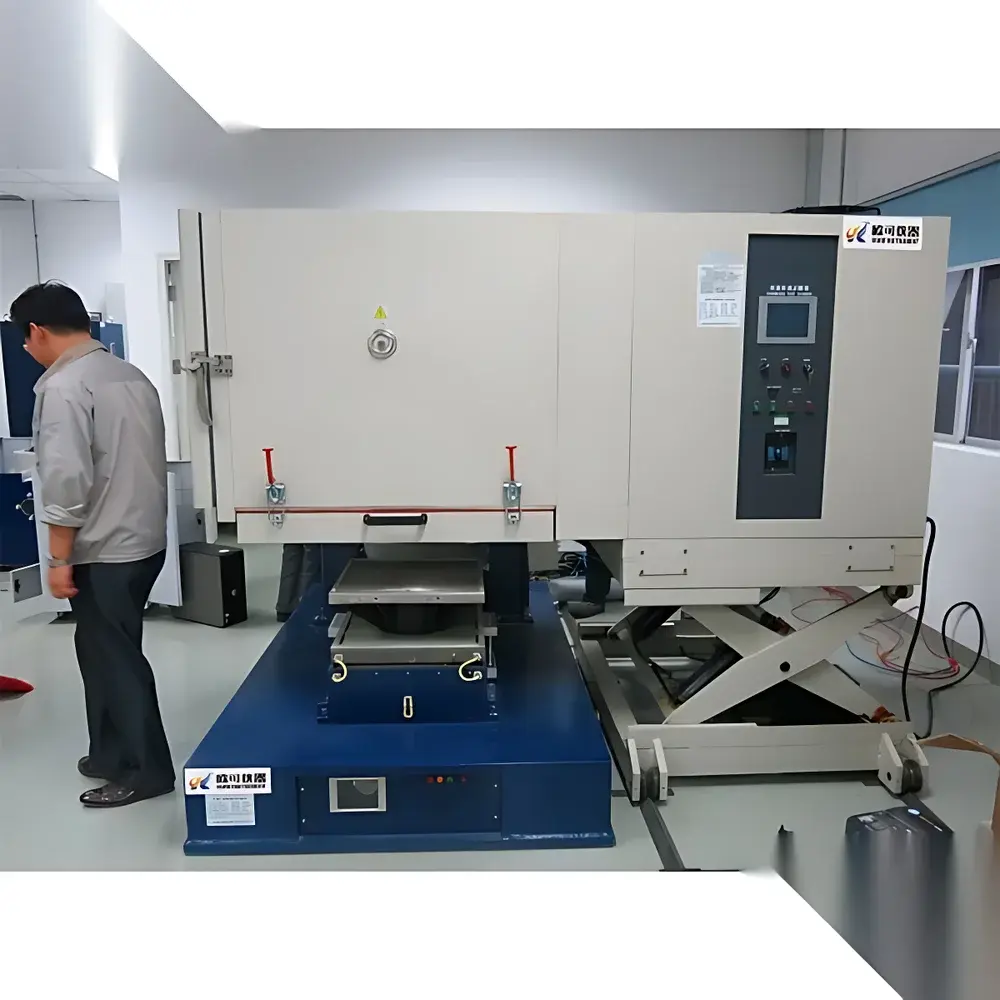
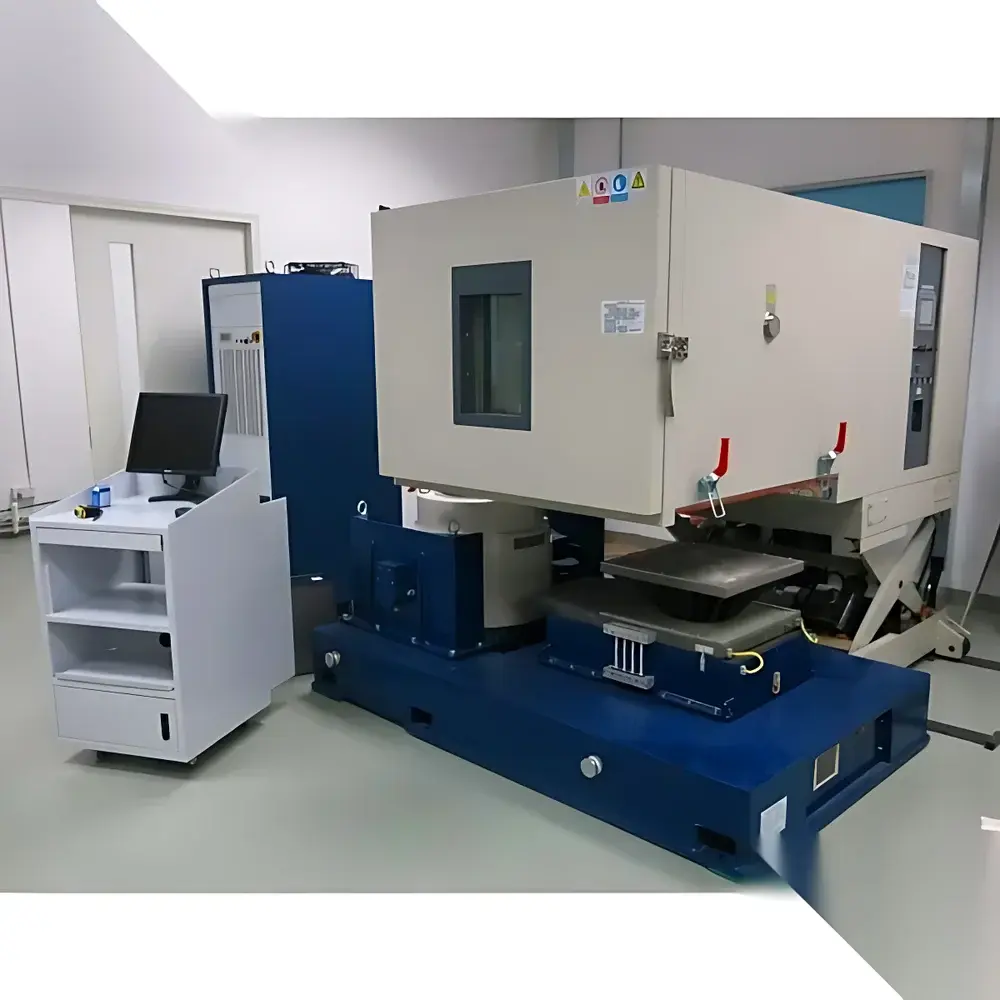
Combined Environmental Test Chamber for Temperature, Humidity and Vibration (Tri-Environmental Test System)
| Key | Temperature Range: -20°C to +130°C |
|---|---|
| Humidity Range | 40–98% RH |
| Temperature Uniformity | ±2°C (unloaded) |
| Temperature Stability | ±0.5°C (unloaded) |
| Humidity Stability | ±2% RH |
| Temperature Deviation | ≤±2°C |
| Humidity Deviation | ≤±2°C |
| Heating Rate | -20°C to +120°C ≤60 min |
| Cooling Rate | Ambient to -20°C ≤45 min (unloaded) |
| Time Setting Range | 0–999 h |
| Vibration Frequency Range | 5–2000 Hz |
| Max Acceleration | 980 m/s² (100 g) |
| Max Velocity | 1.1 m/s |
| Max Displacement | 25 mm p-p |
| Dynamic Load Capacity | 120 kg |
| Moving Mass | 2.7 kg |
| Table Diameter | 150 mm |
| Vibration Axis | Vertical (Z-axis) |
| Excitation Force | 300 kN (300 kgf) |
| Noise Level | Low |
| Power Efficiency | 60% reduction vs. conventional designs |
Overview
The Combined Environmental Test Chamber for Temperature, Humidity and Vibration (Tri-Environmental Test System) is an integrated reliability validation platform engineered for simultaneous or sequential application of thermal, hygroscopic, and mechanical stress stimuli. It operates on the principle of coupled environmental simulation—precisely controlling temperature and relative humidity while concurrently delivering calibrated sinusoidal vibration excitation across a broad frequency spectrum (5–2000 Hz). This triaxial stress combination replicates real-world operational and logistical conditions experienced by products during manufacturing, shipping, storage, and field deployment. The system is designed in accordance with fundamental test methodology standards including IEC 60068-2-6 (vibration), IEC 60068-2-30 (damp heat cyclic), and MIL-STD-810H Method 514.8 (vibration) and Method 507.6 (temperature/humidity), enabling rigorous qualification testing under controlled, repeatable, and auditable conditions.
Key Features
- Triple-stimulus integration: Independent yet synchronized control of temperature (-20°C to +130°C), humidity (40–98% RH), and vertical-axis sinusoidal vibration (5–2000 Hz).
- High-fidelity electromagnetic shaker assembly with 300 kN peak force output, optimized for long-term stability and minimal harmonic distortion.
- Robust chamber architecture featuring monolithic vibration base construction, minimizing structural resonance coupling and enhancing isolation between mechanical and environmental subsystems.
- Modular control design: Separated vibration controller (CT-2000/PD series) and environmental control unit ensure signal integrity, thermal independence, and compliance-ready audit trails.
- Energy-efficient sealed controller enclosure with 60% lower power consumption versus legacy systems—validated per IEC 62684 energy performance benchmarks.
- Intuitive touchscreen interface supporting both manual resonance search and automated sweep-and-hold frequency profiling with programmable dwell times per band.
- Comprehensive thermal management: Achieves ≤60 min ramp from -20°C to +120°C and ≤45 min cooling from ambient to -20°C (unloaded), meeting accelerated life test cycle requirements.
Sample Compatibility & Compliance
This tri-environmental test system accommodates samples up to 120 kg mass on a 150 mm diameter rigid aluminum table, with dynamic moving mass limited to 2.7 kg for optimal force transmission fidelity. It supports standard test specimens used in electronics (PCBAs, connectors, MEMS sensors), medical devices (infusion pumps, diagnostic housings), automotive ECUs, and packaging integrity validation (ASTM D4169, ISTA 3A/3E). All environmental control algorithms comply with ISO/IEC 17025 calibration traceability requirements. Vibration profiles are configurable to meet ISO 10816-1 (machine vibration severity), ASTM D999 (shipping container vibration), and USP packaging integrity guidelines. Data logging meets FDA 21 CFR Part 11 electronic record and signature requirements when paired with validated software.
Software & Data Management
The embedded control firmware supports full-cycle test sequencing—including multi-step temperature/humidity ramps, dwell phases, and synchronized vibration sweeps—with timestamped parameter logging at ≥10 Hz sampling rate. Export formats include CSV, XML, and PDF reports compliant with GLP/GMP documentation standards. Optional PC-based software enables remote monitoring, alarm escalation via SMTP/SNMP, and integration into enterprise LIMS or MES platforms via OPC UA or Modbus TCP. Audit trail functionality records all user actions, parameter changes, and system events with immutable timestamps—fully aligned with Annex 11 and EU GMP Chapter 4 data integrity expectations.
Applications
- Qualification testing of avionics components under combined thermal cycling and flight-spectrum vibration.
- Accelerated aging of lithium-ion battery modules exposed to high-humidity storage followed by mechanical shock simulation.
- Structural integrity verification of handheld medical devices subjected to transport vibration and tropical climate exposure.
- Failure mode analysis of solder joints and wire bonds using resonant frequency tracking during thermal soak.
- Validation of hermetic seals in pharmaceutical primary packaging under damp-heat cycling with concurrent mechanical agitation.
- Reliability screening of 5G RF front-end modules experiencing simultaneous thermal drift and broadband vibrational stress.
FAQ
What standards does this system support for combined environment testing?
It is configured to execute test protocols aligned with IEC 60068-2-64 (combined vibration and temperature), IEC 60068-2-52 (salt mist + humidity + vibration), and MIL-STD-810H Methods 514.8/507.6/520.3.
Can the system perform random vibration alongside temperature and humidity?
Standard configuration supports sinusoidal vibration only; random vibration capability requires optional shaker controller upgrade and dedicated PSD profile module.
Is the chamber suitable for continuous operation over extended test durations?
Yes—designed for unattended 999-hour test cycles with redundant safety interlocks, real-time fault diagnostics, and predictive maintenance alerts based on shaker coil temperature and refrigerant pressure trends.
How is calibration traceability maintained across environmental and mechanical parameters?
Temperature/humidity sensors are NIST-traceable platinum RTDs; acceleration transducers are certified per ISO 16063-21; all calibrations documented per ISO/IEC 17025 and stored within the system’s secure audit log.
Does the system support custom test script development?
Yes—open API access (RESTful JSON interface) enables integration with Python-based test automation frameworks and third-party test sequence editors compliant with IEEE 1671 ATML syntax.



