
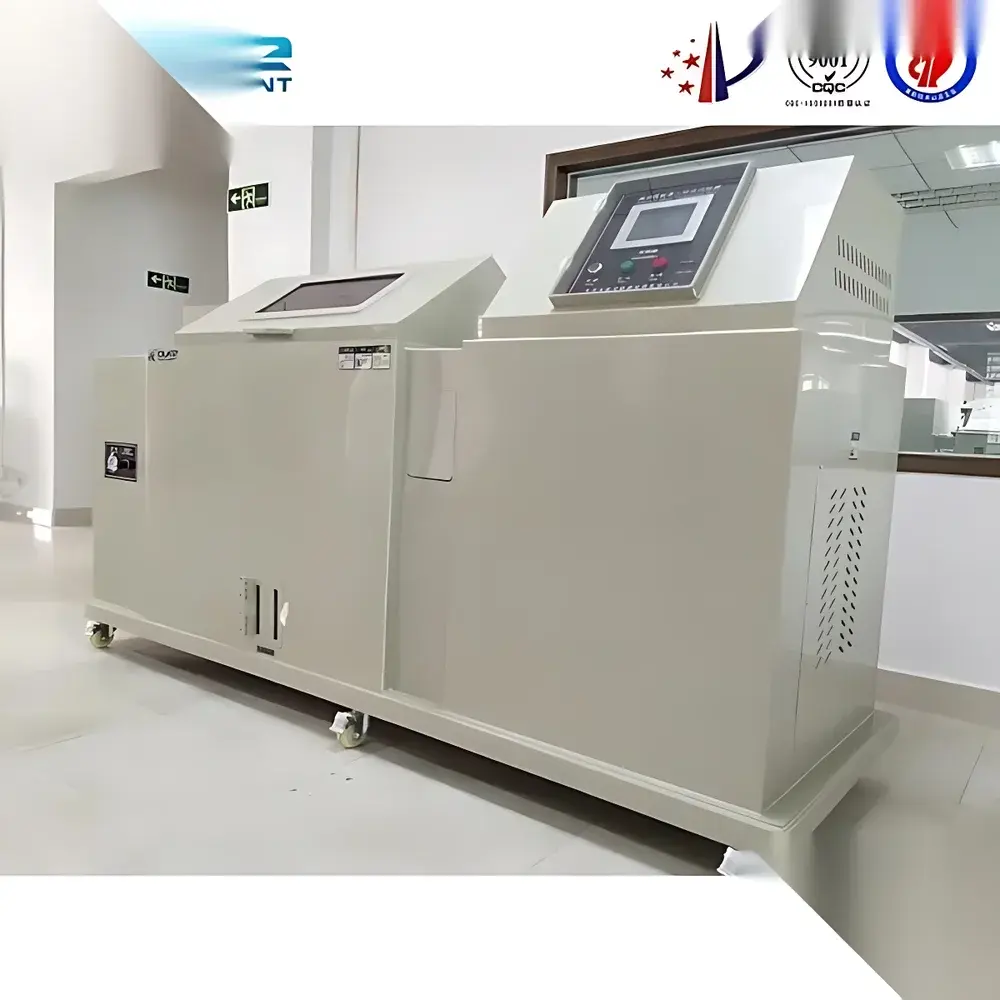
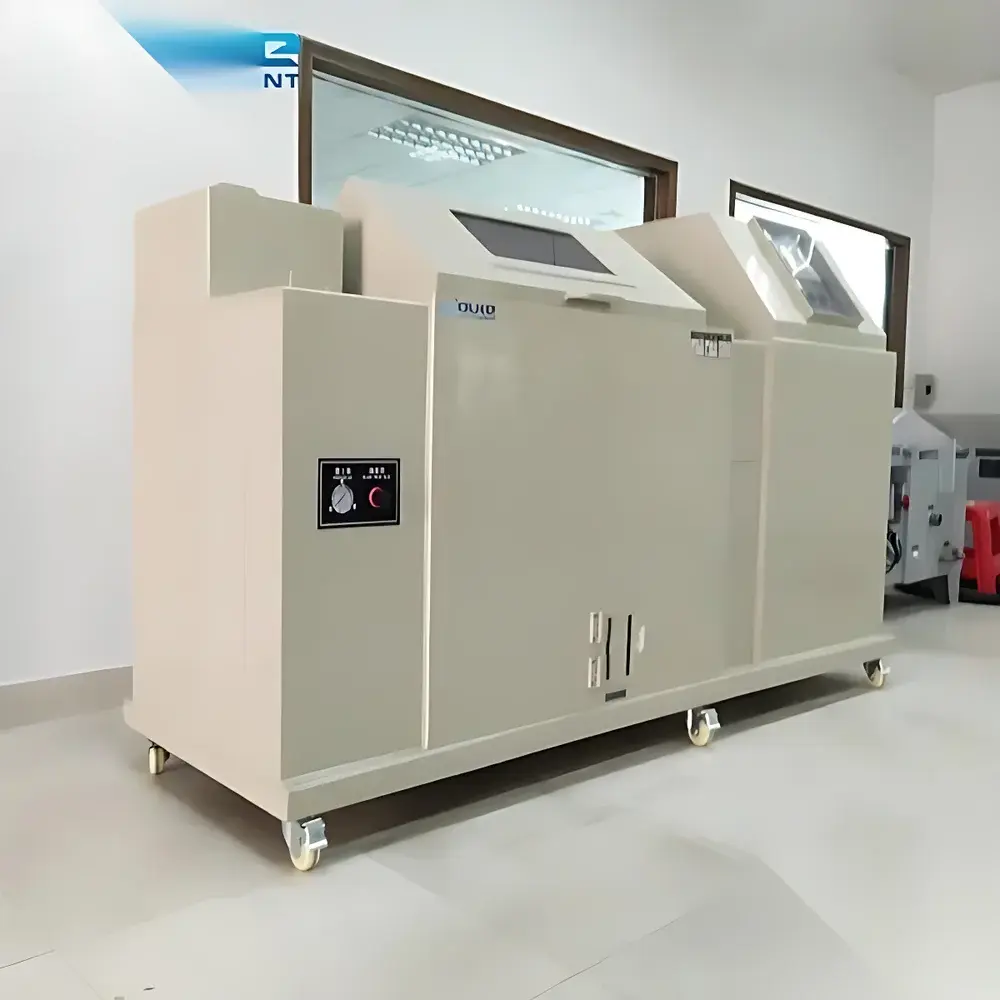
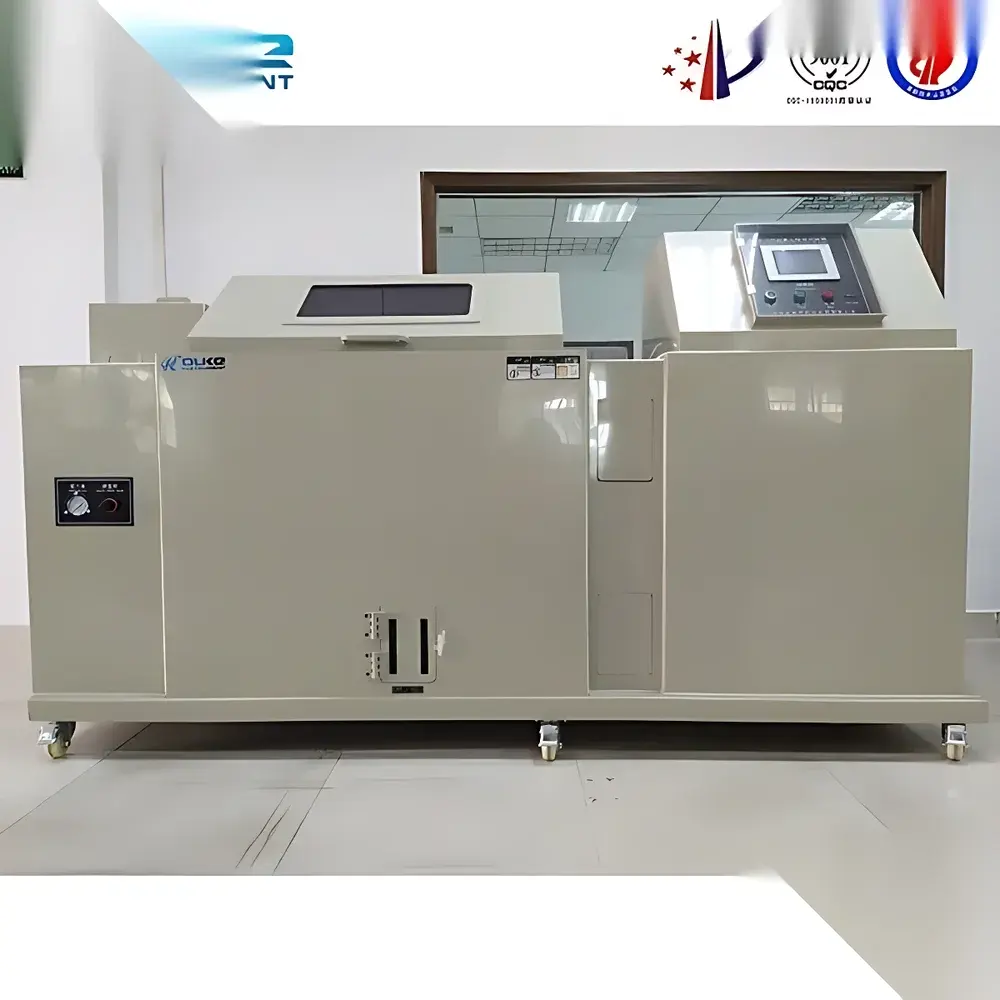
Combined Salt Spray & Environmental Test Chamber – Customizable Industrial-Grade Corrosion Testing System
| Brand | OEM / Custom-Built |
|---|---|
| Origin | Imported |
| Manufacturer Type | Authorized Distributor |
| Quotation | USD 12,500 (FOB) |
| Chamber Dimensions | W120 × H50 × D100 cm |
| Temperature Uniformity | ±2°C |
| Temperature Fluctuation | ±0.5°C |
| Salt Spray Deposition Rate | 1–2 mL / 80 cm²·h |
| Spray Mode | Continuous or Cyclic (Programmable) |
| Operating Temperature Range | +5°C to 60°C |
| Chamber Construction | Dual-layer UV-stabilized gray PVC with circumferential band-reinforced welded joints |
| Heating System | Independent Ni-Cr alloy heaters with PT100Ω RTD sensing |
| Control System | LED-display PID temperature controller with real-time logging capability |
| Spray System | Tower-type atomizer with non-crystallizing nozzles |
| Accessories | Standard漏斗 (funnel) & calibrated measuring cylinder, inline water filtration for brine supply, pre-heated brine delivery ensuring thermal equilibrium with chamber ambient |
Overview
The Combined Salt Spray & Environmental Test Chamber is an industrial-grade corrosion testing system engineered for precise simulation of aggressive saline and humid environments in accordance with ASTM B117, ISO 9227, JIS Z2371, and GB/T 2423.17 standards. Unlike conventional single-mode salt fog chambers, this integrated platform supports both continuous salt spray exposure and programmable cyclic corrosion testing—including humidity, drying, and salt mist phases—enabling accelerated evaluation of coating integrity, metallic substrate resistance, and electrochemical degradation behavior under multi-stress conditions. Its robust architecture ensures long-term operational stability in high-salinity, high-humidity laboratory and quality assurance settings, making it suitable for R&D validation, supplier qualification, and regulatory compliance testing across automotive, aerospace, marine hardware, and electronics manufacturing sectors.
Key Features
- Dual-function chamber design supporting ASTM B117-compliant neutral salt spray (NSS), acetic acid salt spray (AASS), and copper-accelerated acetic acid salt spray (CASS) protocols, as well as customizable multi-phase cyclic corrosion tests (e.g., ISO 14993, VDA 621-415)
- Welded monolithic inner chamber constructed from UV-resistant, high-purity gray PVC with circumferential band reinforcement—eliminating seam leakage, minimizing dimensional drift, and ensuring structural rigidity under thermal cycling
- Independent heating system with Ni-Cr alloy heating elements and Class A PT100Ω platinum resistance thermometers, delivering ±0.5°C temperature stability and ±2°C uniformity across the full test volume
- Tower-type spray generation system equipped with non-crystallizing ceramic nozzles and adjustable air pressure regulation to maintain consistent 1–2 mL/80 cm²·h deposition rate per ASTM requirements
- Integrated brine pre-heating circuit ensuring thermal equilibrium between solution temperature and chamber ambient—critical for reproducible corrosion kinetics and eliminating condensation-induced artifacts
- Comprehensive safety architecture: individual circuit breakers for all subsystems, dual-stage overheat protection (electronic + mechanical), and sealed electrical compartments rated IP54
Sample Compatibility & Compliance
The chamber accommodates flat panels, fasteners, coated substrates, electronic enclosures, and assembled components up to 120 cm wide × 50 cm high × 100 cm deep. Internal geometry permits unobstructed placement of test specimens on adjustable non-metallic racks while maintaining prescribed orientation angles (e.g., 15°–30° from vertical). All materials in contact with saline mist—including chamber walls, nozzles, funnels, and collection cylinders—are chemically inert to NaCl, CH₃COOH, and CuCl₂ solutions. The system meets CE marking requirements for electromagnetic compatibility (EMC Directive 2014/30/EU) and low-voltage safety (LVD Directive 2014/35/EU). Optional IQ/OQ documentation packages are available to support GLP/GMP audit readiness and FDA 21 CFR Part 11–aligned validation workflows.
Software & Data Management
While the base configuration includes a standalone LED-display PID controller with manual parameter entry, optional Ethernet-enabled data acquisition modules provide real-time temperature, humidity, and spray status logging at user-defined intervals (1–60 sec resolution). Exportable CSV files include timestamps, setpoints, actual values, and alarm event flags—fully traceable for internal QA review or external certification submissions. Firmware supports password-protected parameter locking, audit trail recording of operator actions, and configurable alarm escalation (visual + relay output). For laboratories requiring full digital compliance, third-party SCADA integration (Modbus RTU/TCP) enables centralized monitoring across multiple environmental test assets.
Applications
- Corrosion resistance validation of zinc-nickel, electrophoretic, powder-coated, and chromate conversion finishes per ISO 12944 and SAE AMS 2400
- Accelerated life assessment of automotive brake calipers, suspension bushings, and battery enclosure housings under combined thermal-humidity-salt stress
- Qualification of marine-grade stainless steels (e.g., UNS S32205) and aluminum alloys (e.g., AA6061-T6) per NACE TM0169 and ISO 15156
- Electrochemical performance benchmarking of printed circuit board (PCB) conformal coatings and connector platings under IPC-TM-650 2.6.17 conditions
- Supplier audit testing for Tier-1 OEMs requiring repeatable, documented evidence of material conformity to corporate specifications (e.g., Ford WSS-M2G172-A2, GMW14872)
FAQ
Can this chamber perform cyclic corrosion testing (CCT) in addition to standard salt spray?
Yes—the system supports fully programmable multi-phase cycles including salt spray, high-humidity soak, and dry-off stages via optional time-sequence controllers.
Is the chamber compatible with ASTM G85 Annex A5 (modified salt spray with SO₂)?
With factory-installed gas injection ports and corrosion-resistant flow control valves, SO₂ integration is available as a custom engineering option.
What maintenance intervals are recommended for the spray nozzles and brine filtration system?
Nozzle inspection and ultrasonic cleaning are advised every 200 operational hours; inline water filters require replacement every 500 hours or per manufacturer’s water quality report.
Does the system include calibration certificates for temperature and spray rate verification?
A factory-issued calibration report covering PT100 sensor accuracy and deposition rate verification is included; NIST-traceable third-party calibration is available upon request.
Can the chamber be modified to accommodate larger test specimens?
Yes—custom chamber dimensions (up to W200 × H100 × D150 cm), reinforced floor loading capacity, and extended door opening mechanisms are offered under OEM engineering services.
Related Products



