
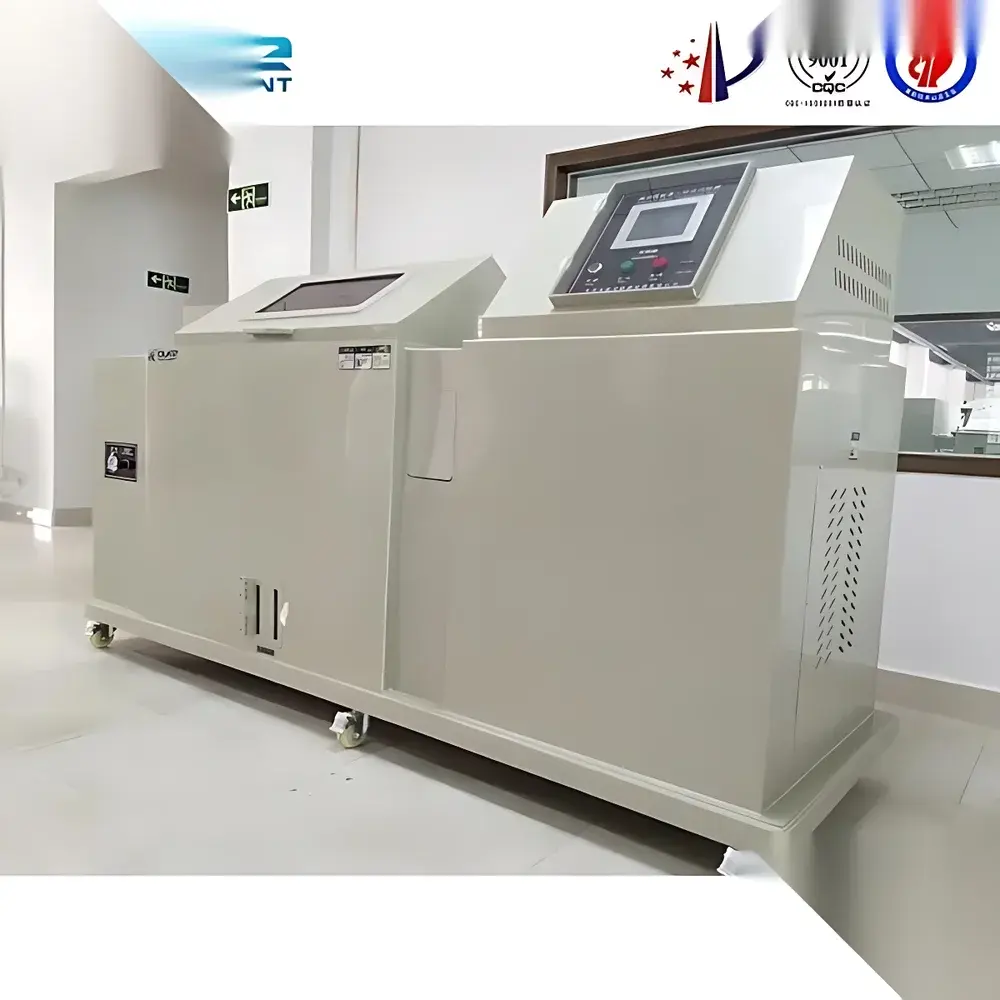
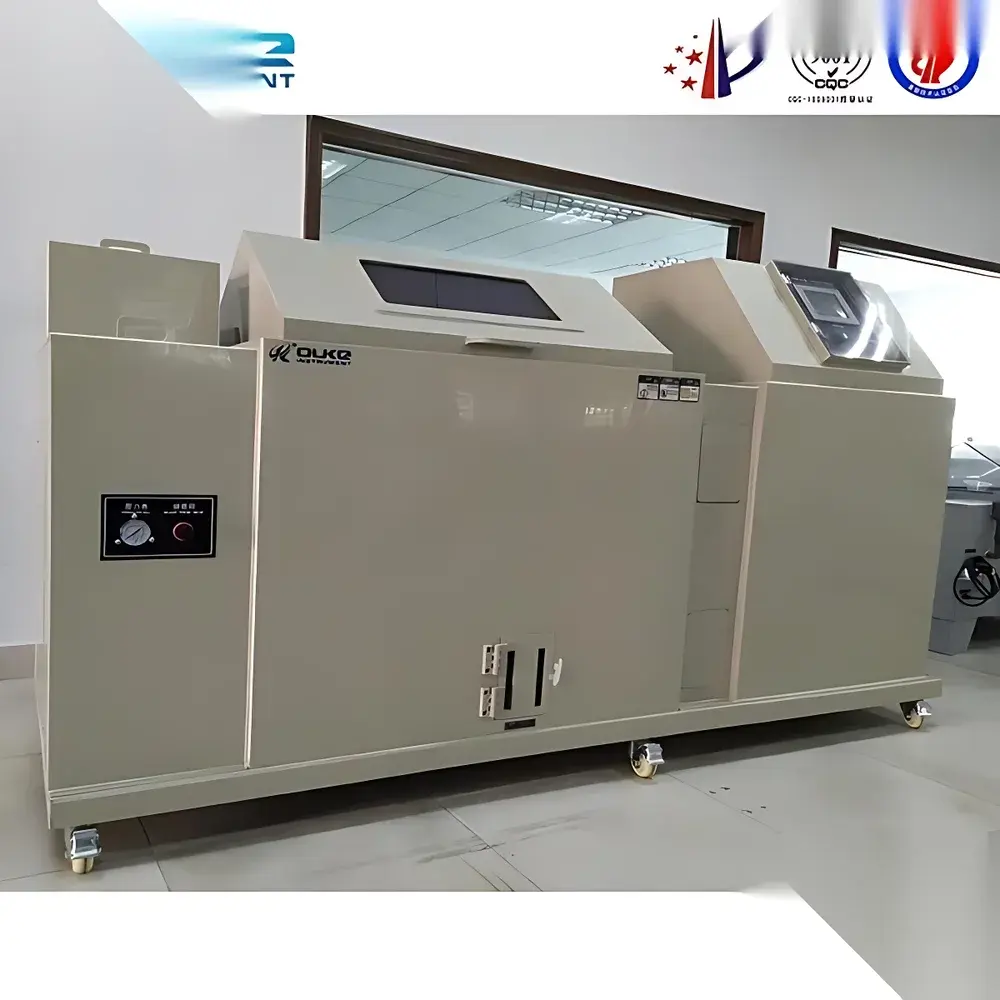
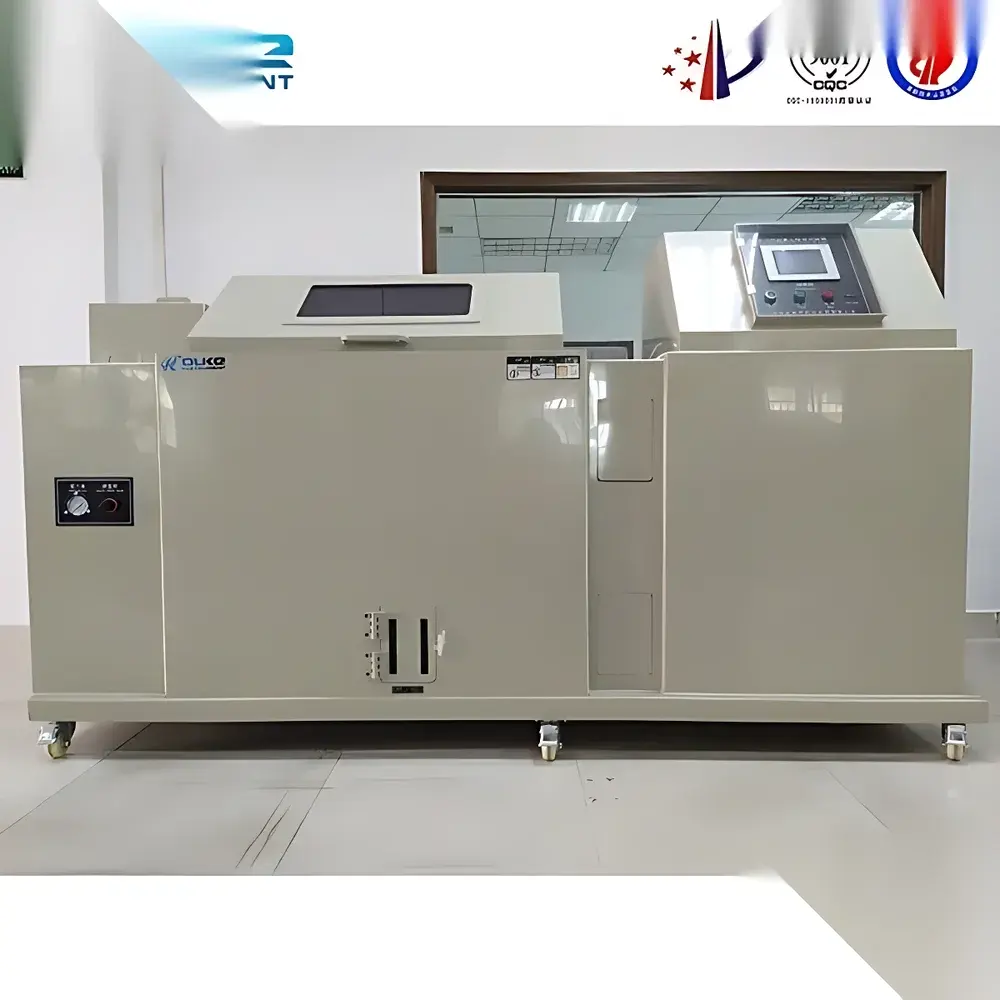
Combined Temperature-Humidity-Salt Spray Environmental Test Chamber
| Brand | OEM / Custom Brand |
|---|---|
| Origin | Imported |
| Manufacturer Type | Authorized Distributor |
| Price | USD 12,500 (FOB) |
| Construction | Full PVC-Coated Steel Frame with Reinforced Structural Bracing |
| Spray Method | Programmable or Continuous Salt Fog Generation |
| Control System | Dual-Channel PID Digital Controller (Lab Chamber & Saturated Air Tank) |
| Temperature Range | 10–60°C (Lab Chamber), 20–70°C (Saturated Air Tank) |
| Humidity Range | 30–98% RH (Controlled via Henry’s Law-Based Saturated Air Delivery) |
| Salt Spray Rate | 1.0–2.0 mL/80 cm²/h (Adjustable via Conical Diffuser & Precision Pressure Regulation) |
| Safety Protections | Dual Over-Temperature Cut-Off, Low-Water Level Alarm, Auto-Replenishment Feed System |
| Nozzle Material | Borosilicate Glass (≥4000 hr crystallization-free operation) |
| Display Resolution | ±0.3°C (Temperature), ±0.01 kg/cm² (Pressure), 0.1 hr (Timer) |
| Compliance | ASTM B117, ISO 9227, JIS Z2371, GB/T 10587 |
Overview
The Combined Temperature-Humidity-Salt Spray Environmental Test Chamber is an integrated corrosion and environmental stress testing system engineered for accelerated evaluation of material durability under synergistic climatic and corrosive conditions. Unlike standalone salt spray chambers, this chamber implements a tri-modal exposure protocol—precisely controlled temperature, regulated relative humidity, and reproducible neutral or acidic salt fog—within a single test volume. It operates on the principle of controlled electrochemical corrosion acceleration, where elevated temperature accelerates ion mobility, saturated air delivery ensures consistent humidity via Henry’s Law-based vapor equilibrium, and calibrated aerosol generation produces standardized NaCl droplet distribution per ASTM B117 and ISO 9227. Designed for QC laboratories, automotive component validation labs, and electronics reliability engineering teams, the chamber supports both cyclic and static test profiles required for qualification against international corrosion resistance standards.
Key Features
- Monocoque structural frame fabricated from high-purity PVC-coated steel with multi-point internal bracing to eliminate warping or dimensional drift during prolonged thermal cycling.
- Dual independent PID-controlled digital regulators—one for test chamber temperature (0–99.9°C, ±0.3°C resolution), one for saturated air tank (0–99.9°C, ±0.3°C resolution)—ensuring traceable thermal stability across all operational modes.
- Glass nozzle assembly made of borosilicate material, certified for ≥4000 hours of uninterrupted operation without salt crystallization or flow obstruction.
- Steam-injection heating system in the test chamber enables rapid thermal ramp rates and minimizes standby time between test cycles.
- Conical diffuser-equipped spray tower enables directional fog guidance, adjustable spray density, and uniform deposition across standardized test panels (per ISO 9227 specimen placement guidelines).
- Automated water replenishment system with dual-level sensing (float switch + conductive probe) maintains uninterrupted operation during extended tests up to 9990 hours.
- Integrated safety architecture includes redundant over-temperature cut-offs (mechanical + electronic), low-water alarm with audible/visual indication, and pressure-regulated air filtration (2.5 kg/cm² nominal, ±0.01 kg/cm² precision gauge).
Sample Compatibility & Compliance
The chamber accommodates standard test specimens up to 600 × 900 × 500 mm (W×D×H) and supports rack-mounted sample holders compliant with ASTM G85 Annex A5 (cyclic acidified salt fog) and ISO 14993 (cyclic corrosion testing). All internal wetted surfaces are non-reactive PVC or stainless-steel lined to prevent cross-contamination. The system meets mandatory requirements for GLP-compliant test documentation: real-time parameter logging (temperature, humidity, pressure, elapsed time), audit-trail-enabled controller firmware, and exportable CSV data files compatible with LIMS integration. It is validated for use in environments requiring adherence to IEC 60068-2-11 (salt mist), ISO 4628-3 (corrosion rating), and automotive OEM specifications including GMW 14872 and Ford CETP 00.00-L-467.
Software & Data Management
While hardware-based control remains primary for regulatory robustness, optional RS-485/Modbus RTU interface enables connection to external SCADA or laboratory informatics systems. Time-stamped operational logs—including chamber temperature, saturated air temperature, pressure setpoint, spray duration, and alarm events—are stored onboard for ≥30 days. Export functionality supports USB flash drive retrieval of raw time-series datasets with ISO 8601 timestamping. Controller firmware conforms to IEC 62443-3-3 security baseline for industrial control systems and supports password-protected configuration access levels (Operator, Technician, Administrator). All calibration constants and sensor offsets are digitally signed and tamper-evident.
Applications
- Corrosion resistance validation of coated metals (e.g., zinc-nickel plating, electrophoretic primers) per ASTM D1654 and ISO 10289.
- Cyclic corrosion testing (CCT) of automotive body panels, fasteners, and brake components per SAE J2334 and VDA 621-415.
- Reliability screening of printed circuit board assemblies (PCBAs) exposed to coastal or industrial atmospheres.
- Qualification of marine-grade hardware (stainless steels, aluminum alloys) under combined thermal-hygrometric-saline stress.
- Material compatibility assessment for packaging films, adhesives, and elastomeric seals used in offshore instrumentation housings.
FAQ
What standards does this chamber comply with for salt spray testing?
It fully supports ASTM B117 (neutral salt spray), ISO 9227 (NSS, AASS, CASS), JIS Z2371, and GB/T 10587. Optional software modules enable automated execution of ASTM G85 Annexes A1–A5.
Can the chamber perform truly cyclic tests—not just sequential modes?
Yes. The dual-zone PID architecture allows independent ramping and dwell control for temperature, humidity, and spray activation, enabling true multi-phase cycling (e.g., 4-hr salt fog → 4-hr drying → 4-hr high-humidity soak) without manual intervention.
Is calibration traceability provided with the unit?
Each unit ships with NIST-traceable calibration certificates for temperature sensors (PT100 class A) and pressure transducers, valid for 12 months from shipment.
What maintenance intervals are recommended for long-term reliability?
Glass nozzles require inspection every 2000 hours; saturated air tank de-scaling every 6 months; pressure regulator filter replacement every 12 months; and full system verification annually per ISO/IEC 17025 guidelines.
Does the controller support remote monitoring or alarm notification?
Standard configuration includes dry-contact alarm outputs for integration into building management systems (BMS); optional Ethernet module adds SNMP trap alerts and web-based status dashboard (HTTPS encrypted).



