
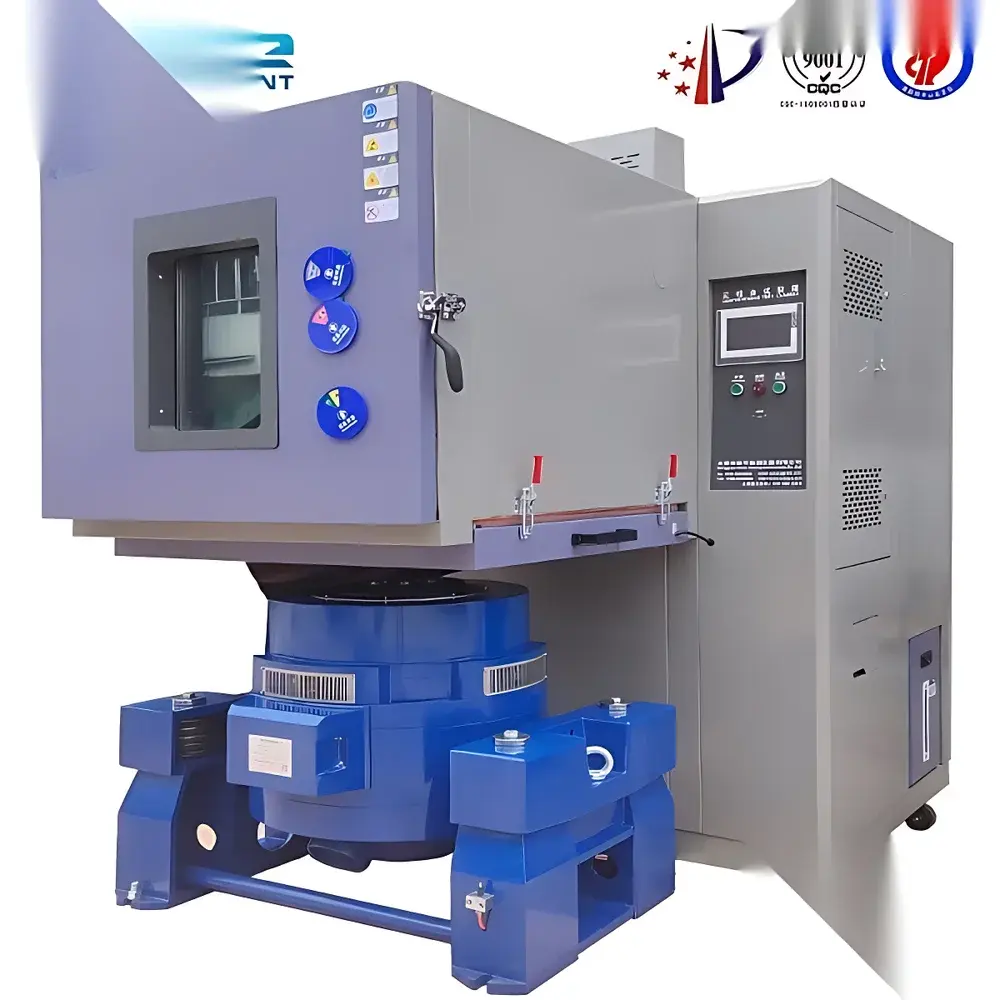
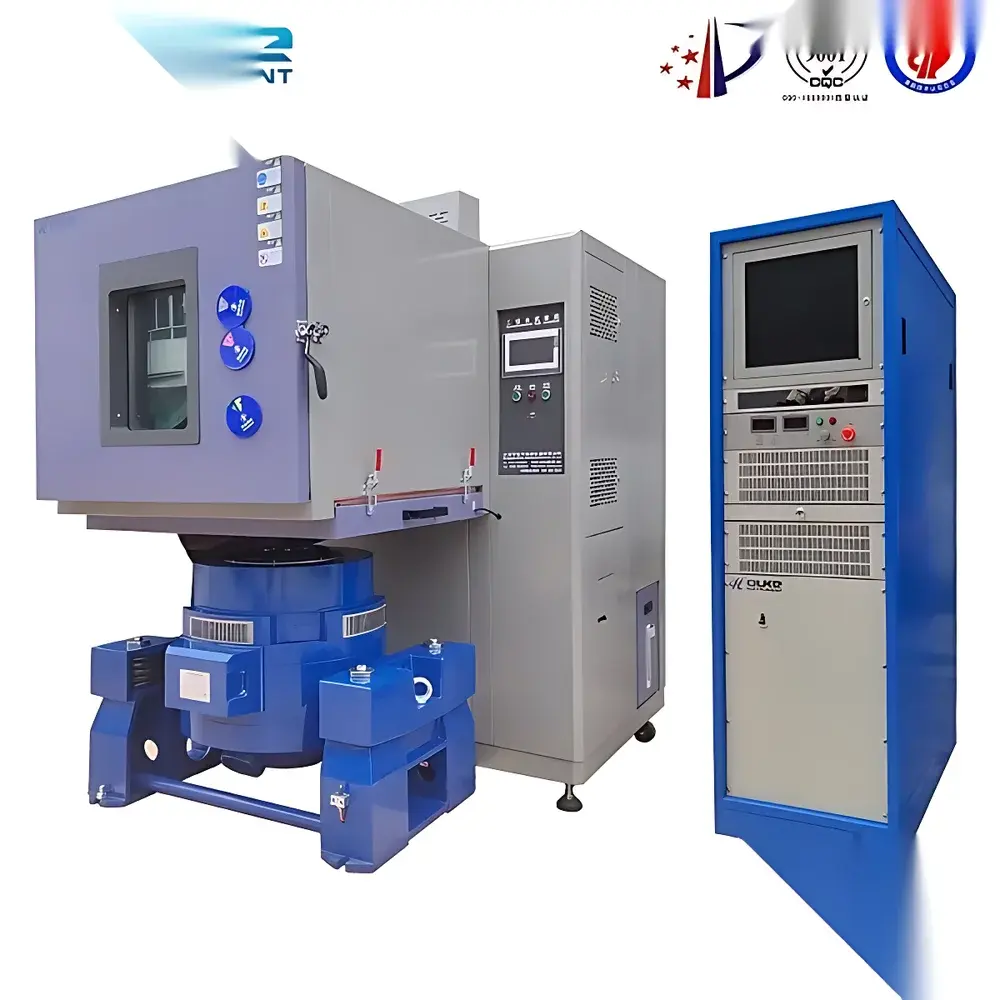
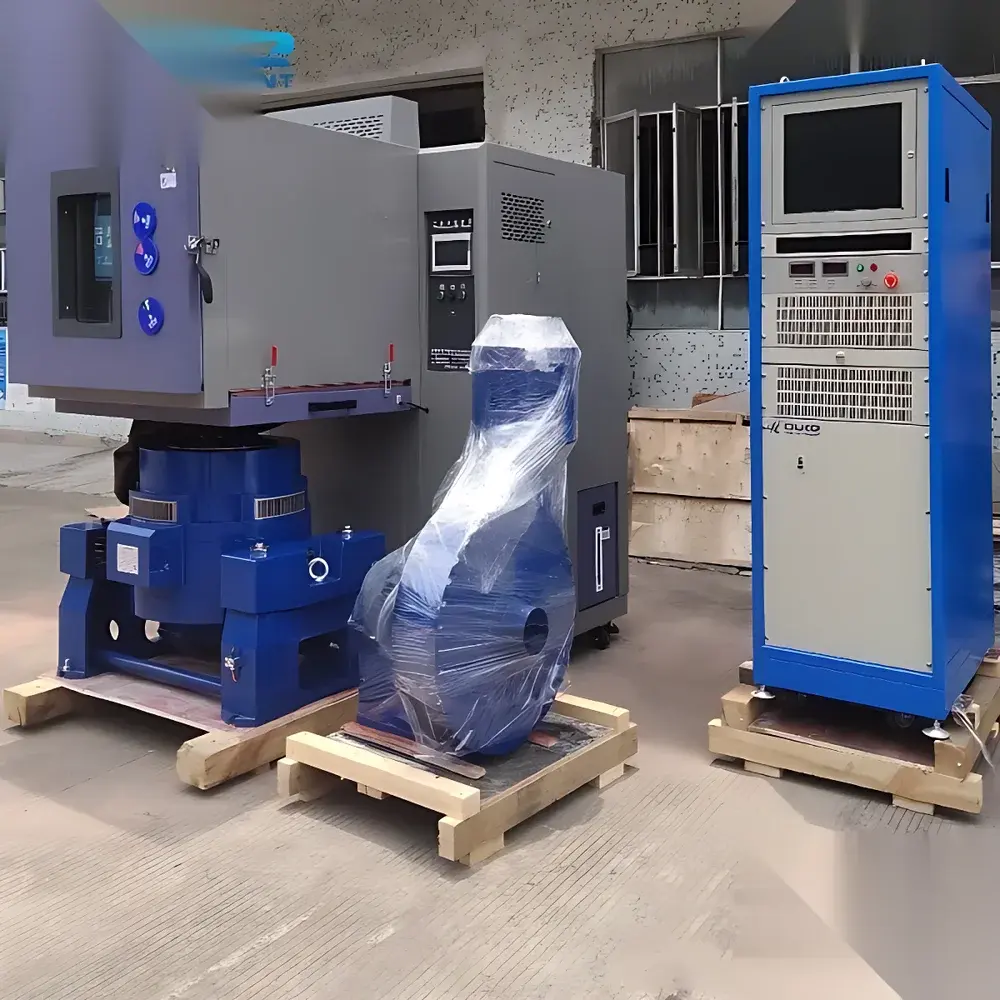
Combined Temperature-Humidity-Vibration Environmental Test Chamber
| Brand | Other Brands |
|---|---|
| Origin | Imported |
| Manufacturer Type | Authorized Distributor |
| Price | USD 21,500 (FOB) |
| Vibration Table Size (L×W) | 50×50 cm |
| Max Load Capacity | 100 kg |
| Vibration Direction | Vertical |
| Frequency Range | 1–600 Hz |
| Max Acceleration | 20 g |
| Peak-to-Peak Amplitude Range | 0–5 mm |
| Vibration Waveform | Sinusoidal |
| Power Supply | 220 V ±20%, 10 A |
| Motor Power | 2.2 kW |
| Control Resolution | 0.01 Hz (display), ±0.1 Hz (accuracy) |
| Programmable Modes | Fixed-frequency, Sweep, Step, Logarithmic, Octave, Cyclic Sequencing (15-segment per profile) |
| Optional Accessories | Real-time acceleration/amplitude measurement module, PC-based control & data logging system with thermal/humidity/vibration synchronization |
Overview
The Combined Temperature-Humidity-Vibration Environmental Test Chamber is an integrated reliability validation platform engineered for concurrent simulation of thermal, hygroscopic, and mechanical stress environments. It operates on the principle of synchronized multi-axis environmental excitation—combining PID-regulated refrigeration/heating systems, precision humidity control via steam injection or desiccant-assisted dry-air mixing, and electromagnetic shaker-driven vertical sinusoidal vibration. This tri-stress coupling enables accelerated life testing aligned with international transport and operational durability standards—including ISTA 3A/3E, MIL-STD-810H Method 514.8 (vibration), Method 507.6 (humidity), and Method 501.7/502.7 (temperature extremes). The chamber is purpose-built for evaluating structural integrity, solder joint fatigue, connector retention, material creep under cyclic thermal strain, and condensation-induced corrosion in electronic assemblies, automotive ECUs, medical device housings, and consumer product packaging.
Key Features
- Four-point synchronized electromagnetic excitation ensures uniform force distribution across the 50 × 50 cm stainless steel vibration table, minimizing modal distortion and enabling repeatable test conditions per ISO 10816-1.
- Digital frequency controller with real-time PID tuning maintains setpoint stability within ±0.1 Hz across the full 1–600 Hz range; resolution extends to 0.01 Hz for precise resonance tracking and dwell positioning.
- Programmable test profiles support 15-segment sequences—including fixed-frequency hold, linear/logarithmic sweep, octave-based spectral shaping, and bidirectional cycling—with independent time, amplitude, and acceleration constraints per segment.
- Integrated thermal-humidity subsystem delivers temperature ranges from –70°C to +180°C and humidity control from 10% to 98% RH (at ≥20°C), compliant with IEC 60068-2-1, -2-2, and -2-30 test protocols.
- Heavy-duty welded steel base frame with high-damping elastomeric isolation mounts eliminates need for anchoring—reducing installation footprint and mitigating floor-transmitted interference during high-g operation.
- EMI-hardened control architecture includes filtered power inputs, shielded signal cabling, and opto-isolated I/O to ensure operational integrity in electromagnetically noisy laboratory or production-floor settings.
Sample Compatibility & Compliance
The chamber accommodates samples up to 100 kg mass and 50 cm × 50 cm planar footprint, with vertical stroke clearance optimized for stacked or vertically oriented DUTs (e.g., server racks, infotainment modules, battery packs). All control firmware and data acquisition logic comply with GLP/GMP audit requirements: event-triggered logging, user-access-level authentication, electronic signature support (per FDA 21 CFR Part 11 when paired with optional PC software), and traceable calibration records per ISO/IEC 17025. Test reports generated meet ASTM D4169, IPC-9592, and JEDEC JESD22-B103B formatting conventions.
Software & Data Management
Optional Windows-based control software provides synchronized acquisition of temperature, relative humidity, acceleration (via external IEPE sensor), displacement, and drive current—all time-stamped to microsecond resolution. Data export supports CSV, MATLAB (.mat), and UFF58 formats. Audit trails record operator ID, parameter changes, alarm events, and calibration interventions. Remote monitoring via Ethernet/IP is supported; TLS 1.2 encryption ensures secure data transmission. Firmware updates are delivered through signed binary packages with SHA-256 verification.
Applications
- Transport simulation: Replicating road, rail, and air freight vibration spectra while maintaining ambient or conditioned storage temperatures.
- Electronics reliability: Assessing solder joint failure modes under thermally induced expansion mismatch combined with resonant vibration.
- Automotive component validation: Testing HVAC actuators, ADAS camera mounts, and infotainment displays per LV-124 and GMW14872 requirements.
- Medical device qualification: Verifying hermetic seal integrity of implantable housing under combined thermal cycling and mechanical shock exposure.
- Packaging performance: Evaluating cushioning effectiveness and carton compression resistance under variable humidity and vibratory loading.
FAQ
What standards does this chamber support for combined environment testing?
It natively supports test execution per MIL-STD-810H Methods 501.7/502.7/507.6/514.8, IEC 60068-2 series, and ISTA 3-series protocols. Full compliance documentation—including uncertainty budgets and traceable calibration certificates—is provided with each unit.
Can vibration parameters be adjusted independently while temperature/humidity remain stable?
Yes. The control architecture decouples thermal/humidity regulation from vibration actuation, allowing real-time amplitude/frequency modulation without affecting chamber setpoints—critical for step-stress HALT/HASS profiling.
Is third-party calibration included at shipment?
Each chamber ships with a NIST-traceable calibration certificate covering temperature uniformity (±1.5°C), humidity accuracy (±3% RH), and vibration amplitude linearity (±2% FS) across the operating range.
What safety interlocks are implemented?
Dual redundant hardware interlocks monitor door position, over-temperature, over-humidity, excessive vibration displacement, and motor phase imbalance—automatically halting all subsystems and triggering audible/visual alarms per EN 61000-6-2 and UL 61010-1 requirements.
How is data synchronization achieved between environmental and vibration channels?
All sensors feed into a common timebase via IEEE 1588 Precision Time Protocol (PTP) synchronization; timestamp alignment error is <100 µs across all measured parameters.
Related Products



