
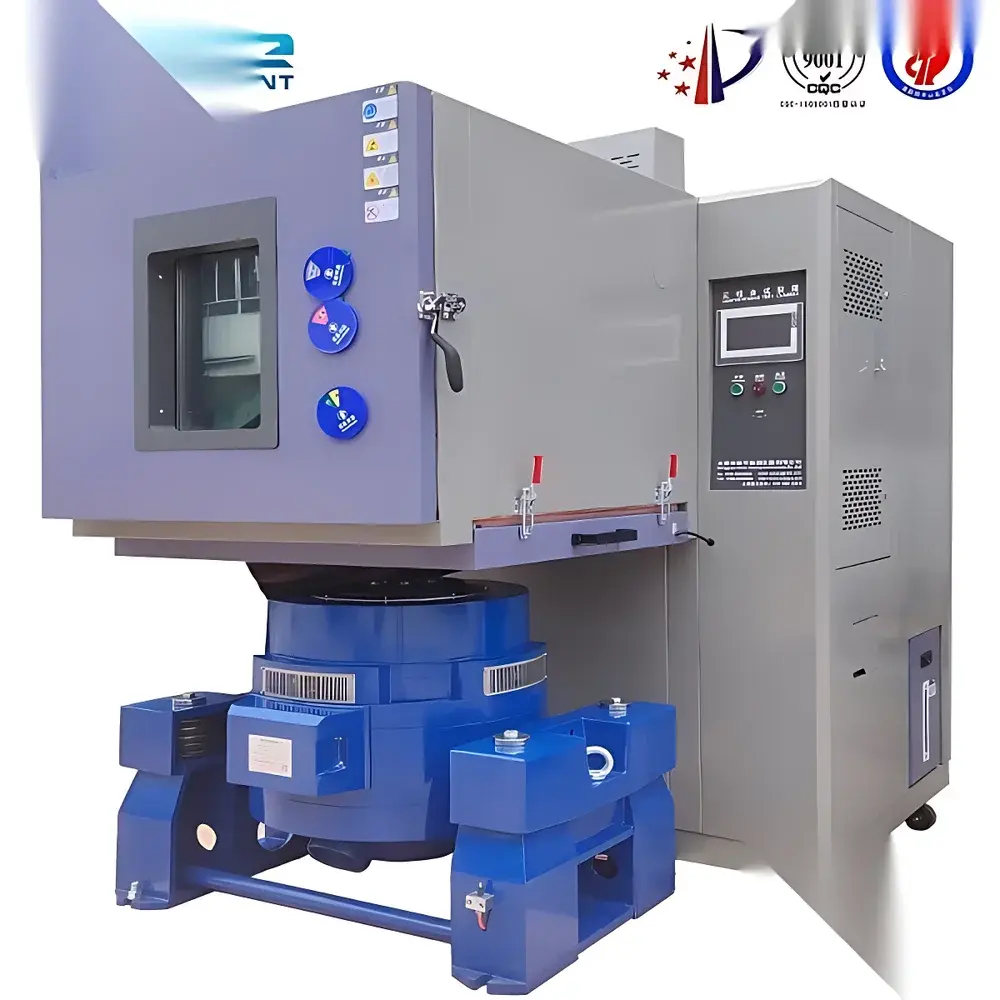
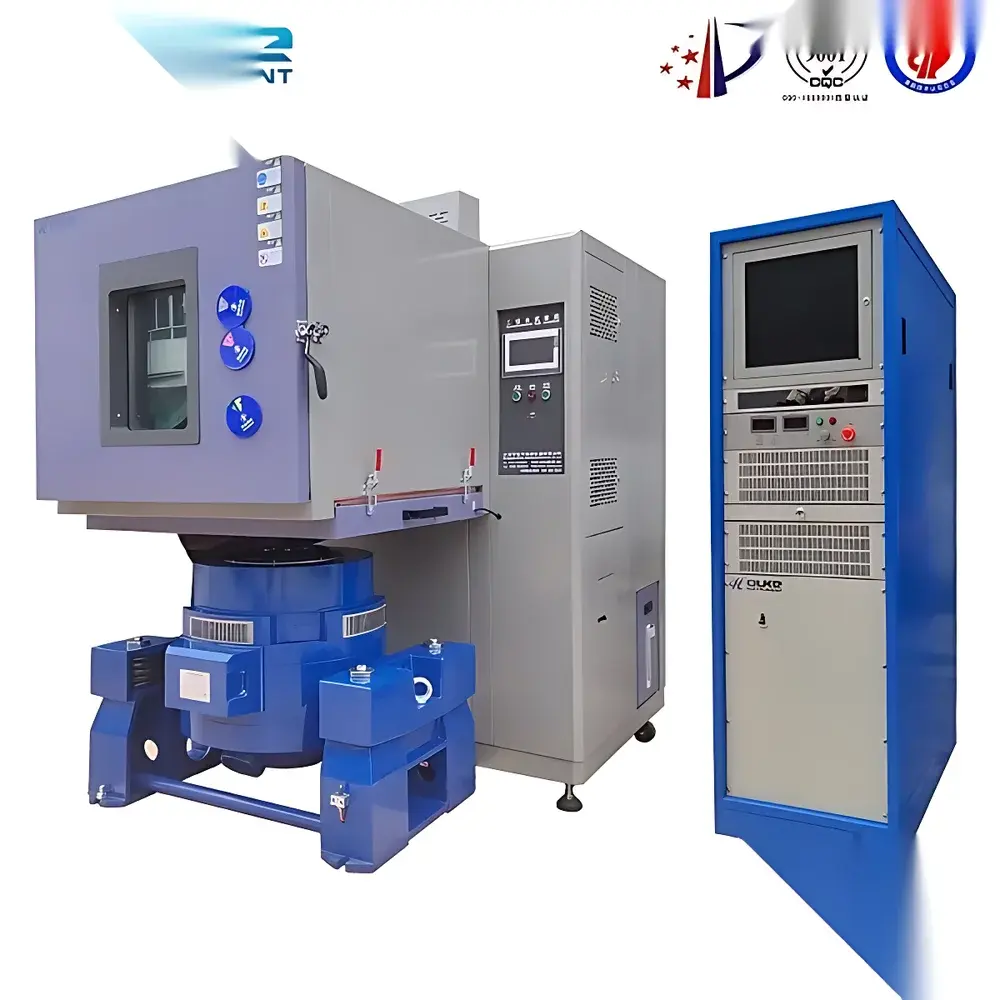
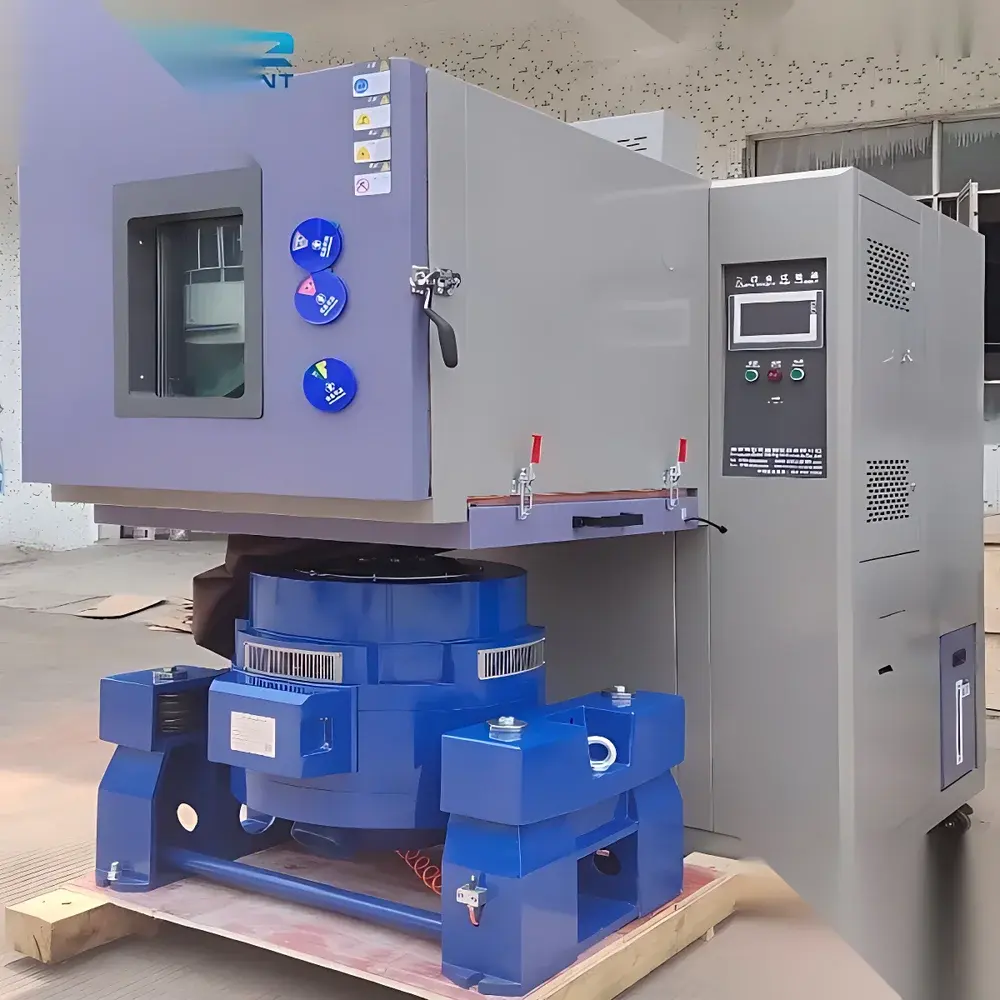
Combined Temperature-Humidity-Vibration Environmental Test Chamber
| Brand | Other Brands |
|---|---|
| Origin | Imported |
| Manufacturer Type | Authorized Distributor |
| Price | USD 21,500 (FOB) |
| Compliance | IEC 60068-2-6, IEC 60068-2-14, IEC 60068-2-30, ISO 16750-4, MIL-STD-810H (Environmental Engineering Considerations) |
Overview
The Combined Temperature-Humidity-Vibration Environmental Test Chamber is an integrated reliability testing system engineered for simultaneous application of thermal cycling, humidity conditioning, and mechanical vibration stress. It operates on the principle of multi-stress acceleration—enabling accelerated life testing (ALT), HALT (Highly Accelerated Life Testing), and qualification per automotive, aerospace, and electronics industry standards. Unlike sequential environmental chambers, this triaxial-combined system replicates real-world operational stresses where temperature gradients, moisture ingress, and dynamic mechanical loads co-occur—such as under-hood automotive electronics, avionics enclosures, or outdoor telecom infrastructure. The chamber integrates a high-efficiency refrigeration unit with PID-controlled humidification, coupled to an electromagnetic shaker system featuring four-point synchronous excitation and closed-loop acceleration feedback. Its architecture supports both steady-state and transient stress profiles, ensuring reproducible test conditions across extended durations.
Key Features
- Precision frequency control with long-term stability (< ±0.05% drift over 100 hr continuous operation), achieved via digital signal processor (DSP)-based servo amplifier and real-time phase-locked loop (PLL) tracking.
- Wide-range amplitude modulation: 0.05–5.0 mm peak-to-peak displacement (adjustable in 0.01 mm increments); acceleration range: 0.5–100 grms, programmable in 0.1 g steps.
- Multi-mode vibration control: fixed-frequency, sweep (linear/logarithmic), programmable profile (up to 99 segments), octave-based (1/3-octave, 1/12-octave), and resonance dwell functions.
- Four-corner synchronized electromagnetic exciters ensure uniform modal energy distribution across the test table surface (flatness deviation < ±1.5 dB within 5–2000 Hz).
- Integrated anti-electromagnetic interference (EMI) shielding: reinforced Faraday cage construction, filtered power inputs, and galvanically isolated sensor channels eliminate spurious coupling into control electronics.
- Embedded amplitude prediction algorithm enables rapid setup calibration—reducing pre-test tuning time by up to 60% compared to manual iterative methods.
Sample Compatibility & Compliance
The chamber accommodates test specimens up to 150 kg (with optional load extension kits) and internal workspace dimensions of 800 × 800 × 800 mm (W×D×H). It meets functional safety requirements per IEC 61508 (SIL2) and includes redundant hardware-level protection: overtemperature cutoff (dual thermocouple verification), refrigerant high-pressure lockout, ground-fault interrupter (GFCI), short-circuit current limiting, and automatic mains disconnection upon any fault condition. All alarms trigger audible/visual alerts and log timestamped event records—including root-cause identifiers (e.g., “Compressor discharge temp >120°C at T=42:18:05”). The system complies with GLP/GMP documentation integrity requirements: audit trails, electronic signatures, and data immutability are enforced via firmware-level write-protection and SHA-256 hashed record storage.
Software & Data Management
Control and analysis are performed through a Windows-based software suite compliant with FDA 21 CFR Part 11 (electronic records and signatures). The interface supports unlimited test sequence programming—including nested modulated profiles (e.g., temperature ramp → humidity soak → random vibration → thermal shock → sine dwell). Real-time waveform visualization (FFT, PSD, time history, transmissibility) is available alongside synchronized environmental parameter overlays. All raw data—including accelerometer voltage outputs, chamber thermocouple readings, and humidity sensor analog signals—are stored in IEEE-compliant .tdms format with embedded metadata (test ID, operator, calibration certificate ID, environmental setpoints). Export options include CSV, PDF reports (with configurable cover pages), and direct integration with LabVIEW™ and MATLAB® via TCP/IP API.
Applications
This chamber is routinely deployed in: qualification testing of PCB assemblies per IPC-9592; validation of battery pack enclosures under combined thermal-vibration stress (UN 38.3 Section 38.3.4); durability assessment of MEMS sensors exposed to condensing humidity + broadband vibration; structural integrity evaluation of medical device housings per ISO 14971 risk management protocols; and component-level screening for satellite subsystems under MIL-STD-810H Method 514.7 (vibration) and Method 502.7 (temperature/humidity). Its ability to execute jump-frequency transitions (e.g., 20 Hz → 1200 Hz in <100 ms) and dynamic mode switching (constant displacement → constant acceleration) makes it suitable for resonant fatigue mapping and modal interaction studies.
FAQ
Does the system support remote monitoring and unattended operation?
Yes—via secure HTTPS web interface with role-based access control (RBAC), live video feed integration (optional IP camera module), and SMTP-based alarm notifications.
What calibration documentation is provided upon delivery?
A NIST-traceable calibration certificate covering temperature uniformity (±0.5°C), humidity accuracy (±2% RH), and vibration amplitude linearity (±1.5% from 10–2000 Hz) is included.
Can the chamber perform humidity-free vibration-only tests?
Yes—the humidity system can be fully deactivated while retaining full vibration and thermal control functionality.
Is third-party validation support available for ISO/IEC 17025 accreditation?
Yes—factory-trained application engineers provide on-site IQ/OQ/PQ protocol development, execution support, and uncertainty budgeting per ILAC-G8:2019.
What is the maximum allowable specimen height above the table surface?
For optimal modal fidelity, center-of-gravity height should not exceed 300 mm above the table; taller configurations require custom fixture analysis and modal survey.



