
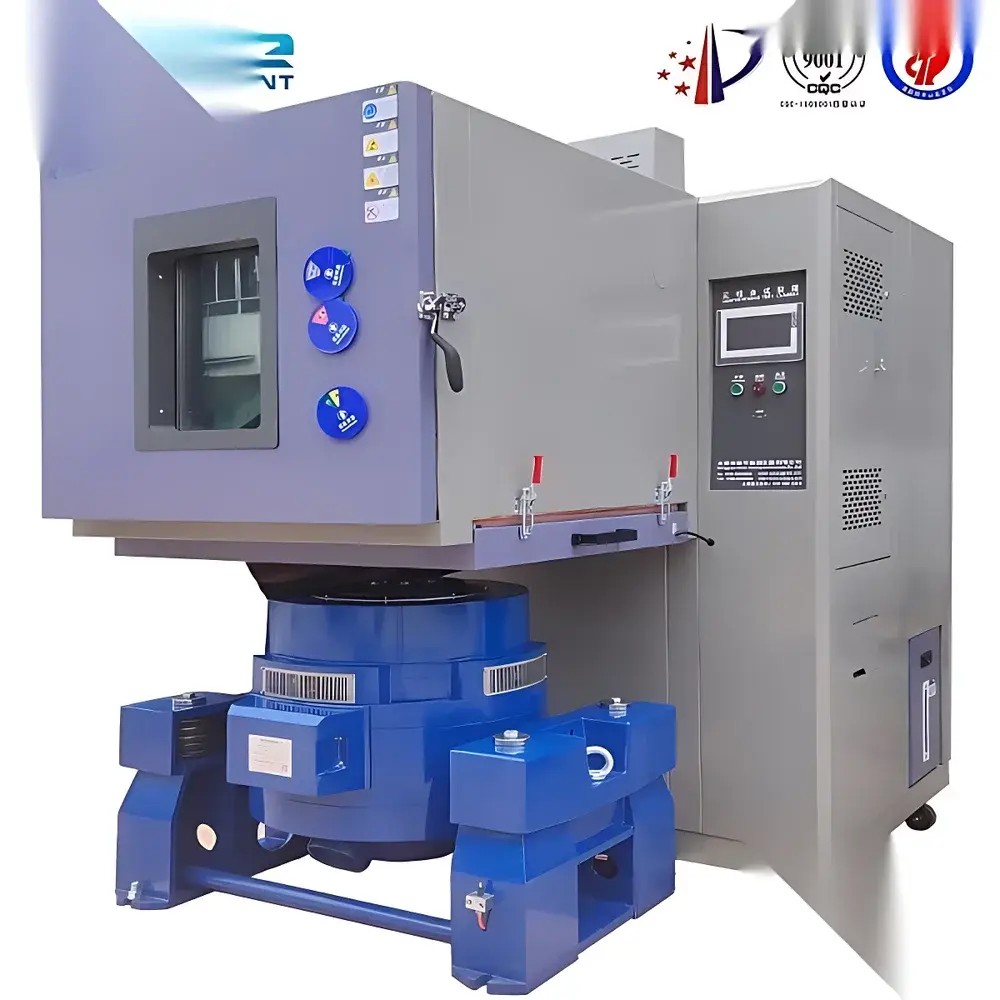
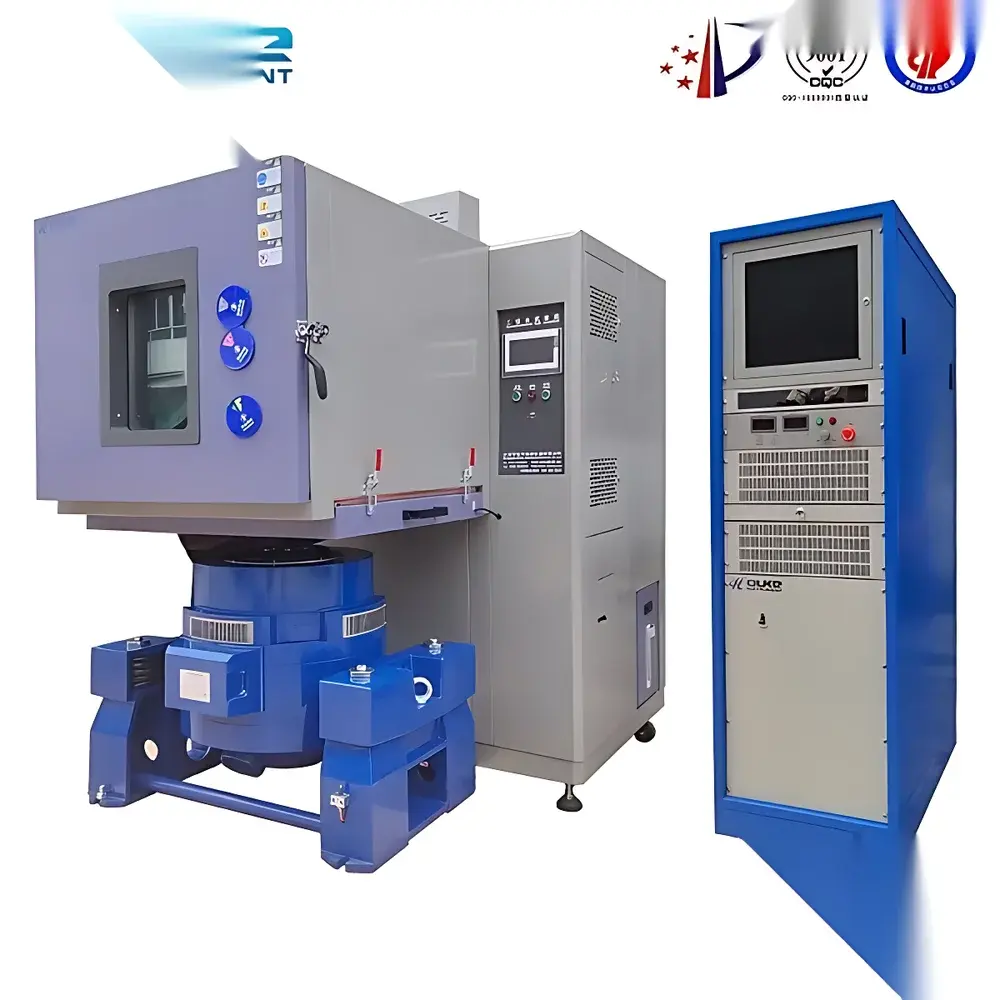
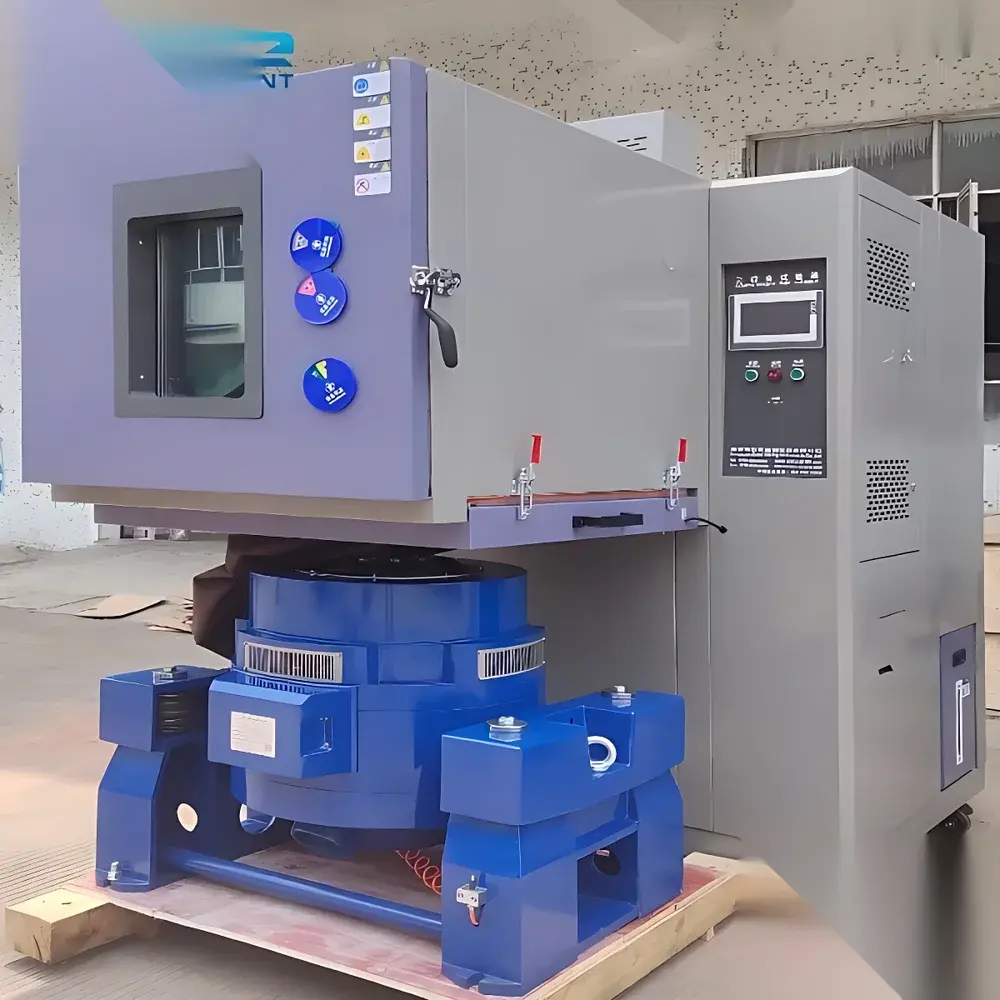
Combined Temperature-Humidity-Vibration Environmental Test Chamber
| Brand | Other Brands |
|---|---|
| Origin | Imported |
| Manufacturer Type | General Distributor |
| Price | USD 21,500 (FOB) |
| Temperature Range | −70°C to +180°C |
| Humidity Range | 10%–98% RH |
| Vibration Frequency Range | 5–3000 Hz |
| Max Sinusoidal Force | 14.2 kN |
| Max Random Force (rms) | 14.2 kN |
| Max Acceleration | 1000 m/s² |
| Max Velocity | 2.00 m/s |
| Max Displacement (p-p) | 51 mm |
| Payload Capacity | 300 kg |
| Refrigeration System | Twin-stage cascade refrigeration with French Tecumseh compressors |
| Humidity Control | Steam generator + ultrasonic humidifier |
| Structural Insulation | High-density fiberglass wool |
| Internal Chamber Material | SUS304 stainless steel mirror finish |
| External Frame | A3 steel with epoxy powder coating |
Overview
The Combined Temperature-Humidity-Vibration Environmental Test Chamber is an integrated reliability validation platform engineered for simultaneous multi-stress exposure testing in accordance with IEC 60068-2, MIL-STD-810H, ISO 16750-4, and ASTM D4332. It enables concurrent application of thermal cycling (−70°C to +180°C), controlled humidity (10–98% RH), and broadband mechanical vibration (5–3000 Hz) — replicating real-world operational and transport conditions for electronic assemblies, automotive ECUs, avionics modules, and military-grade components. Unlike sequential or single-stress chambers, this triaxial system captures synergistic degradation mechanisms — such as condensation-induced corrosion under dynamic loading or thermal expansion mismatch during resonant excitation — critical for accelerated life cycle assessment and failure mode identification.
Key Features
- Triple-domain synchronized control architecture: Independent PID-regulated temperature/humidity subsystems co-orchestrated with a high-fidelity electrodynamic shaker via IEEE 1451.4-compliant digital interface.
- Vibration system based on IMV-designed electromagnetic exciters with ThreeBand-wound voice coils, stainless steel diaphragm support mesh (Tokyo Boeki), and integrated PT100 thermal monitoring for continuous coil temperature compensation.
- Switch-mode power amplifier (20 kVA output) featuring Siemens industrial contactors and solid-state switching topology for stable harmonic suppression and low THD (<0.5% at 1 kHz).
- Dual-redundant refrigeration circuitry utilizing Tecumseh hermetic compressors, Parker Hannifin ACO dry filters, Castel solenoid valves, and oil separation technology to ensure long-term stability across deep-cold cycles (≤−70°C).
- Uniform environmental distribution achieved via backward-curved centrifugal blower (Sanchuan motor), multi-wing impeller design, and optimized air baffle geometry — validated to ±0.5°C/±2% RH spatial uniformity per IEC 60068-3-5.
- Modular chamber construction: 304 stainless steel interior (electropolished mirror finish), A3 carbon steel exterior with epoxy-powder coating, and triple-layer silicone-rubber gasketing rated for 200,000 compression cycles.
Sample Compatibility & Compliance
The chamber accommodates test specimens up to 300 kg mass and 280 mm diameter mounting interface, supporting standard fixtures per ISO 5344 and MIL-STD-1377 for vibration table coupling. Internal volume configurations range from benchtop (300 L) to walk-in (10 m³) variants. All control firmware complies with FDA 21 CFR Part 11 requirements for electronic records and signatures, including audit trail logging, user-level access control, and data integrity verification. Test profiles are exportable in XML format compliant with ASAM MCD-2 MC (ASAM-STEP) standards for traceability in GLP/GMP environments.
Software & Data Management
Control and analysis are executed via a dedicated real-time Windows-based workstation equipped with dual-channel charge amplifiers, 24-bit ADC sampling, and deterministic loop timing (≤1 ms jitter). The software suite includes three certified modules: Sine Control (per ISO 10816-1), Random Control (with PSD synthesis per ISO 18431-4), and Classical Shock Synthesis (half-sine, trapezoidal, sawtooth per ISO 5344 Annex B). All test data — including time-history waveforms, spectral density plots, thermal ramp logs, and humidity transients — are stored in HDF5 format with embedded metadata tags for automated report generation (PDF/CSV/XLSX). Optional integration with LabVIEW™ and MATLAB® via TCP/IP API enables custom algorithm deployment and statistical process control (SPC) linkage.
Applications
This system serves as a core validation tool across aerospace (DO-160 Section 22 vibration + Section 25 temperature/humidity), automotive electronics (ISO 16750-4 combined stress), medical device sterilization packaging (ISO 11607-2 accelerated aging), and semiconductor packaging qualification (JEDEC JESD22-A104E + JESD22-B103B). It is routinely deployed for HALT/HASS screening, solder joint fatigue modeling, conformal coating adhesion evaluation under thermal-mechanical strain, and qualification of battery management systems subjected to thermal runaway propagation scenarios.
FAQ
Does the chamber support remote monitoring and alarm notification?
Yes — Ethernet-connected SNMP v3 interface enables real-time status polling, email/SMS alerts on parameter deviation, and secure HTTPS-based web dashboard access.
Can vibration and climate profiles be synchronized at sub-second resolution?
Yes — hardware-triggered synchronization ensures phase-aligned execution of thermal ramps, humidity steps, and vibration spectra with ≤50 µs timestamp correlation accuracy.
Is calibration documentation provided per ISO/IEC 17025?
Factory calibration certificates are supplied for all primary sensors (PT100, capacitive RH, piezoelectric accelerometers), traceable to NIST and PTB standards, with optional third-party certification.
What maintenance intervals are recommended for the refrigeration system?
Compressor oil analysis every 2,000 operating hours; filter-drier replacement every 12 months or 4,000 hours — documented in the preventive maintenance logbook included with shipment.
Are custom test protocols programmable beyond standard sine/random modes?
Yes — user-defined waveform synthesis (including transient shock envelopes and modulated random spectra) is supported through the built-in script editor using Python 3.9-compatible syntax.
Related Products



