
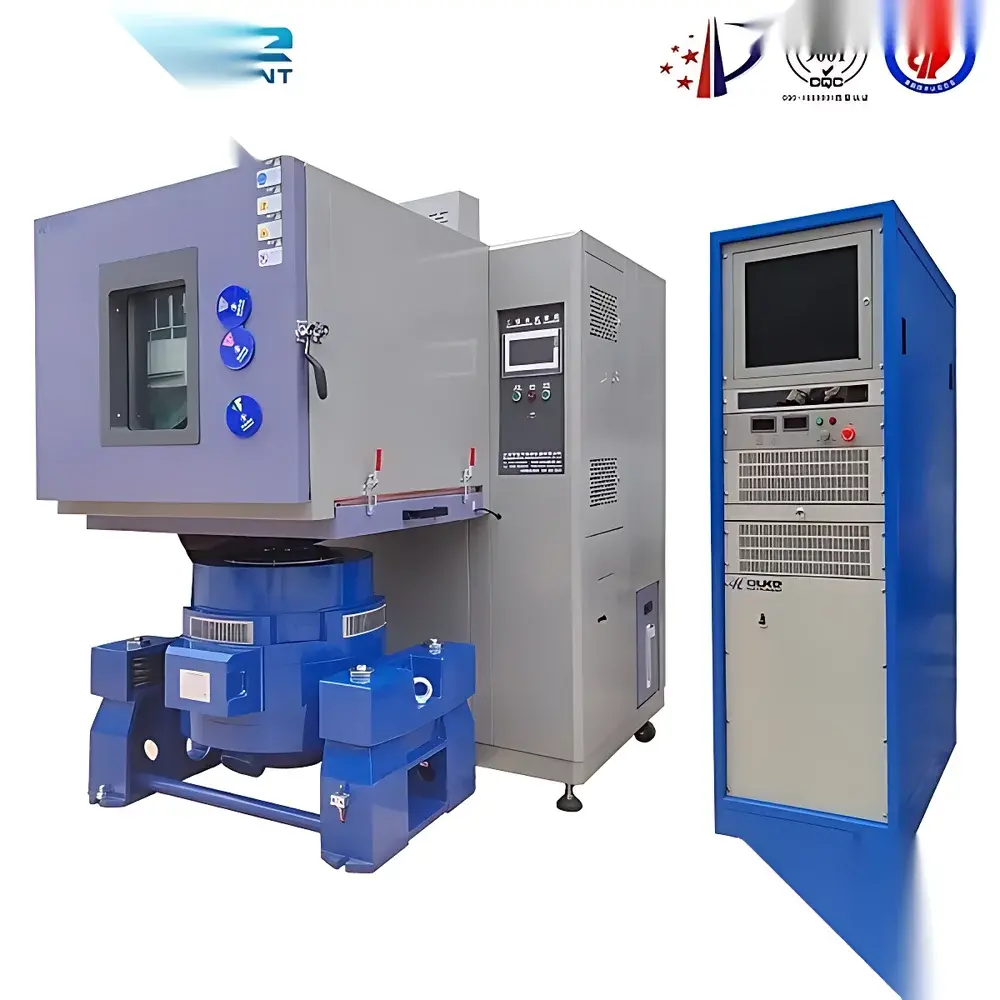
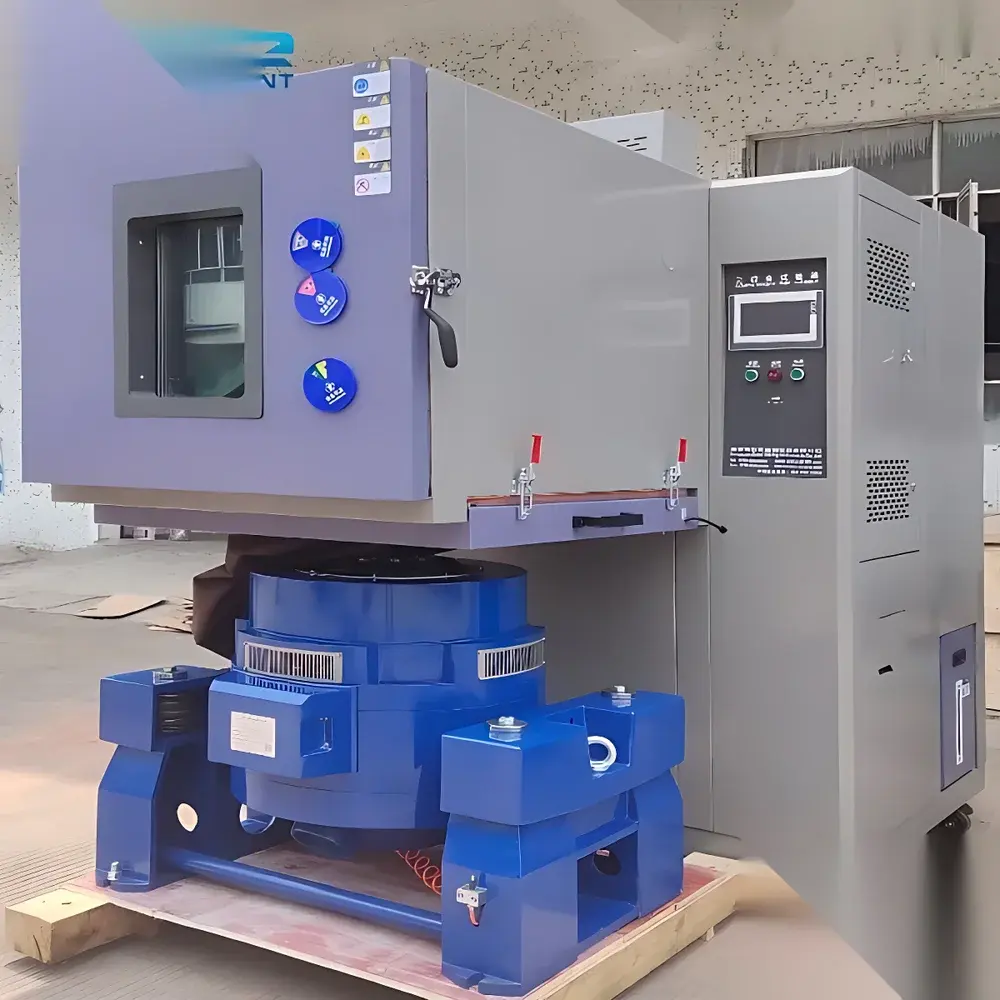
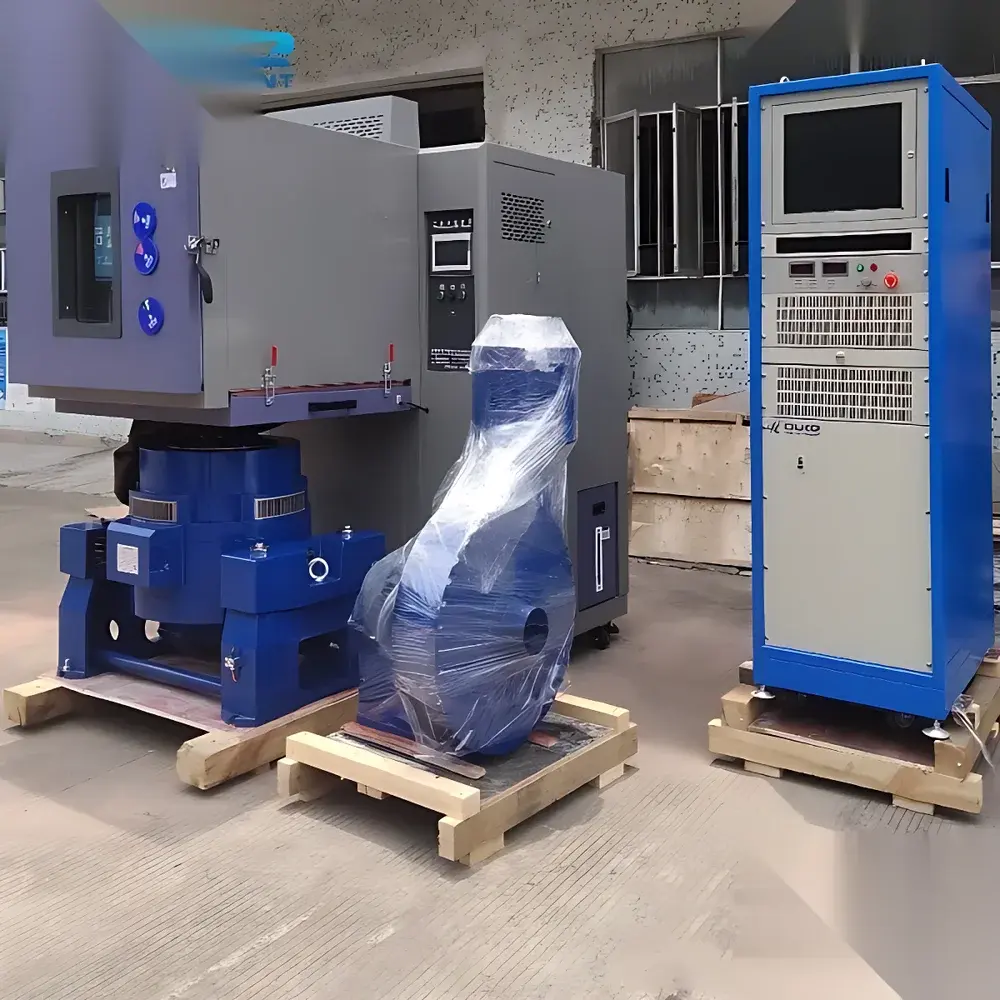
Combined Temperature-Humidity-Vibration Environmental Test Chamber
| Key | Temperature Range Options: -20°C to 150°C |
|---|---|
| Humidity Range | 20–98% RH |
| Temperature Uniformity | ≤ ±0.5°C |
| Temperature Stability | ≤ ±2°C |
| Humidity Deviation | +2 / –3% RH |
| Heating Rate (–20°C → 100°C) | ~35 min |
| Cooling Rate (25°C → –40°C) | ~50 min |
| Vibration System | Electrodynamic Shaker (OK-ES), Sinusoidal/Random/Shock Control, Vertical Magnesium Alloy Table (VT0404), Accelerometer (BW), DA-6 Power Amplifier, Excitation Supply, RS232 & USB Data Interface |
| Optional Add-ons | LN2V Liquid Nitrogen Rapid Cooling Unit, LHC Low-Humidity Sensor with Regenerative Desiccant Dryer |
| Compliance | Designed for IEC 60068-2, MIL-STD-810, ASTM D4332, ISO 16750-4, and GLP/GMP-aligned test documentation workflows |
Overview
The Combined Temperature-Humidity-Vibration Environmental Test Chamber is an integrated reliability validation platform engineered for simultaneous or sequential application of thermal, hygroscopic, and mechanical stress stimuli. It operates on the principle of multi-stress acceleration—leveraging synergistic environmental loading to replicate real-world field conditions encountered during transportation, storage, and operational service life. Unlike standalone chambers, this system synchronizes high-fidelity temperature-humidity control with high-dynamic-range electrodynamic vibration excitation, enabling rigorous assessment of product integrity under coupled stress states. The chamber’s architecture supports full compliance with internationally recognized environmental testing standards, including IEC 60068-2-1 (cold), IEC 60068-2-2 (dry heat), IEC 60068-2-30 (damp heat cyclic), and IEC 60068-2-64 (vibration—random), making it suitable for qualification testing in aerospace, automotive electronics, medical device packaging, and industrial IoT hardware development.
Key Features
- Multi-zone thermal control with four selectable low-temperature configurations (–20°C, –40°C, –60°C, and –80°C minimum), all extending to +150°C; optimized for rapid thermal transitions using PWM-based refrigeration modulation to reduce energy consumption without compromising stability.
- High-accuracy humidity regulation (20–98% RH) with calibrated deviation tolerance of +2 / –3% RH and uniformity maintained within ±2°C across working volume—achieved via saturated air jacket (47°C ±1°C) and precision steam injection.
- Dual-mode vibration subsystem comprising an OK-ES electrodynamic shaker, VT0404 vertical magnesium alloy table (400 × 400 mm active surface), DA-6 power amplifier, and BW triaxial accelerometer—capable of sinusoidal, random, and classical shock profiles per ISO 5344 and IEEE 1610.
- Condensation prevention logic embedded in control firmware: real-time dew-point monitoring and adaptive boundary management ensure test specimens remain non-condensing—even during rapid cooldown or high-RH ramping phases.
- Integrated data acquisition and remote supervision: RS232 serial interface for PLC-level integration, USB mass-storage logging, wireless SMS/email alarm notification, and multi-point internal sensor monitoring (temperature, humidity, vibration amplitude, coil current, refrigerant pressure).
- Expandable modular design: optional LN2V liquid nitrogen assist enables sub–70°C cooling rates up to 15 K/min; LHC low-humidity sensing module with regenerative desiccant dryer extends operational range down to 5% RH for specialized polymer or optical component testing.
Sample Compatibility & Compliance
This chamber accommodates samples up to 150 kg (centered on VT0404 table) with dimensional envelope constraints of 600 × 600 × 600 mm (W × D × H). Its structural rigidity and vibration isolation base minimize cross-coupling between thermal and mechanical domains. All control algorithms and calibration traceability align with ISO/IEC 17025 requirements. Test reports generated via bundled software include timestamped parameter logs, alarm event histories, and digital signatures—supporting FDA 21 CFR Part 11 compliance when deployed in regulated GxP environments. Routine verification follows ASTM E2234 (thermal chamber performance) and ISO 16750-4 (road vehicle environmental conditions).
Software & Data Management
The included vibration and environmental control suite runs on a dedicated industrial PC with dual-monitor support (one for real-time waveform visualization, one for chamber status dashboard). Software features include scriptable test sequencing, FFT-based spectral editing for random profiles, rainflow cycle counting for fatigue analysis, and automated pass/fail evaluation against user-defined thresholds. All raw data—including thermocouple voltages, humidity capacitance readings, and accelerometer time histories—are stored in vendor-neutral CSV and HDF5 formats. Audit trails record operator login, parameter changes, and emergency stops with immutable timestamps—enabling full traceability for internal QA audits or regulatory inspections.
Applications
- Qualification of avionics enclosures subjected to combined thermal cycling and flight-spectrum vibration.
- Accelerated aging of lithium-ion battery modules under humid heat + mechanical shock conditions.
- Validation of MEMS sensor packaging integrity during reflow simulation and post-solder thermal shock.
- Reliability screening of automotive ECUs per ISO 16750-4 and GMW3172 specifications.
- Stress screening of sterile barrier systems (e.g., Tyvek pouches) under damp heat + transport vibration profiles.
- Materials research on polymer composites exposed to hygrothermal swelling followed by resonant frequency shift analysis.
FAQ
What standards does this chamber support for combined stress testing?
It complies with IEC 60068-2 series, MIL-STD-810H Method 520.5 (combined environments), and ISO 16750-4 Annex C for road vehicle applications. Custom profiles can be built to meet proprietary OEM requirements.
Can vibration and climate profiles run simultaneously with synchronized triggers?
Yes—the system supports time-synchronized multi-domain execution, including phase-locked thermal ramps with broadband random vibration onset and humidity hold points aligned to dwell durations.
Is third-party calibration certification available?
Calibration certificates traceable to NIST or PTB standards are provided upon request, covering temperature, humidity, and vibration transducers per ISO/IEC 17025-accredited labs.
What is the maximum payload capacity for the VT0404 table under full vibration spectrum?
At 2000 m/s² peak acceleration (50 g), the recommended maximum mass is 80 kg; at 200 m/s² (20 g), it increases to 150 kg—with center-of-gravity height limited to 200 mm above table surface.
Does the system support remote operation and monitoring via Ethernet or cloud interface?
Standard configuration includes RS232 and USB; optional Ethernet-to-Modbus TCP gateway and secure HTTPS web interface enable integration into enterprise MES/QMS platforms.



