
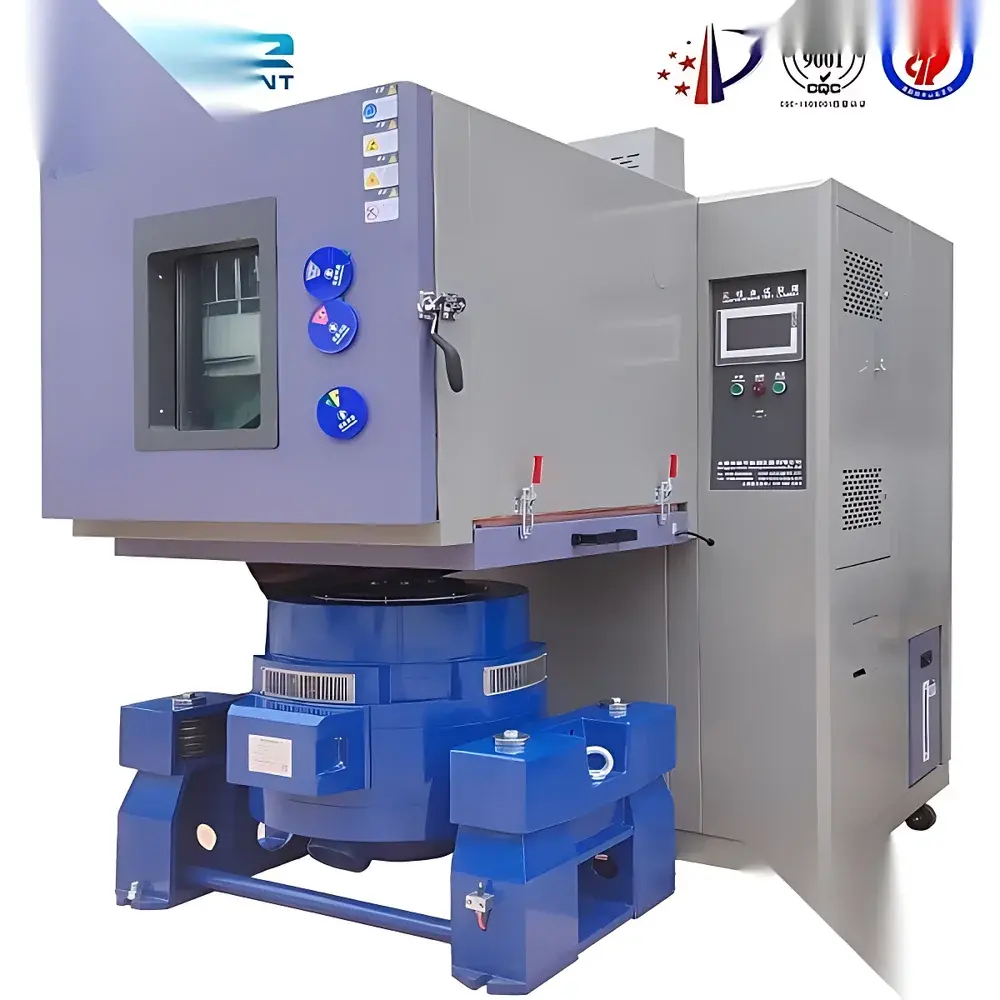
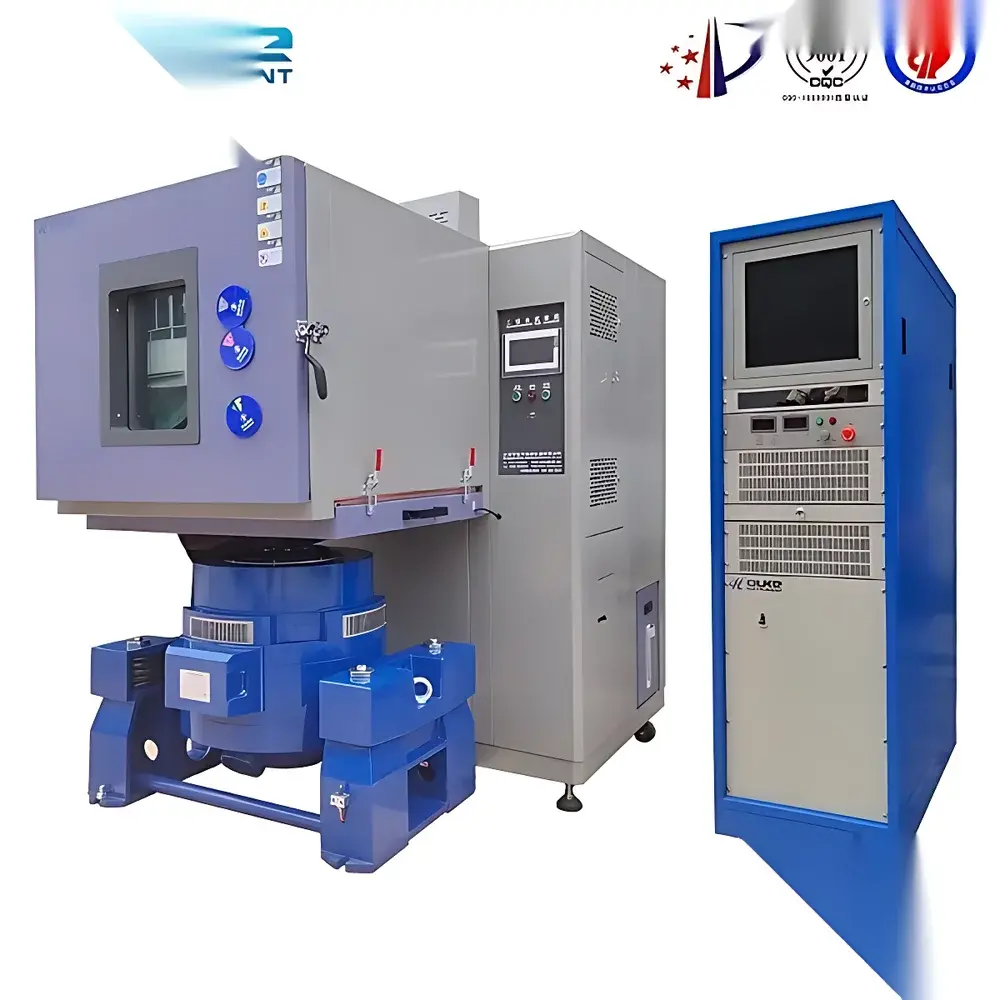
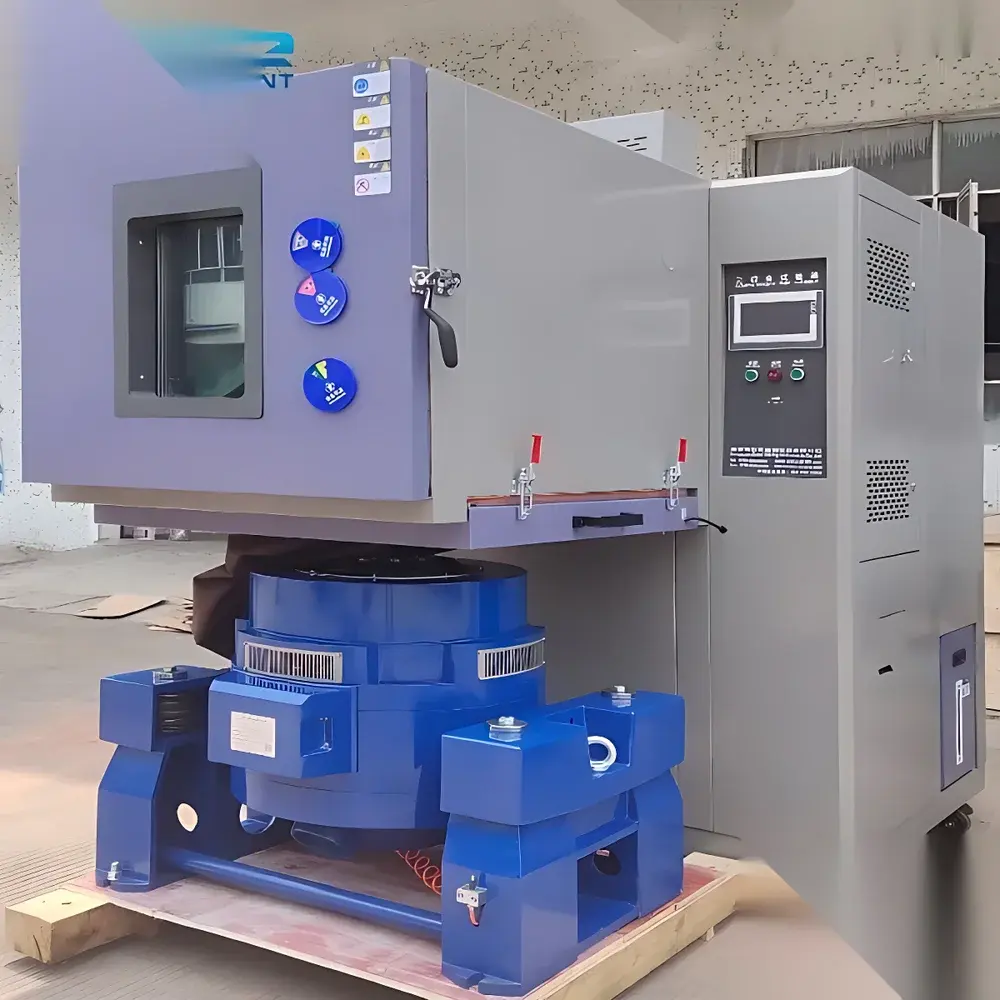
Combined Temperature-Humidity-Vibration Environmental Test Chamber
| Brand | OEM / Custom-Built |
|---|---|
| Origin | Imported |
| Manufacturer Type | Authorized Distributor |
| Price | USD 21,500 (FOB) |
| Temperature Range | −70°C to +180°C |
| Humidity Range | 10%–98% RH |
| Vibration System | Electrodynamic Shaker with Hydraulic Assist |
| Max. Payload | 1,000 kg |
| Table Surface | 2090 × 1600 × 1615 mm (L×W×H) |
| Enclosure Height | 1000 mm |
| Vibration Mode | Reciprocating (Rotary Eccentric Drive) |
| Frequency Range | 1–600 Hz |
| Displacement Peak-to-Peak | 25.4 mm |
| Acceleration Range | 0.5–100 g (adjustable) |
| Sweep Type | Logarithmic & Linear |
| Programmable Timer | 0.1 s – 99 h 59 min |
| Power Supply | 380 V / 220 V, 50 Hz, 3-Phase |
| Total Weight | 1200 kg |
| Compliance | ASTM D999, ISTA 3A/3E/3F, EN 71-1, UL 60950-1, ISO 16750-3, IEC 60068-2-6 & -2-64 |
Overview
The Combined Temperature-Humidity-Vibration Environmental Test Chamber is an integrated reliability validation platform engineered for simultaneous exposure of large-scale products to controlled thermal, hygrothermal, and dynamic mechanical stress conditions. Unlike sequential or single-stress test systems, this chamber implements true concurrent triaxial environmental simulation—enabling accelerated life testing, transport simulation, and structural integrity assessment under realistic field-representative load spectra. Its core vibration subsystem employs a high-inertia electrodynamic shaker augmented by hydraulic assist for low-frequency force amplification (1–20 Hz), while the climate control system utilizes dual-refrigerant cascade cooling and precision steam-humidification to maintain stable temperature/humidity profiles across the full operational envelope (−70°C to +180°C; 10–98% RH). This architecture conforms to the physical principles underlying combined stress failure mechanisms—particularly thermomechanical fatigue, moisture-induced delamination, and resonance-driven component fracture—making it essential for validating automotive ECUs, industrial control cabinets, medical imaging enclosures, and large consumer electronics assemblies.
Key Features
- True concurrent tri-environmental simulation: Independent yet synchronized control of temperature, humidity, and multi-axis vibration within a single test volume
- Programmable vibration profile engine supporting fixed-frequency, linear/logarithmic sweep, multi-segment random, sine-on-random, and resonant dwell modes (15-step programmable sequence, up to 999 cycles)
- Dual-range acceleration capability: High-g mode (up to 100 g peak) for shock sensitivity screening; low-frequency high-displacement mode (25.4 mm p-p at 1–10 Hz) for transport simulation per ISTA 3-series protocols
- Climate chamber with stainless-steel insulated double-wall construction, PID-controlled steam humidification, and refrigerant cascade system for rapid ramp rates (≥10°C/min cooling from 25°C to −40°C)
- Integrated data acquisition interface compliant with IEEE 1451.4 TEDS for real-time sensor metadata embedding and traceable channel calibration
- Robust structural frame rated for 1,000 kg static load and validated for long-term cyclic operation at rated amplitude and frequency extremes
Sample Compatibility & Compliance
This chamber accommodates large-format test specimens—including office furniture systems, home appliances (refrigerators, washing machines), telecom base station cabinets, and aerospace ground support equipment—within its 2090 × 1600 mm horizontal table area and 1615 mm vertical working height. The 1000 mm perimeter guardrail ensures operator safety during high-amplitude excitation. All operational modes and environmental setpoints are validated against internationally recognized standards: vibration profiles align with ASTM D999 (shipping container testing), ISTA 3A (parcel delivery), ISTA 3E (unitized loads), and ISO 16750-3 (road vehicle environmental conditions); thermal/humidity cycling meets IEC 60068-2-1/-2/-30; and combined stress sequences satisfy MIL-STD-810H Method 514.7 (vibration) and Method 502.7 (temperature/humidity). Full audit trails—including parameter logs, alarm events, and calibration records—are retained in accordance with GLP and ISO/IEC 17025 requirements.
Software & Data Management
Control and monitoring are managed via a dedicated Windows-based application featuring a deterministic real-time kernel (1 ms loop resolution) and dual redundancy: primary local HMI with touchscreen interface and optional remote web-accessible SCADA layer (HTTPS/TLS 1.2 secured). The software supports full test script definition—including nested loops, conditional branching based on sensor thresholds, and automatic pass/fail evaluation per user-defined acceptance criteria. All raw vibration time histories, temperature/humidity trend data, and system status variables are stored in HDF5 format with embedded metadata (test ID, operator, calibration certificate IDs, environmental setpoints). Export options include CSV, MATLAB .mat, and universal ASAM MDF4 for downstream analysis in nCode DesignLife, Siemens Testlab, or MATLAB Signal Processing Toolbox. Audit trail functionality complies with FDA 21 CFR Part 11 for electronic signatures and change history tracking.
Applications
- Transportation simulation: Replicating road, rail, and air cargo vibration spectra while subjecting packaged goods to thermal cycling representative of cross-continental logistics corridors
- Structural durability validation: Assessing weld integrity, fastener retention, and panel resonance behavior of large enclosures under combined thermal expansion and dynamic loading
- Electromechanical system qualification: Identifying latent defects in motor drives, HVAC controllers, and power distribution units induced by thermally modulated vibration coupling
- Material interface testing: Evaluating adhesive bond strength, gasket compression recovery, and PCB solder joint reliability under hygrothermal-mechanical stress interaction
- Standards compliance verification: Executing full-scope test plans per UL 60950-1 (safety), IEC 60529 (IP rating validation), and AEC-Q200 (automotive passive components)
FAQ
What standards does this chamber support for combined environment testing?
It fully supports ASTM D999, ISTA 3A/3E/3F, EN 71-1, ISO 16750-3, IEC 60068-2-6 (vibration), IEC 60068-2-64 (random vibration), and MIL-STD-810H Methods 502.7 and 514.7.
Can the vibration system operate independently of climate control?
Yes—the chamber allows standalone vibration-only, temperature/humidity-only, or fully coupled tri-environmental operation via software-selectable mode configuration.
Is remote monitoring and data export supported?
Yes, the system provides secure HTTPS-based remote access, real-time dashboard visualization, and native export to CSV, HDF5, MATLAB .mat, and ASAM MDF4 formats.
What is the calibration interval and traceability documentation?
Factory calibration is performed per ISO/IEC 17025 with NIST-traceable references; recommended recalibration interval is 12 months or after 500 operational hours, whichever occurs first.
Does the system meet FDA 21 CFR Part 11 requirements for regulated industries?
Yes—electronic signature support, role-based access control, immutable audit trails, and full change history logging are implemented in accordance with Part 11 Annex 11 (EU GMP) and ALCOA+ data integrity principles.



