
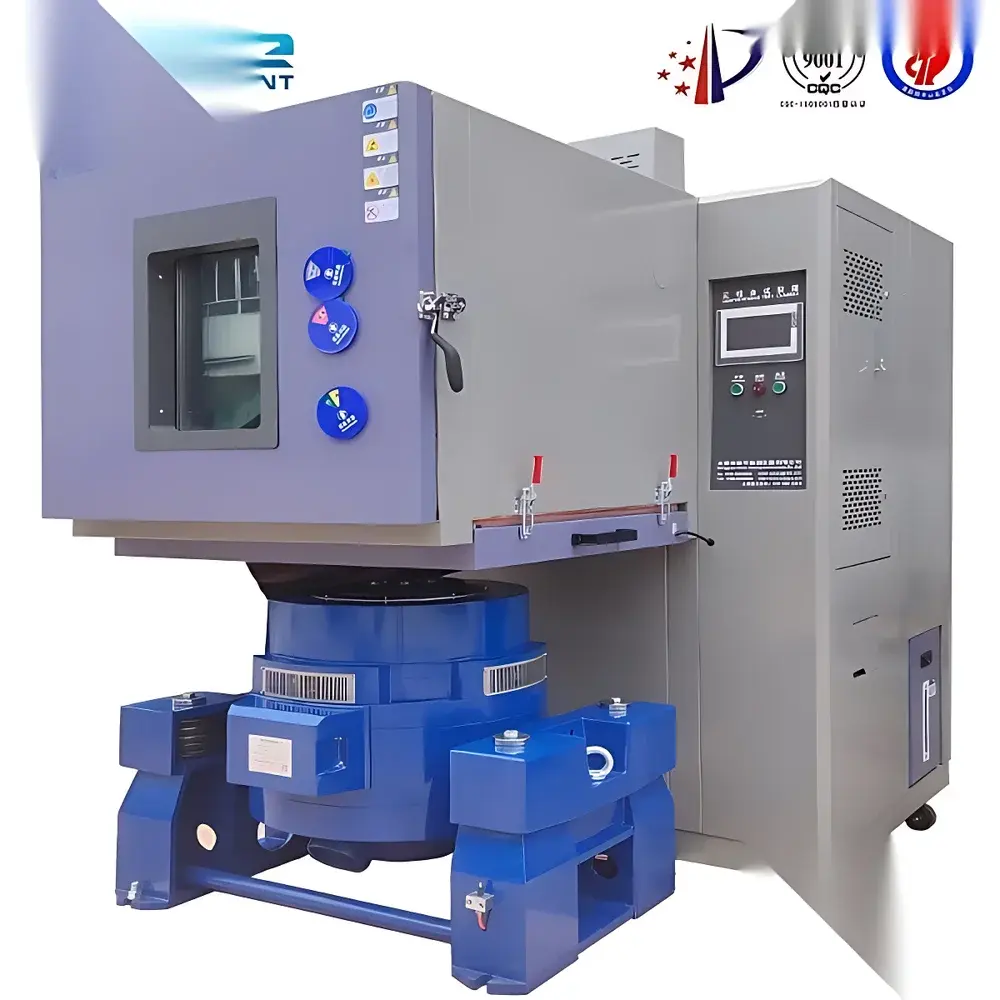
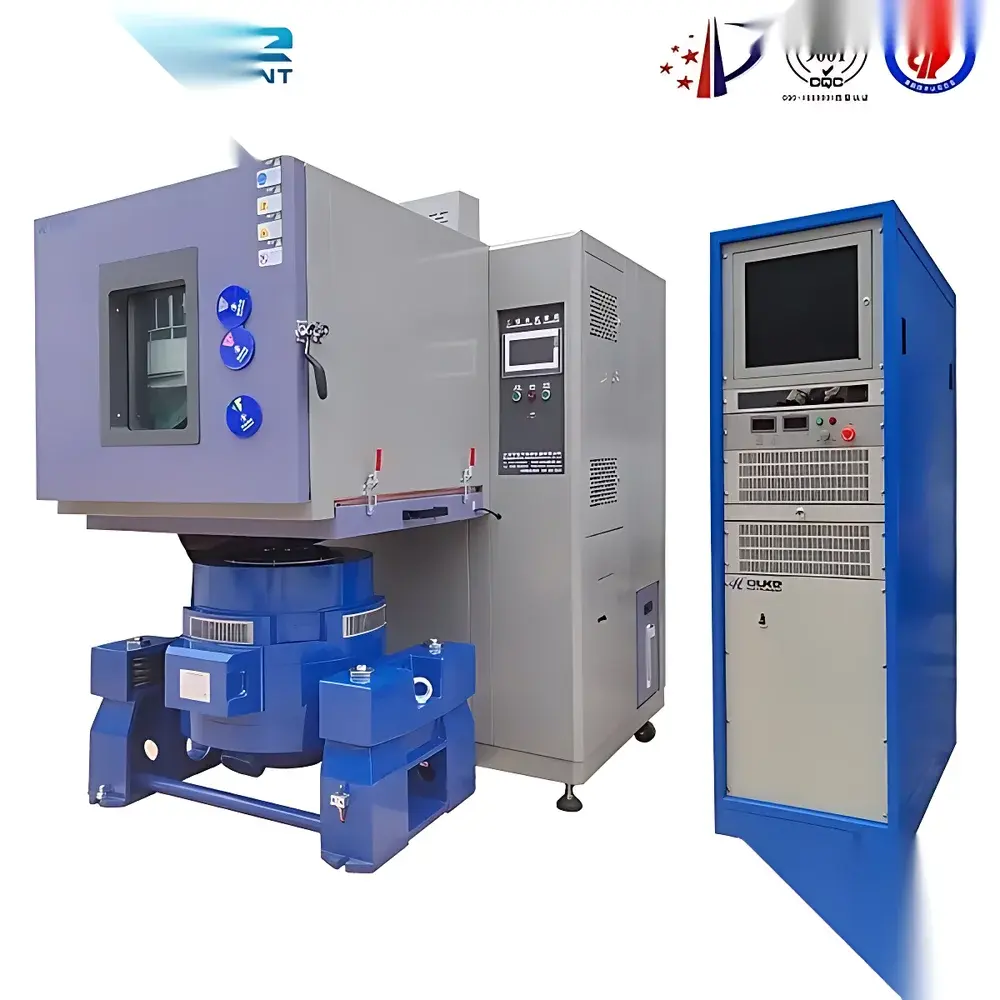
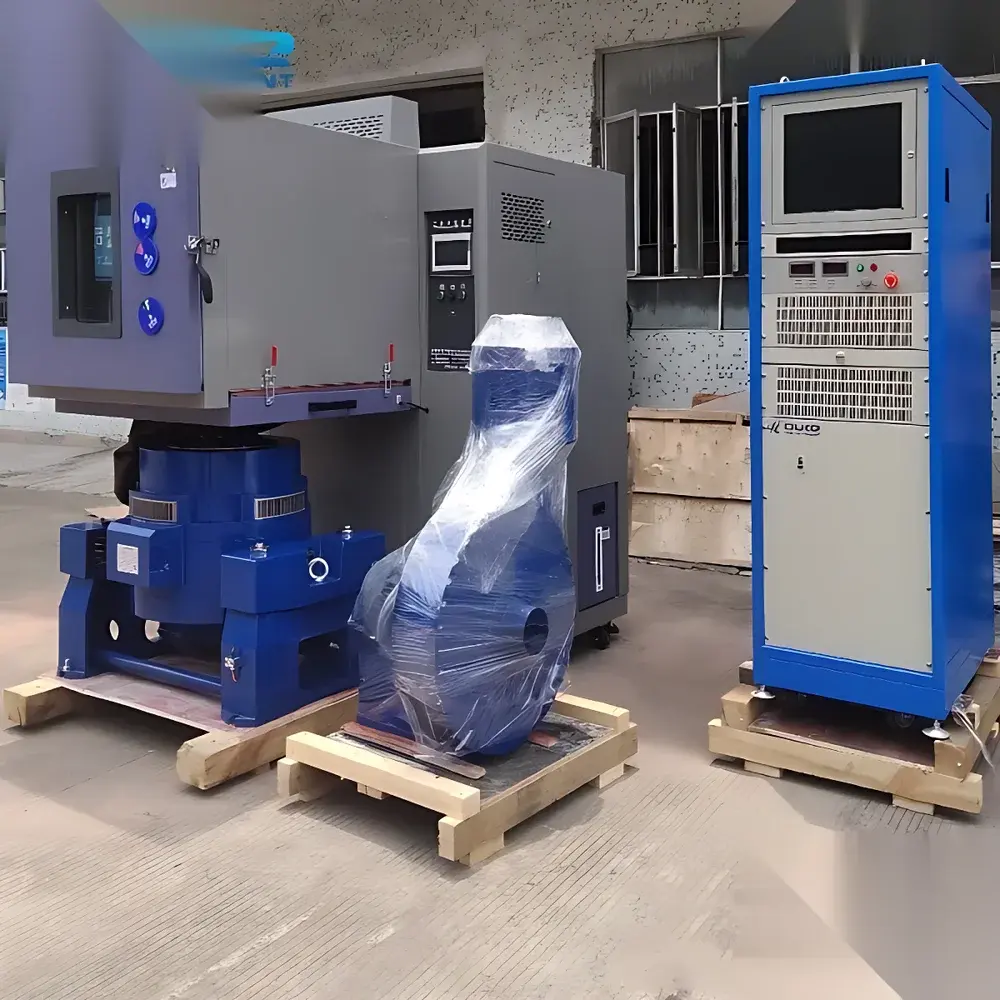
Combined Temperature-Humidity-Vibration Environmental Test Chamber
| Brand | Other Brands |
|---|---|
| Origin | Imported |
| Manufacturer Type | Authorized Distributor |
| Internal Volume | Customizable (L) |
| Temperature Range | -70 °C to +150 °C |
| Temperature Uniformity | ≤2 °C |
| Temperature Stability | ≤±0.5 °C |
| Temperature Deviation | ≤±2 °C |
| Humidity Range | 20–98 %RH (at +20 °C to +80 °C) |
| Humidity Tolerance | ≤±3 %RH (≤75 %RH), ≤±5 %RH (>75 %RH) |
| Rapid Thermal Range | -55 °C to +85 °C |
| Ramp Rate | 5 °C/min or 10 °C/min (average or linear mode) |
| Inner Liner | Mirror-finish SUS304 stainless steel |
| Outer Casing | Brushed SUS304 or galvanized cold-rolled steel |
| Insulation | Glass fiber wool / rigid polyurethane foam |
| Heating System | Ni-Cr alloy electric heaters |
| Cooling System | Twin-stage mechanical refrigeration (Bizerba semi-hermetic compressors) |
| Refrigerants | HFC-R404A / HFC-R23 |
| Condenser | Stainless steel brazed plate heat exchanger |
| Air Circulation | Forced convection via centrifugal fan, bottom-in top-out airflow |
| Humidification | Built-in water tank with booster pump |
| Control System | PLC-based programmable controller with bilingual (English/Chinese) color touchscreen interface |
| Vibration Subsystem | Optional electrodynamic or servo-hydraulic shaker system (custom-configured per user requirements) |
| Compliance Standards | GB/T 5170.2, GB/T 2423.1–2423.3, GJB 150.3–150.4 |
Overview
The Combined Temperature-Humidity-Vibration Environmental Test Chamber is an integrated reliability validation platform engineered for simultaneous exposure of test specimens to controlled thermal, hygrothermal, and dynamic mechanical stress conditions. It operates on the principle of multi-stress acceleration—leveraging synergistic environmental loading to replicate real-world service life degradation mechanisms in aerospace components, automotive electronics, military-grade avionics, and high-reliability medical devices. Unlike sequential single-stress testing, this chamber enables concurrent application of temperature cycling (−70 °C to +150 °C), humidity modulation (20–98 %RH), and broadband vibration excitation (via externally coupled shaker systems), thereby exposing latent design weaknesses such as solder joint fatigue, polymer creep under thermal-mechanical strain, or condensation-induced insulation breakdown. Its twin-stage refrigeration architecture ensures stable low-temperature performance down to −70 °C, while the PLC-driven control system maintains traceable, repeatable profiles compliant with accelerated life testing protocols.
Key Features
- Customizable internal volume to accommodate full-system assemblies, PCB modules, or structural subassemblies
- High-fidelity thermal control with ≤±0.5 °C stability and ≤2 °C uniformity across working volume, validated per GB/T 5170.2
- Dual-mode ramp control: selectable average-rate or linear-rate temperature transitions (5 °C/min or 10 °C/min)
- Environmentally compliant refrigeration using HFC-R404A/R23 blends and Bizerba semi-hermetic compressors
- Corrosion-resistant construction: mirror-polished SUS304 interior, reinforced insulation, and stainless-steel heat exchangers
- Bilingual (English/Chinese) touchscreen HMI with real-time data logging, alarm history, and profile editing capability
- Modular vibration integration: standardized mounting interface for electrodynamic or hydraulic shakers (user-specified frequency range and force capacity)
Sample Compatibility & Compliance
The chamber accommodates samples ranging from miniature sensors (<100 g) to large-scale enclosures (up to 1 m³ volume, subject to custom configuration). Its physical layout supports direct cable feedthroughs, optical access ports, and external sensor interfaces for in situ monitoring during test execution. All thermal and humidity performance parameters are verified against national and industry standards including GB/T 2423.1 (cold), GB/T 2423.2 (dry heat), GB/T 2423.3 (damp heat), and GJB 150.3–150.4 (military environmental methods). The control system architecture supports audit-ready operation: event logs include timestamped setpoint changes, deviation alerts, and operator ID entries—facilitating GLP/GMP-aligned documentation workflows. While not inherently FDA 21 CFR Part 11-compliant, optional firmware upgrades enable electronic signature support and secure user role management.
Software & Data Management
The embedded PLC controller runs deterministic real-time firmware with non-volatile memory for up to 100 program sequences (each supporting 99 segments). Data acquisition records temperature, humidity, and chamber status at configurable intervals (1–60 s resolution), exporting CSV-formatted datasets via USB or Ethernet. Remote supervision is supported through Modbus TCP/IP protocol for integration into enterprise MES or LIMS platforms. Optional PC-based software provides advanced analysis tools—including thermal gradient mapping, humidity hysteresis visualization, and failure correlation tagging—enabling root cause analysis of field return data against lab-generated stress profiles.
Applications
This system is routinely deployed in qualification testing of printed circuit board assemblies subjected to thermal shock and vibration; validation of hermetic seals in MEMS packages under cyclic humidity exposure; screening of battery module thermal runaway propagation under combined mechanical agitation and elevated ambient temperature; and durability assessment of composite airframe components per MIL-STD-810H Method 509.1 (combined environments). Its flexibility supports both development-stage robustness testing and production-line acceptance verification, particularly where regulatory submission requires evidence of multi-stress interaction effects.
FAQ
Can the chamber operate without the vibration subsystem?
Yes—the thermal-humidity section functions independently as a standalone climatic chamber, with full compliance to GB/T 2423.3 and IEC 60068-2-78.
Is remote calibration verification supported?
Calibration certificates for integrated Pt100 sensors and capacitive RH transducers are provided upon delivery; periodic recalibration follows ISO/IEC 17025-accredited procedures.
What vibration specifications can be integrated?
Vibration subsystems are selected based on required frequency range (e.g., 5–2000 Hz), maximum displacement (±25 mm), and force capacity (up to 100 kN peak); detailed compatibility matrices are available upon request.
Does the system support automated test sequencing across multiple environmental profiles?
Yes—programmable logic allows nested loops, conditional branching, and external trigger inputs (TTL or dry contact) to synchronize with auxiliary equipment such as power analyzers or DAQ systems.
What maintenance intervals are recommended for the refrigeration system?
Compressor oil and filter driers require replacement every 24 months under continuous operation; annual inspection of refrigerant charge and heat exchanger cleanliness is advised per manufacturer guidelines.



