
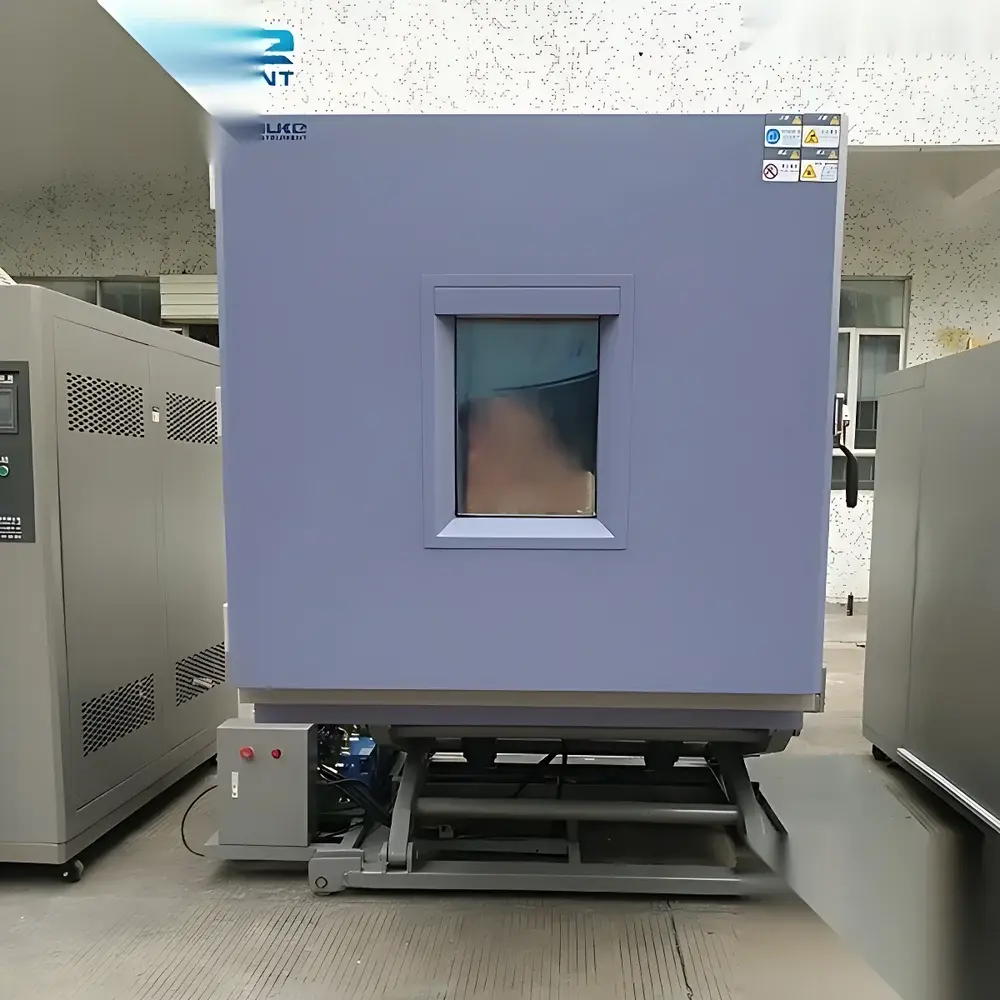
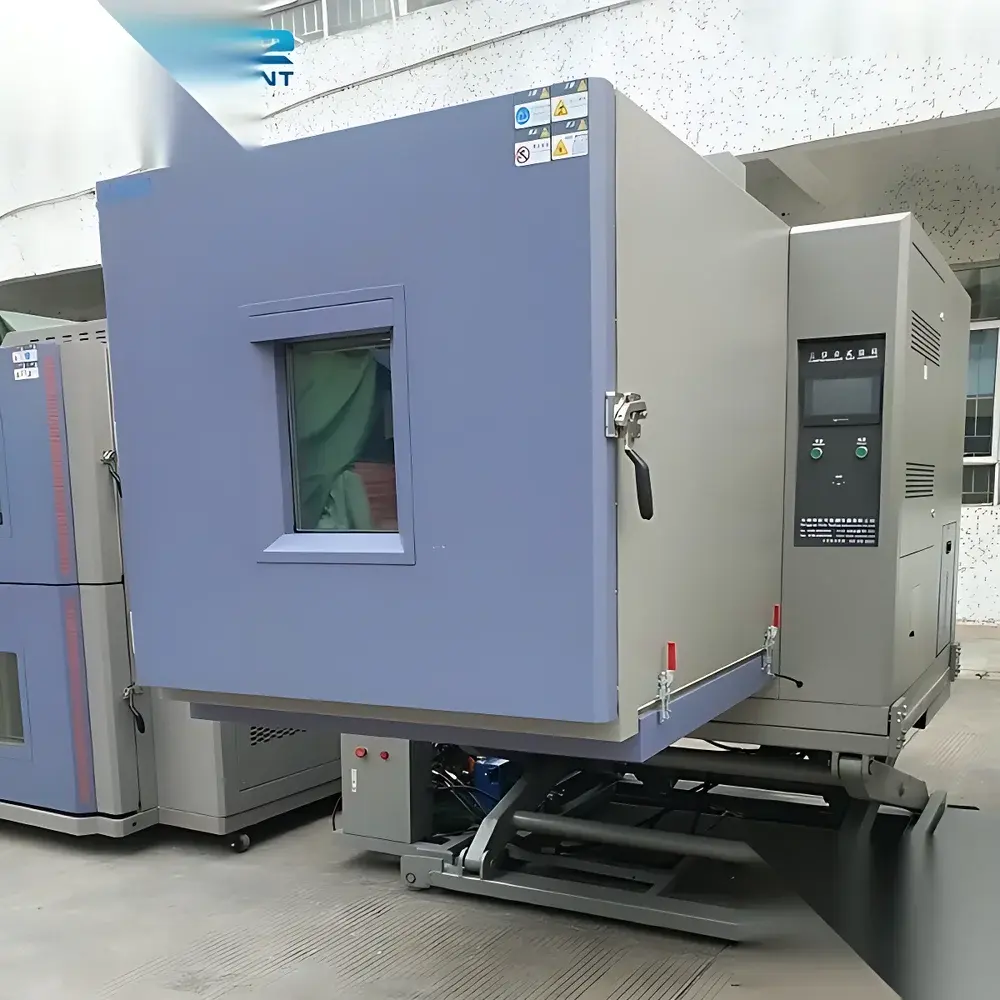
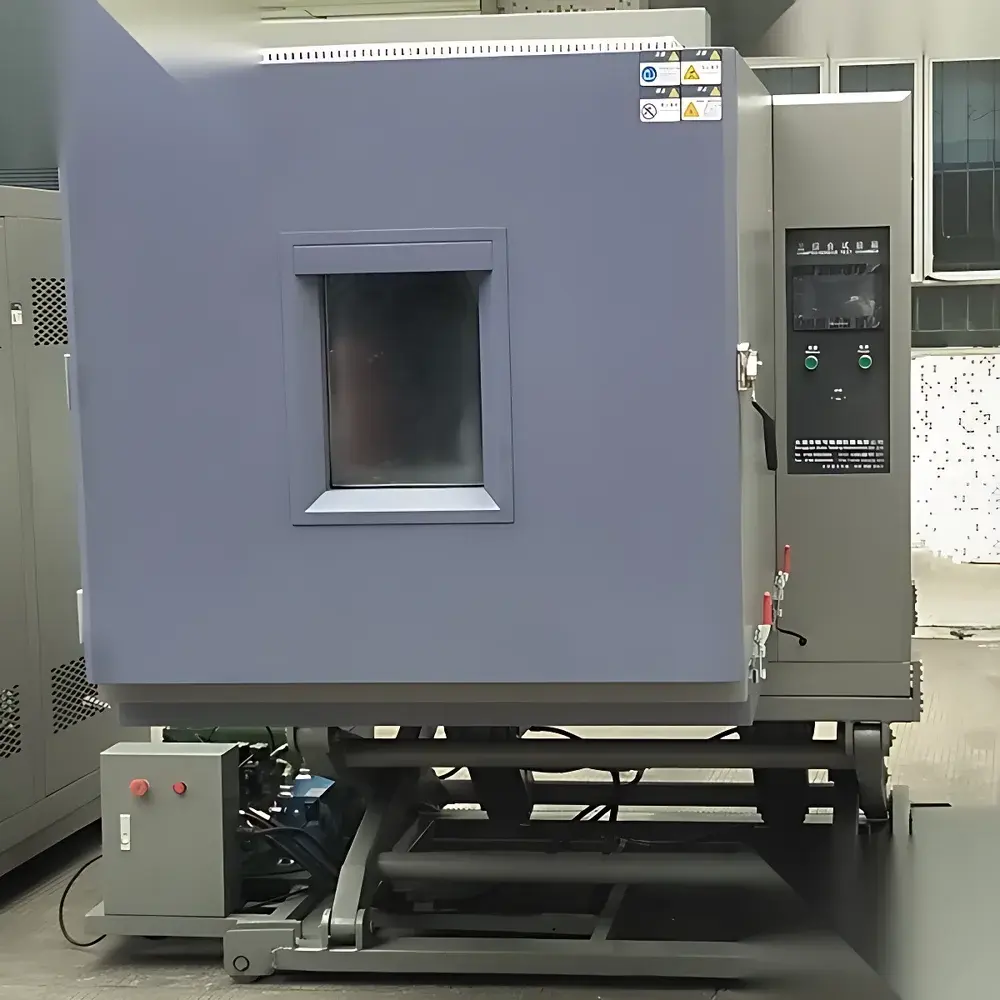
Combined Temperature-Humidity-Vibration Environmental Test Chamber
| Key Features | Platform Size: 1000 × 1000 mm |
|---|---|
| Chamber Dimensions (W×D×H) | 1100 × 1200 × 650 mm |
| Weight | ~350 kg |
| Power Supply | AC 220 V, Single-Phase, 15 A |
| Drive Mechanism | Motor-Cam Actuation |
| Max. Amplitude | 25.4 mm (1 in) |
| Rotational Speed Range | 120–300 rpm |
| Frequency Range | 2.00–5.00 Hz |
| Test Duration | Up to 80 min per cycle |
| Cycle Count | Up to 14,500 cycles per run |
| Operating Ambient | 23 °C ± 5 °C, RH < 80 % (non-condensing) |
| Sound Pressure Level | <74 dB(A) at 5 Hz |
| 台面材质 translated as Top Plate Material | 19-mm (3/4″) Structural Plywood |
| Display | Dual independent digital displays for simultaneous frequency and rpm readout |
| Control Modes | Timer-based and counter-based operation |
| Vibration Modes | Vertical-only, Horizontal-only, Dual-axis synchronous, Dual-axis alternating |
| Compliance | ISTA 3A, ISTA 3B, ASTM D999, ASTM D4169, ASTM D3580 |
Overview
The Combined Temperature-Humidity-Vibration Environmental Test Chamber is an integrated reliability assessment system engineered for simulating real-world distribution environments where temperature, humidity, and mechanical vibration co-occur. Unlike sequential or single-stress test chambers, this tri-combined platform applies thermal, hygric, and dynamic mechanical stresses simultaneously—mimicking the cumulative degradation mechanisms experienced during global logistics, warehouse storage, and last-mile delivery. Its core actuation employs a motor-driven cam mechanism, delivering controlled sinusoidal vertical and horizontal excitation within a thermally and hygrostatically regulated enclosure. This architecture enables accelerated fatigue testing of packaging systems and finished goods under ISO/IEC 17025-aligned conditions, supporting failure mode identification at structural joints, adhesive interfaces, and material grain boundaries prior to field deployment.
Key Features
- Simultaneous triple-stress application: programmable temperature (-10 °C to +85 °C), relative humidity (10–95 %RH), and broadband mechanical vibration (2.00–5.00 Hz, 25.4 mm peak-to-peak amplitude)
- Dual-channel digital display interface providing real-time, non-interleaved readouts of vibration frequency (Hz) and rotational speed (rpm), eliminating manual conversion errors
- Timer- and counter-based dual control logic: supports time-limited (up to 80 minutes) or event-driven (up to 14,500 cycles) test termination with automatic shutdown and data logging
- Structurally reinforced 19-mm plywood test platform (1000 × 1000 mm) with high-damping mounting feet to suppress floor resonance and isolate adjacent equipment from transmitted energy
- Low-noise cam-driven actuation system (<74 dB(A) at 5 Hz) compliant with industrial facility acoustic emission limits
- Intuitive operator interface with preconfigured test profiles aligned to ISTA 3-series and ASTM D999/D3580 transport simulation standards
Sample Compatibility & Compliance
This chamber accommodates packaged consumer electronics, furniture assemblies, ceramic ware, toy enclosures, and medical device shipping containers up to 50 kg on the standard platform. Its mechanical envelope and environmental range align with international transport simulation protocols—including ISTA 3A (parcel delivery), ISTA 3B (unitized pallets), and ASTM D999 (vibration testing of shipping containers). The system’s thermal-hygric control subsystem meets IEC 60068-2-30 (damp heat, cyclic) requirements, while its vibration fidelity is validated per ISO 10816-1 for machine condition monitoring reference spectra. All operational parameters are traceable to NIST-traceable calibration sources, and the chamber supports GLP-compliant audit trails when integrated with external data acquisition hardware.
Software & Data Management
The embedded controller supports five programmable motion modes: vertical-only oscillation, horizontal-only oscillation, synchronized dual-axis motion, alternating-axis sequencing, and user-defined waveform modulation. Test parameters—including dwell time per temperature/humidity setpoint, ramp rates, vibration dwell duration, and cycle repetition—are stored in non-volatile memory with timestamped version control. Raw sensor data (temperature, RH, acceleration, elapsed time) is exportable via USB 2.0 in CSV format for post-processing in MATLAB, Python (NumPy/Pandas), or JMP. Optional Ethernet connectivity enables remote monitoring and integration into enterprise LIMS or MES platforms under FDA 21 CFR Part 11-compliant electronic signature frameworks.
Applications
- Evaluation of corrugated box compression strength loss under combined thermal cycling and resonant vibration
- Accelerated fatigue analysis of solder joint integrity in PCB assemblies subjected to temperature-humidity swelling and mechanical shock
- Verification of seal integrity in sterile medical packaging exposed to condensation and low-frequency transport vibration
- Structural validation of polymer housing adhesion in outdoor-rated consumer electronics under thermal expansion mismatch and vibrational shear stress
- Pre-shipment qualification of fragile ceramic and glassware packaging systems per ASTM D4169 performance-based distribution testing protocols
FAQ
Does this chamber meet ISTA certification requirements for third-party validation?
Yes—when operated within specified parameter envelopes and calibrated per ISTA Procedure 3A Section 5.2, the system satisfies all mechanical and environmental boundary conditions required for certified lab submission.
Can the vibration profile be customized beyond the five standard modes?
The base firmware supports only the five defined motion sequences; however, optional OEM firmware upgrade enables arbitrary waveform loading via .wav or .csv input for research-grade transient shock simulation.
Is humidity control active during vibration operation?
Yes—humidity generation (via steam injection) and dehumidification (via refrigerant coil condensation) remain fully functional and dynamically compensated during all vibration modes.
What maintenance intervals are recommended for long-term repeatability?
Cam follower lubrication and bearing inspection every 500 operational hours; humidity sensor recalibration every 6 months; full thermal chamber leak check annually per ISO 10816-3 Annex C guidelines.
Is the test platform statically balanced for asymmetric loads?
The platform includes adjustable leveling feet and dynamic balancing weights; maximum permissible eccentric mass offset is 15 % of total load—verified via onboard accelerometer feedback during commissioning.



