
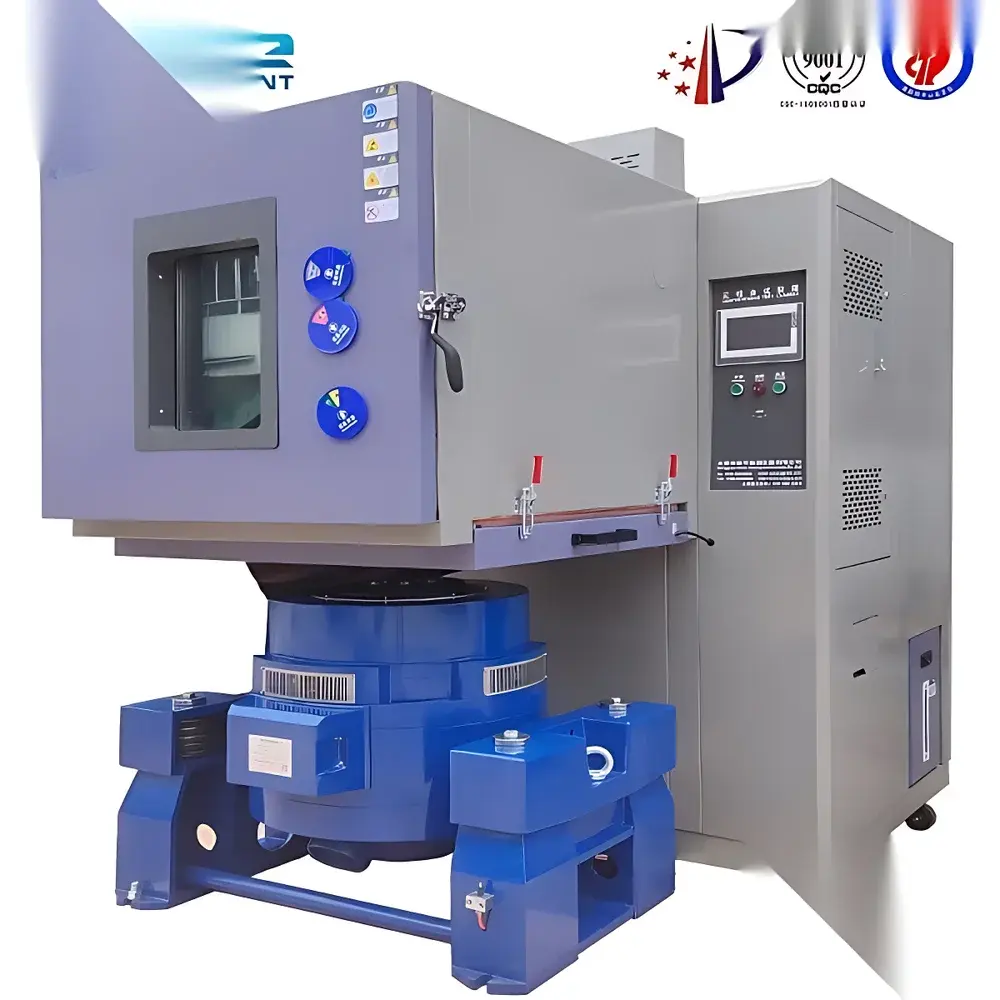
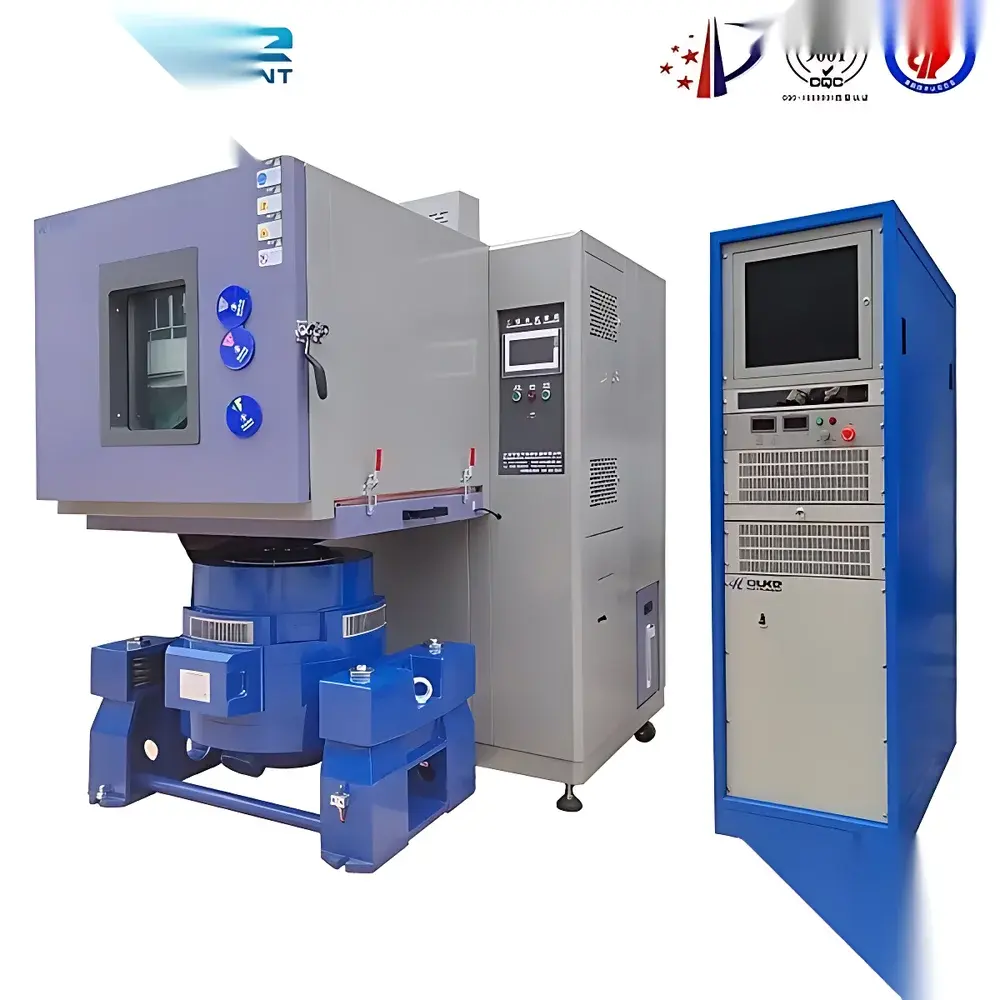
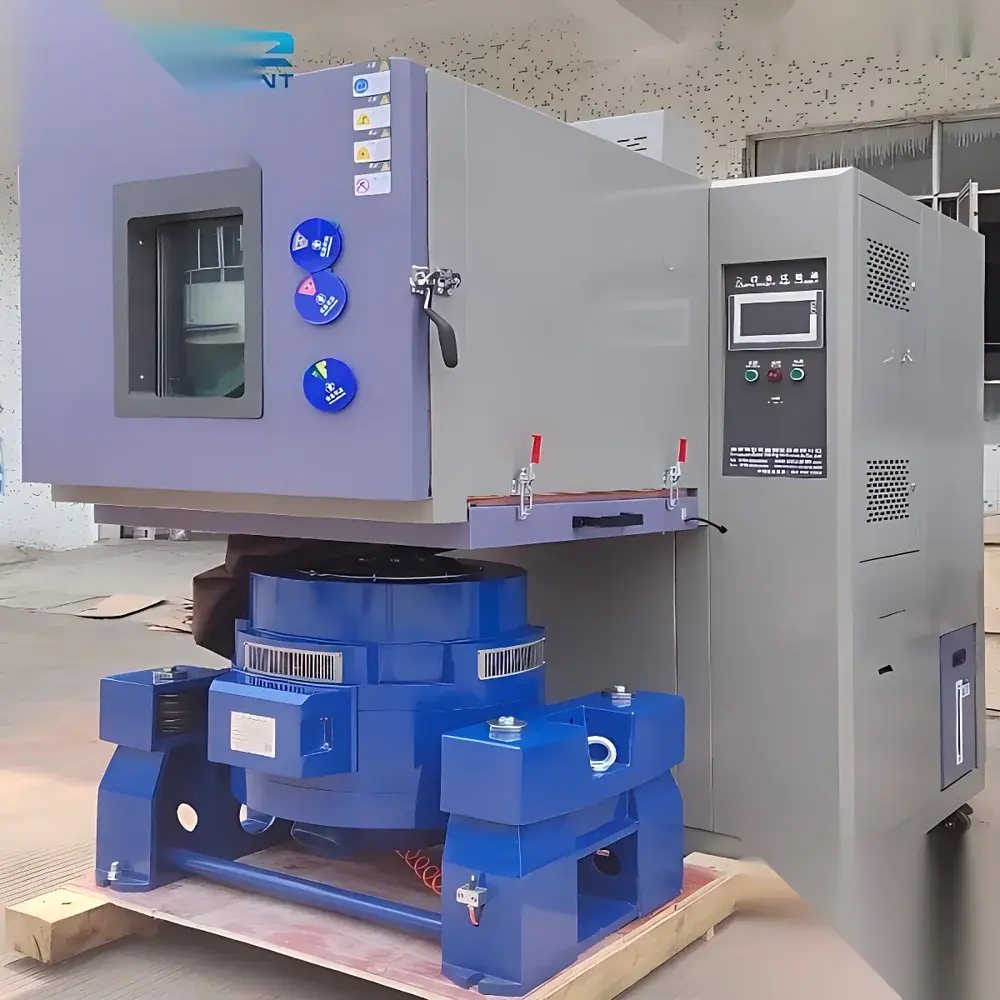
Combined Temperature-Humidity-Vibration Environmental Test Chamber
| Key Specifications | Temperature Range: -40°C to +130°C |
|---|---|
| Humidity Range | 40–98% RH |
| Temp. Uniformity | ±2°C (unloaded) |
| Temp. Stability | ±0.5°C (unloaded) |
| Humidity Stability | ±2% RH |
| Heating Rate | ≤60 min (-20°C → +120°C) |
| Cooling Rate | ≤45 min (ambient → -20°C, unloaded) |
| Vibration Force | 2.94 kN (300 kgf) |
| Frequency Range | 5–2000 Hz |
| Max. Acceleration | 980 m/s² (100 g) |
| Max. Velocity | 1.1 m/s |
| Max. Displacement | 25 mm p-p |
| Table Diameter | 150 mm |
| Vibration Axis | Vertical (Z-axis only) |
| Payload Capacity | 120 kg |
| Control Timer | 0–999 h |
| Compliance Standards | ASTM D999, ASTM D3580, ISTA 2A/3A, EN 60068-2-6 & -2-78, ANSI/UL 60950, ISO 16750-3 |
Overview
The Combined Temperature-Humidity-Vibration Environmental Test Chamber is an integrated reliability validation system engineered for concurrent or sequential exposure of test specimens to controlled thermal, hygrothermal, and mechanical vibration stressors. It operates on the principle of accelerated life testing—simulating real-world environmental and dynamic loading conditions encountered during manufacturing, logistics, and end-use deployment. Unlike standalone chambers or shakers, this triaxial-combined platform enables synchronized application of temperature cycling, humidity conditioning, and sinusoidal vibration (per ISO 10816-1 and IEC 60068-2-6), thereby revealing latent defects such as solder joint fatigue, delamination in multilayer PCBs, seal integrity failure in hermetic enclosures, or adhesive bond degradation under thermo-mechanical strain. Its architecture supports both deterministic (fixed-frequency, swept-sine) and pseudo-random vibration profiles, with closed-loop acceleration control ensuring fidelity across the full 5–2000 Hz operational bandwidth.
Key Features
- Triple-stress integration: Simultaneous or programmable sequence control of temperature, relative humidity, and vertical-axis sinusoidal vibration
- High-fidelity electrodynamic shaker system with 2.94 kN force capacity, 100 g peak acceleration, and 25 mm p-p displacement limit
- Precision climate chamber with refrigerant-based cooling, steam injection humidification, and PID-controlled air circulation for ±0.5°C temperature stability and ±2% RH repeatability
- Modular controller interface supporting multi-step test programs with independent setpoint ramping, dwell, and hold functions for each stress domain
- Robust aluminum alloy vibration table (150 mm diameter) mounted on low-resonance isolators; maximum payload 120 kg with center-of-gravity alignment verification
- Compliance-ready hardware architecture: Built-in data logging with timestamped sensor outputs, audit trail capability, and optional 21 CFR Part 11–compliant software package
Sample Compatibility & Compliance
This chamber accommodates a broad spectrum of physical samples—from miniature SMD components and automotive ECUs to medical device housings and consumer electronics assemblies—provided dimensional and mass constraints are observed. Specimens must be secured using non-resonant fixtures compatible with the 150 mm table; custom fixture design services are available upon request. The system meets mandatory requirements for environmental qualification per MIL-STD-810H Method 514.7 (vibration), Method 502.7 (temperature), and Method 507.6 (humidity), as well as commercial transport validation standards including ISTA 3A, ASTM D4169, EN 15308, and UL 62368-1 Annex G. All calibration procedures follow ISO/IEC 17025–accredited protocols, with traceable NIST-certified references for temperature, humidity, and acceleration transducers.
Software & Data Management
Control and monitoring are executed via a Windows-based embedded HMI running proprietary test sequencing software. The interface supports drag-and-drop test profile construction, real-time waveform visualization (FFT and time-domain), and automatic pass/fail evaluation against user-defined thresholds. Raw sensor data—including chamber temperature/humidity readings, accelerometer voltage output, and shaker coil current—are logged at configurable sampling intervals (10 ms to 1 s) in CSV and binary formats. Exported datasets include metadata headers compliant with ASTM E2911 for archival traceability. Optional upgrade paths include GLP/GMP audit trail modules with electronic signatures, role-based access control, and automated report generation aligned with FDA 21 CFR Part 11 Annex 11 requirements.
Applications
- Qualification testing of aerospace avionics under combined thermal shock and resonance excitation
- Accelerated aging of lithium-ion battery packs subjected to humidity cycling and road-spectrum vibration
- Validation of IP67-rated enclosures through simultaneous high-humidity soak and 10–500 Hz sine sweep
- Package integrity assessment per ISTA 3E for e-commerce fulfillment centers
- Reliability screening of MEMS sensors exposed to thermal gradients and resonant frequencies matching their operational bands
- Material compatibility studies involving polymer seals, conformal coatings, and elastomeric gaskets under thermo-mechanical stress
FAQ
Can the chamber perform random vibration while maintaining constant temperature and humidity?
Yes—the system supports concurrent operation of all three stress domains, with vibration control loop operating independently from climate regulation subsystems.
Is remote monitoring and control supported over Ethernet or industrial protocols?
Standard configuration includes TCP/IP-enabled Ethernet port with Modbus TCP and OPC UA server support for integration into factory MES or SCADA systems.
What calibration documentation is provided with shipment?
Each unit ships with a full calibration certificate covering temperature uniformity, humidity accuracy, and shaker force linearity, traceable to national metrology institutes (NMI) with uncertainty budgets per ISO/IEC 17025.
Are custom table sizes or multi-axis vibration configurations available?
Yes—custom engineering options include 250 mm and 300 mm tables, horizontal (X/Y) actuation add-ons, and 6-DOF motion platforms upon formal technical review.
Does the system meet electromagnetic compatibility (EMC) requirements for laboratory use?
The chamber complies with EN 61326-1:2013 for EMC emissions and immunity, and has been verified for safe co-location with sensitive measurement equipment within Class A laboratory environments.



