
Combined Temperature-Humidity-Vibration Environmental Test Chamber – CTVC Series
| Key | Temperature Range: -20°C to +130°C |
|---|---|
| Temperature Uniformity | ±2°C (unloaded) |
| Temperature Fluctuation | ±0.5°C (unloaded) |
| Humidity Range | 40–98% RH |
| Humidity Fluctuation | ±2% RH |
| Temperature Deviation | ≤±2°C |
| Humidity Deviation | ≤±2% RH |
| Heating Rate | -20°C to +120°C ≤ 60 min (unloaded) |
| Cooling Rate | Ambient to -20°C ≤ 45 min (unloaded) |
| Vibration Force (Sine) | 2.94 kN (300 kgf) |
| Frequency Range | 5–2000 Hz |
| Max Acceleration | 980 m/s² (100 g) |
| Max Velocity | 1.1 m/s |
| Max Displacement | 25 mm p-p |
| Moving Mass | 2.7 kg |
| Payload Capacity | 120 kg |
| Table Diameter | 150 mm |
| Vibration Axis | Vertical (Z-axis) |
| Timer Range | 0–999 h |
| Compliance | GB/T 2423.1, GB/T 2423.3, GB/T 2423.4, IEC 60068-2-1, IEC 60068-2-3, IEC 60068-2-30 |
Overview
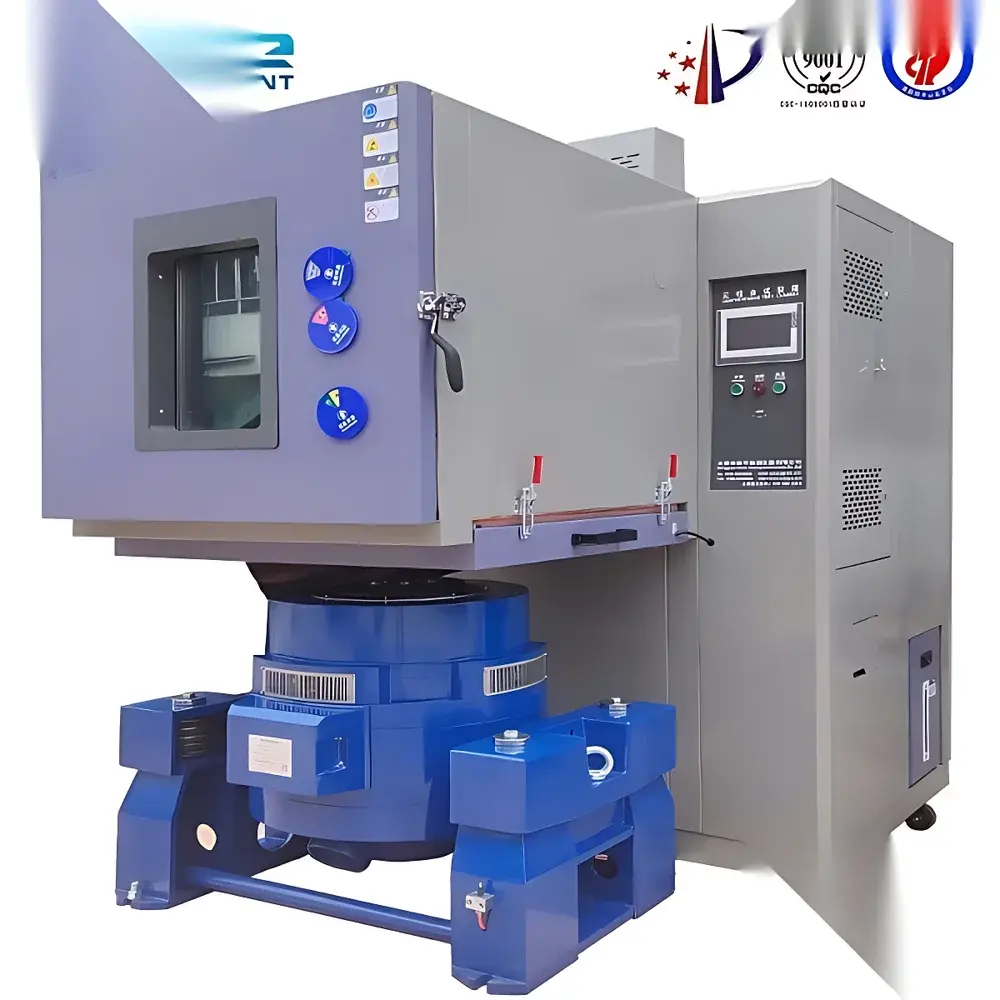
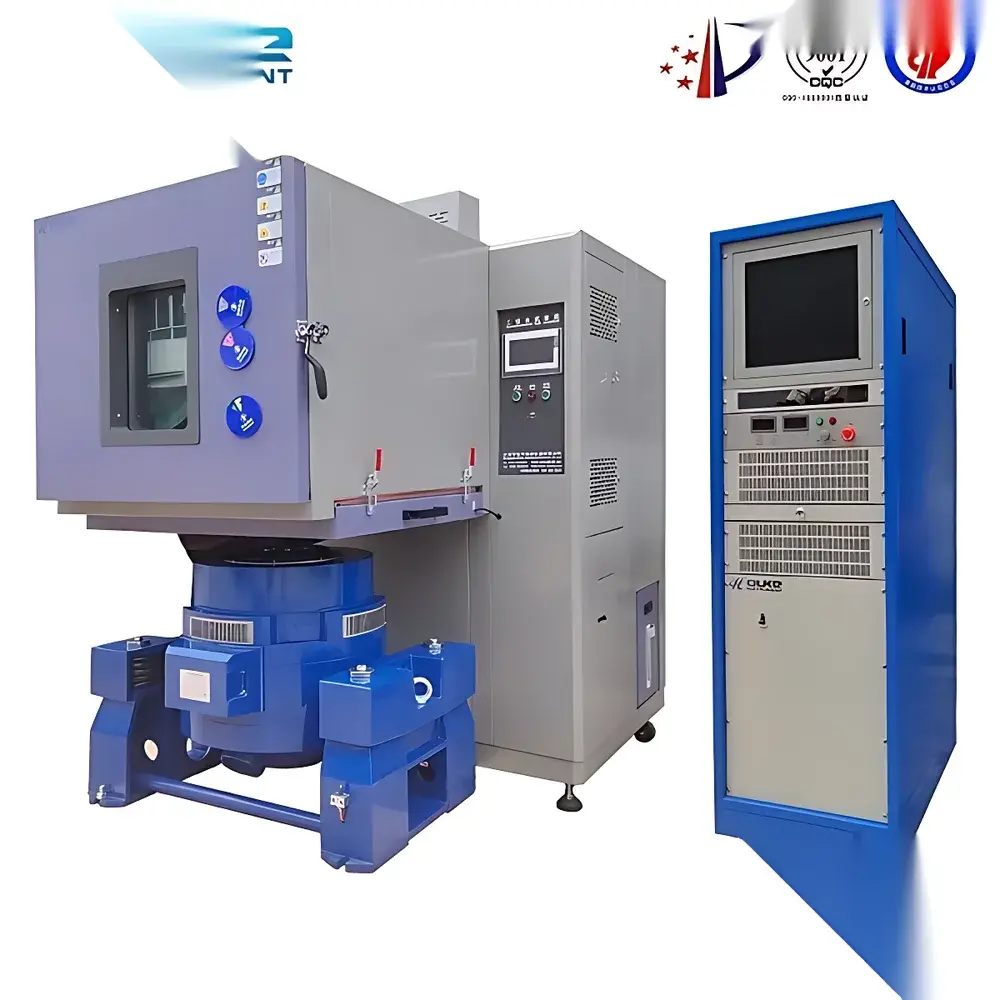
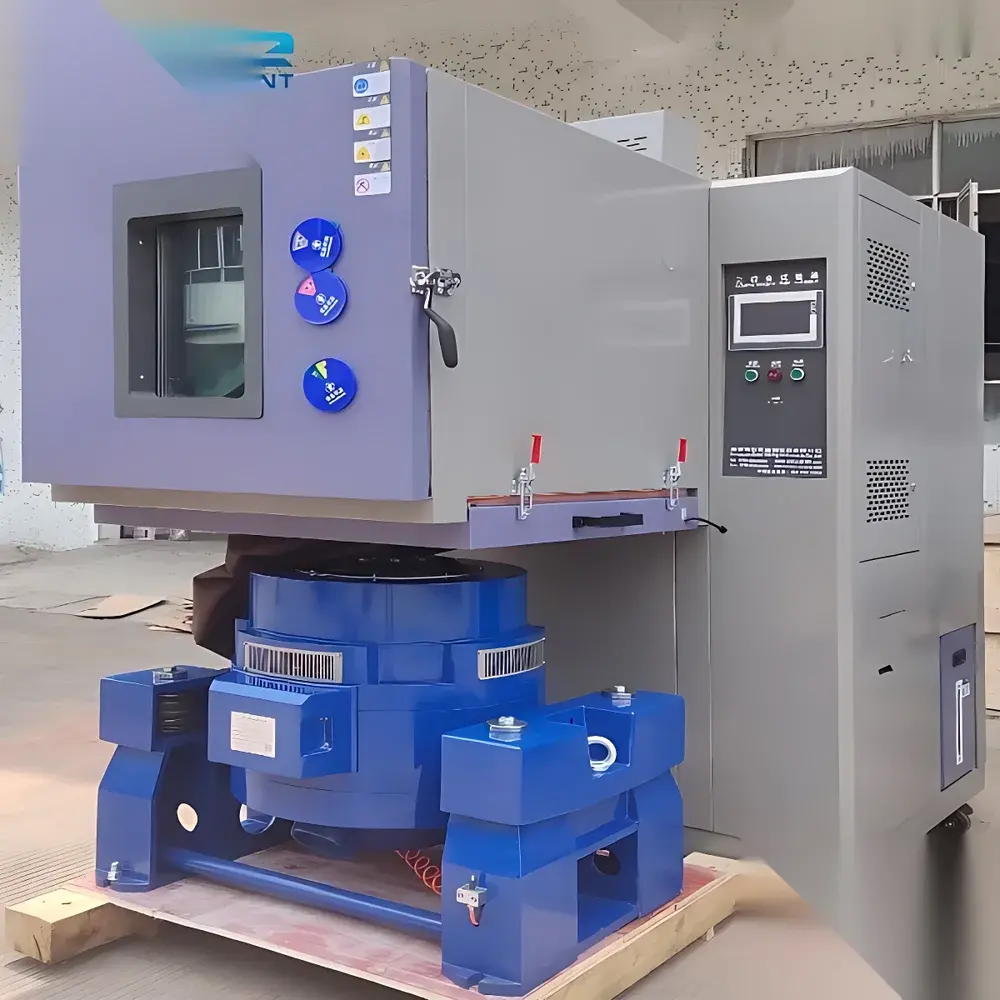
The CTVC Series Combined Temperature-Humidity-Vibration Environmental Test Chamber is an integrated reliability validation platform engineered for simultaneous application of thermal, hygroscopic, and mechanical stress stimuli. It operates on the principle of coupled environmental simulation—precisely synchronizing programmable temperature-humidity profiles with high-fidelity electrodynamic vibration excitation—to replicate real-world operational and transit conditions encountered by electronic components, automotive modules, medical devices, and aerospace subsystems. Unlike sequential or standalone test methods, this triaxial (thermal/humidity/vibration) system enables accelerated life testing under true synergistic stress states, supporting failure mode analysis, design validation, and conformance assessment per international environmental stress screening (ESS) protocols.
Key Features
- Electrodynamic shaker system with sealed, low-noise electromagnetic actuator—designed for long-term stability, minimal maintenance, and >10,000-hour operational life under rated load.
- Modular chamber architecture: SUS304 stainless steel inner chamber, cold-rolled steel outer shell with acid-phosphate pretreatment and electrostatic polyester coating; high-efficiency insulation using flame-retardant polyurethane foam + glass fiber composite.
- Dual-sealed, high-flexibility waveguide interface (circular Ø200 mm and square 1000 × 1000 mm) between chamber and shaker table—constructed from organosilicon composite elastomer capable of continuous operation from -70°C to +150°C and 10–98% RH without degradation.
- Independent control cabinet (CT-2000/PD series frequency controller) with IP54-rated sealed enclosure—ensuring EMI immunity, thermal stability, and compliance with IEC 61000-4 electromagnetic compatibility standards.
- Motorized horizontal translation and vertical lift platform (2500 mm travel / 1200 mm lift height / 2-ton lifting capacity) enabling precise, repeatable alignment with vibration tables—eliminating manual repositioning and reducing setup uncertainty.
- Three interchangeable blind plates and dedicated trolleys facilitate rapid reconfiguration for vertical vibration, horizontal vibration, or standalone temperature-humidity cycling—supporting ISO/IEC 17025 traceable method validation across test modes.
Sample Compatibility & Compliance
The CTVC chamber accommodates test specimens up to 120 kg mass and 150 mm mounting diameter, with internal volume configurable via modular panel assembly. Its design conforms to multiple national and international standards including GB/T 2423.1 (cold), GB/T 2423.3 (damp heat, cyclic), GB/T 2423.4 (damp heat, steady-state), IEC 60068-2-1 (Test A), IEC 60068-2-3 (Test Ca), and IEC 60068-2-30 (Test Db). All thermal and humidity control subsystems are calibrated per ISO/IEC 17025 requirements, with optional NIST-traceable certification available. The system supports GLP-compliant audit trails when integrated with validated data acquisition software meeting FDA 21 CFR Part 11 criteria.
Software & Data Management
Control is executed via a touchscreen HMI running embedded real-time OS, supporting both manual parameter entry and script-based test sequencing. The system includes built-in frequency sweep logic (logarithmic/linear), resonance search algorithms for sine dwell testing, and programmable dwell-hold-ramp cycles. All sensor data—including chamber temperature, relative humidity, shaker acceleration, velocity, displacement, and drive current—are sampled at ≥1 kHz and logged with UTC timestamps. Export formats include CSV, XML, and PDF reports compliant with ISO/IEC 17025 documentation requirements. Optional Ethernet/IP or Modbus TCP interfaces enable integration into centralized MES or LIMS platforms.
Applications
This chamber is routinely deployed in R&D labs and production QA environments for: qualification of PCB assemblies against solder joint fatigue under thermal-vibration coupling; validation of MEMS sensor housing integrity during shipping simulation; evaluation of battery pack thermal runaway propagation under vibrational excitation; verification of display module adhesion strength during combined humidity-cycling and resonant vibration; and accelerated aging of polymer-based medical device housings exposed to sterilization-grade humidity and transport-level shock spectra. Its ability to sustain controlled humidity while applying broadband vibration makes it uniquely suited for assessing moisture-induced delamination in multilayer ceramic capacitors (MLCCs) and conformal-coated circuit boards.
FAQ
What standards does the CTVC chamber meet for vibration testing?
It complies with IEC 60068-2-6 (vibration), IEC 60068-2-64 (broadband random vibration), and GB/T 2423.10 for sinusoidal vibration—when paired with a certified shaker controller.
Can the chamber operate at full humidity range while vibrating at 2000 Hz?
Yes—the waveguide interface and chamber sealing system maintain integrity across the full specified humidity (40–98% RH) and frequency (5–2000 Hz) envelope without leakage or condensation ingress.
Is remote monitoring and alarm notification supported?
Standard Ethernet connectivity enables SNMP-based network monitoring; optional SMS/email alert modules provide real-time fault notifications for over-temperature, over-humidity, or shaker over-current events.
How is calibration traceability maintained?
Temperature and humidity sensors are factory-calibrated against NIST-traceable references; annual recalibration services include full uncertainty budget reporting per ISO/IEC 17025 Annex A.
What safety interlocks are implemented?
Hardware-enforced dual-channel door lock, shaker emergency stop linkage, refrigerant pressure cut-off, and independent thermal fuse protection on all heater circuits—meeting CE machinery directive EN ISO 13857 requirements.



