
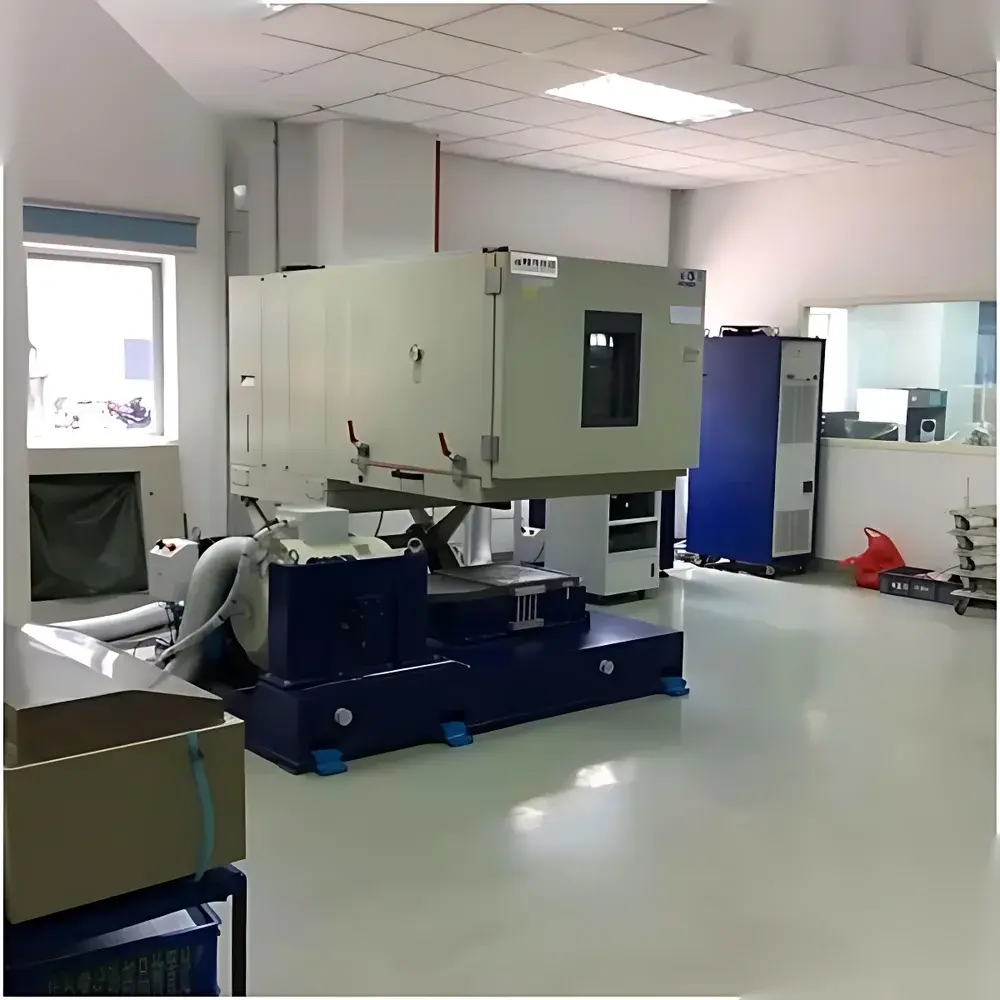
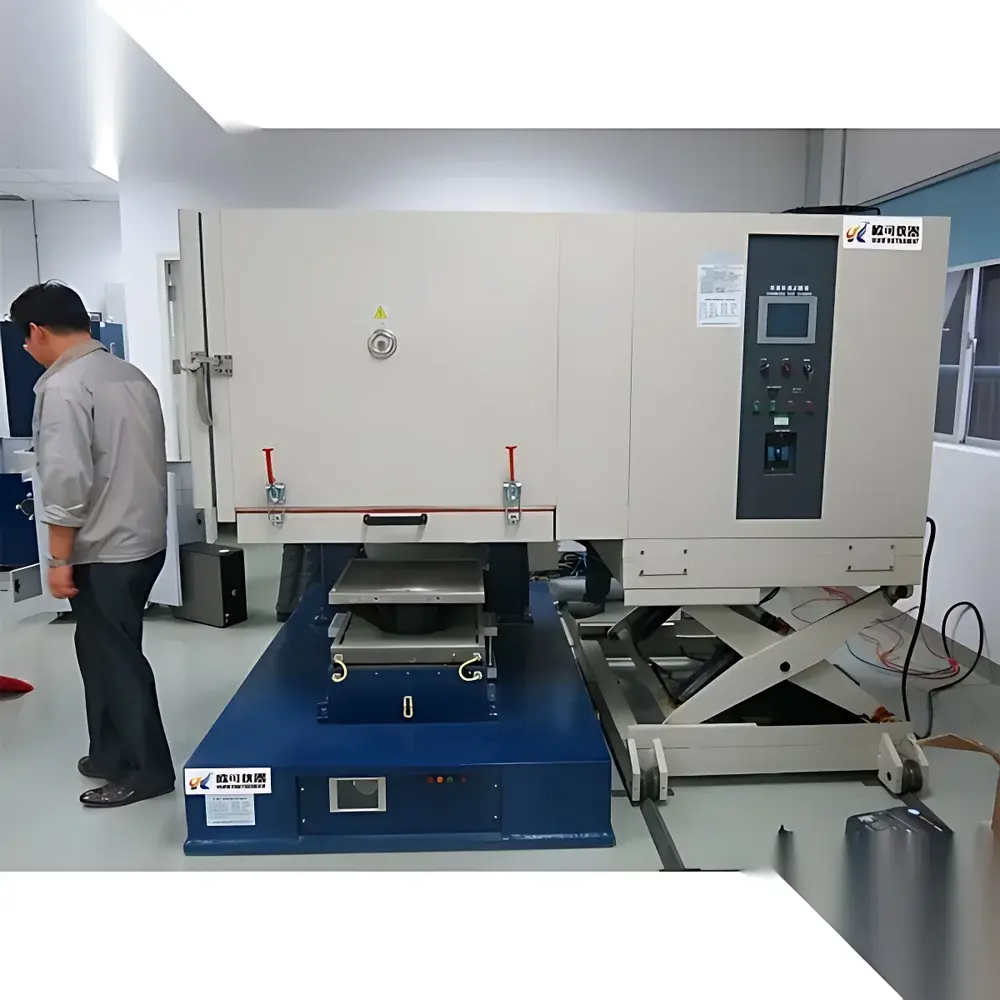
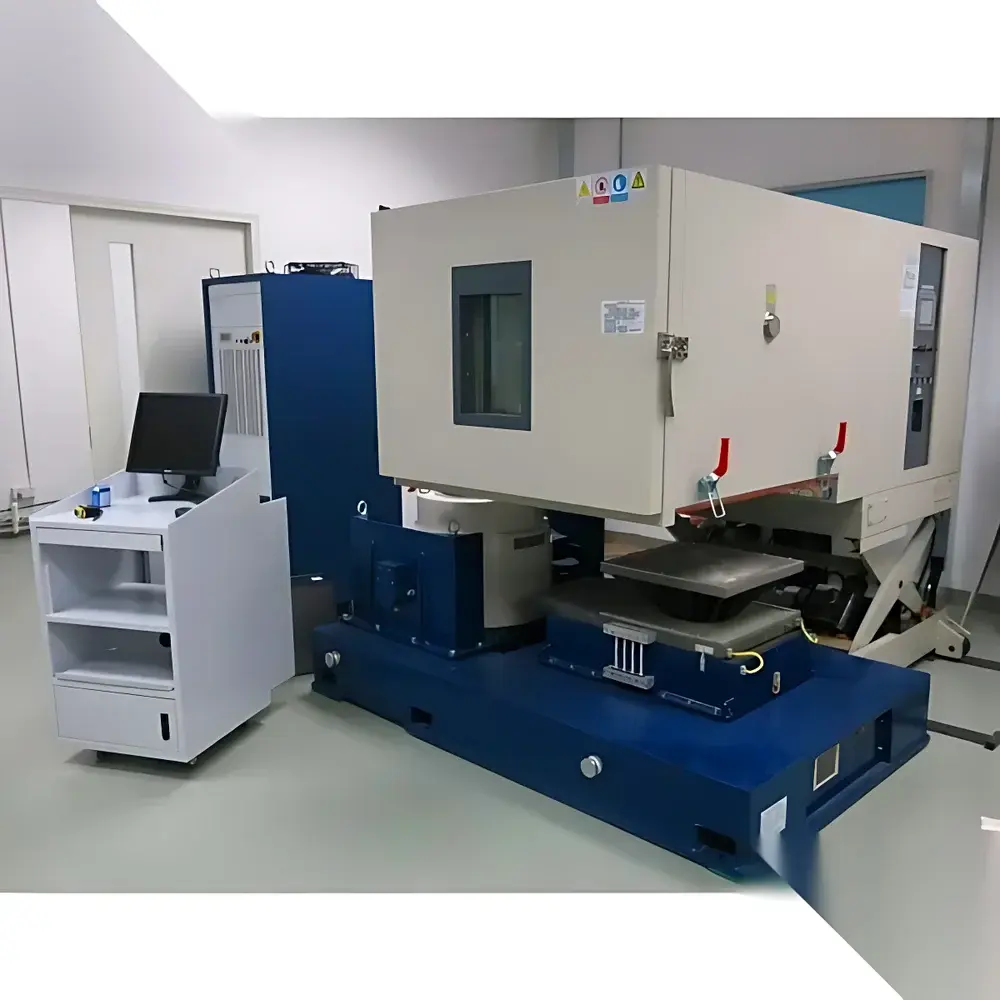
Combined Temperature-Humidity-Vibration Environmental Test Chamber – Custom-Engineered for Aerospace & Electronics Reliability Testing
| Key | Vibration Table Dimensions (L×W): 30×30 / 50×50 / 75×75 / 100×100 cm |
|---|---|
| Cabinet Dimensions (L×H×W) | Vertical Mode: 30×15×30 to 100×20×100 cm |
| Horizontal Mode | 30×25×30 to 100×25×100 cm |
| Temperature Range | −100 °C to +180 °C |
| Temperature Uniformity | ≤ ±2 °C |
| Temperature Stability | ≤ ±0.5 °C |
| Control Accuracy | ±1.0 °C |
| Ramp Rate | ≥60 °C/min |
| Vibration Axes | Triaxial, 6-DOF |
| Frequency Range | 10–5,000 Hz (pseudo-random acceleration profile) |
| Acceleration Range | 1–50 g |
| Max Vibration Table Surface | 1220 mm × 1220 mm |
| LN₂ Consumption | 50 L/min |
| Operating Ambient | +5 °C to +35 °C |
Overview
The Combined Temperature-Humidity-Vibration Environmental Test Chamber is an integrated reliability validation platform engineered for simultaneous application of thermal, hygric, and mechanical stress stimuli. It operates on a coupled-system architecture: a high-performance climatic chamber (with cryogenic liquid nitrogen injection and steam-based humidification) is mechanically interfaced with a triaxial electrodynamic shaker system capable of six-degree-of-freedom (6DOF) motion synthesis. This configuration enables true concurrent exposure—unlike sequential or loosely synchronized alternatives—ensuring that thermal transients, humidity cycling, and broadband vibratory loading occur within the same physical volume and time domain. The system is purpose-built for accelerated life testing, HALT/HASS protocols, and qualification per MIL-STD-810, RTCA DO-160, and IEC 60068-2 series standards. Its design prioritizes thermal inertia minimization, vibration isolation integrity, and signal coherence across all three stress domains—critical for evaluating solder joint fatigue, connector micro-motion, polymer creep under cyclic strain, and condensation-induced corrosion in mission-critical electronics.
Key Features
- Triple-stress synchronization engine ensuring phase-aligned temperature ramping, RH modulation, and real-time vibration profile execution without temporal decoupling
- Cryogenic cooling via regulated liquid nitrogen injection (50 L/min max flow), enabling rapid cooldown to −100 °C with <60 °C/min ramp rate across full load mass
- Electrodynamic shaker with 6DOF motion synthesis—capable of generating pseudo-random acceleration spectra from 10 Hz to 5 kHz at peak accelerations up to 50 g RMS
- Modular table interface accommodating standard mounting configurations (e.g., ISO 10816-3 compliant flanges) and custom fixture integration up to 1220 mm × 1220 mm surface area
- Dual-mode vibration orientation: vertical (Z-axis dominant) and horizontal (X/Y-axis selectable), with independent force feedback control per axis
- Humidity control range: 10–98% RH at +20 °C to +85 °C; dew point tracking with NIST-traceable capacitive hygrometers
- Thermal uniformity maintained at ≤±2 °C across test volume per IEC 60068-3-5, verified via 9-point thermocouple mapping during qualification
Sample Compatibility & Compliance
The chamber accommodates unit-under-test (UUT) configurations ranging from PCB assemblies and avionics modules to full subsystem enclosures (e.g., radar transceivers, flight control computers). Internal dimensions support standardized test fixtures per MIL-STD-1540D and NASA-HDBK-7005. All operational modes comply with electromagnetic compatibility (EMC) Class B limits (CISPR 32) and meet grounding requirements for safety-critical instrumentation per IEC 61000-6-2/6-4. Data acquisition channels are calibrated to ISO/IEC 17025-accredited traceability. The system supports audit-ready operation under GLP and GMP frameworks, including electronic signature enforcement, change control logs, and 21 CFR Part 11-compliant data archiving when paired with optional validation software packages.
Software & Data Management
Control and analysis are executed via a deterministic real-time OS (VxWorks-based) with dual-redundant Ethernet interfaces. The embedded test sequencer supports hierarchical script definition (XML-based syntax) for multi-stage profiles—including dwell, ramp, step, and conditional branching based on sensor thresholds. Vibration spectra are generated using power spectral density (PSD) definitions compliant with ASTM D4728 and ISO 10816-2. All environmental and dynamic parameters are timestamped with microsecond resolution and logged to encrypted SQLite databases. Export formats include CSV, HDF5, and ASAM MDF 4.2 for interoperability with MATLAB, NI DIAdem, and Siemens Testlab. Optional FDA 21 CFR Part 11 add-on provides role-based access control, electronic audit trails, and digital certificate authentication for regulatory submissions.
Applications
- Aerospace: Structural integrity verification of satellite payloads under launch vibration + thermal vacuum transition stress
- Automotive: Validation of ADAS ECUs against combined thermal shock and road-spectrum vibration per ISO 16750-4
- Medical Devices: Biocompatibility and functional stability assessment of implantable electronics under sterilization-cycle humidity and handling vibration
- 5G Infrastructure: Thermal-mechanical endurance testing of mmWave antenna arrays subjected to wind-induced oscillation and ambient humidity cycling
- Energy Sector: Reliability screening of offshore wind turbine converters exposed to salt fog, wide thermal swings, and resonant tower vibrations
FAQ
What standards does this chamber support for qualification testing?
It is configured to execute test plans aligned with MIL-STD-810H Method 514.7 (vibration), Method 502.7 (temperature), Method 507.6 (humidity), as well as IEC 60068-2-64 (broadband random vibration) and RTCA DO-160G Section 16/20/21.
Can the system perform HALT with controlled humidity?
Yes—its integrated humidity control allows stepped or gradient humidity excursions during thermal-vibration stress profiling, enabling failure mode identification in moisture-sensitive components such as MEMS sensors and conformally coated assemblies.
Is the vibration table compatible with external data acquisition systems?
All analog I/O channels (accelerometer, thermocouple, RH) provide isolated 0–10 V outputs with 16-bit resolution and IEEE 1588 precision time stamping, supporting direct integration with third-party DAQ hardware including National Instruments PXIe and Dewesoft X.
How is calibration maintained across combined stress conditions?
The system undergoes quarterly interlocked calibration: thermal sensors per ISO/IEC 17025, shaker force transducers per ISO 16063-21, and humidity sensors per ISO 18434-1—all documented in a centralized calibration management module with auto-expiry alerts.
Does the chamber support automated fault injection during vibration?
When integrated with optional programmable power supplies and signal injectors, the control software can trigger voltage sags, clock glitches, or communication faults synchronized to specific vibration phase angles—enabling root-cause analysis of timing-related failures.



