
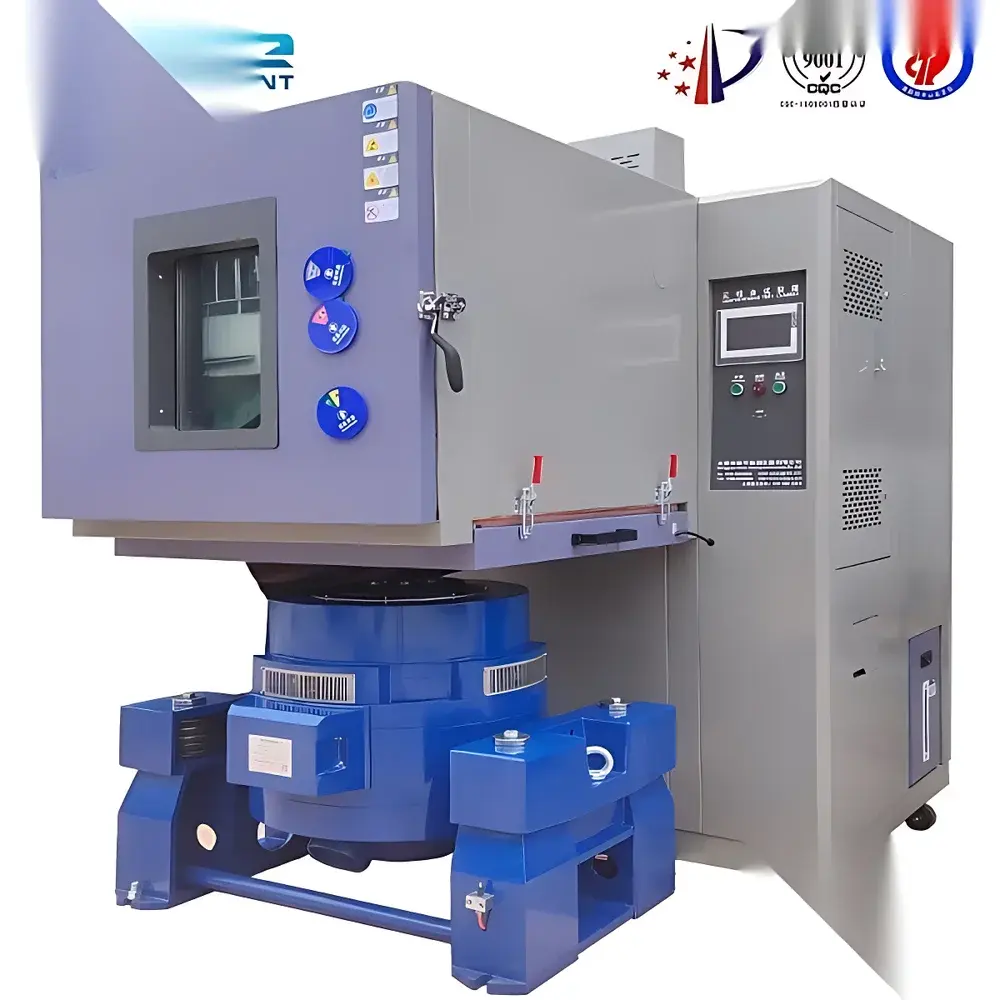
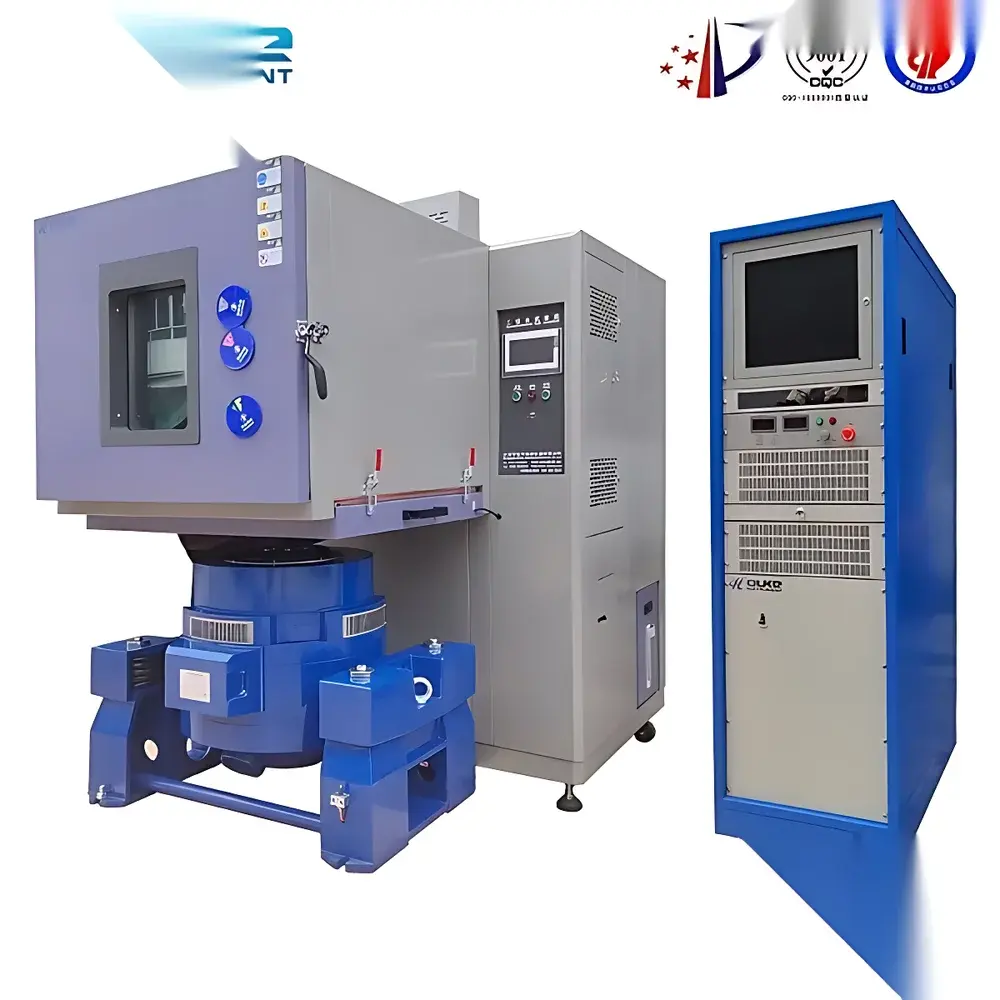
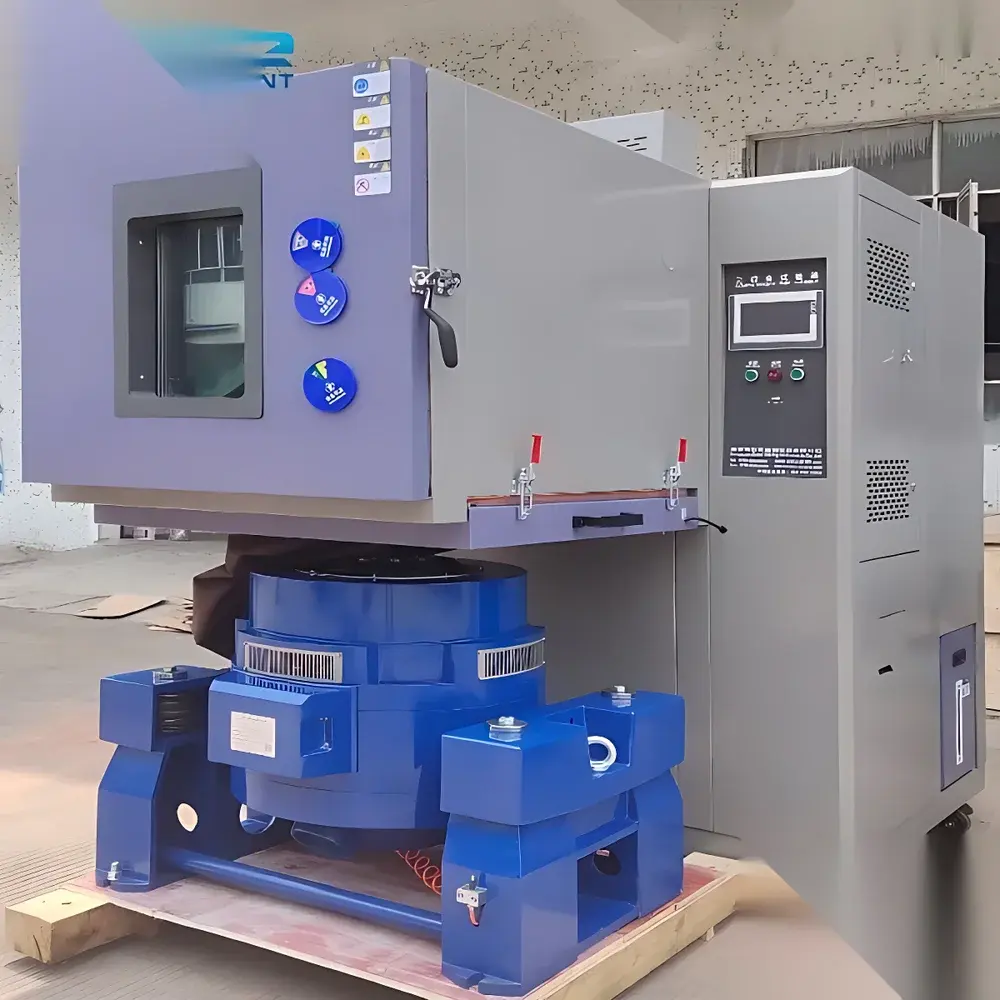
Combined Temperature-Humidity-Vibration Environmental Test Chamber – Large-Volume Industrial Grade
| Brand | OEM / Custom-Built |
|---|---|
| Origin | Imported |
| Manufacturer Type | Authorized Distributor |
| Price | USD 21,500 (FOB) |
| Internal Volume | 120 L / 250 L / 500 L |
| Internal Dimensions (W×D×H, mm) | 400×550×700 |
| Temperature Range | −40 °C to +150 °C or −60 °C to +150 °C |
| Temp. Uniformity | ≤ ±2.0 °C |
| Temp. Stability | ±0.5 °C |
| Humidity Range | 30–98% RH |
| Humidity Tolerance | ±5% RH (<75% RH) |
| Vibration Interface | Isolated stainless-steel mounting platform with elastomeric sealing gasket |
| Compliance | GB/T 2423.1–2008, GB/T 2423.2–2008, GB/T 2423.3–2006, GB/T 2423.10–1999, JJG 190–1997 |
Overview
The Combined Temperature-Humidity-Vibration Environmental Test Chamber is an integrated reliability validation platform engineered for simultaneous exposure of electronic assemblies, automotive components, aerospace subsystems, and industrial packaging to controlled thermal, hygrothermal, and mechanical stress profiles. It operates on the principle of accelerated environmental stress screening (ESS), enabling replication of real-world service conditions—including thermal cycling, condensation-induced corrosion, and resonant vibration fatigue—in a single, synchronized test sequence. Unlike sequential chamber testing, this tri-axial combined system eliminates inter-test handling delays and measurement uncertainty introduced by specimen repositioning or ambient recovery. Its structural architecture supports full compliance with MIL-STD-810H Method 514.7 (vibration), Method 502.7 (temperature), and Method 507.6 (humidity), while its control fidelity meets the repeatability requirements of IEC 60068-2 series standards for environmental testing of electrotechnical products.
Key Features
- Robust dual-wall construction: Outer shell fabricated from A3 carbon steel with electrostatic powder coating; inner chamber lined with mirror-finish SUS 304 stainless steel; insulation comprised of high-density ultra-fine glass wool (thermal conductivity ≤ 0.036 W/m·K at 25 °C)
- Independent dual-loop climate control: Separate PID-regulated heating (far-infrared Ni-Cr alloy heating elements with aluminum finned heat exchangers) and refrigeration (hermetic French Tecumseh compressors, binary cascade low-temperature circuitry) systems ensure zero cross-interference during dynamic profile execution
- High-fidelity humidity generation: Steam-type humidifier with stainless-steel water reservoir and auto-drain function; desiccant-assisted dehumidification integrated into the refrigeration cycle
- Vibration coupling interface: Precision-machined stainless-steel shaker table mounted on linear guide rails with removable rail assembly—enabling physical isolation of the vibration actuator during non-vibration thermal/humidity tests
- Sealing integrity: Dual-layer high-tensile silicone gasket at door interface; multi-layer laminated observation window with embedded ITO conductive film for anti-fog clarity and EMI shielding
- Intelligent control core: Dual-channel microprocessor-based PID controller with SSR solid-state relays, built-in power failure memory (retains settings for ≥5 years), and real-time error logging with audible/visual alarm output
Sample Compatibility & Compliance
The chamber accommodates specimens up to 500 L internal volume (max. payload: 150 kg on vibration table), supporting standard test fixtures per ISO 16750-4 (road vehicles), IPC-9701A (printed board reliability), and JEDEC JESD22-A108F (accelerated moisture resistance). All thermal and humidity performance metrics are verified per ASTM E744–20 (Standard Practice for Calibrating Environmental Chambers) using NIST-traceable PT100 sensors and capacitive RH probes. Vibration performance adheres to ISO 5344:2004 (shaker calibration) and IEEE 1159.2 (signal integrity verification). The system’s data acquisition and control firmware support audit-ready operation under GLP and GMP frameworks, including configurable user access levels, electronic signature capability, and 21 CFR Part 11-compliant audit trail generation when paired with optional validation software packages.
Software & Data Management
Control and monitoring are executed via a dedicated industrial PC running proprietary real-time OS (Windows Embedded Standard 7), equipped with dual-channel charge amplifiers, 16-bit ADC resolution, and 10 kHz sampling rate. Pre-installed vibration control software includes modules for sine sweep, random vibration (PSD synthesis), classical shock (half-sine, trapezoidal), and mixed-mode profiles—all compliant with ISO 10816-1 and SAE J2305. Climate control software provides programmable ramp-soak cycles with conditional branching (e.g., “hold humidity at 85% RH until temperature reaches −20 °C”). Raw data is exported in CSV and universal HDF5 formats; trend charts and statistical summaries (min/max/mean/stdev) are auto-generated. Optional cloud synchronization enables remote supervision via secure TLS 1.3–encrypted API endpoints.
Applications
This chamber serves as a primary qualification tool in R&D labs and production QA departments for validating product robustness across multiple domains: thermal expansion mismatch analysis in multilayer PCBAs; condensation-induced leakage current evaluation in high-voltage battery enclosures; solder joint fatigue life prediction under thermo-mechanical cycling; moisture ingress resistance testing of MEMS sensors and optical housings; and HALT/HASS protocol execution for avionics subassemblies. Its large-volume variants are routinely deployed in Tier-1 automotive suppliers for ISO/TS 16949-compliant PPAP submissions and in defense contractors for MIL-PRF-38534 Class K device screening.
FAQ
Does the chamber support automated test sequencing across temperature, humidity, and vibration domains?
Yes—via the integrated profile editor, users can define multi-step sequences with time-synchronized transitions between climate-only, vibration-only, and fully combined modes.
What is the maximum allowable specimen weight for vibration testing at 500 L capacity?
The vibration table is rated for static loads up to 150 kg and dynamic payloads up to 75 kg at peak acceleration of 60 g (non-resonant frequency range 5–2000 Hz).
Is third-party IQ/OQ/PQ documentation available?
Yes—factory-certified validation kits (including traceable sensor calibration certificates, installation checklists, operational protocols, and performance verification reports) are supplied as optional add-ons.
Can the system be integrated into an existing MES or LIMS infrastructure?
Standard Modbus TCP and OPC UA interfaces are provided; custom RESTful API integration is supported under NDA.
What maintenance intervals are recommended for the refrigeration and vibration subsystems?
Compressor oil and refrigerant filter replacement every 24 months; shaker armature alignment and coil impedance verification annually; full calibration of all environmental sensors every 12 months per ISO/IEC 17025 guidelines.



