
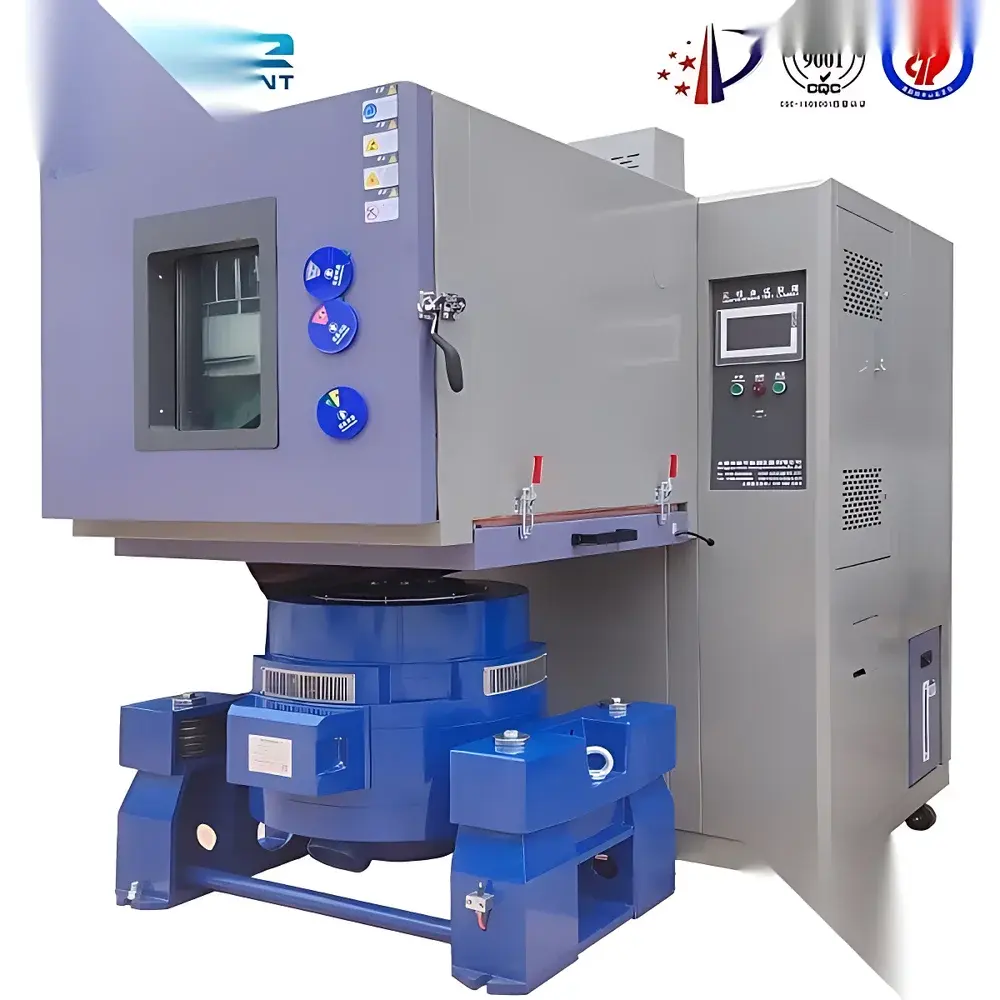
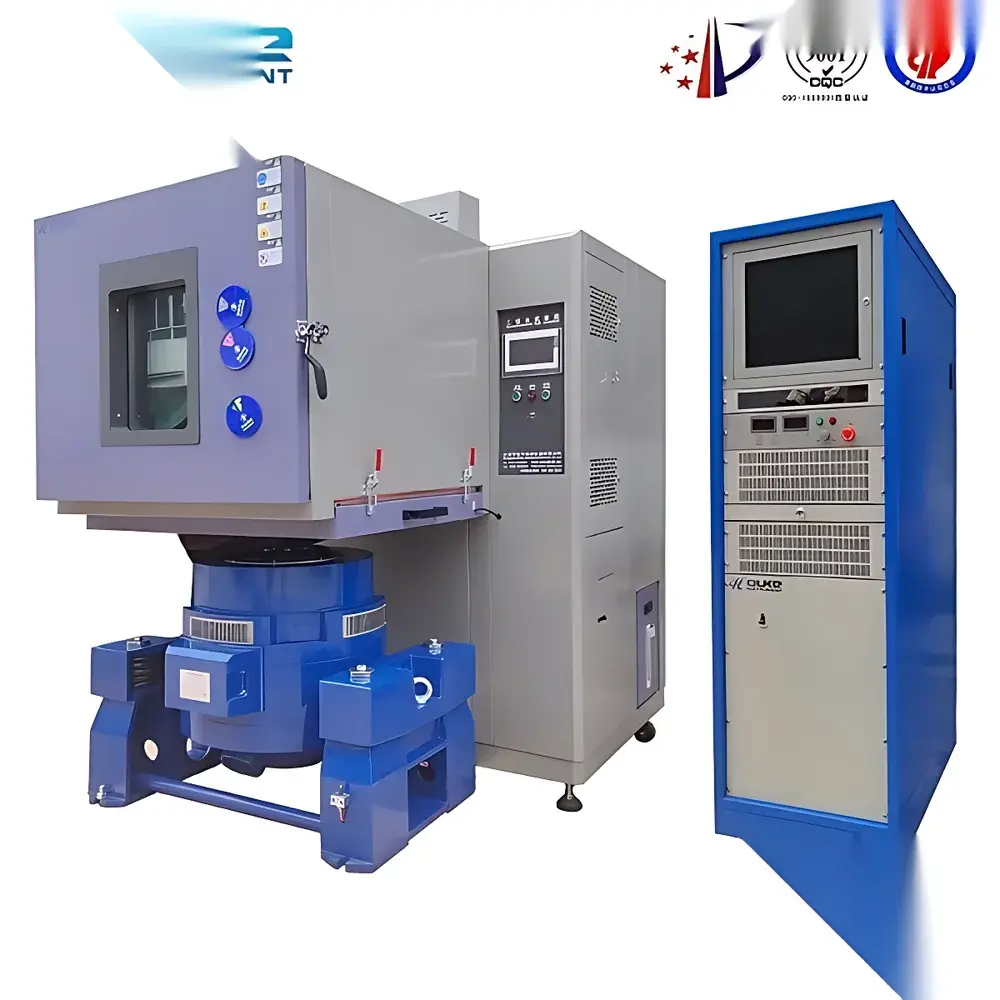
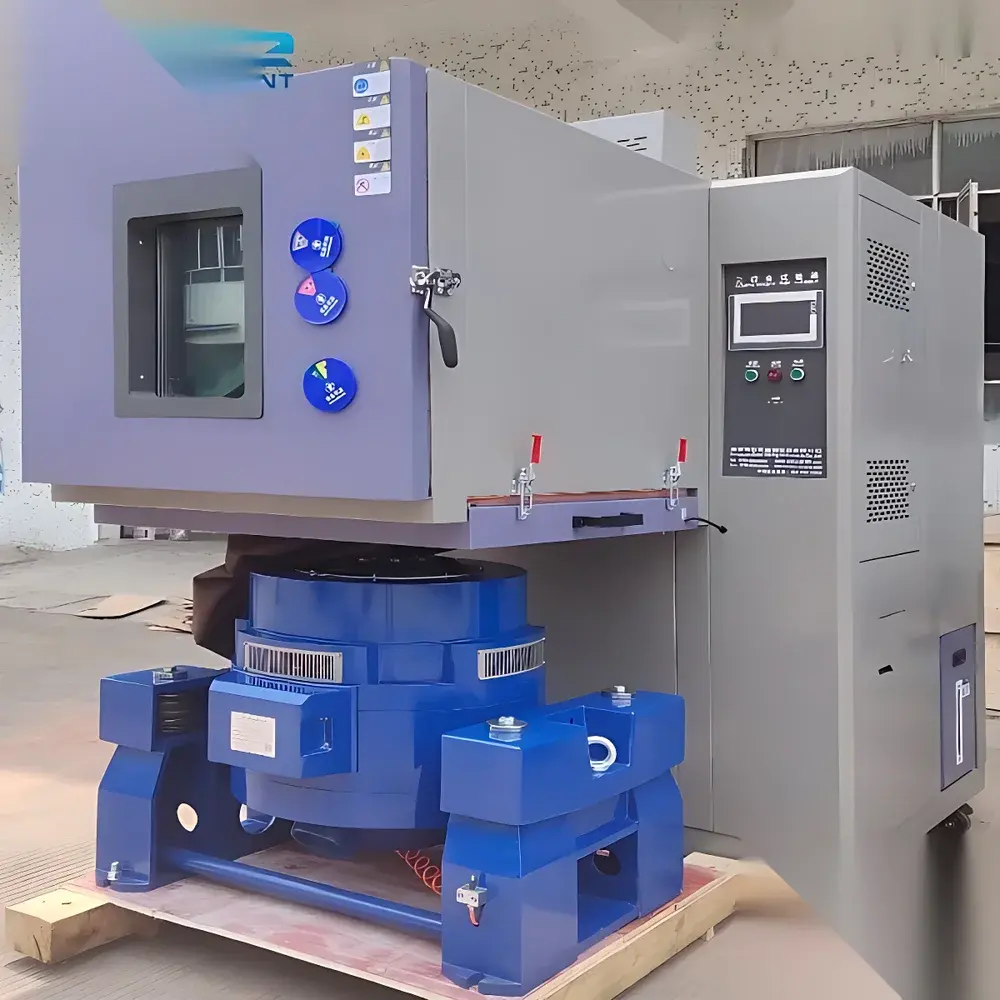
Combined Temperature-Humidity-Vibration Environmental Test Chamber – Multi-Function Climatic & Mechanical Stress Testing System
| Key | Temperature Range: -60°C to +150°C |
|---|---|
| Temperature Uniformity | ≤ ±2°C |
| Temperature Stability | ±0.5°C |
| Temp. Deviation | ≤ ±2°C |
| Ramp Rate | 0.7–1.0°C/min |
| Time Setting Range | 0–9999 h |
| Vibration Force (Sine) | 2.94 kN (300 kgf) |
| Frequency Range | 5–500 Hz |
| Max Acceleration | 980 m/s² (100 g) |
| Max Velocity | 1.1 m/s |
| Max Displacement | 25 mm p-p |
| Moving Mass | 2.7 kg |
| Payload Capacity | 120 kg |
| Table Surface | 150 mm × 150 mm |
| Vibration Axis | Vertical (Z-axis only) |
| Power Supply | AC 380 V ±10%, 50 Hz, 3-phase 5-wire |
| Refrigeration | Twin-stage mechanical cascade system with R404A/R23 refrigerants |
| Compressor | Semi-hermetic Copeland (Germany) |
| Cooling Method | Water-cooled |
| Humidity Control | Built-in stainless steel water tank with booster pump |
| Air Circulation | Wide-band forced convection via extended-shaft centrifugal blower, bottom-in/top-out airflow |
| Control System | PLC-based programmable controller with bilingual (EN/CN) color touchscreen (OYO or TIME) |
| Compliance | GB/T 5170.2, GB/T 2423.1–3, GJB 150.3–4 |
Overview
The Combined Temperature-Humidity-Vibration Environmental Test Chamber is an integrated reliability validation platform engineered for simultaneous application of thermal, hygrothermal, and dynamic mechanical stress on electronic components, aerospace subsystems, automotive modules, and military-grade enclosures. Unlike sequential single-stress testing, this tri-combined chamber enables true synergistic stress exposure—mimicking real-world operational environments where temperature cycling, humidity ingress, and mechanical vibration co-occur. Its core architecture employs a dual-stage cascade refrigeration system using environmentally compliant HFC refrigerants (R404A/R23), enabling stable operation across an extended thermal range from −60°C to +150°C. The vibration subsystem operates on electrodynamic or servo-hydraulic principles (configurable per user specification), delivering controlled sinusoidal excitation up to 100 g acceleration within 5–500 Hz bandwidth. Precision is maintained through ISO/IEC 17025-aligned thermal uniformity (≤±2°C) and stability (±0.5°C), verified per GB/T 5170.2 calibration protocols.
Key Features
- Tri-stress synchronization: Independent yet coordinated control of temperature, humidity, and vibration parameters in real time—ensuring temporal alignment critical for failure mode replication.
- Dual-stage cascade refrigeration: Optimized for rapid thermal transitions (0.7–1.0°C/min ramp rate) and deep-cold capability down to −60°C without nitrogen assist or cryogenic supplementation.
- Water-cooled condensing system: Stainless steel brazed plate heat exchanger and finned air-cooled secondary stage ensure consistent thermal rejection under continuous high-load operation.
- Forced convection airflow: Extended-shaft stainless steel centrifugal blower with wide-band airflow design guarantees uniform temperature/humidity distribution (≤±2°C deviation) and sub-60-second recovery post-door opening.
- Bilingual PLC control interface: OYO or TIME programmable controller with 7-inch color touchscreen supports multi-segment profile programming, data logging, alarm history, and USB export—fully traceable per GLP/GMP requirements.
- Modular vibration integration: Standard vertical (Z-axis) excitation; optional horizontal axis expansion available. Includes sealed baseplate interface and vacuum-compatible mounting flange for sensor-integrated DUT fixtures.
Sample Compatibility & Compliance
This chamber accommodates test specimens up to 120 kg mass and 150 mm × 150 mm footprint, with a moving mass of 2.7 kg optimized for high-fidelity transmissibility. It meets the full scope of national and defense environmental test standards, including GB/T 2423.1 (cold), GB/T 2423.2 (heat), GB/T 2423.3 (damp heat), and GJB 150.3–4 (military temperature profiles). All thermal performance metrics are validated against GB/T 5170.2 calibration methodology. The system supports ASTM D4332 (conditioning of plastics), IEC 60068-2-1/2/14 (environmental testing), and MIL-STD-810H Method 502.7 (temperature shock) when operated in program mode. Humidity control adheres to IEC 60068-2-78 for damp heat testing, while vibration profiles comply with ISO 10816-1 (vibration severity assessment) and SAE J2412 (automotive component durability).
Software & Data Management
Data acquisition and control are managed through an embedded real-time operating system with non-volatile memory retention. The controller logs temperature, humidity, vibration acceleration/velocity/displacement, and system status at user-defined intervals (100 ms minimum resolution). Export formats include CSV and Excel-compatible .xls, supporting post-test statistical analysis (Cpk, Weibull, HALT-derived FIT rates). Audit trails record all parameter changes, operator logins, and alarm events—fully compliant with FDA 21 CFR Part 11 requirements for electronic records and signatures when paired with optional digital certificate authentication. Remote monitoring is supported via Ethernet (TCP/IP) with Modbus TCP protocol for integration into factory MES or LabVantage LIMS platforms.
Applications
- Qualification testing of avionics modules subjected to thermal cycling during flight envelope expansion and vibration resonance during takeoff/landing.
- Reliability screening of EV battery management systems (BMS) under combined thermal gradient and road-spectrum vibration stress.
- Failure analysis of hermetically sealed sensors exposed to condensation-induced micro-corrosion during thermal-hygric cycling and mechanical fatigue.
- Accelerated life testing of PCB assemblies per IPC-9701A, evaluating solder joint integrity under thermo-mechanical strain.
- Environmental stress screening (ESS) of defense electronics per MIL-STD-2164A, integrating temperature dwell, humidity soak, and random vibration sweep.
FAQ
What vibration actuator technologies are supported?
The standard configuration includes a high-force electrodynamic shaker (2.94 kN sine force); servo-hydraulic options are available for higher displacement or low-frequency (<5 Hz) applications.
Is humidity control available across the full temperature range?
Yes—relative humidity from 20% to 98% RH is controllable between +10°C and +85°C; below +10°C, dehumidification is limited by dew point constraints.
Can the system operate in temperature shock mode with vibration active?
No—thermal shock (two-chamber transfer) is not supported. This is a single-chamber tri-combined system optimized for synchronized, ramp-and-soak profiles—not step-transition shock.
What documentation is provided for IQ/OQ/PQ validation?
Factory-issued Installation Qualification (IQ) checklist, Operational Qualification (OQ) test report per GB/T 5170.2, and blank Protocol Templates for Performance Qualification (PQ) are included.
Is remote diagnostics supported?
Yes—via embedded web server with secure HTTPS access, enabling real-time parameter viewing, alarm acknowledgment, and firmware updates over LAN/WAN infrastructure.



