
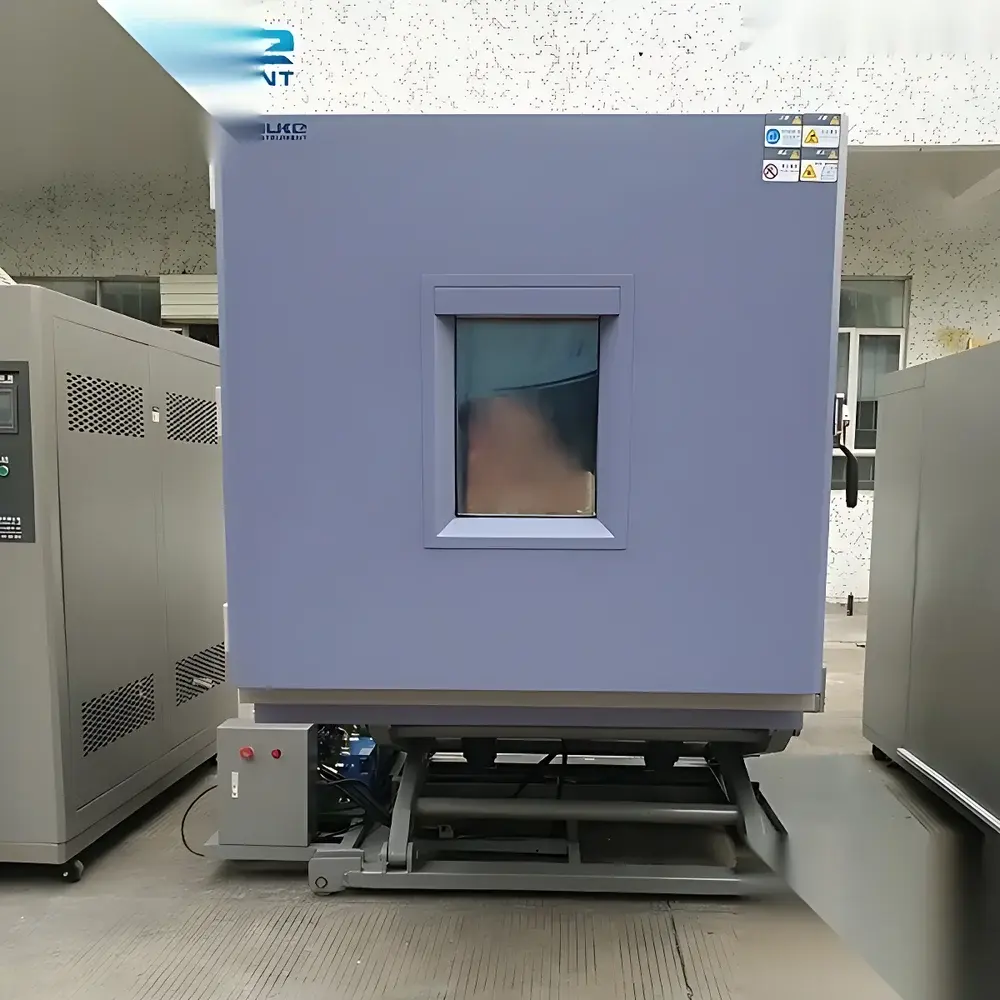
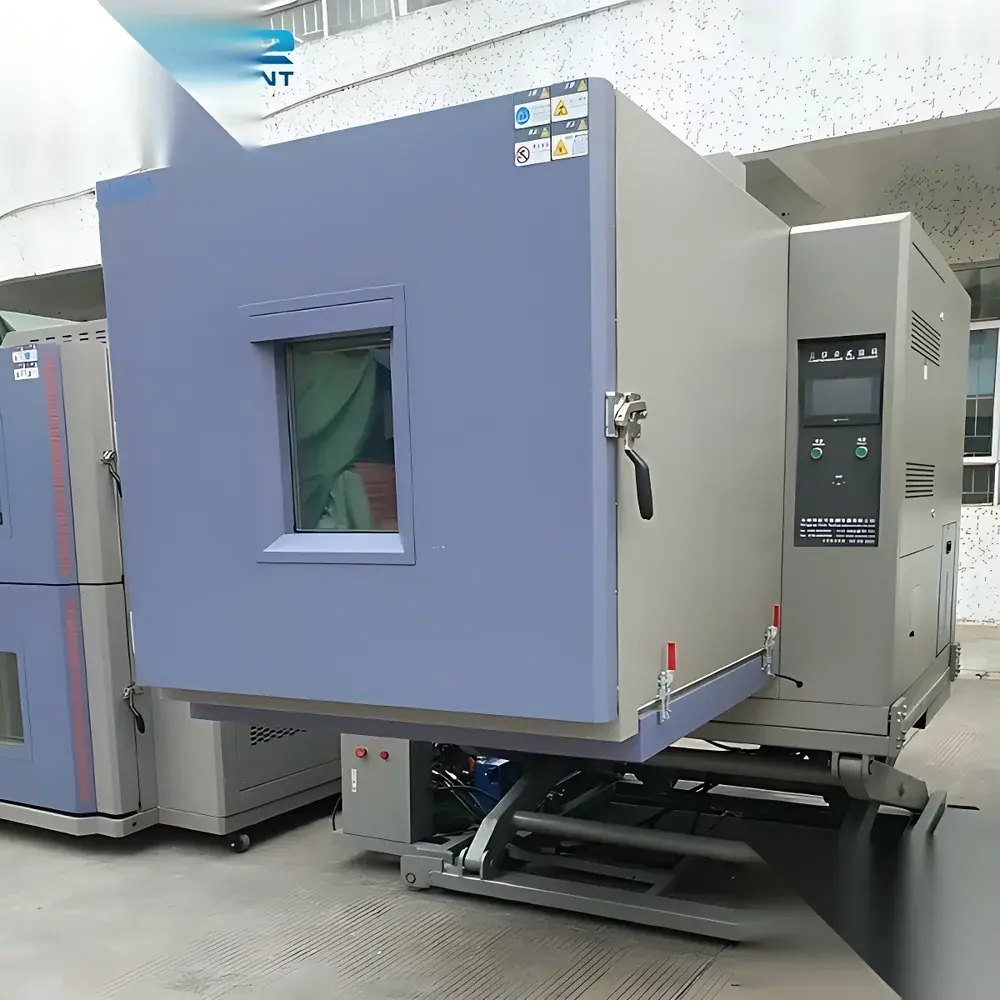
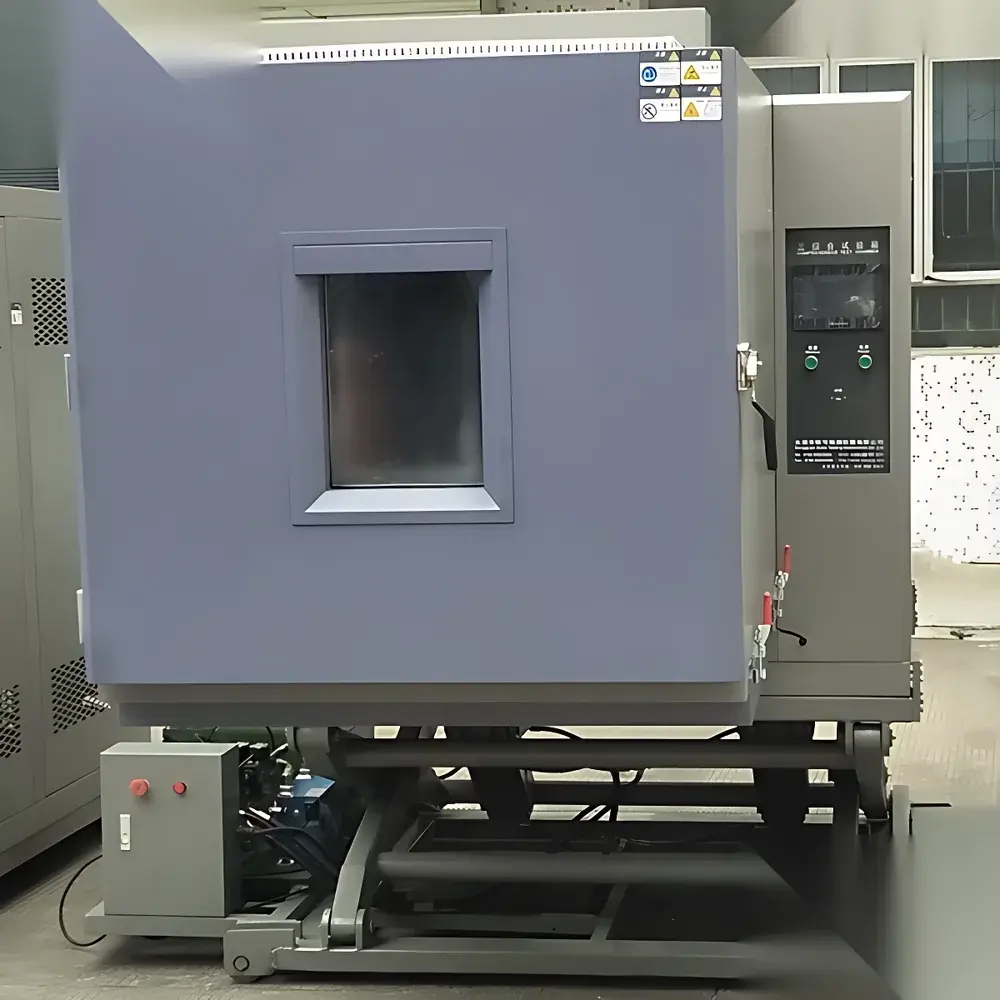
Combined Temperature-Humidity-Vibration Environmental Test Chamber – OEM Manufacturer Supply
| Key | Function Modes: Programmable, Sweep, Time-Controlled |
|---|---|
| External Dimensions (approx.) | 500 × 200 × 500 mm (H × W × D) |
| Vibration Axis | Vertical (Horizontal optional) |
| Max. Load Capacity | 60 kg |
| Frequency Range | 1–400 Hz (Programmable in 0.01 Hz increments) |
| Acceleration | Up to 20 g (peak) |
| Displacement Amplitude | 0–5 mm p-p (adjustable) |
| Vibration Waveform | Sinusoidal |
| Drive Power | 2.2 kW |
| Frequency Resolution & Accuracy | 0.01 Hz display / ±0.1 Hz accuracy |
| Time Control Unit | Second-level programmability |
| Input Voltage | 220 V ±20% |
| Max. Current Draw | 5 A |
| Platform Options | 250×250 mm to 800×800 mm |
| Max. Shock Acceleration (optional high-shock mode) | Up to 650 g |
| Max. Shock Velocity Change | 7.4 m/s (HS mode) |
| Max. Shock Pulse Duration | 1–3 ms (selectable) |
| Compressed Air Requirement | 6–8 kgf/cm² |
| Compliance | Designed for ISO 16750-3, IEC 60068-2-64, MIL-STD-810H, GB/T 2423.10, GB/T 2423.34 |
Overview
The Combined Temperature-Humidity-Vibration Environmental Test Chamber is an integrated reliability validation platform engineered for simultaneous or sequential exposure of test specimens to controlled thermal, hygrothermal, and mechanical vibration stressors. Unlike standalone environmental or vibration chambers, this system implements synchronized multi-stress conditioning based on Couette-type electrodynamic excitation combined with precision PID-controlled refrigeration/humidification modules. Its core architecture enables accelerated life testing under realistic field conditions—such as transportation shock, operational resonance, or storage-induced condensation—thereby supporting failure mode identification, design margin verification, and qualification against international durability standards including ISO 16750-3 (road vehicles), IEC 60068-2-64 (broadband random vibration), and MIL-STD-810H Method 514.8. The chamber supports both sinusoidal sweep/programmed vibration profiles and steady-state climatic profiles, with real-time synchronization of temperature (−70 °C to +180 °C), relative humidity (10–98% RH), and acceleration spectra (1–400 Hz).
Key Features
- Triple-stress integration: Independent yet synchronized control of temperature, humidity, and electrodynamic vibration within a single sealed test volume.
- High-fidelity electrodynamic shaker: 2.2 kW drive amplifier delivering up to 20 gpk sinusoidal acceleration with programmable amplitude (0–5 mm p-p) and frequency resolution of 0.01 Hz.
- Programmable vibration profiles: Up to 15 user-defined segments per test sequence; each segment specifies frequency, dwell time, sweep rate, and acceleration limit—enabling compliance with ASTM D999, ISTA 3A, and JEDEC JESD22-B103.
- Modular platform options: Four standard table sizes (250×250 mm to 800×800 mm) with corresponding load capacities (50–105 kg) and peak acceleration ratings (300–650 g for optional high-shock configurations).
- Robust climate control: Dual-refrigerant cascade cooling system, steam-humidification with dehumidification bypass, and stainless-steel insulated chamber interior meeting ISO 16750-4 corrosion resistance requirements.
- Real-time data logging: Synchronized acquisition of temperature, RH, acceleration (X/Y/Z), displacement, and drive current at ≥1 kHz sampling rate via embedded DAQ module.
- Compliance-ready architecture: Built-in audit trail, electronic signature support, and configurable user access levels aligned with FDA 21 CFR Part 11 and GLP/GMP documentation workflows.
Sample Compatibility & Compliance
This chamber accommodates rigid and semi-rigid samples up to 60 kg (standard configuration) without requiring fixture redesign—ideal for PCB assemblies, automotive ECUs, medical device enclosures, aerospace avionics housings, and packaging prototypes. All internal surfaces are electropolished stainless steel (AISI 316L) to prevent outgassing and corrosion during extended high-humidity cycling. The system complies with mandatory environmental test clauses in IEC 60068-2 series, ISO 16750-3 (vibration), ISO 16750-4 (humidity), and GB/T 2423.10 (vibration) and GB/T 2423.34 (combined temp/humidity). Optional calibration certificates traceable to NIST or PTB standards are available upon request. Full test reports include raw waveform files (.tdms), climatic trend plots, and pass/fail annotations per specified acceptance criteria.
Software & Data Management
Control and analysis are executed via the proprietary TriStress Manager software suite (Windows 10/11 compatible), featuring dual-mode operation: manual parameter tuning for R&D iteration and automated script execution for production-line qualification. The software includes built-in test templates aligned with ISTA, JEDEC, and automotive OEM specifications (e.g., Ford WERS, GMW14872). All test logs are stored in encrypted SQLite databases with SHA-256 hashing; export formats include CSV, PDF (with digital signature), and XML for LIMS integration. Audit trails record operator ID, timestamp, parameter changes, and alarm events—fully compliant with FDA 21 CFR Part 11 Annex 11 requirements. Remote monitoring via HTTPS-enabled web interface supports secure off-site supervision without compromising network integrity.
Applications
- Transportation simulation: Replicating road, rail, and air freight vibration spectra while maintaining ambient or extreme thermal/humidity conditions.
- Early-life failure screening: Identifying solder joint fatigue, connector fretting, capacitor delamination, and adhesive bond degradation under combined stress.
- Packaging validation: Assessing corrugated box integrity, foam cushion performance, and blister-pack seal strength under climatic cycling + vibration.
- Electronic reliability assessment: Detecting intermittent opens/shorts, relay chatter, and MEMS sensor drift induced by resonant frequencies amplified under humidified conditions.
- Material aging studies: Monitoring polymer creep, coating adhesion loss, and metal oxide formation on contacts exposed to cyclic condensation and mechanical strain.
- Qualification testing for MIL-STD-810H, DO-160G Section 8, and ISO 16750-3 Category C/D environments.
FAQ
Does the system support random vibration profiles in addition to sine sweep?
Yes—optional broadband random vibration control module (per IEC 60068-2-64) is available with PSD shaping, kurtosis enhancement, and real-time fatigue damage spectrum synthesis.
Can humidity be maintained during high-g vibration testing?
Yes—advanced condensation management algorithms dynamically adjust humidifier output and chamber wall heating to sustain target RH ±3% even at 15 gpk and 60 Hz.
Is third-party calibration and IQ/OQ/PQ documentation included?
Factory calibration is provided with NIST-traceable certificates; IQ/OQ/PQ protocols and execution services are available as optional add-ons.
What safety interlocks prevent hardware damage during over-acceleration or thermal runaway?
Hardware-enforced limits include dual-stage over-acceleration cutoff, refrigerant pressure safeties, chamber door lockout during vibration, and independent thermal fuses rated at 200 °C.
How is synchronization accuracy between climate and vibration subsystems verified?
Synchronization jitter is validated using cross-channel phase analysis on reference accelerometer and Pt100 signals; typical latency is <10 ms across all operating ranges.



