
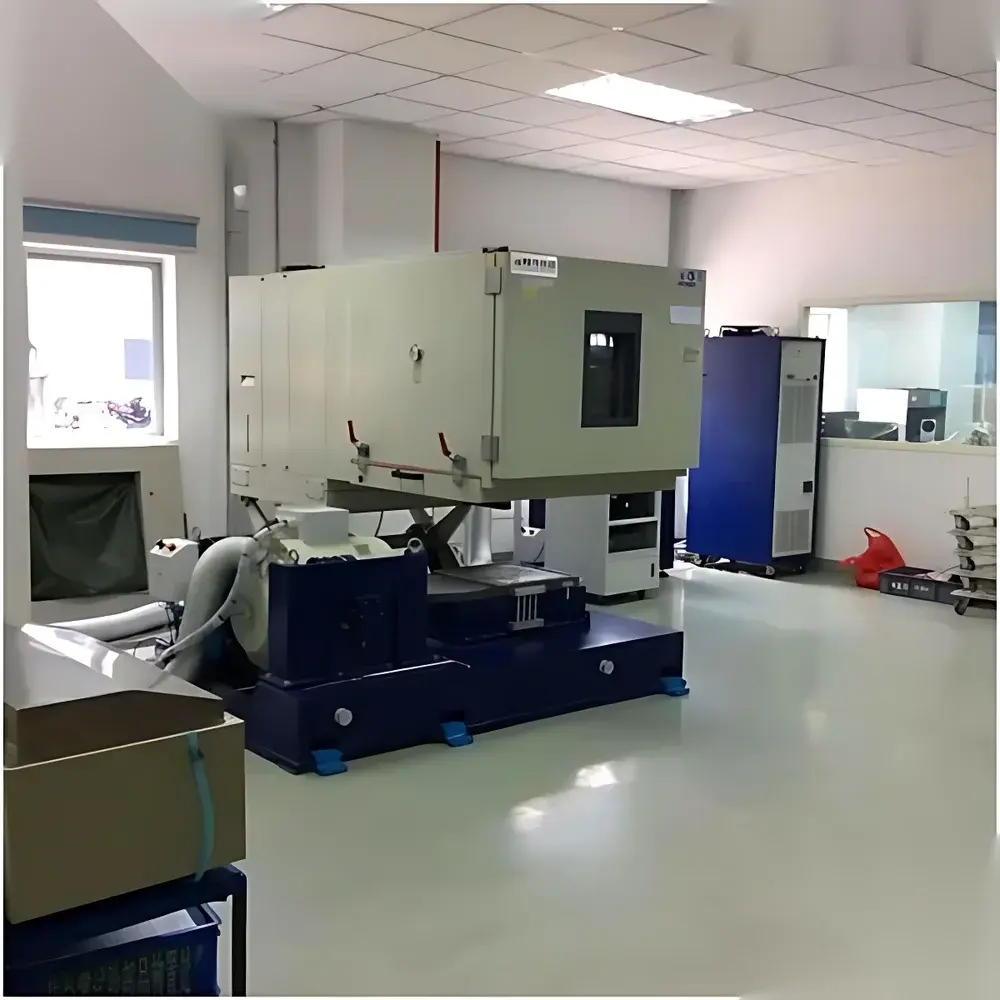
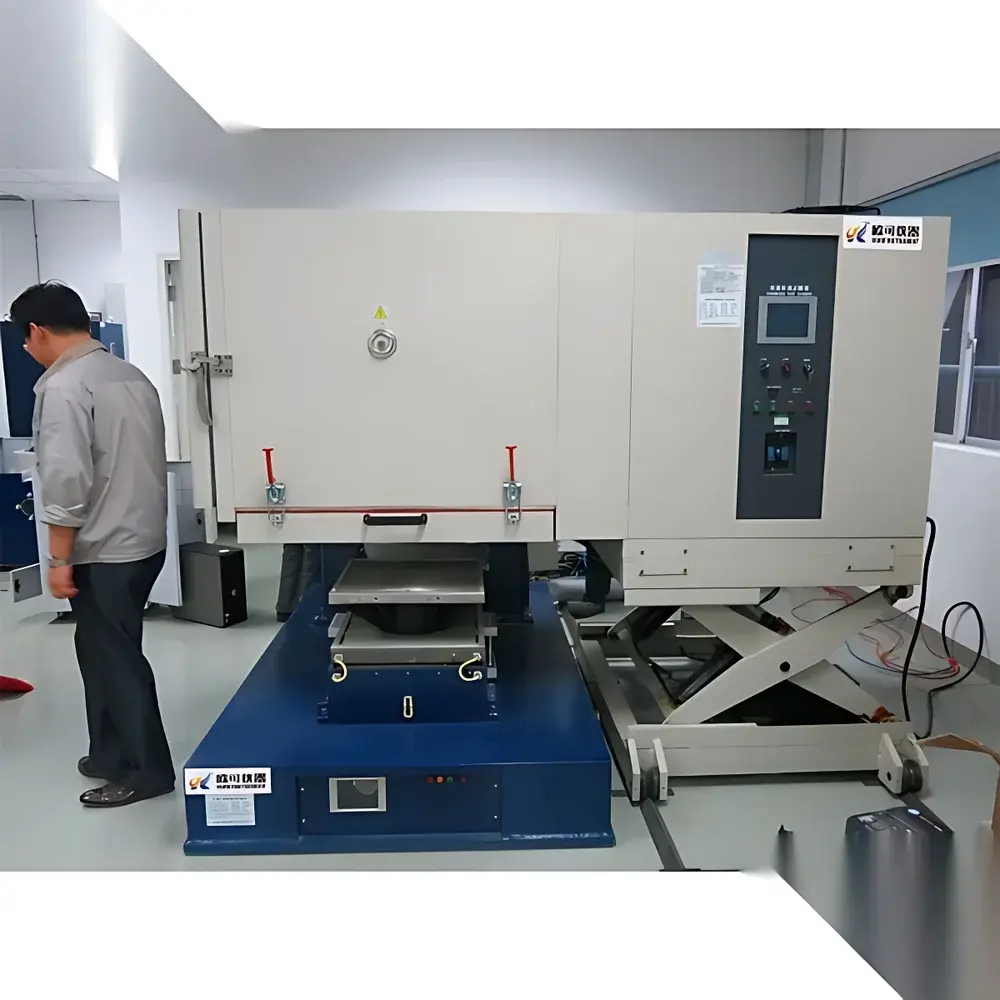
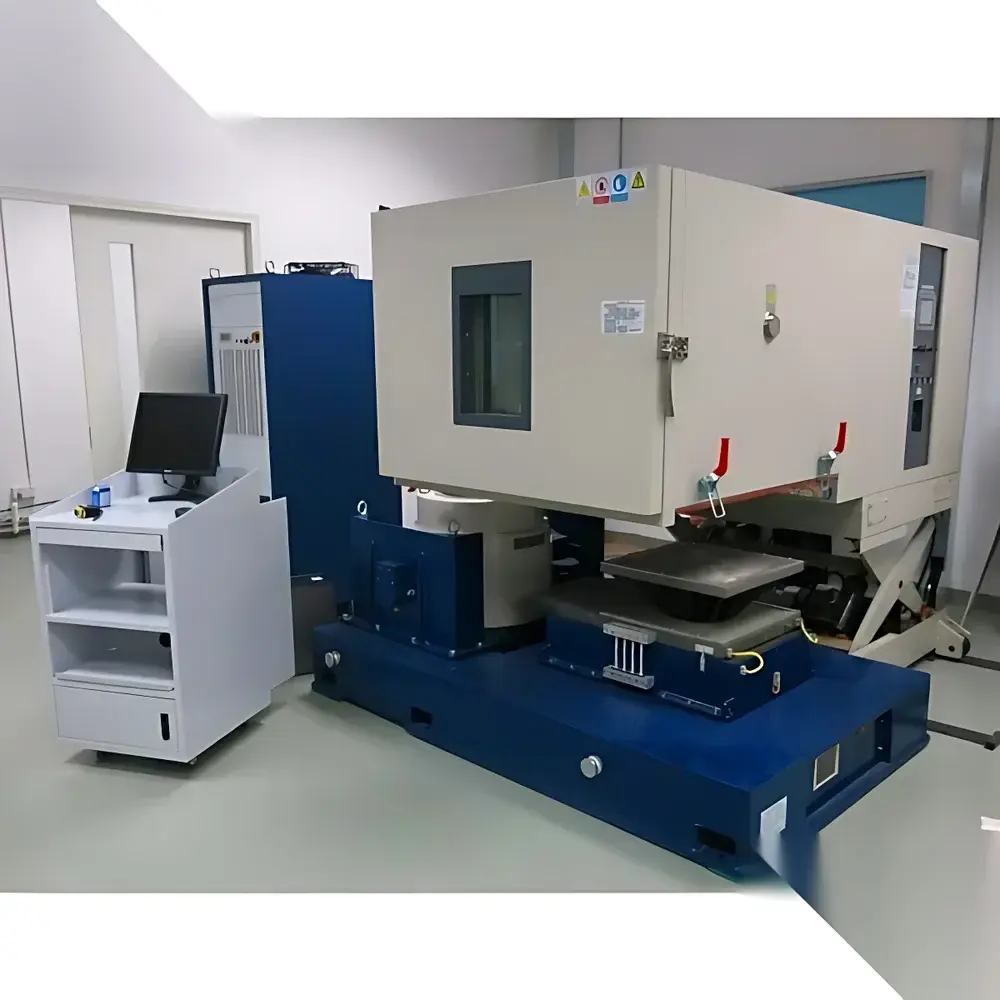
Combined Temperature-Humidity-Vibration Environmental Test Chamber – OEM/ODM Capable
| Key | Vibration Frequency Range: 100–300 rpm (continuous adjustment, ASTM-compliant) |
|---|---|
| Vibration Amplitude | 25.4 mm (1 inch) |
| Max Payload Capacity | 60 kg (standard), up to 100 kg (customizable) |
| Operating Time Range | 0–9999 h / min / sec |
| Motor Power | 1 HP (746 W) |
| Max Current Draw | 4 A |
| Worktable Dimensions | 1000 × 1200 mm (standard, customizable) |
| Base Frame | Structural steel channel (100 × 50 mm), 6 mm powder-coated steel top plate |
| Test Platform | 10 mm anodized aluminum plate |
| Main Mast | Solid 45# steel, surface-hardened, 1900 mm total length, Ø95 mm |
| Primary Drive Rod | Solid 60# steel leadscrew with hardened nut assembly, 1700 mm effective stroke, Ø30 mm |
| Fixture Rod | Solid 45# steel, surface-hardened, 1000 mm length, Ø15 mm |
| Standard Fixture | Six-point adjustable corner clamping system with hardened steel angle brackets |
| Compliance | Designed per ASTM D999, ASTM D3580, ISO 2247, ISO 8767, and EN 1185 for transport simulation testing |
Overview
The Combined Temperature-Humidity-Vibration Environmental Test Chamber is an integrated reliability validation platform engineered for simultaneous exposure of packaged products to controlled thermal, hygrothermal, and mechanical vibration stressors. Unlike sequential or single-stress test systems, this chamber implements true tri-axial environmental synchronization—enabling accelerated simulation of real-world distribution conditions where temperature cycling, humidity variation, and road-simulated vibration occur concurrently. Its core vibration subsystem employs a robust electromagnetic or electromechanical shaker mechanism (depending on configuration), calibrated to replicate the spectral energy profiles defined in ASTM D999 (Standard Test Methods for Shock Testing of Shipping Containers) and ASTM D3580 (Vibration Testing of Products). The chamber’s climate control system maintains precise temperature (typically −40°C to +150°C) and relative humidity (10%–98% RH) profiles per IEC 60068-2-1, IEC 60068-2-2, and IEC 60068-2-78, while the vibration actuator delivers repeatable sinusoidal motion at frequencies from 100 to 300 rpm (1.67–5 Hz), with fixed 25.4 mm peak-to-peak displacement—matching low-frequency transport vibration spectra observed in truck, rail, and maritime logistics.
Key Features
- Triple-stress integration: Independent yet synchronized control of temperature, humidity, and vertical-axis vibration within a single sealed chamber enclosure.
- ASTM-compliant vibration drive: Precision-engineered 1 HP motor coupled with 20:1 reduction gearbox and hardened steel leadscrew transmission, ensuring long-term torque stability and minimal drift over extended test durations (up to 9999 hours).
- Structural rigidity: Base frame constructed from 100 × 50 mm structural steel channels; top mounting surface features 6 mm powder-coated carbon steel plate for uniform load distribution and corrosion resistance.
- Modular test platform: 10 mm thick anodized aluminum worktable (standard 1000 × 1200 mm) offers high flatness tolerance (<0.1 mm/m), non-magnetic properties, and compatibility with custom fixture tooling.
- Customizable payload support: Standard 60 kg capacity extends to 100 kg via reinforced mast assembly, dual-guide rod stabilization, and upgraded motor-controller pairing—validated under static and dynamic loading per ISO 2041.
- Low-noise operation: Optimized gear meshing, vibration-damped motor mount, and acoustic insulation reduce operational noise to ≤72 dB(A) at 1 m distance—suitable for shared laboratory environments.
Sample Compatibility & Compliance
This chamber accommodates a broad range of packaged goods—from small electronics enclosures and medical device cartons to furniture subassemblies and ceramic ware shipping containers. Sample mounting utilizes a six-point adjustable corner clamping system fabricated from surface-hardened 45# steel, enabling secure fixation of irregular geometries without deformation. All structural components—including main mast (Ø95 mm, 45# steel, heat-treated), drive rods (Ø30 mm, 60# steel), and fixture rods (Ø15 mm, 45# steel)—are machined to ISO 2768-mK tolerances and certified for fatigue life exceeding 5 × 10⁶ cycles at rated load. The system meets mechanical safety requirements per EN 61000-6-2 (immunity) and EN 61000-6-4 (emissions), and supports full auditability for GLP/GMP-regulated packaging validation protocols when paired with compliant data logging firmware.
Software & Data Management
Control and monitoring are executed via a dedicated industrial-grade HMI with embedded real-time OS, supporting programmable test profiles with up to 99 segments per cycle. Temperature/humidity setpoints and vibration parameters (frequency, amplitude, dwell time) are independently configurable and interlocked to prevent out-of-spec excursions. All sensor inputs—including PT100 temperature probes, capacitive RH sensors, and piezoelectric acceleration transducers—are sampled at ≥10 Hz and logged with UTC timestamps. Raw data exports to CSV or .tdms formats; optional software add-ons provide automated report generation aligned with ASTM D4169 Appendix X1 (distribution cycle definition) and support FDA 21 CFR Part 11-compliant electronic signatures, audit trails, and user access controls.
Applications
- Transportation simulation: Replicating vibration spectra from Class A (paved highway), Class B (rural road), and Class C (off-road) environments per ASTM D4169.
- Packaging design validation: Quantifying compression creep, seal integrity loss, and component loosening under combined thermal-hygric-vibrational stress.
- Supply chain resilience testing: Assessing performance degradation of lithium-ion battery packs, PCB assemblies, and sterile barrier systems during simulated multi-modal shipment.
- Regulatory pre-certification: Generating evidence for ISTA 3A, ISTA 3E, and MIL-STD-810H Method 514.7 compliance prior to third-party certification.
- Material aging studies: Accelerating moisture ingress, polymer relaxation, and adhesive bond failure mechanisms in controlled climatic-vibrational fields.
FAQ
What standards does this chamber specifically address for transport simulation?
It is configured to meet ASTM D999, ASTM D3580, ISO 2247, ISO 8767, EN 1185, and supports profile-based execution per ISTA 3-series and MIL-STD-810H Method 514.7.
Can the vibration frequency be swept across a range, or is it fixed per test segment?
The standard configuration supports fixed-frequency operation within 100–300 rpm; optional servo-controlled shaker modules enable linear/logarithmic sweeps and random vibration profiles.
Is remote monitoring and control supported?
Yes—via Ethernet/IP interface with Modbus TCP and OPC UA support; optional cloud telemetry enables real-time dashboard viewing and SMS/email alerting on parameter deviation.
What is the typical lead time for custom configurations (e.g., 100 kg payload, extended temperature range)?
Standard units ship in 8–10 weeks; custom-engineered variants require 14–18 weeks, including FAT (Factory Acceptance Test) documentation and calibration certificate issuance.
Does the system include calibration traceability to national standards?
All delivered units include NIST-traceable calibration certificates for temperature, humidity, and acceleration sensors, valid for 12 months from commissioning date.



