
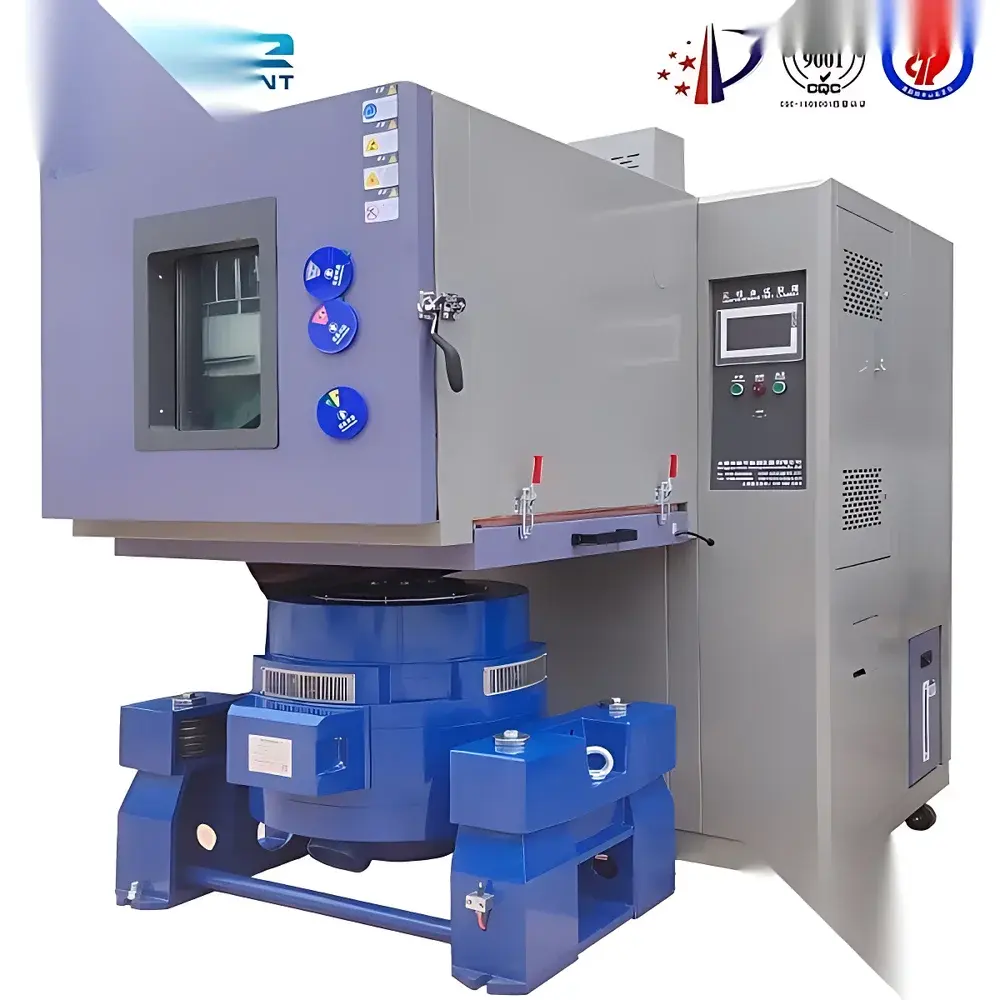
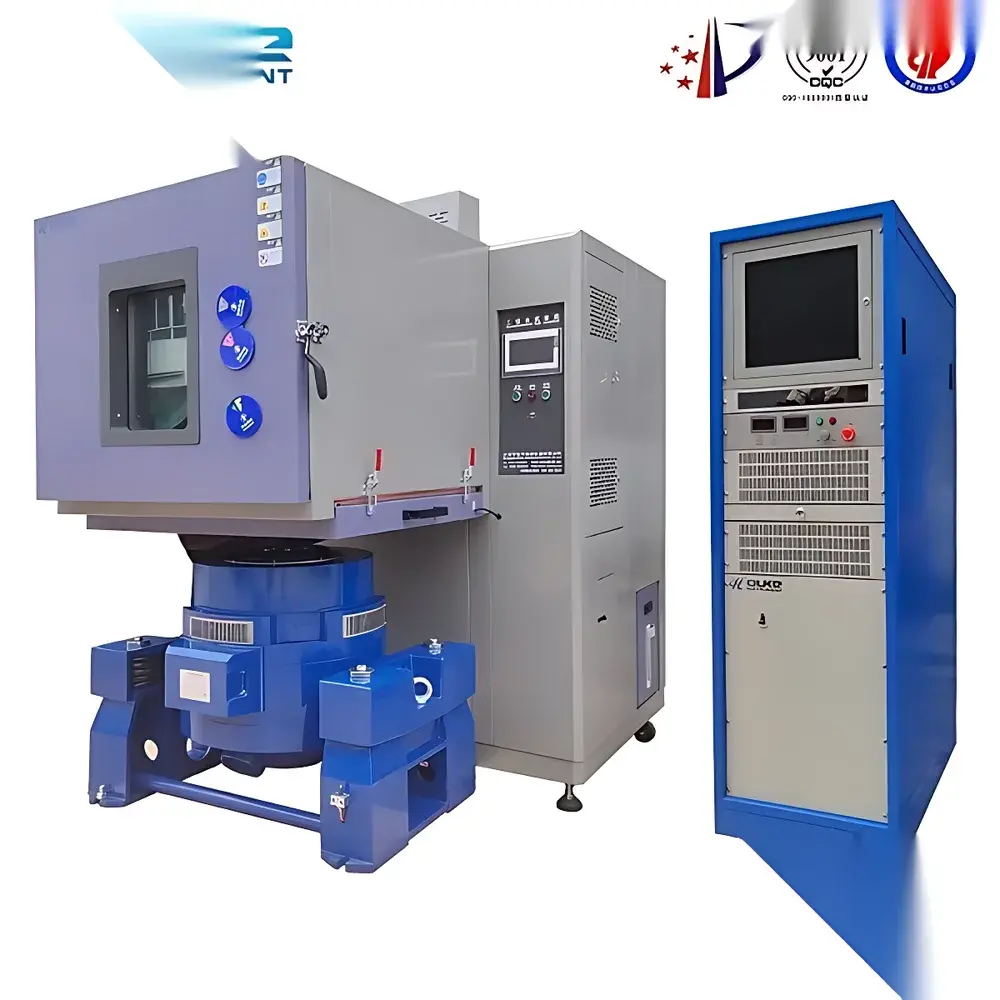
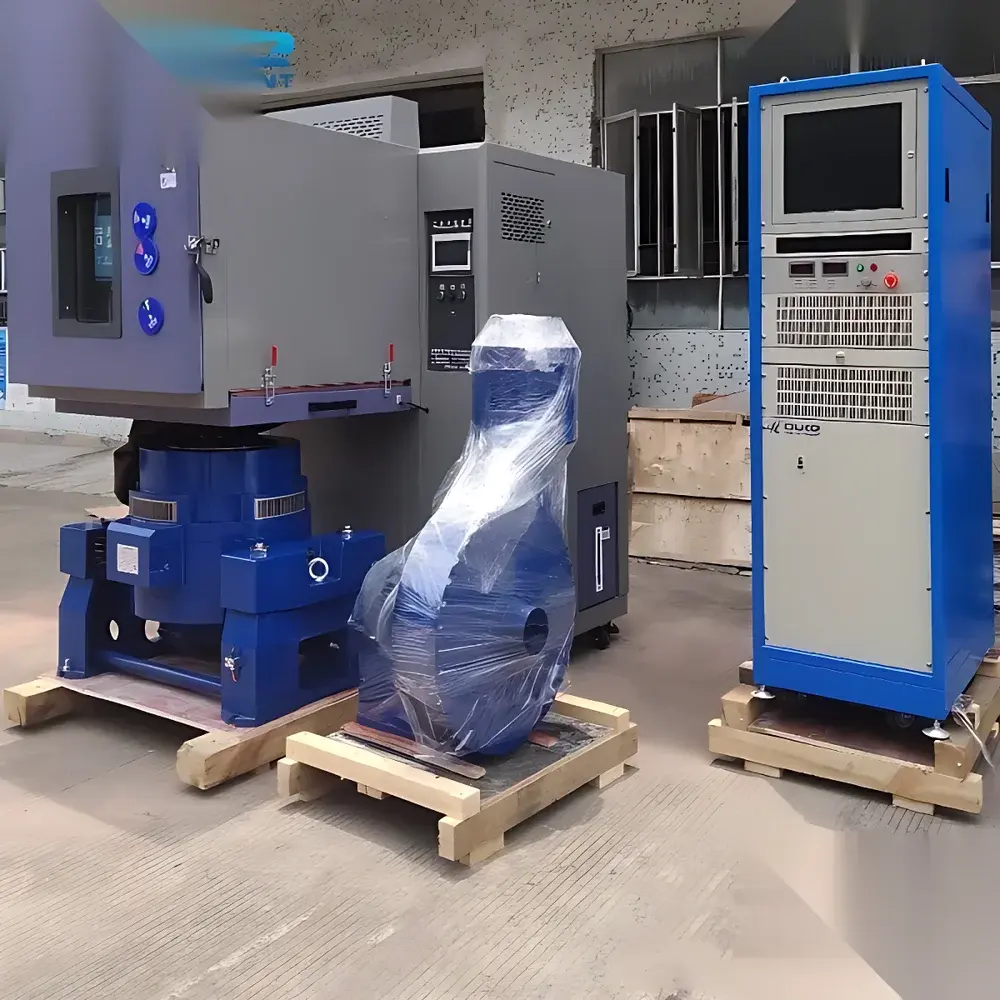
Combined Temperature-Humidity-Vibration Environmental Test Chamber for PCB Reliability Testing
| Brand | OEM / Custom-Built |
|---|---|
| Origin | Imported |
| Manufacturer Type | Authorized Distributor |
| Price | USD 21,000 (FOB) |
| Internal Liner | Mirror-Finish SUS304 Stainless Steel |
| External Casing | Brushed SUS304 or Galvanized Cold-Rolled Steel |
| Insulation | Glass Wool + Rigid Polyurethane Foam |
| Heating System | Ni-Cr Alloy Heaters |
| Cooling System | Two-Stage Mechanical Refrigeration (Bitzer or Copeland Semi-Hermetic Compressors) |
| Refrigerants | HFC-404A / HFC-23 |
| Condenser | Stainless Steel Brazed Plate Heat Exchanger |
| Evaporator | Finned-Tube Air Cooler |
| Cooling Method | Water-Cooled |
| Humidification | Built-in Reservoir with Precision Submersible Pump |
| Air Circulation | Single-Cycle Forced Convection (Bottom-In/Top-Out), Extended-Shaft Centrifugal Fan with Wide-Band Stainless Blades |
| Control System | Dual-Language (English/Chinese) Color Touchscreen + PLC-Based Controller (OYO or TIME) |
| Vibration Interface | Optional Electrodynamic or Electromechanical Shaker Mounting Kit (User-Specified) |
| Compliance | GB/T 5170.2, GB/T 2423.1–2423.3, GJB 150.3–150.4 |
Overview
The Combined Temperature-Humidity-Vibration Environmental Test Chamber is an integrated reliability validation platform engineered for accelerated stress testing of printed circuit boards (PCBs), electronic assemblies, and embedded modules under synchronized thermal, hygrothermal, and dynamic mechanical loads. It operates on the principle of multi-stress coupling—simultaneously imposing controlled temperature gradients (−70 °C to +180 °C), relative humidity (10–98% RH), and broadband vibration profiles (5–2000 Hz, up to 60 g peak acceleration) to replicate real-world field conditions encountered during aerospace avionics deployment, automotive ECU qualification, or industrial control system lifecycle validation. Unlike sequential single-stress chambers, this triaxial test system enables true synergistic failure mode identification—such as solder joint fatigue accelerated by thermal cycling-induced moisture diffusion, or delamination triggered by combined hygrothermal swelling and resonant structural excitation.
Key Features
- Triple-Independent Climate Control Architecture: Separate high-precision PID loops govern heating, refrigeration, and humidification subsystems, ensuring ±0.3 °C temperature uniformity and ±2% RH stability across the working volume (standard 400–1000 L configurations).
- Two-Stage Cryogenic Refrigeration: Utilizes environmentally compliant HFC-404A (low-temperature stage) and HFC-23 (ultra-low substage) in a cascade configuration, achieving rapid cooling rates up to 10 K/min from ambient to −70 °C without compressor overload.
- Corrosion-Resistant Chamber Construction: Interior lined with electropolished SUS304 stainless steel (Ra ≤ 0.4 µm surface roughness) and exterior clad in brushed-grade SUS304 or zinc-coated cold-rolled steel—designed for long-term exposure to condensing humidity and saline mist environments.
- Water-Cooled Condensation Management: Integrated water-cooling circuit maintains stable condenser head pressure across ambient temperatures up to 40 °C, eliminating reliance on ambient air ventilation and enabling installation in temperature-controlled labs without HVAC derating.
- Modular Vibration Integration: Standardized ISO 10816-compliant mounting interface (M12 threaded holes on reinforced base plate) supports bolt-on electrodynamic shakers (e.g., LDS V875, TIRA TV 51120) or servo-hydraulic exciters, with real-time synchronization via IEEE 1588 PTP time stamping.
Sample Compatibility & Compliance
The chamber accommodates standard PCB test fixtures (up to 600 mm × 500 mm × 150 mm DUT envelope) and integrates seamlessly with industry-standard test jigs, including JEDEC-standard board carriers and IPC-9701-compliant thermal interface measurement frames. All operational parameters—including ramp rates, dwell times, vibration spectra, and humidity soak durations—are fully programmable and auditable per GLP/GMP requirements. The system complies with mandatory test standards for electronics qualification: GB/T 2423 series (equivalent to IEC 60068), MIL-STD-810H Method 502.7 (temperature shock), Method 507.6 (humidity), and Method 514.7 (vibration); additionally certified for conformance with ISO/IEC 17025-accredited laboratory use when paired with traceable calibration records.
Software & Data Management
Equipped with an embedded Linux-based controller running dual-language (English/Chinese) HMI firmware, the chamber supports full-cycle test scripting via drag-and-drop sequence editors and real-time waveform monitoring of temperature, humidity, and vibration acceleration (via optional IEPE sensor inputs). Data logging occurs at user-selectable intervals (100 ms to 10 s resolution) with automatic CSV export, timestamped with NTP-synchronized UTC. Audit trails comply with FDA 21 CFR Part 11 requirements—including electronic signatures, role-based access control, and immutable event logs—enabling direct integration into LIMS platforms such as LabWare or Thermo Fisher SampleManager.
Applications
- PCB solder joint reliability assessment under thermomechanical cycling (IPC-9701, JESD22-A104)
- Conformal coating adhesion and dielectric integrity evaluation under combined humidity-vibration stress
- Automotive ADAS module qualification per AEC-Q200 Rev D and ISO 16750-4
- Aerospace avionics box validation against DO-160G Sections 4 (temperature), 5 (humidity), and 7 (vibration)
- Failure analysis root cause isolation in high-reliability power supply units exposed to coastal or desert microclimates
FAQ
Can the chamber operate vibration and humidity simultaneously without condensation interference on the shaker armature?
Yes—the chamber employs a dedicated dehumidified purge gas channel around the vibration feedthrough and uses hydrophobic sealing gaskets to prevent moisture ingress into the shaker’s moving coil assembly.
Is remote monitoring supported over Ethernet or industrial protocols?
Standard Modbus TCP and optional OPC UA server integration enable SCADA-level supervision and alarm forwarding via SNMP or MQTT to centralized MES systems.
What calibration documentation is provided upon delivery?
NIST-traceable calibration certificates for temperature (PT100 sensors), humidity (capacitive hygrometers), and vibration (reference accelerometer) are included, with annual recalibration intervals defined per ISO/IEC 17025 Annex A.3.
Does the system support custom vibration profiles beyond sine sweep and random PSD?
Yes—user-defined transient waveforms (e.g., shock pulses, road profile simulations) can be imported as ASCII time-history files and executed synchronously with climate profiles.
How is chamber leakage rate verified during factory acceptance testing?
Helium mass spectrometry leak testing is performed at 1×10⁻⁶ mbar·L/s sensitivity, with results documented in the FAT report alongside pressure decay curves at 100 kPa gauge.



