
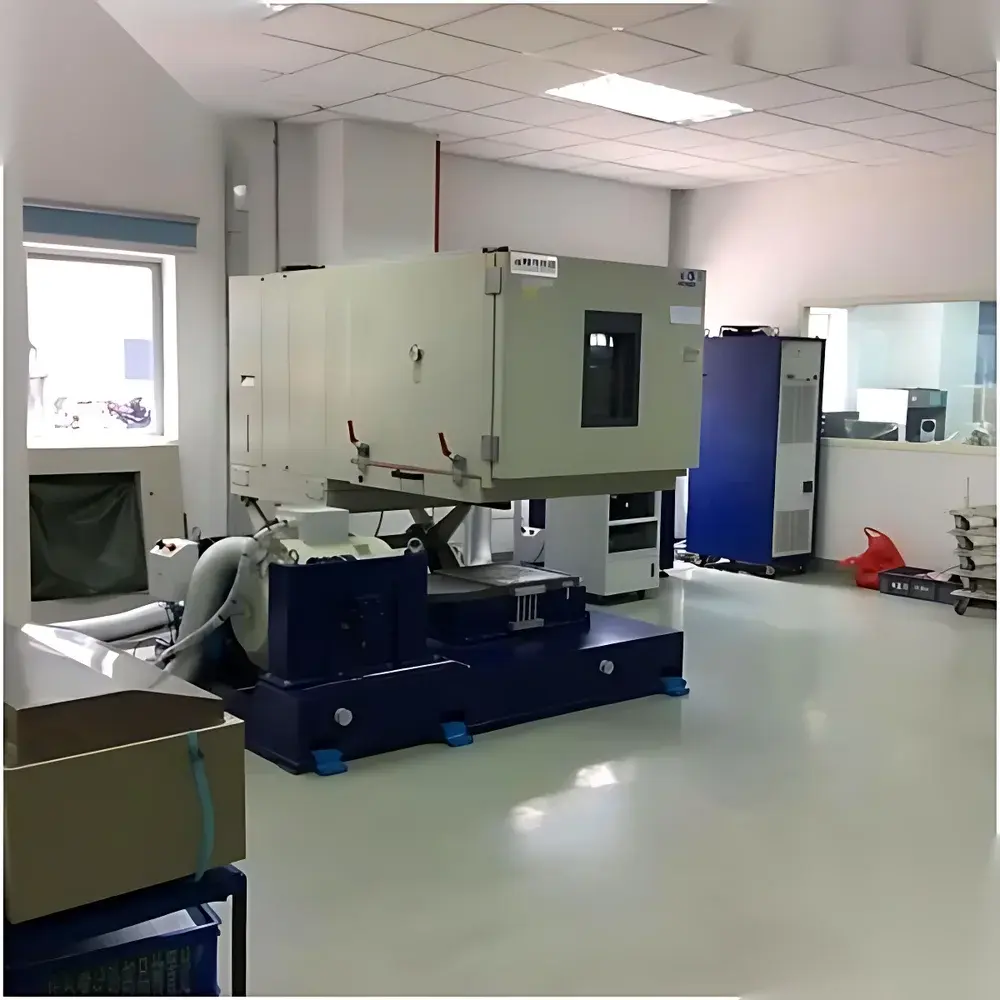
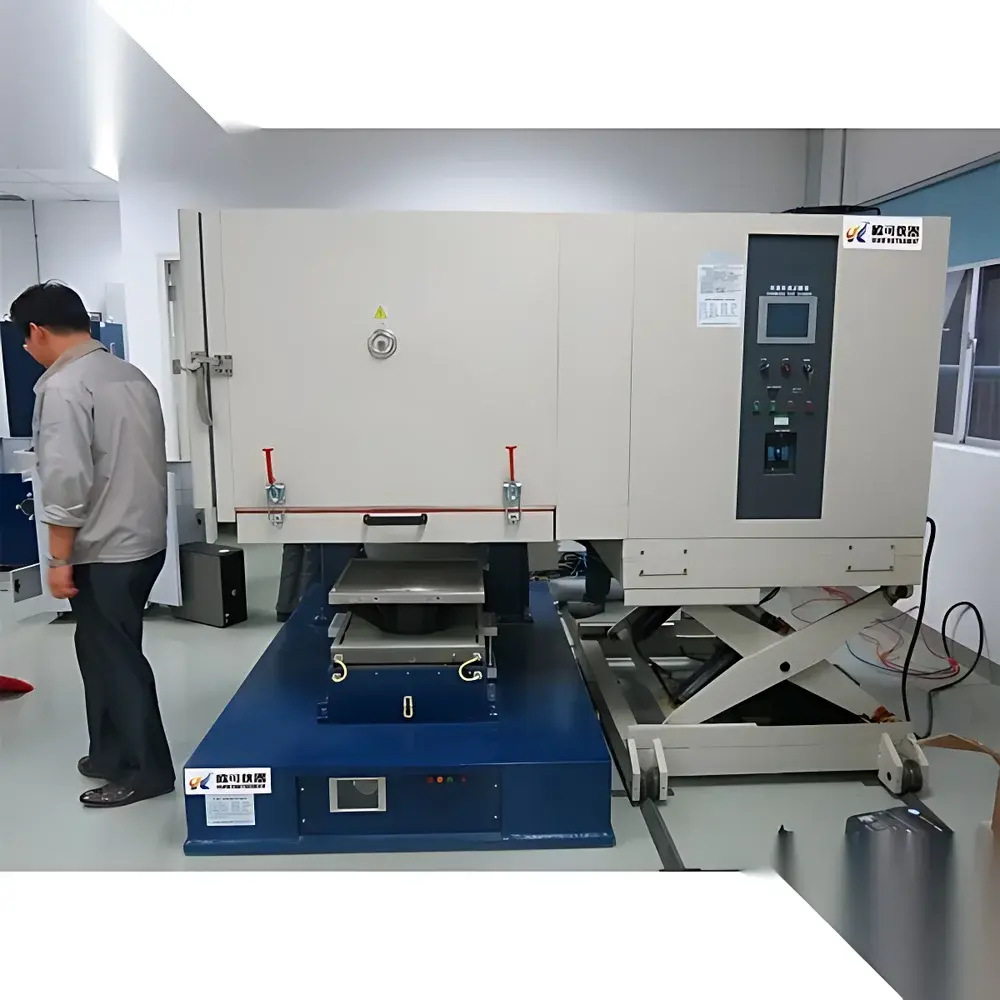
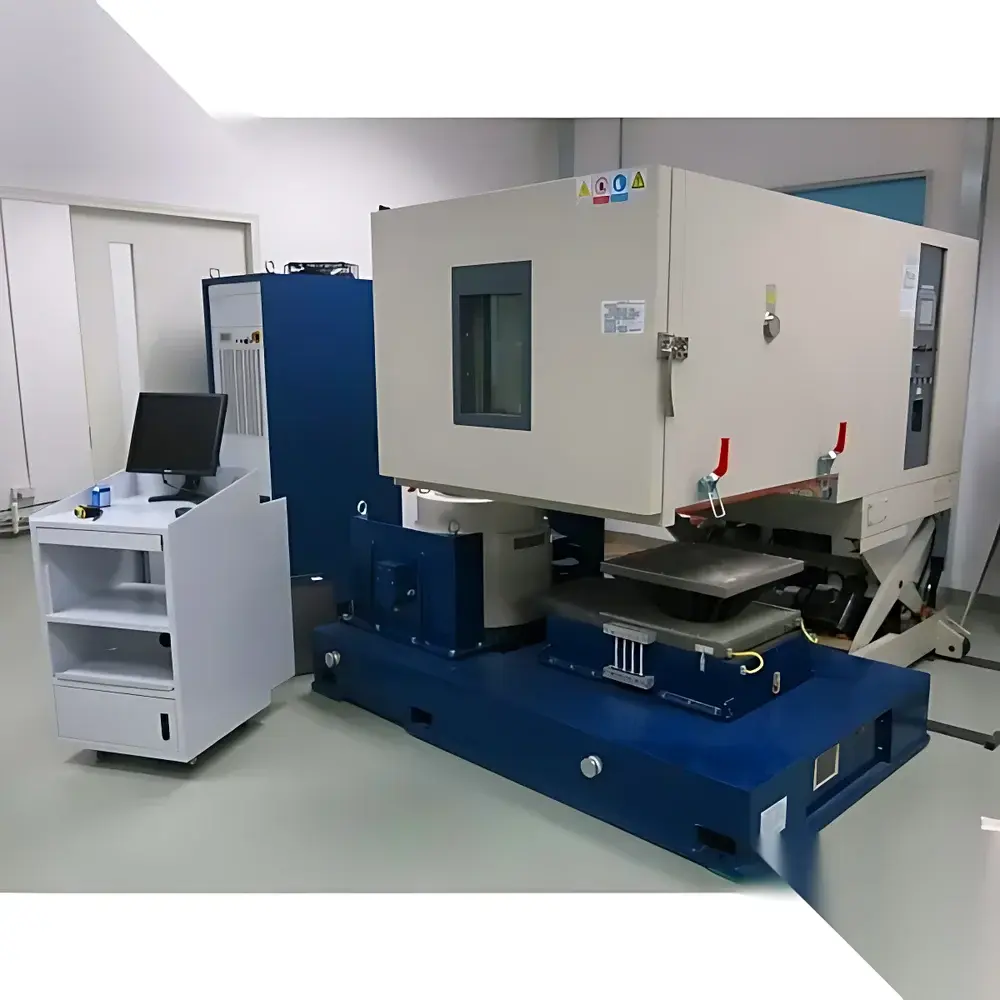
Combined Temperature-Humidity-Vibration Environmental Test Chamber – Standard Configuration
| Key | Construction Material: SUS#304 stainless steel interior & exterior |
|---|---|
| Insulation | High-density polyurethane foam (chlorinated ethyl carbamate-based, high-temp resistant) |
| Cooling System | Air-cooled |
| Temperature Range | −70 °C to +150 °C (selectable low-temp tiers: −70/−60/−40/−20/0/25 °C |
| high-temp options | 100 °C or 150 °C) |
| Humidity Range | 5–98% RH (standard: 20–98% RH |
| Temp/Humidity Resolution | 0.1 °C / 0.1% RH |
| Temp Uniformity | ±2.0 °C |
| Humidity Uniformity | ±3.0% RH |
| Control Accuracy | ±0.5 °C / ±2.5% RH |
| Heating Rate | ~4.0 °C/min |
| Cooling Rate | ~1.0 °C/min |
| Controller | OYO 8226 touchscreen HMI (Japanese-made), bilingual UI (EN/CN), 100 programs × 1000 segments × 999 cycles, max segment duration: 99 h 59 min |
| Communication | RS-232 / RS-485 interface for PC-based test scheduling, real-time monitoring, and remote start/stop |
| Safety Protections | Fuseless circuit breaker, compressor overload protection, refrigerant HP/LP cut-off, over-temp/over-humidity interlock, water shortage alarm, fault diagnostic display |
| Structural Features | A3 carbon steel outer shell (powder-coated), SUS#304 mirror-finish inner chamber, multi-layer tempered observation window with conductive ITO film, Φ50 mm cable port (left side), double-lip high-tensile silicone door seal, counterforce-free door handle, retractable vibration table rail system, low-noise centrifugal blower (single-cycle airflow), epoxy-silicone hybrid sealing between shaker table and chamber base |
| Compliance | Designed per IEC 60068-2 series, MIL-STD-810H environmental test methodology frameworks, supports GLP/GMP audit-ready data logging when integrated with compliant software |
Overview
The Combined Temperature-Humidity-Vibration Environmental Test Chamber (Standard Configuration) is an engineered platform for simultaneous exposure of electronic components, automotive modules, aerospace subsystems, and medical devices to controlled thermal, hygroscopic, and dynamic mechanical stressors. It operates on the principle of accelerated life testing by replicating real-world operational and storage environments—where temperature cycling, moisture ingress, and mechanical resonance interact synergistically to reveal latent design weaknesses, material fatigue, solder joint degradation, or seal integrity failures. Unlike sequential single-stress chambers, this triaxial system maintains traceable, synchronized control across all three domains—enabling correlation of failure modes that only emerge under compound stimuli. Its architecture adheres to foundational environmental test standards including IEC 60068-2-1 (cold), IEC 60068-2-2 (dry heat), IEC 60068-2-30 (damp heat cyclic), and ISO 16750-4 (road vehicle climatic loads), serving as a primary qualification tool in product development, reliability screening, and pre-compliance verification.
Key Features
- Triple-domain synchronization: Independent yet coordinated regulation of temperature (−70 °C to +150 °C), relative humidity (5–98% RH), and electrodynamic vibration input (via integrated shaker table with rail-based retraction mechanism).
- High-fidelity chamber construction: Interior chamber fabricated from electropolished SUS#304 stainless steel; outer enclosure from A3 carbon steel with industrial-grade powder coating; insulation composed of closed-cell polyurethane foam formulated for thermal stability up to 150 °C.
- Intelligent climate control: Japanese OYO 8226 controller featuring capacitive touchscreen interface, real-time trend visualization, programmable ramp/soak profiles, and lockable parameter editing to prevent inadvertent modification during test execution.
- Robust safety architecture: Comprehensive hardware-level protections—including refrigerant pressure monitoring, compressor thermal cutoff, dual-stage over-temperature interlock, humidity sensor redundancy, and automatic shutdown upon water reservoir depletion.
- Human-centered ergonomics: Multi-layer conductive-glass observation window with anti-fogging ITO film; counterforce-free door latch; Φ50 mm feedthrough port with IP54-rated gland; low-noise air circulation system using sealed centrifugal impeller.
Sample Compatibility & Compliance
The chamber accommodates DUTs up to 150 kg (vibration table load limit) and dimensions compatible with standard ISO 16750-4 mounting fixtures. Internal volume configurations range from 150 L to 1000 L (customizable). Sample mounting interfaces support bolt-down, fixture-clamp, and suspended configurations. All thermal and humidity performance metrics are validated per IEC 60068-3-5 (methods for determining tolerances) and ASTM E145-22 (specification for gravity-convection and forced-ventilation ovens). Vibration coupling complies with ISO 10816-1 (vibration severity evaluation) when used with external shakers. The system supports documentation requirements for FDA 21 CFR Part 11 (when paired with validated data acquisition software), EU Annex 11 (computerized system validation), and ISO/IEC 17025 calibration traceability protocols.
Software & Data Management
The embedded OYO controller logs timestamped temperature, humidity, and status events at user-defined intervals (default: 10 s). Raw data exports via USB or serial interface in CSV format. Optional PC-based software (sold separately) enables full test orchestration—including multi-step profile generation, live telemetry dashboarding, alarm escalation rules, and PDF report generation with digital signature fields. Audit trails record operator ID, parameter changes, and system faults—meeting GLP and GMP documentation expectations. Data encryption and role-based access control align with NIST SP 800-53 Rev. 5 security controls for laboratory information systems.
Applications
- Automotive electronics: ECUs, ADAS sensors, battery management systems under combined thermal shock, condensation, and road-induced vibration.
- Aerospace avionics: Flight-critical PCBAs subjected to high-altitude thermal gradients, humidity soak, and turbulence-spectrum excitation.
- Medical device validation: Implantable pulse generators, infusion pumps, and diagnostic imaging subsystems per ISO 14971 risk management workflows.
- Consumer electronics: Smartphones, wearables, and IoT gateways undergoing HALT/HASS simulation prior to mass production release.
- Materials science: Polymer encapsulant adhesion testing, conformal coating delamination analysis, and solder paste reliability assessment under thermo-mechanical stress.
FAQ
What vibration specifications does the integrated shaker table support?
The standard configuration includes a retractable electrodynamic shaker table with mechanical interface per ISO 5344; maximum payload capacity is 150 kg. Vibration input parameters (frequency range, displacement, acceleration) are defined by the external shaker driver—not the chamber itself—and must be selected based on application-specific test plans (e.g., MIL-STD-810H Method 514.8).
Can the chamber operate continuously at −70 °C and 5% RH?
Yes—provided ambient conditions remain within specified limits (≤30 °C, ≤60% RH) and the dual-stage refrigeration system is properly maintained. Continuous operation at extreme low-temperature/low-humidity setpoints requires periodic defrost cycle management, which is automated in firmware v3.2+.
Is third-party calibration certification included?
Factory calibration certificates (traceable to NIST or equivalent national metrology institutes) are provided with shipment. Full ISO/IEC 17025-accredited calibration services are available as an optional add-on through authorized service partners.
How is data integrity ensured during power interruption?
The controller retains active program state and logged data in non-volatile memory. Upon power restoration, it resumes operation from the last valid segment or enters safe hold mode per user-configurable recovery policy.
Does the system meet RoHS and REACH requirements?
All structural materials, insulation compounds, and electronic assemblies comply with Directive 2011/65/EU (RoHS 2) and Regulation (EC) No 1907/2006 (REACH), with full substance declaration documentation available upon request.



