
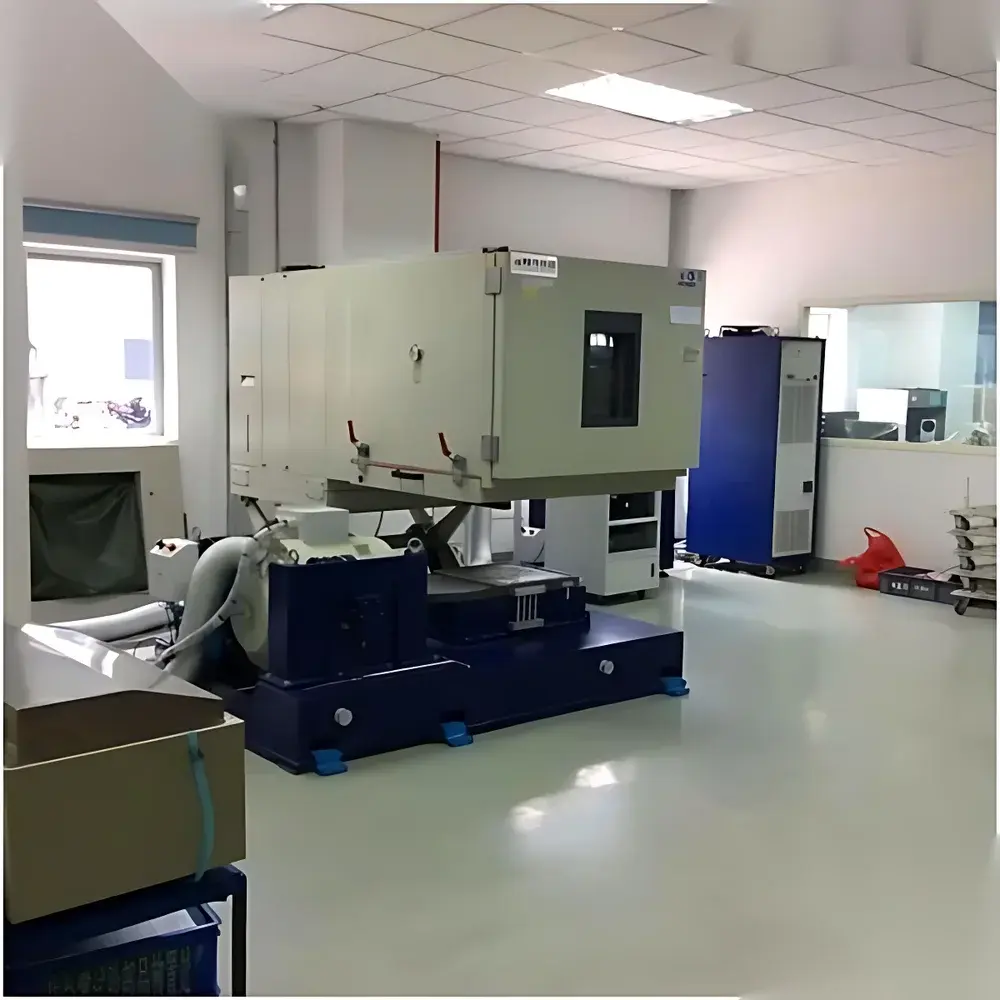
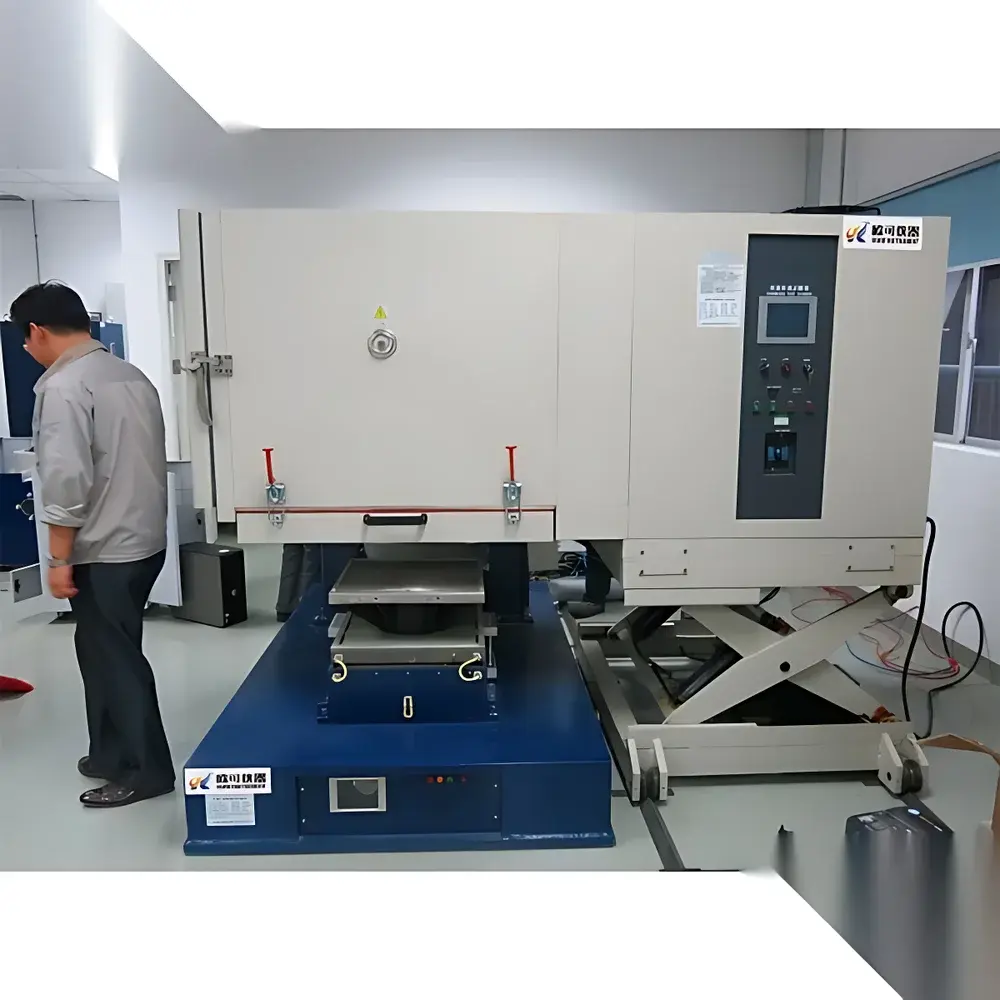
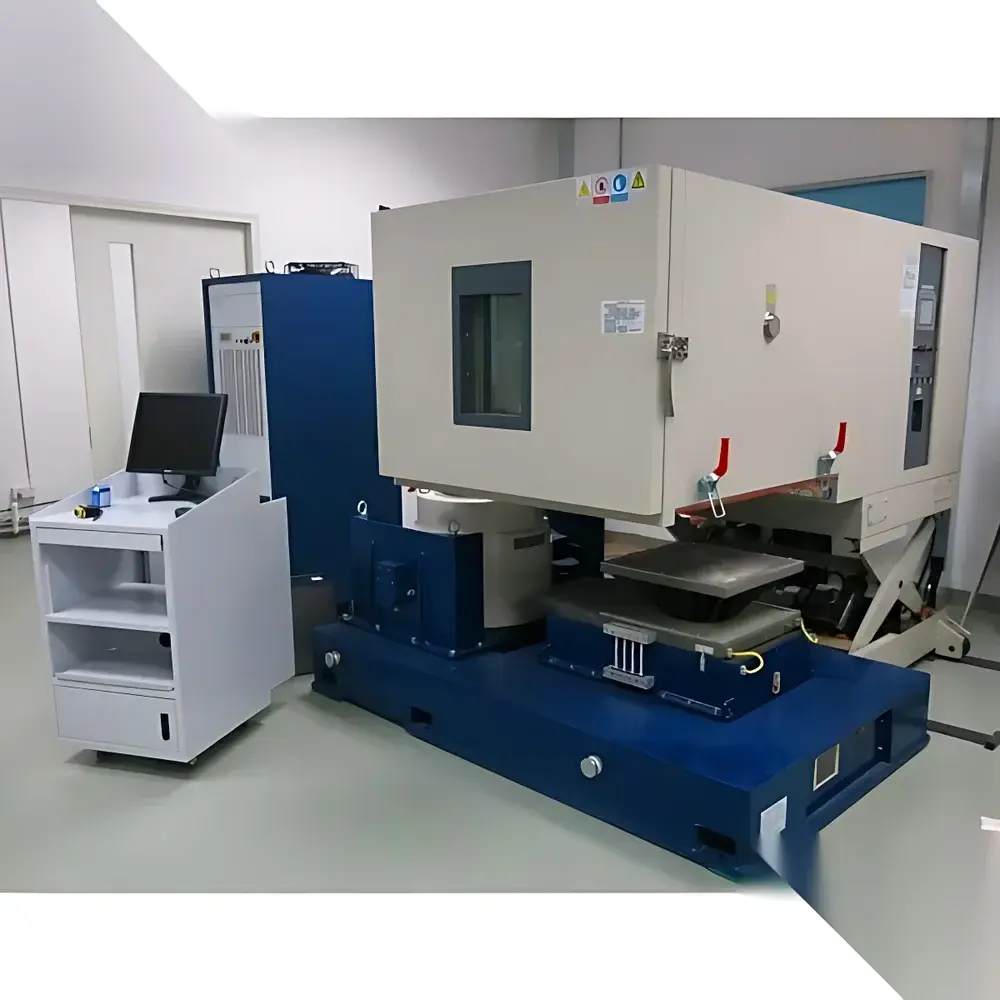
Combined Temperature-Humidity-Vibration Environmental Test Chamber – Standard Industrial Model
| Key | Brand: OEM/White-Label |
|---|---|
| Origin | Imported (Global Sourcing) |
| Manufacturer Type | Authorized Distributor |
| Price | USD 21,000 (FOB) |
| Temperature Range Options | -20°C to +150°C |
| Humidity Range | 20–98% RH |
| Temp. Uniformity | ≤ ±2.0°C |
| Temp. Stability | ≤ ±0.5°C |
| Humidity Deviation | +2 / −3% RH |
| Heating Rate | −20°C → +100°C in ≈35 min |
| Cooling Rate | +25°C → −40°C in ≈50 min |
| Refrigeration System | Twin-stage or cascade refrigeration with hermetic compressors (e.g., Tecumseh/Tecumseh-derived or equivalent industrial-grade units) |
| Air Circulation | Multi-blade centrifugal blower with optimized ducted airflow for uniform chamber distribution |
| Control Algorithm | PID-based digital controller with auto-tuning and parameter lockout |
| Compliance Standards | GB/T 2423.1–2023, GB/T 2423.2–2023, GB/T 5170.2–2017, GB/T 2424.1–2023, GB 11158–2012, GB 10592–2023 |
Overview
The Combined Temperature-Humidity-Vibration Environmental Test Chamber is an integrated reliability validation platform engineered for simultaneous exposure of test specimens to controlled thermal, hygrothermal, and mechanical vibration stressors. It operates on the principle of synchronized environmental simulation—where temperature and humidity conditioning (via forced-air convection and precision vapor injection) is concurrently coupled with electrodynamic or servo-hydraulic vibration excitation across three orthogonal axes (X/Y/Z). This triaxial stress combination replicates real-world operational extremes encountered by aerospace components, automotive ECUs, military electronics, and medical device assemblies during transport, storage, and field deployment. The chamber’s architecture adheres to fundamental thermodynamic and mechanical integrity requirements for accelerated life testing, supporting both steady-state and programmed ramp-hold profiles per internationally recognized environmental test standards.
Key Features
- Multi-stage air circulation system featuring a multi-wing centrifugal blower and optimized internal ductwork to ensure temperature uniformity ≤ ±2.0°C and stability ≤ ±0.5°C across the working volume—critical for repeatable qualification testing.
- Cascade or dual-circuit refrigeration system using industrial-grade hermetically sealed compressors (compliant with Tecumseh-equivalent performance specifications), enabling stable operation down to −80°C without cryogenic consumables.
- Digital PID controller with auto-tuning capability and parameter lockout functionality—prevents unauthorized modification of setpoints during unattended operation and supports traceable profile execution.
- Robust chamber insulation (≥120 mm high-efficiency polyurethane foam) and double-glazed observation window with anti-fog heating to minimize thermal leakage and support visual monitoring under condensing conditions.
- Integrated vibration interface compliant with ISO 5344 and IEC 60068-2-64, supporting mounting plate integration with standard electrodynamic shakers (not included) and synchronization via analog/digital trigger signals.
- Comprehensive safety architecture including over-temperature cut-off, refrigerant pressure monitoring, humidity sensor self-diagnostic, and emergency power-off circuitry aligned with IEC 61000-6-2 EMC immunity requirements.
Sample Compatibility & Compliance
This test chamber accommodates samples up to 600 × 600 × 600 mm (W×D×H) with standardized mounting interfaces for vibration coupling. It meets the technical verification criteria defined in GB/T 5170.2–2017 (temperature/humidity equipment calibration), GB/T 2423.1–2023 (cold testing), GB/T 2423.2–2023 (dry heat), and GB/T 2424.1–2023 (temperature cycling). While not certified to UL or CE as a complete system (due to variable vibration subsystem integration), its thermal-humidity subsystem complies with GB 11158–2012 and GB 10592–2023 for environmental test equipment classification. All control firmware logs include timestamped operational data suitable for GLP/GMP audit trails when used with external data acquisition systems.
Software & Data Management
The embedded controller provides local profile programming, real-time graphing, and event-triggered data logging at user-defined intervals (1–60 s resolution). Export formats include CSV and PDF reports compatible with laboratory information management systems (LIMS). Optional Ethernet or RS-485 connectivity enables remote monitoring and integration into centralized test orchestration platforms. For regulated environments, optional 21 CFR Part 11-compliant software modules are available—featuring electronic signatures, audit trail generation, and role-based access control—though native controller firmware does not include full Part 11 functionality out-of-the-box.
Applications
- Qualification of printed circuit board assemblies (PCBAs) under combined thermal cycling and broadband vibration per MIL-STD-810H Method 514.7.
- Accelerated aging of polymer-based enclosures and gaskets under cyclic humidity soak and mechanical fatigue loading.
- Validation of battery pack thermal management systems under dynamic charge/discharge loads while exposed to −40°C to +85°C gradients and 10–2000 Hz random vibration spectra.
- Reliability screening of avionics housings per DO-160G Section 24 (Temperature), Section 25 (Humidity), and Section 8 (Vibration).
- Pre-compliance environmental stress screening (ESS) for automotive ADAS modules according to ISO 16750-4 and AEC-Q200 stress categories.
FAQ
Does this chamber include the vibration shaker system?
No—the unit is supplied as a temperature-humidity chamber with integrated vibration interface (mounting flange, signal I/O terminals, and synchronization triggers). A compatible electrodynamic shaker must be procured separately and mechanically/electrically integrated by qualified personnel.
What is the maximum allowable sample mass for vibration coupling?
The standard mounting plate supports static loads up to 50 kg. Dynamic load capacity depends on selected shaker model and frequency range; consult shaker manufacturer specifications for payload vs. acceleration limits.
Is calibration certification included with shipment?
A factory-as-built temperature and humidity calibration report (traceable to NIM or equivalent national metrology institute) is provided. On-site field calibration and uncertainty budgeting require third-party service engagement.
Can the controller log data continuously for 30 days?
Yes—internal memory supports ≥30 days of 10-second-interval logging for temperature, humidity, and alarm status. External USB or network export is recommended for long-term archival.
Are custom chamber dimensions available?
Standard configurations are offered in five internal volume tiers (150 L to 1000 L). Custom geometries, extended low-temperature options (e.g., −100°C), or specialized corrosion-resistant interiors can be quoted upon engineering review.



