
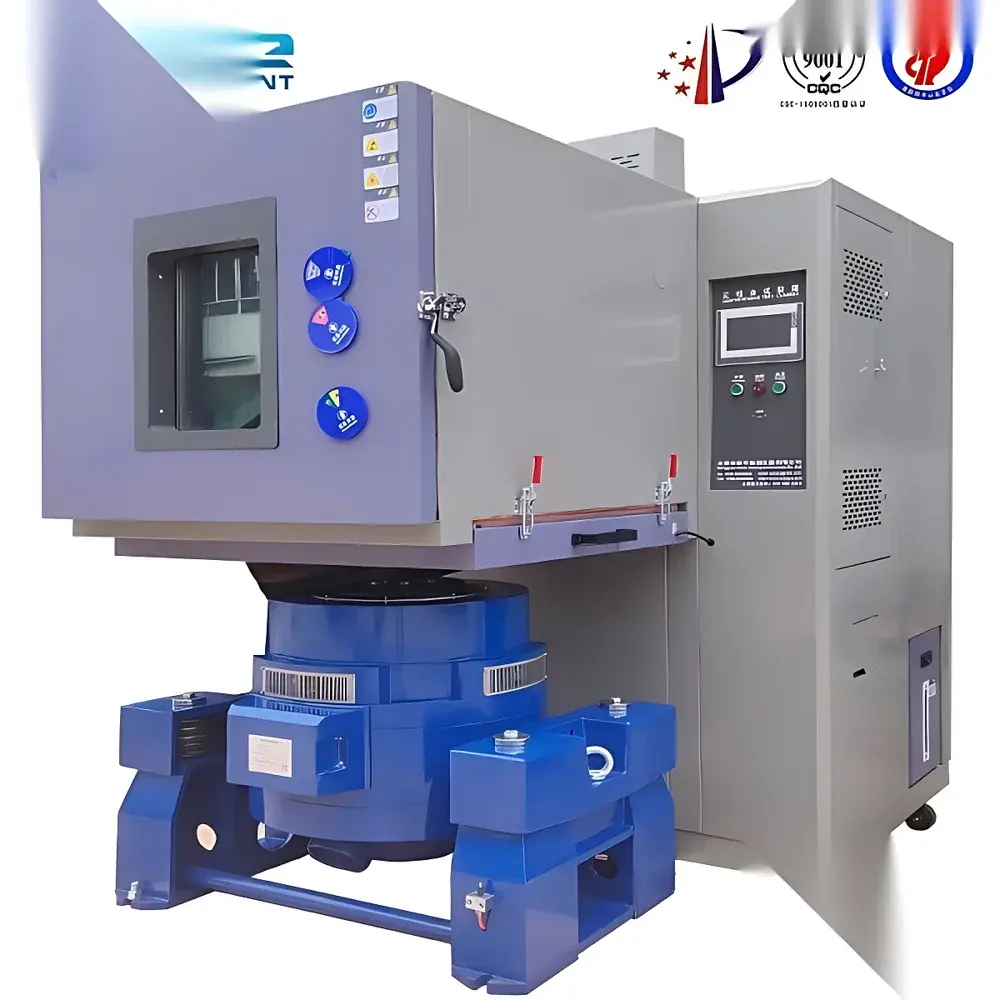
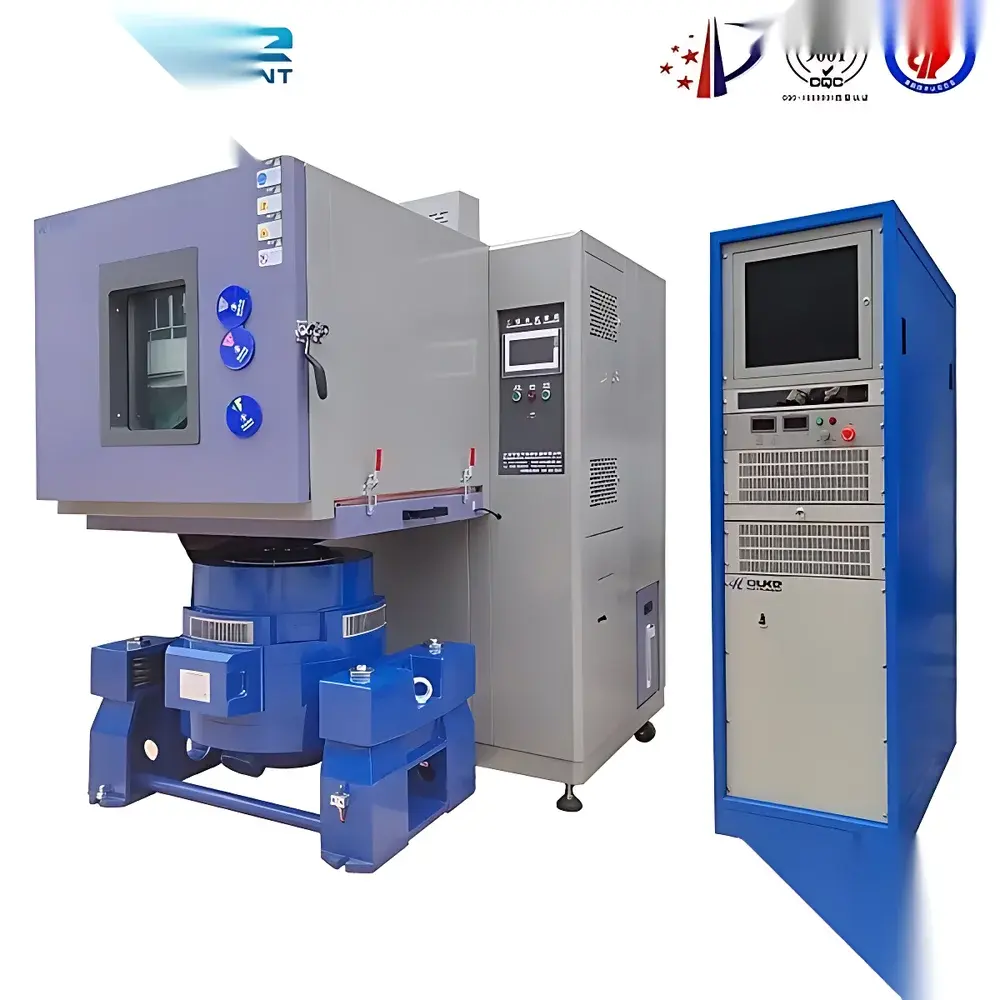
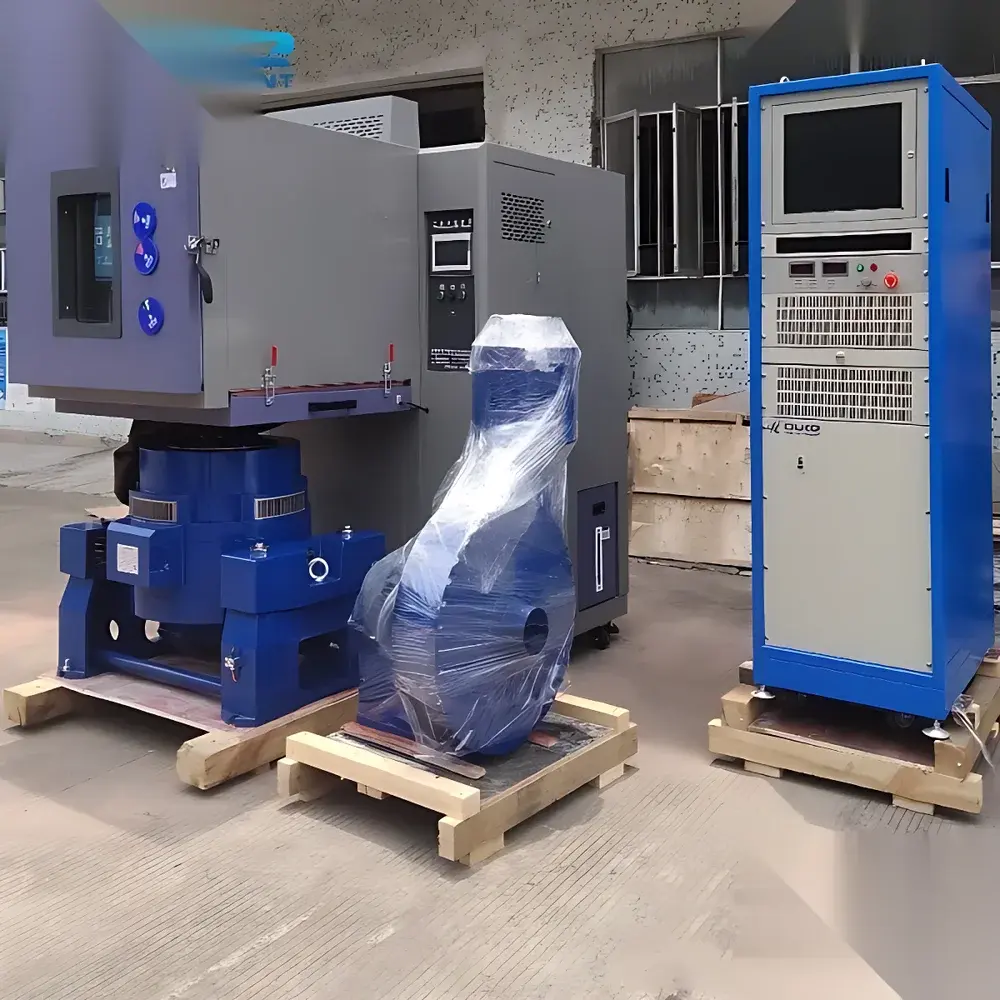
Combined Temperature-Humidity-Vibration Environmental Test Chamber OK-ZTH-225 Series
| Key | Temperature Range: −20 °C to +150 °C / −40 °C to +150 °C / −60 °C to +150 °C |
|---|---|
| Temperature Uniformity | ≤ ±2 °C |
| Temperature Fluctuation | ±0.5 °C |
| Temperature Deviation | ≤ ±2 °C |
| Ramp Rate | 0.7–1.0 °C/min |
| Time Setting Range | 0–9999 h |
| Sinusoidal Force Capacity | 2.94 kN (300 kgf) |
| Frequency Range | 5–500 Hz |
| Max Acceleration | 980 m/s² (100 g) |
| Max Velocity | 1.1 m/s |
| Max Displacement | 25 mm p-p |
| Moving Mass | 2.7 kg |
| Payload Capacity | 120 kg |
| Tabletop Dimensions | 150 mm × 150 mm |
| Vibration Axis | Vertical (Z-axis only) |
| Power Supply | AC 380 V ±10%, 50 Hz, 3-phase 5-wire |
| Cooling Method | Water-cooled |
| Refrigerant | R404A/R23 (HFC-based, non-ozone-depleting) |
| Control System | PLC-based programmable controller with bilingual (English/Chinese) color touchscreen interface (OYO or TIME brand) |
Overview
The OK-ZTH-225 Series Combined Temperature-Humidity-Vibration Environmental Test Chamber is an integrated reliability validation platform engineered for simultaneous exposure of test specimens to controlled thermal, hygric, and dynamic mechanical stress conditions. It operates on the principle of coupled environmental simulation—precisely synchronizing climatic conditioning (via dual-stage refrigeration and steam-based humidification) with electrodynamic or electromagnetic vibration excitation in a single test volume. This architecture enables accelerated life testing, HALT/HASS protocols, and qualification per MIL-STD-810, IEC 60068-2, and automotive OEM standards such as GM W3177 and Ford CETP 00.00-L-467. The chamber’s rigid stainless steel inner chamber, reinforced structural frame, and water-cooled condensing system ensure long-term stability under high-duty-cycle operation across aerospace, automotive electronics, and medical device manufacturing environments.
Key Features
- Triple-range refrigeration system utilizing cascade compression with environmentally compliant HFC refrigerants (R404A/R23), enabling extended low-temperature capability down to −60 °C while maintaining thermal stability during concurrent vibration input.
- Vertical-axis electrodynamic shaker integrated within the insulated chamber base, rated for 2.94 kN sinusoidal force output and capable of 100 g peak acceleration across 5–500 Hz—designed to accommodate payloads up to 120 kg without compromising modal integrity.
- Dual-mode climate control: precision PID-regulated heating/cooling combined with ultrasonic-assisted steam humidification, delivering humidity ranges from 20% to 98% RH at temperatures between +10 °C and +85 °C.
- Robust thermal insulation using high-density fiberglass wool (≥100 mm thickness) and seamless SUS304 mirror-finish interior lining to minimize thermal bridging and ensure uniform field distribution (≤±2 °C uniformity).
- Bilingual (English/Chinese) PLC-driven control interface with real-time waveform monitoring, multi-segment programmability, and event-triggered data logging—compatible with external SCADA integration via Modbus TCP or RS-485.
- Engineered access features: double-layer high-tensile silicone gasketed door seal, heated conductive ITO-coated observation window, and 50 mm diameter feedthrough port with IP54-rated gland assembly for signal/power line routing.
Sample Compatibility & Compliance
The OK-ZTH-225 supports test specimens with maximum dimensions of 150 mm × 150 mm footprint and height clearance compatible with the internal chamber volume (225 L nominal). Its vertical-only vibration configuration ensures compatibility with PCB assemblies, sensor modules, battery packs, and compact electronic enclosures where axial resonance dominates failure modes. The system complies with key international test standard requirements including ISO 16750-4 (road vehicles), IEC 60068-2-64 (vibration—broadband random), IEC 60068-2-30 (damp heat, cyclic), and ASTM D4729 (environmental stress screening of microelectronic packages). All thermal and humidity control subsystems are calibrated traceable to NIST or equivalent national metrology institutes; full calibration certificates and uncertainty budgets are provided upon delivery.
Software & Data Management
The embedded control firmware supports both fixed-condition and multi-step profile execution—including temperature ramp-soak-hold sequences synchronized with vibration sweep/hold patterns. Real-time data acquisition records temperature, relative humidity, acceleration (X/Y/Z), velocity, displacement, and drive current at user-selectable sampling intervals (10 Hz to 1 kHz). Export formats include CSV, TDMS, and XML-compliant datasets suitable for post-processing in MATLAB, Python (NumPy/Pandas), or commercial fatigue analysis tools. Audit trail functionality meets GLP/GMP documentation requirements: all parameter changes, operator logins, and alarm events are timestamped and digitally signed. Optional FDA 21 CFR Part 11 compliance package includes electronic signature workflows, role-based access control, and immutable record archiving.
Applications
- Environmental stress screening (ESS) of avionics components subjected to launch vibration spectra and upper-atmosphere thermal gradients.
- Thermo-mechanical fatigue assessment of lithium-ion battery modules under charge/discharge cycling within humidified thermal chambers.
- Validation of MEMS accelerometer packaging integrity under combined thermal shock and broadband random vibration per AEC-Q200.
- Reliability qualification of automotive ADAS camera housings exposed to condensation cycles and road-induced shake.
- Accelerated corrosion testing of coated metallic substrates under cyclic salt fog, humidity, and mechanical flexure.
- Pre-compliance testing for DO-160 Section 22 (vibration) and Section 4/5 (temperature/humidity) prior to formal certification.
FAQ
What standards does this chamber support for combined environment testing?
It is configured to execute test plans aligned with MIL-STD-810H Method 520.5 (combined environments), IEC 60068-2-66 (combined temperature/humidity/vibration), and RTCA DO-160G Section 22.
Is remote monitoring and control available?
Yes—the PLC controller supports Ethernet connectivity for web-based status viewing, alarm notification via SMTP/SNMP, and secure remote parameter adjustment using TLS-encrypted HTTPS sessions.
Can the vibration system be upgraded to multi-axis operation?
The base configuration supports vertical-axis excitation only; optional triaxial shaker integration (X/Y/Z) is available as a factory-installed upgrade with corresponding structural reinforcement and controller firmware expansion.
What maintenance intervals are recommended for the refrigeration system?
Compressor oil analysis and refrigerant purity verification are advised every 2,000 operational hours; water-cooling circuit descaling and filter replacement should occur quarterly in hard-water regions.
Does the system include validation documentation for IQ/OQ protocols?
Yes—delivery includes Factory Acceptance Test (FAT) reports, as-built drawings, calibration certificates for all critical sensors, and a customizable IQ/OQ protocol template compliant with ISO/IEC 17025 and GAMP5 guidelines.



