
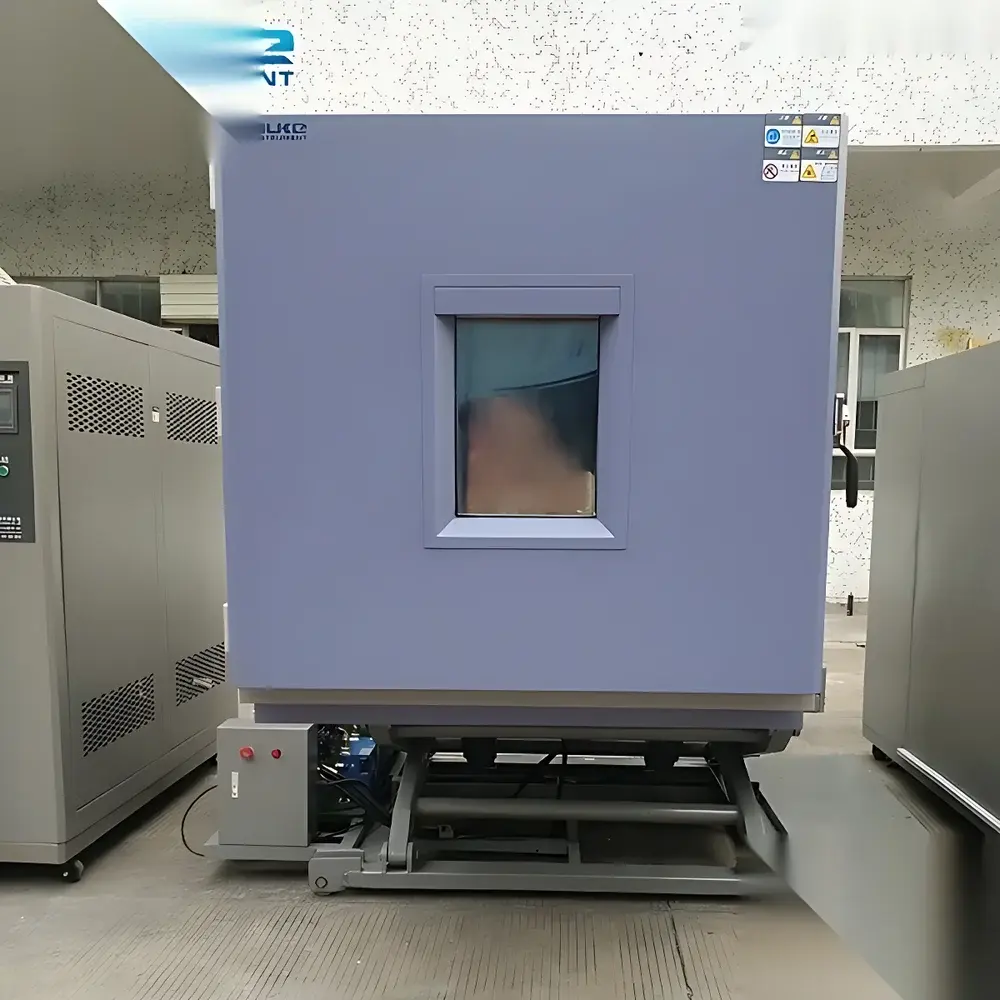
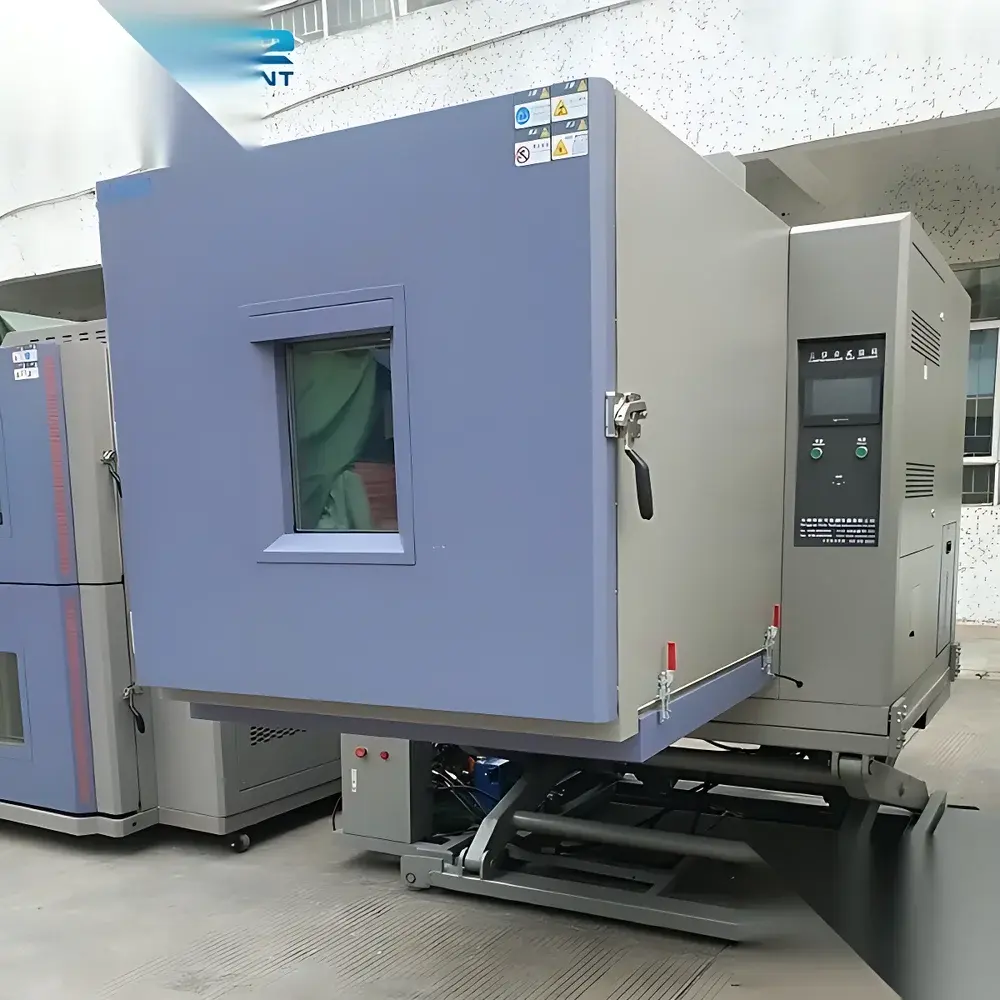
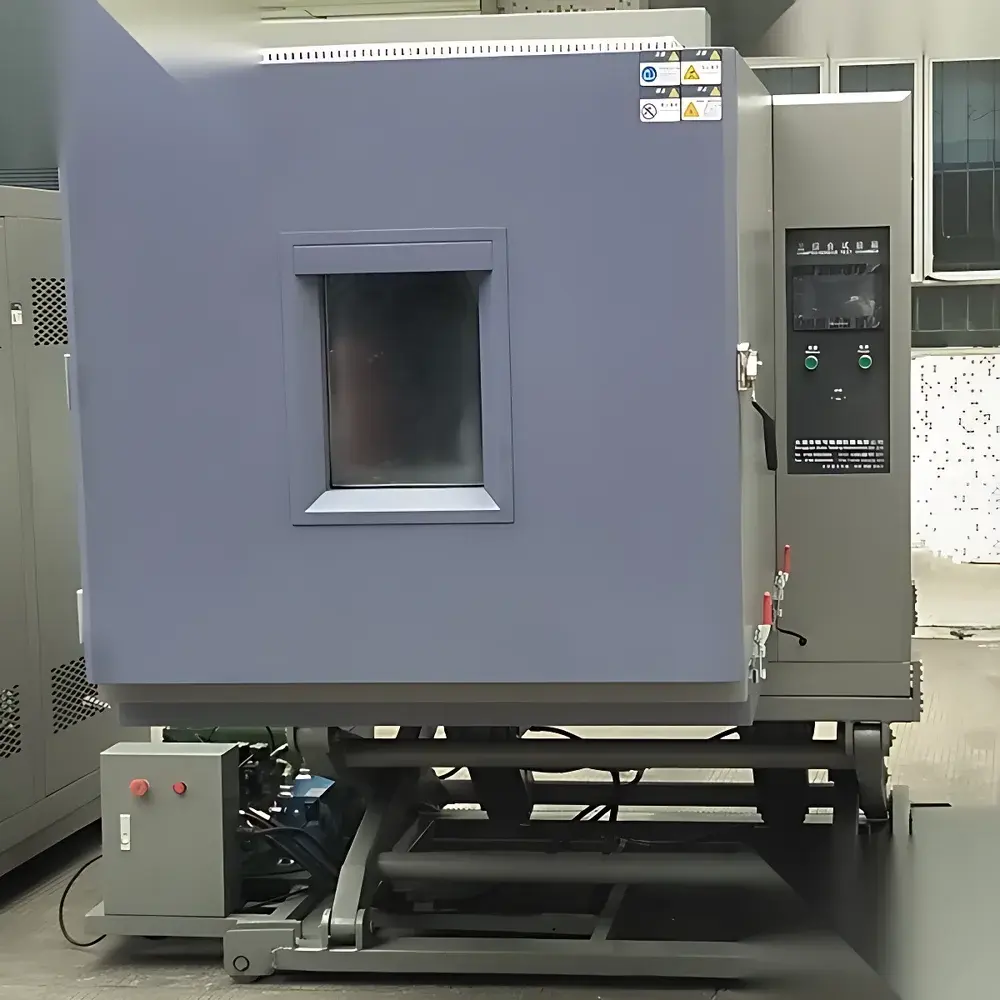
Combined Temperature-Humidity-Vibration Environmental Test System
| Tabletop Dimensions | 500 × 500 mm |
|---|---|
| Vibration Axis | Vertical |
| Maximum Payload | 100 kg |
| Frequency Range | 1–600 Hz |
| Sweep Frequency Range | 1–600 Hz |
| Displacement Amplitude | 0–5 mm (peak-to-peak) |
| Maximum Acceleration | 20 g |
| Time Control Resolution | 1 second (up to 1 year duration) |
| Waveforms | Sine, Half-Sine |
| Drive Power | 2.2 kVA |
| Input Voltage | 220 V ±10% AC |
| Maximum Current | 5 A |
| Frequency Resolution | 0.01 Hz (displayed to 0.1 Hz) |
| Shaker Body Dimensions (H×W×D) | 500 × 500 × 160 mm |
| Origin | Imported |
| Manufacturer Type | Authorized Distributor |
Overview
The Combined Temperature-Humidity-Vibration Environmental Test System is an integrated reliability validation platform engineered for simultaneous application of thermal stress, humidity exposure, and mechanical vibration—enabling accelerated life testing, failure mode identification, and structural integrity assessment under realistic operational conditions. Based on electrodynamic shaker technology coupled with a climate-controlled chamber, the system implements synchronized control of temperature (typically −70 °C to +180 °C), relative humidity (10–98% RH), and broadband mechanical excitation (1–600 Hz). This triaxial environmental simulation capability aligns with industry-critical test standards including MIL-STD-810H Method 514.7 (vibration), Method 502.7 (temperature), and Method 507.6 (humidity), as well as IEC 60068-2 series and automotive-specific protocols such as ISO 16750-4 and GMW 3172. The system supports both deterministic (fixed-frequency) and stochastic (sweep, random, or transient) vibration profiles, facilitating compliance-driven qualification across aerospace, defense electronics, automotive ECUs, and medical device packaging.
Key Features
- Electrodynamic shaker with vertical-axis configuration and 100 kg payload capacity, optimized for high-force, low-distortion output across 1–600 Hz
- Digital PID-controlled frequency generation with 0.01 Hz resolution and real-time sweep rate adjustment (logarithmic/linear)
- Integrated anti-electromagnetic-interference circuitry ensuring stable operation in high-noise laboratory or production-floor environments
- Modular chamber design enabling precise coupling between vibration actuator and environmental enclosure without mechanical decoupling loss
- Programmable test duration from 1 second to 365 days, with automatic shutdown and event logging upon completion
- Front-panel digital interface with dedicated sine/half-sine waveform selection, amplitude ramping, and acceleration limiting functions
- Compact shaker body (500 × 500 × 160 mm) and reinforced base structure eliminating need for anchoring—suitable for standard laboratory flooring
Sample Compatibility & Compliance
The system accommodates test specimens up to 500 × 500 mm footprint and 100 kg mass, supporting rigid mounting via threaded inserts or custom fixture plates. It is routinely deployed in GLP-compliant laboratories for qualification of PCB assemblies, avionics enclosures, battery modules, and sensor housings. All operational parameters—including temperature setpoint stability (±0.5 °C), humidity accuracy (±2% RH), and acceleration linearity (<±5% deviation from commanded value)—are traceable to NIST-calibrated reference instruments. The control architecture supports audit-ready data logging per FDA 21 CFR Part 11 requirements when paired with compliant software (e.g., LabVIEW-based SCADA or third-party test management suites). Compliance documentation includes ISO/IEC 17025-accredited calibration certificates for vibration transducers and environmental sensors.
Software & Data Management
While the base unit features standalone front-panel operation, optional PC-based control software enables full test sequencing, real-time waveform visualization, and post-test spectral analysis (FFT, PSD, SRS). Data export is supported in CSV, TDMS, and MATLAB-compatible formats. The software layer incorporates configurable alarm thresholds (e.g., over-acceleration, temperature excursion), automated report generation with timestamped metadata, and user-access-level permissions aligned with ISO 9001 quality management systems. Optional integration with enterprise MES or PLM platforms allows traceability from test execution to BOM-level component records.
Applications
This system is routinely applied in early-stage design verification (DV) and production lot acceptance testing (PV) for mission-critical components. Typical use cases include: thermal cycling-induced solder joint fatigue under concurrent vibration (IPC-9701); humidity-driven corrosion evaluation of connectors during mechanical shock; resonance mapping of EV battery trays across operating temperature bands; and validation of MEMS sensor housing integrity under combined hygrothermal-mechanical stress. End-user sectors span Tier-1 automotive suppliers, satellite subsystem integrators, Class II medical device manufacturers, and 5G infrastructure OEMs—where multi-stress interaction effects cannot be isolated using sequential single-environment testing.
FAQ
Does this system support random vibration profiles?
No—the standard configuration supports only sine and half-sine waveforms. Random vibration capability requires optional controller upgrade and power amplifier expansion.
Is external cooling water required for continuous operation at 20 g above 100 Hz?
Yes—sustained high-acceleration operation beyond 100 Hz necessitates auxiliary chilled water supply (recommended flow: ≥4 L/min at 15 °C inlet) to maintain coil temperature within safe limits.
Can the system be configured for horizontal vibration?
Horizontal axis operation is not supported in the standard vertical-shaker architecture; retrofitting requires mechanical reorientation and structural reinforcement—contact engineering support for feasibility assessment.
What is the typical calibration interval for the integrated sensors?
Vibration transducers and environmental probes are calibrated annually per ISO/IEC 17025 requirements; certificate of calibration is provided with each service visit.
Is remote monitoring possible via Ethernet or Modbus?
Ethernet connectivity is available as an optional module, enabling SNMP-based status polling and secure HTTPS API access for integration into centralized test fleet management systems.
Related Products



