
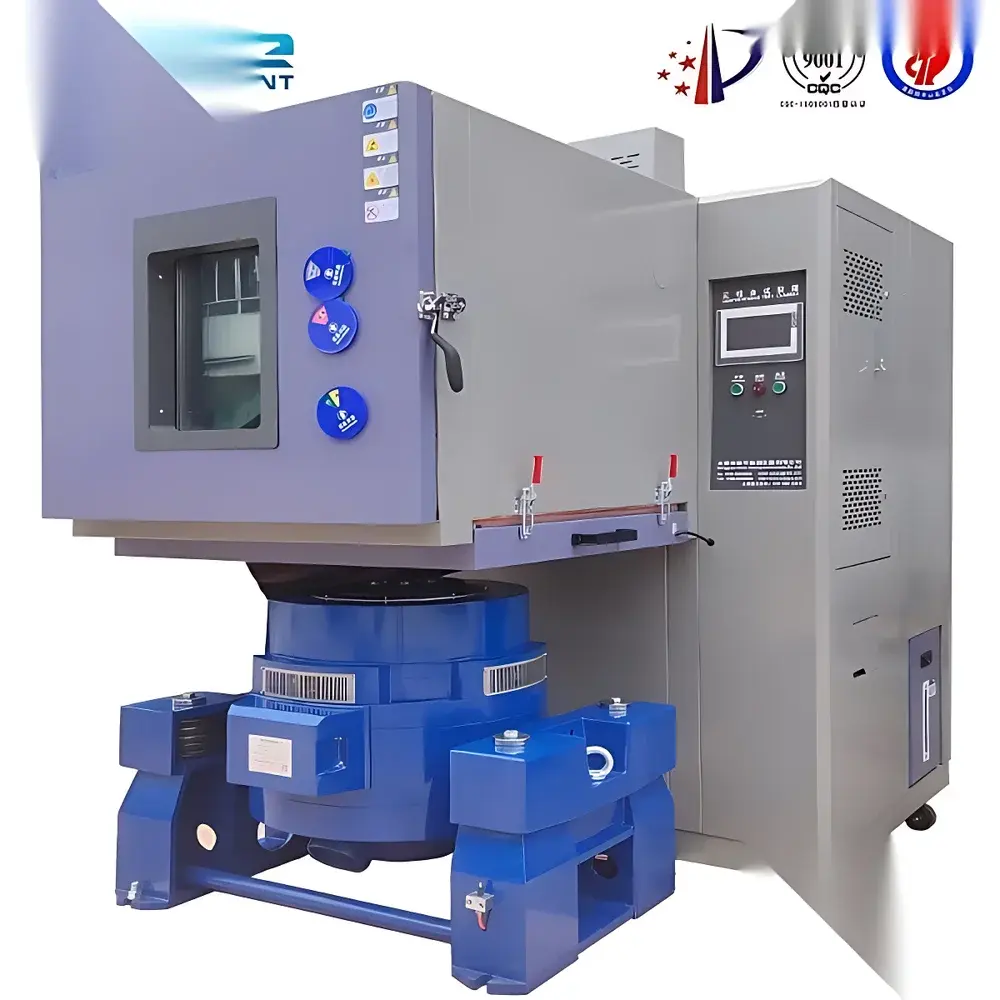
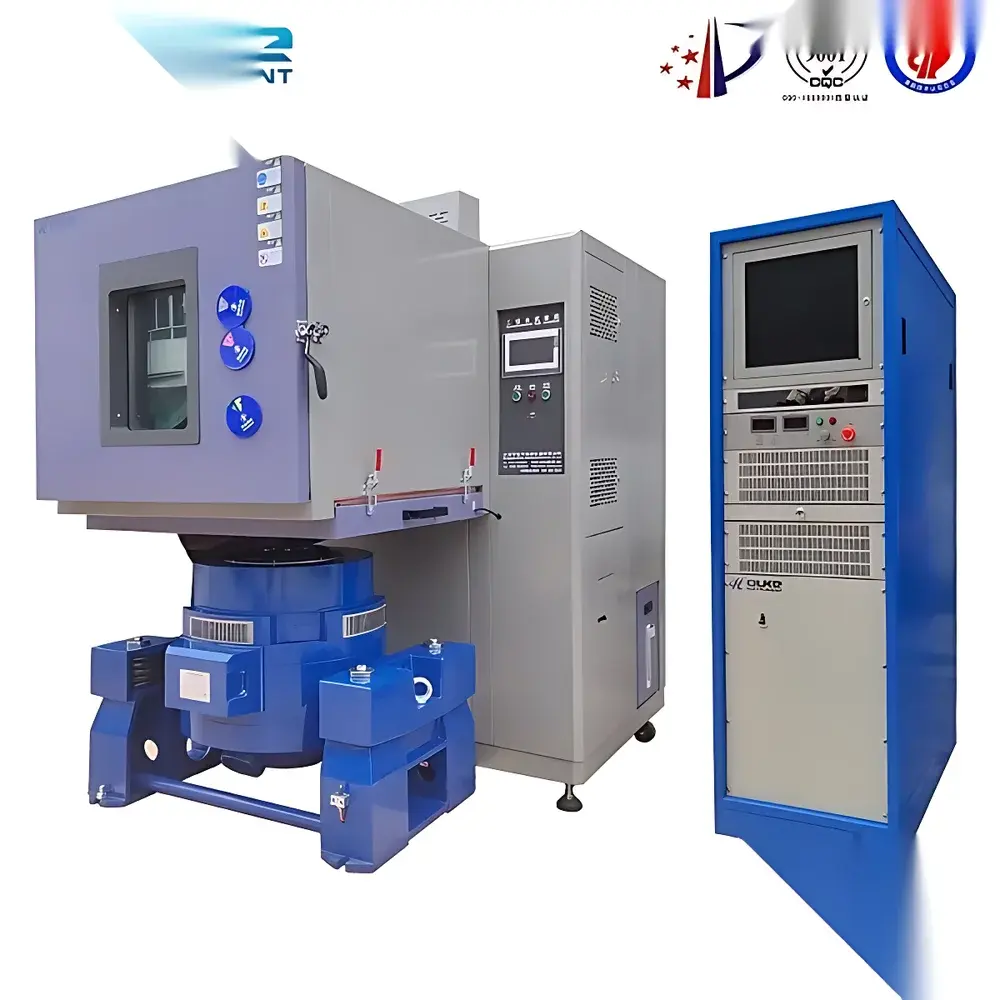
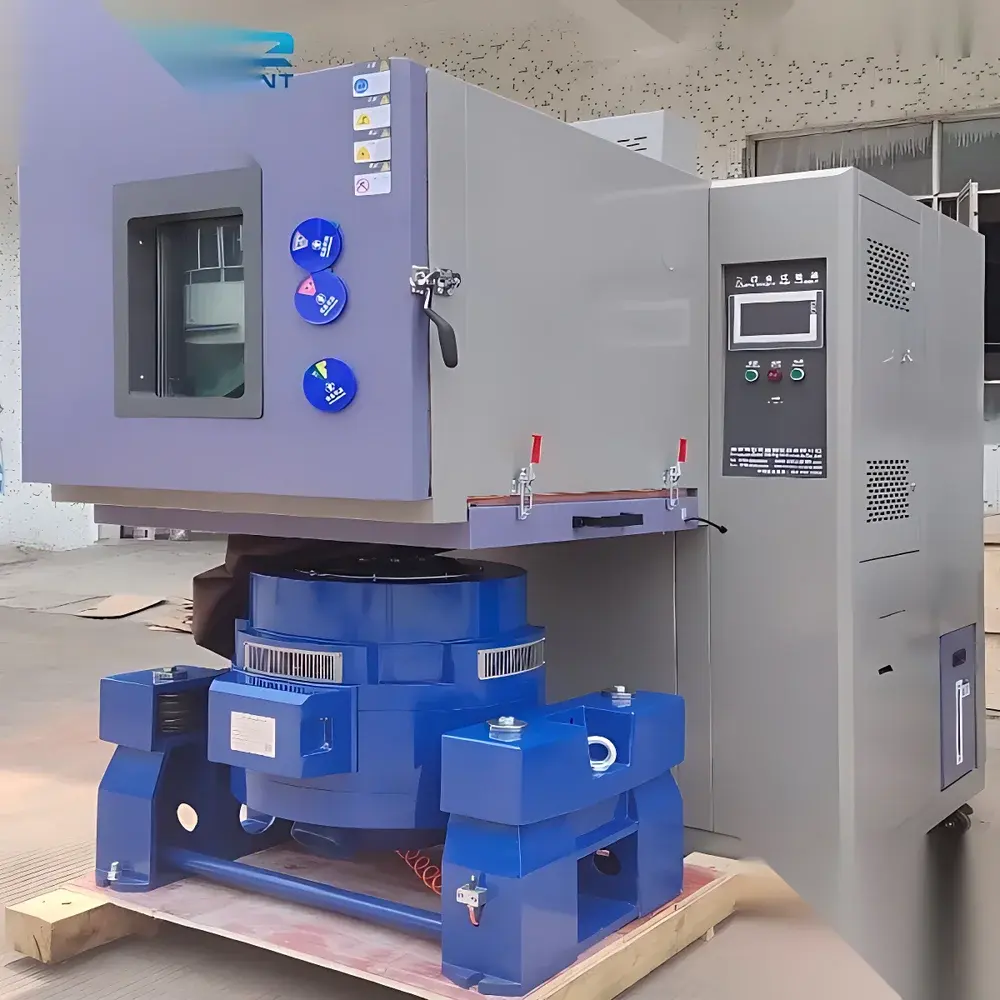
Combined Temperature-Humidity-Vibration Environmental Test System
| Brand | Other Brands |
|---|---|
| Origin | Imported |
| Manufacturer Type | Authorized Distributor |
| Price | USD 21,500 (FOB) |
| Vibration Frequency Range | 5–3000 Hz |
| Rated Sinusoidal Force | 14.2 kN |
| Rated Random Force (RMS) | 14.2 kN RMS |
| Maximum Acceleration | 20 g (196 m/s²) |
| Maximum Velocity | 2.00 m/s |
| Maximum Displacement | 51 mm peak-to-peak |
| Maximum Load Capacity | 300 kg |
| Ambient Operating Temperature | 5–40 °C (24-hr avg ≤25 °C) |
| Ambient Humidity | ≤85% RH |
| Power Supply | AC 220 V (±10%) / 50 Hz or AC 380 V (±10%) / 50 Hz |
Overview
The Combined Temperature-Humidity-Vibration Environmental Test System is an integrated reliability validation platform engineered for simultaneous application of thermal cycling, humidity exposure, and mechanical vibration stress. It operates on the principle of coupled environmental excitation—where controlled climatic conditions (temperature and relative humidity) are maintained inside a sealed chamber while a high-performance electrodynamic shaker applies calibrated vibratory inputs (sinusoidal, random, or transient waveforms) to the test specimen via a rigid load table. This system enables accelerated life testing, failure mode analysis, and qualification verification per international product reliability standards. Designed for aerospace components, automotive ECUs, medical electronics, and industrial control systems, it supports deterministic stress profiling across three physical domains—thermal, hygroscopic, and dynamic mechanical—within a single test cycle, eliminating sequential test artifacts and reducing total validation time by up to 60% compared to standalone chamber/shaker workflows.
Key Features
- Triple-domain synchronization: Real-time coordination between refrigeration/humidification subsystems and electrodynamic shaker controller ensures phase-aligned thermal-vibrational stress application without timing drift.
- High-fidelity shaker performance: 14.2 kN rated sinusoidal and random force output with closed-loop acceleration/velocity/displacement control; compliant with ISO 5344 and IEC 60068-2-64 for vibration test integrity.
- Thermal-humidity chamber: Dual-refrigerant cascade cooling system achieving -70 °C to +180 °C temperature range; steam humidification and desiccant drying enabling 10–98% RH control at ±2% RH accuracy.
- Structural integrity: Reinforced steel frame with anti-resonance isolation mounts; optimized modal damping to suppress chamber-shell coupling below 50 Hz, preserving shaker transfer function fidelity.
- Safety-critical interlocks: Redundant over-acceleration, over-temperature, over-humidity, and over-pressure shutdown logic compliant with IEC 61000-4-27 and EN 60204-1.
- Modular expansion capability: Optional LN₂ precooling, HALT/HASS profile modules, and MIL-STD-810G-compliant shock pulse integration.
Sample Compatibility & Compliance
The system accommodates test specimens up to 300 kg mass and 51 mm peak-to-peak displacement envelope, with standard 600 × 600 × 600 mm internal chamber dimensions (customizable). Mounting interfaces include threaded T-slots (M10), inertial reaction mass anchoring points, and through-chamber feedthroughs for sensor cabling. Regulatory alignment includes full traceability to GB/T 10592, GB/T 2423.1 (IEC 60068-2-1), GB/T 2423.2 (IEC 60068-2-2), GB/T 2423.3 (IEC 60068-2-78), JJG 190 (vibration calibration), and ISO 16750-4 for automotive environmental stress screening. All firmware and calibration certificates support GLP/GMP audit trails and FDA 21 CFR Part 11 electronic signature requirements.
Software & Data Management
Control and data acquisition are managed via a real-time deterministic OS (VxWorks-based) with dual-channel synchronized sampling at 100 kHz per channel. The embedded software suite provides: (1) multi-axis vibration profile editor supporting SRS, PSD, sine-on-random, and transient synthesis; (2) thermohygrometric ramp-soak-dwell sequencing with humidity condensation modeling; (3) automated test report generation in PDF/XML formats with embedded metadata (test ID, operator, calibration expiry, environmental logs); (4) secure database archiving with role-based access control (RBAC) and SHA-256 hash integrity verification. Export options include CSV, MATLAB .mat, and NI TDMS for post-test spectral analysis using MATLAB Signal Processing Toolbox or LMS Test.Lab.
Applications
This system is deployed in R&D labs and quality assurance centers for: qualification testing of avionics enclosures under DO-160 Section 20; durability validation of battery packs per UN 38.3 and IEC 62133; solder joint fatigue assessment in PCB assemblies using combined thermal cycling and resonant vibration; reliability screening of MEMS sensors under mixed-mode stress; and accelerated corrosion testing of coated metallic substrates via humidity-vibration synergy. Its deterministic multi-stress architecture is particularly effective for identifying latent defects such as wire bond lift-off, conformal coating delamination, and connector fretting wear—failure mechanisms rarely exposed under single-stress conditions.
FAQ
What is the maximum allowable acceleration limit across the full frequency range?
Acceleration is capped at 20 g (196 m/s²) regardless of frequency; this limit is enforced by hardware-synchronized safety governors and verified during annual metrological calibration per ISO 17025.
Can the system perform HALT testing with rapid thermal transients?
Yes—optional liquid nitrogen injection module enables thermal ramp rates up to 60 °C/min, meeting ASTM F1879 and Telcordia GR-468-CORE HALT protocol requirements.
Is remote monitoring and control supported over corporate networks?
Standard Ethernet (TCP/IP) interface with TLS 1.2 encryption supports secure remote operation via browser-based HMI; firewall-configurable port mapping and VLAN segmentation are fully documented in the network integration manual.
How is shaker-to-chamber decoupling validated during installation?
A modal survey using impact hammer and triaxial accelerometers is conducted onsite; acceptance criterion requires <−30 dB cross-coupling between shaker drive signal and chamber wall response below 100 Hz.
Does the system comply with ISO/IEC 17025 for accredited lab use?
Yes—the base configuration includes NIST-traceable calibration certificates for all critical sensors (accelerometers, PT100s, capacitive RH probes), and firmware supports audit-ready calibration history logging with digital signatures.



