
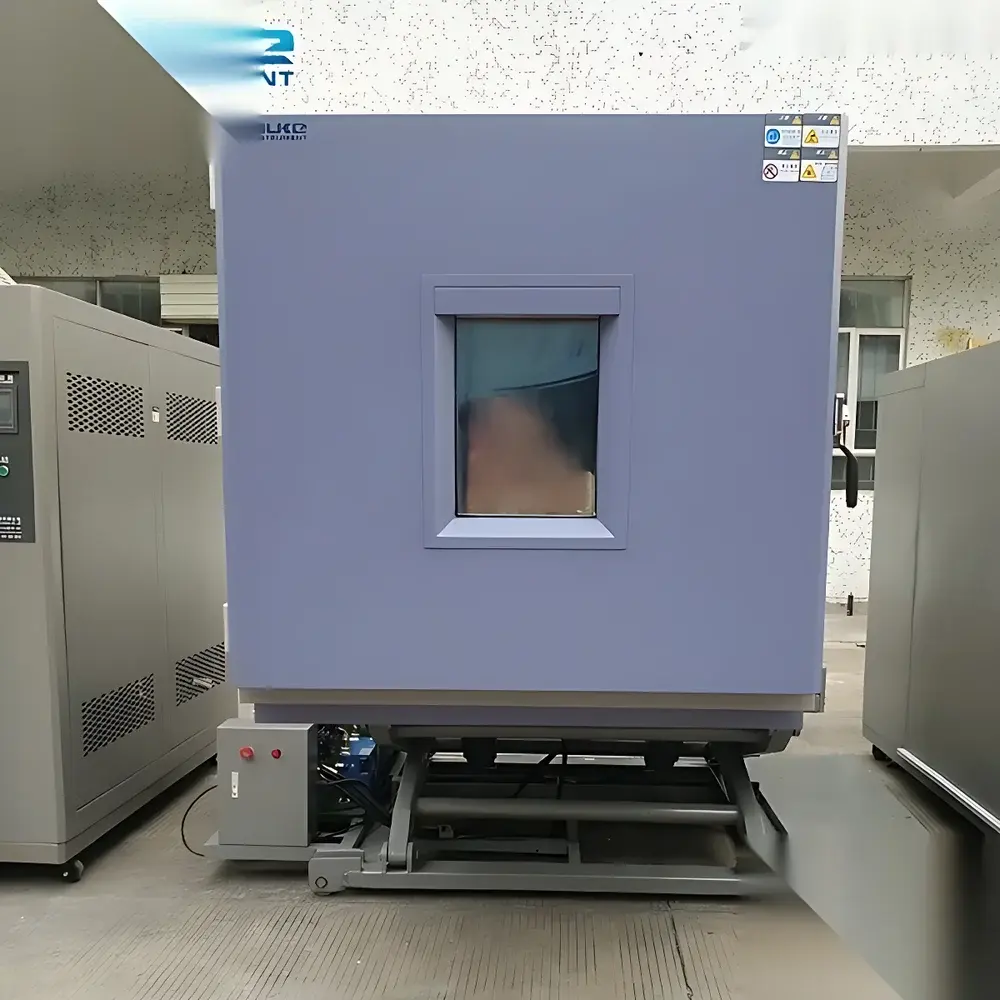
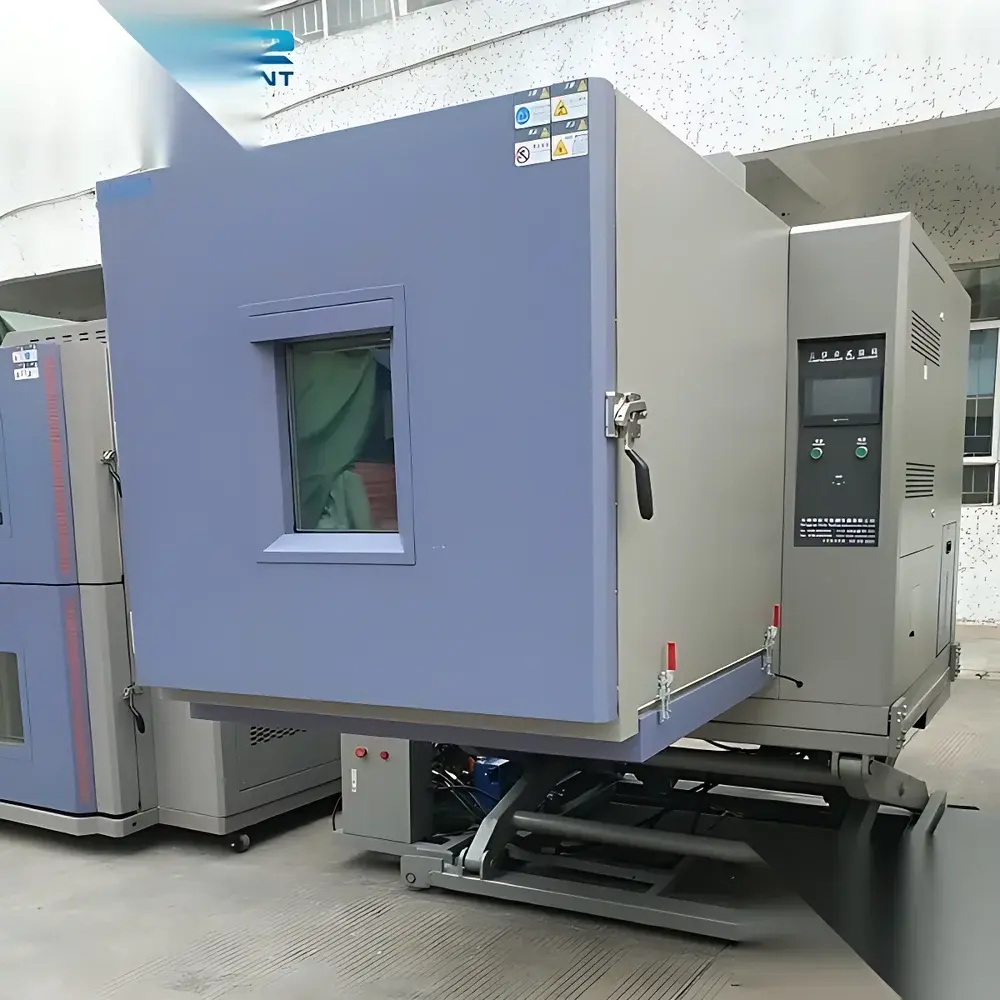
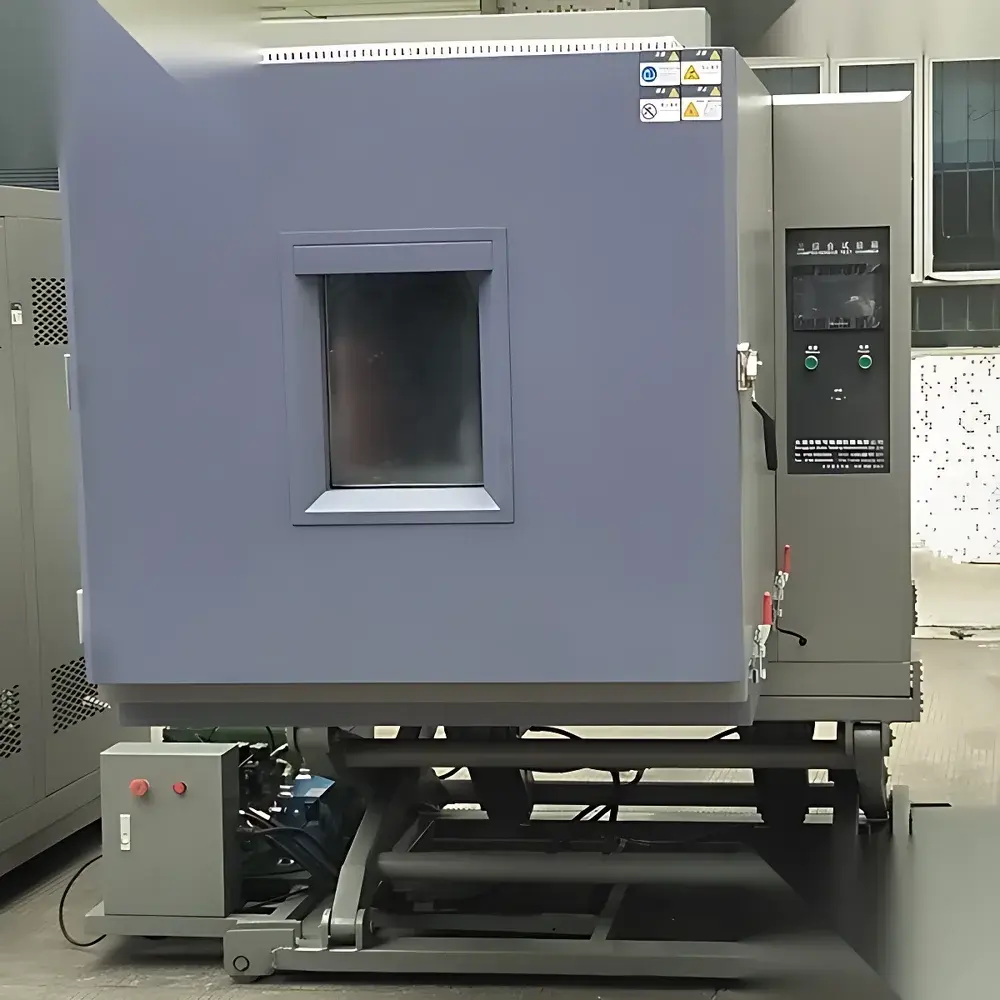
Combined Temperature-Humidity-Vibration Environmental Test System
| Key | Table Size: 350 × 350 mm (customizable) |
|---|---|
| Max Load Capacity | 25 / 50 / 75 / 100 kg |
| Vibration Axis | Vertical, Horizontal, or Dual-Axis (selectable) |
| Frequency Range | 1–600 Hz / 1–3000 Hz / 1–5000 Hz |
| Displacement Peak-to-Peak | 0–5 mm (5 mm max) |
| Max Acceleration | <20 g |
| Vibration Duration | 0–9999 h/min/sec (programmable) |
| Waveform | Sinusoidal |
| Frequency Resolution | 0.01 Hz |
| Frequency Accuracy | ±0.1 Hz |
| Power Supply | AC 220 V / 50 Hz or AC 380 V / 50 Hz |
| Compliance | GB/T 2423.10 |
Overview
The Combined Temperature-Humidity-Vibration Environmental Test System is an integrated reliability validation platform engineered for rigorous physical stress testing under dynamically coupled environmental conditions. It simultaneously applies controlled thermal cycling (high/low temperature), humidity variation, and mechanical vibration—enabling replication of real-world transport, storage, and operational environments encountered by electronic assemblies, automotive components, precision instruments, and consumer goods. The system operates on the principle of sinusoidal forced vibration in conjunction with programmable climatic conditioning, delivering synchronized multi-stress exposure critical for accelerated life testing, design validation, and failure mode analysis. Its architecture supports deterministic mechanical excitation via electromagnetic shaker technology while maintaining precise thermal-hygrometric control per IEC 60068-2 series and GB/T 2423 standards.
Key Features
- Dual- or tri-axis vibration capability (vertical, horizontal, or combined), configurable to match actual mounting orientation and service loading profiles.
- Four-point synchronous electromagnetic excitation ensures uniform acceleration distribution across the 350 × 350 mm test table—minimizing modal distortion and supporting repeatable, high-fidelity response measurement.
- Programmable frequency resolution down to 0.01 Hz with ±0.1 Hz accuracy, enabling precise resonance tracking and narrow-band dwell testing.
- Flexible test sequencing: single-frequency dwell, linear/logarithmic sweep, multi-segment stepped profiles, and user-defined modulated sequences—including jump-frequency transitions and amplitude-acceleration mode switching within a single test run.
- Integrated anti-electromagnetic-interference circuitry eliminates signal drift and controller instability during high-g, high-frequency operation—ensuring long-term calibration stability and data integrity.
- Real-time amplitude prediction algorithm and intuitive digital amplitude adjustment allow rapid setup and repeatability verification without external instrumentation.
- Modular test definition supports unlimited nested vibration routines (sweep, dwell, random, resonant search) combinable with temperature/humidity ramps—fully scriptable via embedded controller or PC interface.
Sample Compatibility & Compliance
This system accommodates specimens up to 100 kg across standard and custom table configurations, supporting PCB assemblies, ECUs, sensors, housings, and subassemblies with minimal fixturing constraints. It complies with GB/T 2423.10 (vibration), GB/T 2423.1–2 (cold/heat), and GB/T 2423.3 (damp heat), and aligns with international equivalents including IEC 60068-2-6 (vibration), IEC 60068-2-1/2 (cold/heat), and ISO 16750-3 (automotive environmental requirements). All control firmware and data logging modules are structured to support GLP/GMP-aligned audit trails when operated in regulated development environments.
Software & Data Management
A full-featured Windows-based control suite provides waveform visualization, real-time spectral monitoring, and automated report generation—including time-history plots, FFT spectra, and pass/fail status flags against user-defined thresholds. Data is stored in timestamped, non-rewritable binary format with embedded metadata (test ID, operator, configuration checksum, environmental setpoints). Export options include CSV, PDF, and XML formats compatible with LIMS integration. The software supports 21 CFR Part 11-compliant user access controls, electronic signatures, and change history logging—meeting documentation rigor required for ISO 17025 accredited labs and automotive Tier-1 supplier validation workflows.
Applications
- Design verification of solder joint integrity and interconnect fatigue resistance under thermal-mechanical cycling.
- Validation of structural stiffness and damping characteristics in plastic enclosures and composite brackets.
- Qualification of MEMS devices and optical modules subjected to broadband vibration and condensation cycles.
- Reliability screening of battery packs, power converters, and ADAS sensors for automotive OEM PPAP submission.
- Failure root cause isolation through correlated thermal-vibrational stress mapping (e.g., identifying cold solder cracks exacerbated by resonant excitation).
- Environmental stress screening (ESS) and HALT/HASS protocol execution for electronics manufacturing.
FAQ
What standards does this system fully support for vibration testing?
It meets GB/T 2423.10 and IEC 60068-2-6 for sinusoidal vibration, with optional upgrade paths for random vibration per IEC 60068-2-64.
Can the system perform temperature-vibration-humidity coupling in real time?
Yes—temperature, humidity, and vibration profiles are synchronized and executed concurrently from a unified test plan; no manual staging or sequential operation is required.
Is remote monitoring and control supported?
The system includes Ethernet connectivity and supports secure remote access via TLS-encrypted client interface for live parameter adjustment and diagnostic telemetry.
How is calibration traceability maintained?
Vibration transducers are supplied with NIST-traceable calibration certificates; thermal/humidity sensors are certified to ISO/IEC 17025-accredited laboratories, with annual recalibration intervals documented in the maintenance log.
What safety mechanisms prevent over-stress damage to test articles?
Hardware-enforced limits on acceleration, displacement, and thermal rate-of-change are active at the controller level; emergency stop circuits interrupt all subsystems independently upon threshold violation.



