
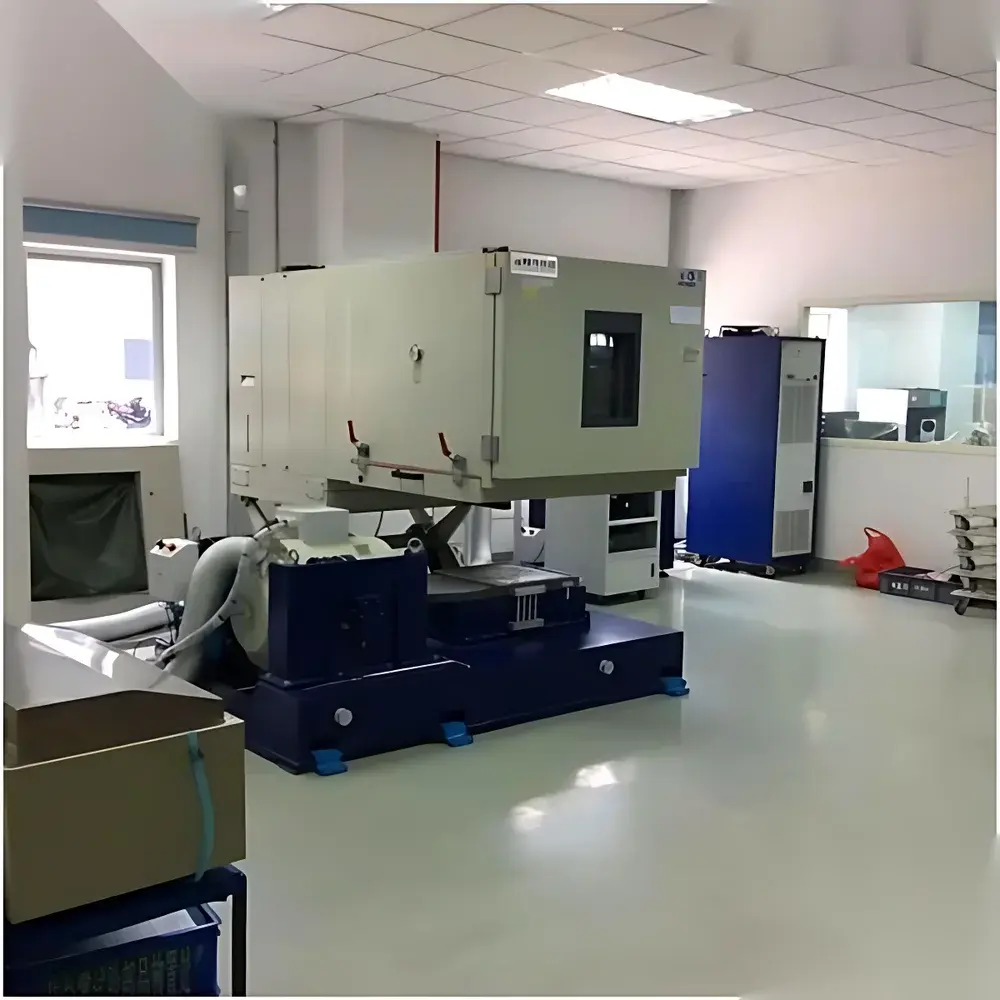
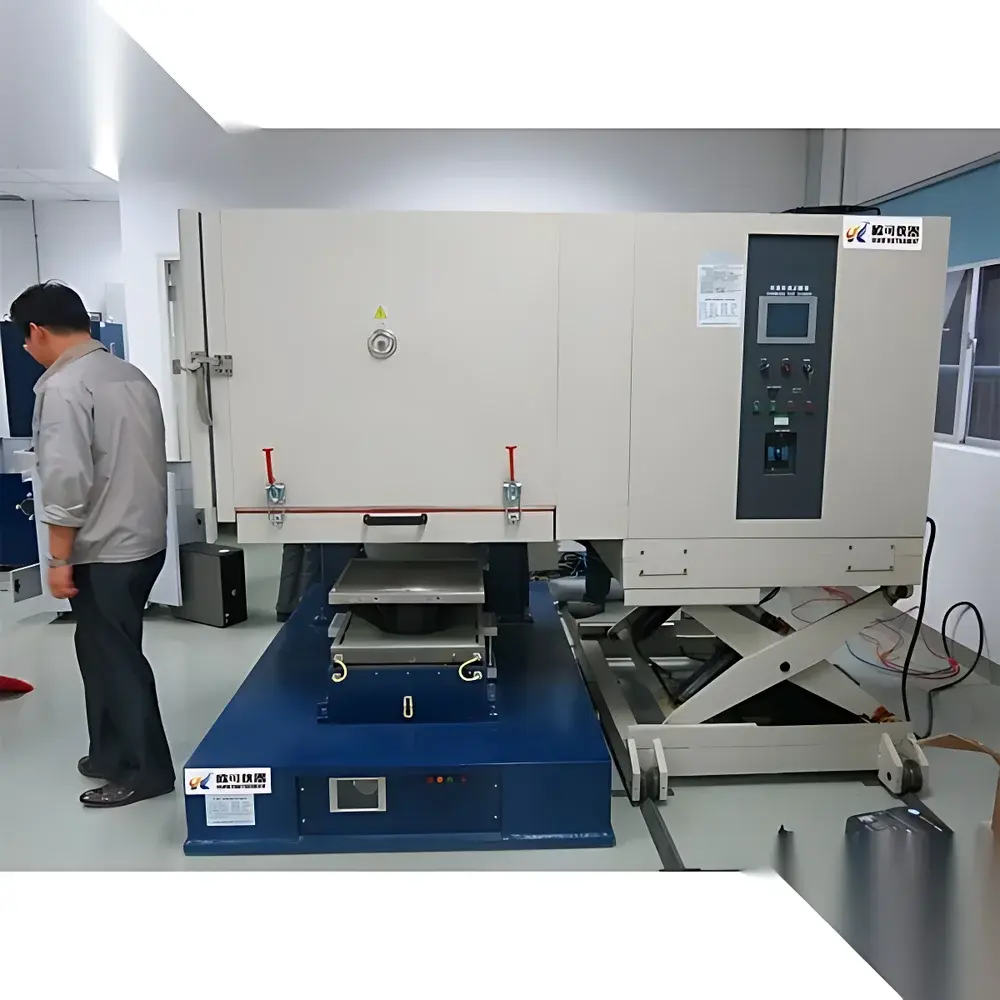
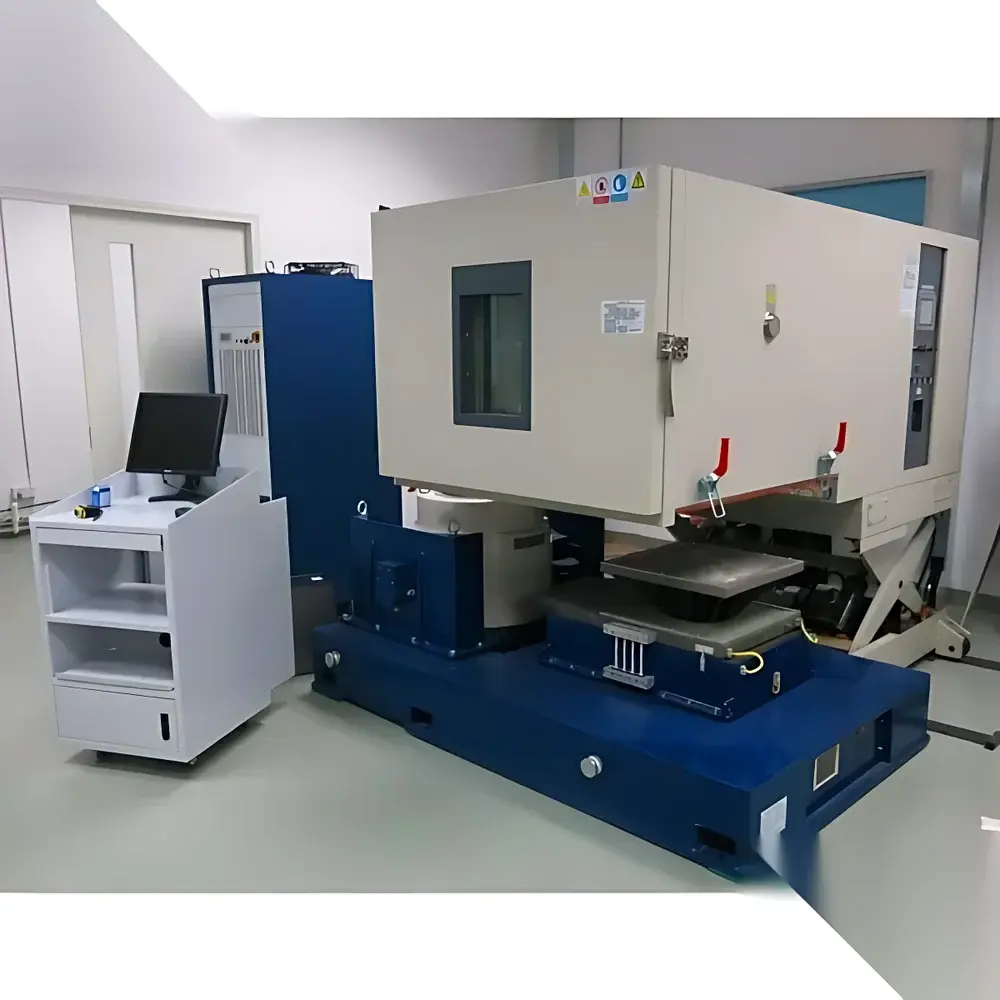
Combined Temperature-Humidity-Vibration Environmental Test System
| Key | Temperature Range: -40°C to +100°C |
|---|---|
| Humidity Range | 30–98% RH |
| Temp. Uniformity | ≤2°C (-40–100°C) |
| Temp. Stability | ±0.5°C |
| Humidity Control Accuracy | ±3% RH |
| Heating/Cooling Rate | ≥1°C/min |
| Internal Chamber Dimensions | 1000 × 900 × 1100 mm (D×W×H) |
| Observation Window | 270 × 320 mm |
| Power Supply | 380 V AC ±10%, 50 Hz, 3-phase 5-wire |
| Total Installed Power | ≥20 kW |
| Refrigeration | Mechanical, Air- or Water-Cooled |
| Compliance | GB/T 2423.1, GB/T 2423.3, GB/T 2423.4, IEC 60068-2-1 (Cold), IEC 60068-2-3 (Dry Heat), IEC 60068-2-30 (Damp Heat Cycle) |
Overview
The Combined Temperature-Humidity-Vibration Environmental Test System is an integrated reliability validation platform engineered for simultaneous application of thermal, hygroscopic, and mechanical stress stimuli. It operates on the principle of multi-stress acceleration—combining programmable climatic conditioning (temperature and relative humidity) with controlled electrodynamic or servo-hydraulic vibration excitation in a single enclosed chamber. This architecture enables true triaxial environmental simulation, replicating the cumulative physical stresses experienced by electronic assemblies, avionics modules, automotive ECUs, and industrial control systems during logistics transit, field deployment, and mission-critical operation. Unlike sequential single-stress testing, this system exposes latent design weaknesses—including solder joint fatigue, material delamination, condensation-induced short circuits, and thermo-mechanical interface failure—under realistic compound load conditions. Its design adheres to fundamental principles of accelerated life testing (ALT) and highly accelerated stress screening (HASS), supporting both qualification and process validation under defined test profiles.
Key Features
- Modular chamber construction using SUS304 stainless steel interior and cold-rolled steel exterior with epoxy-polyester powder coating for corrosion resistance and long-term dimensional stability.
- High-efficiency insulation comprising flame-retardant polyurethane foam and glass fiber composite layers, minimizing thermal bridging and eliminating external surface condensation across the full operating range.
- Dual-mode refrigeration system (air- or water-cooled) with cascade compression stages for reliable sub-zero performance down to –40°C; integrated dehumidification via low-temperature coil condensation and reheating control.
- Electrostatically heated, multi-layer resistive-glass observation window (270 × 320 mm) with anti-frost film and internal LED lighting for real-time visual monitoring without thermal leakage.
- Mechanically decoupled lifting-and-translating platform (±1200 mm vertical travel, 2500 mm horizontal displacement, 2-ton load capacity) enabling precise alignment with external shaker tables (vertical Ø200 mm or horizontal 1000 × 1000 mm interface).
- Double-sealed, high-flexibility bellows coupling made from organosilicon composite material—rated for continuous operation between –70°C and +150°C—ensuring hermetic integrity during dynamic vibration inputs up to 100 gpk.
- Interchangeable blind plates (three included) support configuration flexibility: dedicated vertical/horizontal vibration modes or standalone temperature-humidity cycling—each installed via aligned trolleys matching chamber base height for ergonomic handling.
Sample Compatibility & Compliance
This system accommodates test specimens up to 1000 × 900 × 1100 mm (L×W×H) and 200 kg mass, making it suitable for full-system evaluation of embedded controllers, PCBAs, sensor housings, battery packs, and sealed enclosures. All structural interfaces—including mounting flanges, cable feedthroughs, and pressure-relief vents—are designed to preserve chamber integrity while allowing unimpeded vibrational transmission. The system conforms to internationally recognized environmental testing standards including GB/T 2423.1 (cold), GB/T 2423.3 (damp heat), GB/T 2423.4 (cyclic damp heat), IEC 60068-2-1, IEC 60068-2-3, and IEC 60068-2-30. It supports test profile definition per MIL-STD-810H Method 514.7 (vibration) and Method 502.7 (temperature), and is compatible with test execution under ISO/IEC 17025-accredited laboratory workflows. Optional calibration traceability to NIST or PTB reference standards is available upon request.
Software & Data Management
Control and data acquisition are managed via a real-time embedded controller running deterministic RTOS firmware, synchronized with IEEE 1588 Precision Time Protocol (PTP) for microsecond-level timestamp alignment across thermal, humidity, and vibration channels. The HMI provides intuitive profile programming—including ramp-soak-dwell sequences, sinusoidal/random vibration spectra, and combined stress overlays—with preloaded templates for common standards (e.g., DO-160 Section 22, JEDEC JESD22-A110). All operational parameters—including chamber setpoints, sensor feedback, shaker drive signals, and alarm logs—are recorded at user-configurable intervals (minimum 100 ms) into encrypted binary archives compliant with FDA 21 CFR Part 11 requirements (electronic signatures, audit trails, role-based access control). Export formats include CSV, MATLAB .mat, and ASAM MDF4 for post-test statistical analysis (Weibull, Arrhenius, Coffin-Manson modeling). Remote monitoring and secure cloud backup are supported via TLS 1.3–encrypted MQTT or OPC UA interfaces.
Applications
- Aerospace & Defense: Qualification of flight-critical avionics under combined thermal cycling and random vibration per DO-160G, Section 22 and 25.
- Automotive Electronics: End-of-line validation of ADAS ECUs, infotainment units, and battery management systems per ISO 16750-4 and LV-124.
- Medical Devices: Verification of IEC 60601-1 compliance for portable diagnostic equipment subjected to transport shock and ambient variability.
- Industrial IoT Sensors: Accelerated reliability assessment of wireless nodes deployed in outdoor substations, oilfield telemetry hubs, or rail-side infrastructure.
- Consumer Electronics: Stress screening of wearables, smart home gateways, and AR/VR headsets prior to mass production release.
- Materials R&D: Investigation of polymer sealant adhesion loss, conformal coating cracking, and MEMS package resonance shifts under hygrothermal-mechanical loading.
FAQ
What vibration shakers are compatible with this system?
The chamber supports integration with standard electrodynamic shakers (up to 100 kN force capacity) and hydraulic exciters via its Ø200 mm vertical or 1000 × 1000 mm horizontal interface plates—provided the shaker’s stroke, payload, and control interface (e.g., LAN-XI, Vibration Research VR9500) meet mechanical and signal synchronization requirements.
Can humidity be maintained during rapid temperature transitions?
Yes—the system employs predictive dew-point compensation and adaptive reheating algorithms to sustain target RH within ±5% during ramp rates up to 3°C/min, verified per IEC 60068-3-6 Annex A.
Is the chamber suitable for HALT/HASS applications?
While not a dedicated HALT chamber, its wide thermal range, fast transition capability, and robust vibration coupling make it appropriate for HASS-level screening when configured with appropriate step-stress profiles and failure detection protocols.
How is condensation managed during low-temperature, high-RH cycles?
Condensate is actively drained through gravity-fed internal channels to a centralized collection pan beneath the compressor compartment, then expelled externally via a sealed, insulated drain line—preventing recirculation or ice accumulation in airflow paths.
What maintenance intervals are recommended for long-term reliability?
Compressor oil and refrigerant levels should be verified annually; desiccant filters replaced every 18 months; chamber door seals inspected quarterly; and full system calibration (temperature, humidity, vibration transducers) performed biannually per ISO/IEC 17025 procedures.
Related Products



