
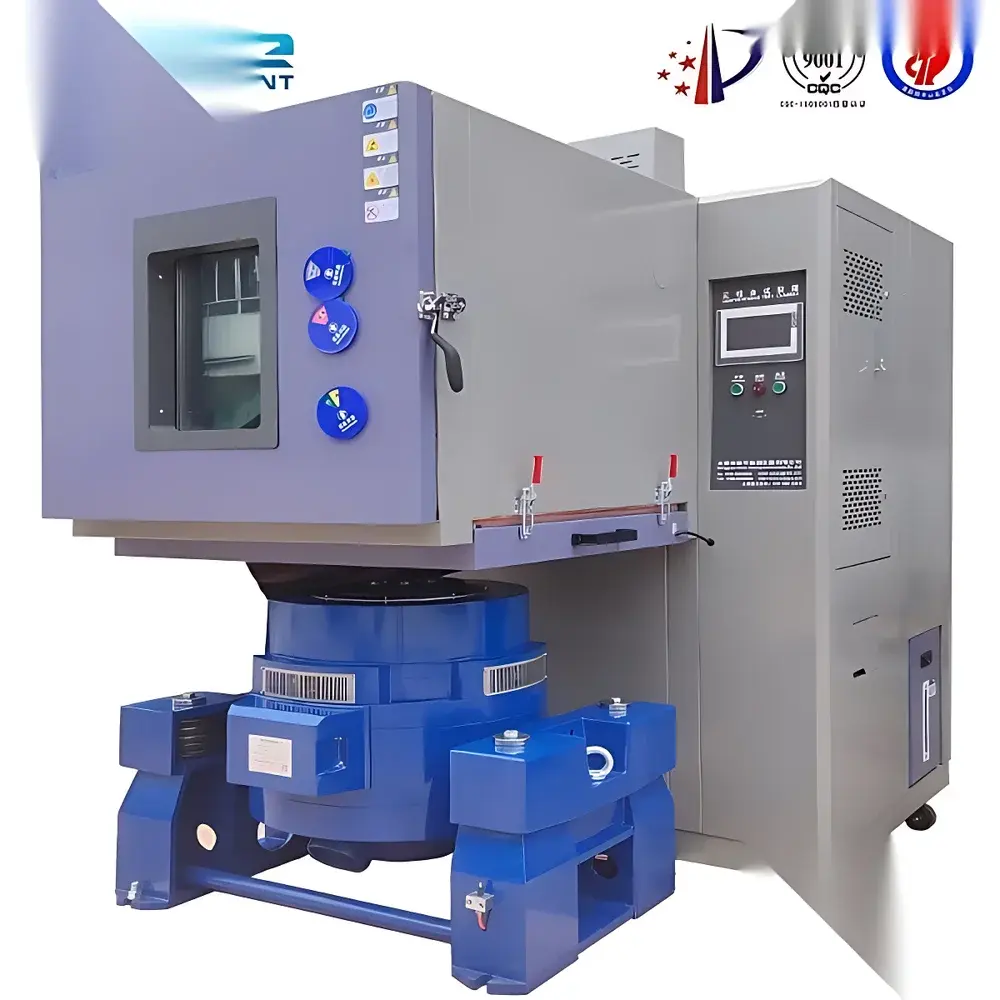
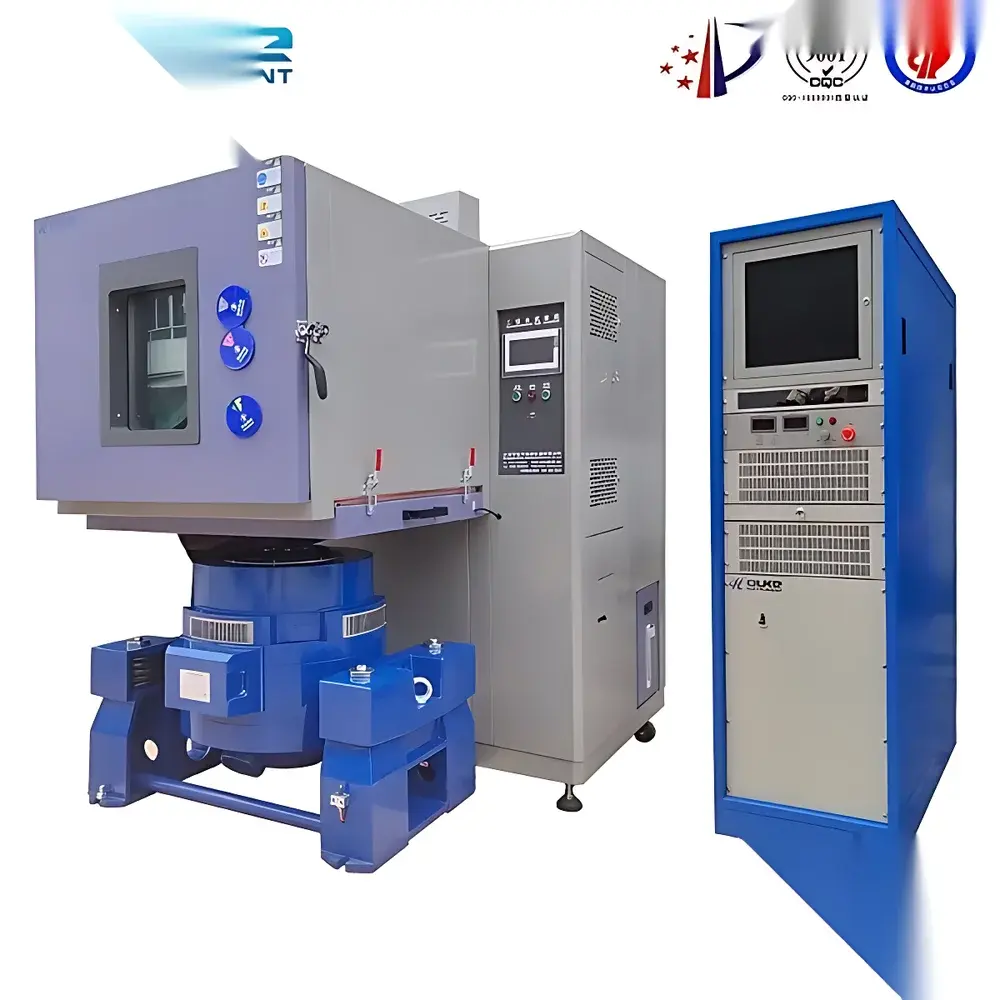
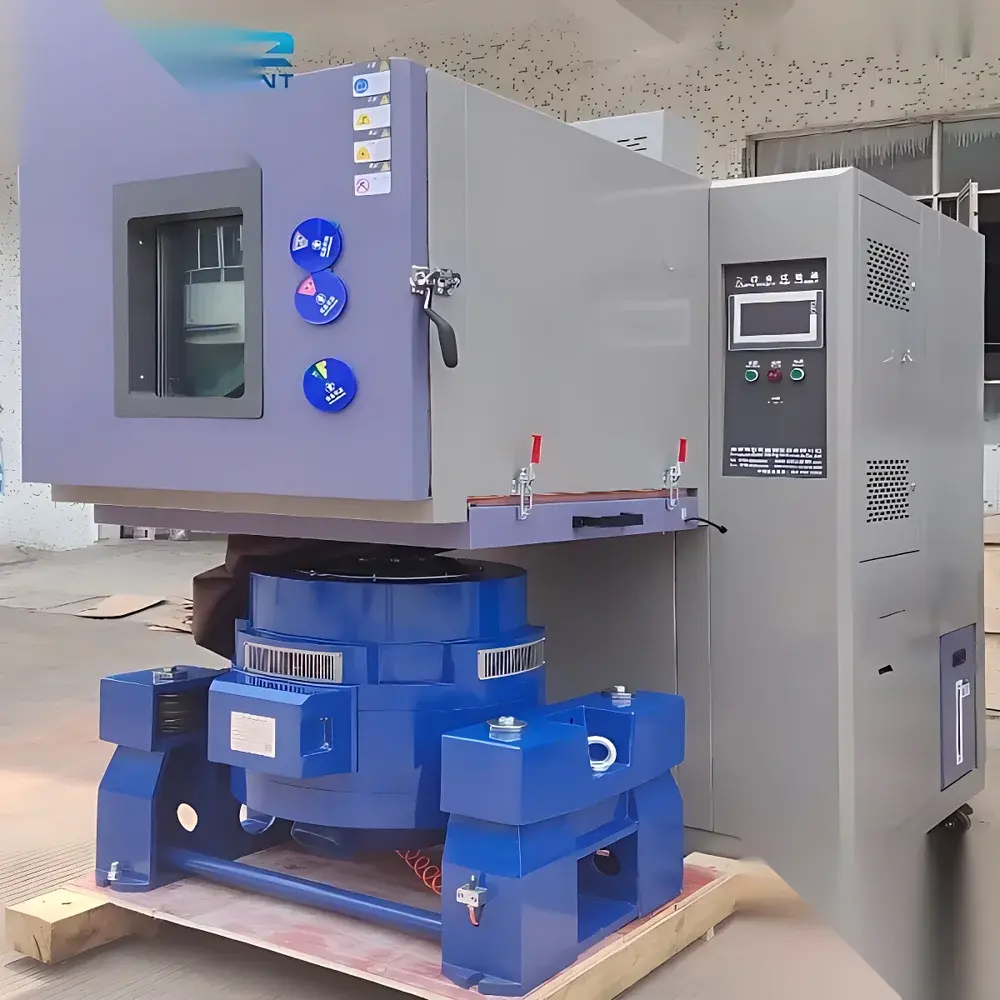
Combined Temperature-Humidity-Vibration Environmental Test System – OK-ES Series
| Brand | Other Brands |
|---|---|
| Origin | Imported |
| Manufacturer Type | Authorized Distributor |
| Frequency Range | 1–5000 Hz |
| Max. Acceleration | 20 g |
| Vibration Amplitude (p-p) | 0–5 mm |
| Vibration Axes | Vertical + Horizontal |
| Waveform | Sine |
| Programmable Segments | Up to 15 segments (frequency & time per segment) |
| Sweep Duration Range | 1 second – 30 days |
| Test Duration Capability | Continuous operation ≥ 90 days |
| Max. Load Capacity | 100 kg (customizable) |
| Table Surface Dimensions | 50 × 50 cm (customizable) |
| Power Supply | 220 V ±20%, 5 A, 2.2 kW |
| Frequency Resolution | 0.01 Hz (display), ±0.1 Hz accuracy |
| Compliance | Designed to support test protocols per ISO 16750-3, IEC 60068-2-6, ASTM D4728, MIL-STD-810H Method 514.8, and GB/T 2423.10–2019 |
Overview
The OK-ES Series Combined Temperature-Humidity-Vibration Environmental Test System is an integrated reliability validation platform engineered for concurrent simulation of thermal, hygroscopic, and dynamic mechanical stress environments. Unlike sequential or single-stress chambers, this system implements synchronized control of temperature (−70 °C to +180 °C), relative humidity (10–98% RH), and electrodynamic vibration (1–5000 Hz, up to 20 g peak acceleration, 0–5 mm p-p amplitude) — enabling realistic replication of transport, storage, and operational conditions encountered by automotive ECUs, avionics modules, battery packs, PCB assemblies, and industrial sensors. Its core architecture adheres to Couette-flow-driven shaker dynamics with closed-loop servo control, ensuring high reproducibility across sine, swept-sine, random, and programmable vibration profiles. The chamber’s structural integrity has been validated via continuous 90-day operational stress testing under full-load thermal-vibrational coupling, confirming long-term stability for production-grade qualification cycles.
Key Features
- Triple-stress synchronization: Real-time coordinated control of temperature, humidity, and multi-axis vibration within a single test volume
- Electrodynamic shaker system with dual-axis capability (vertical + horizontal) and force-rated capacity up to 100 kg payload
- High-resolution frequency control: Adjustable from 1 Hz to 5000 Hz in 0.01 Hz increments; display resolution ±0.1 Hz
- Comprehensive waveform generation: Standard sine, logarithmic sweep, linear sweep, programmable multi-segment (up to 15 segments), and octave-based (×2, ×3, ×10) frequency scaling
- Robust thermal-humidity subsystem: Refrigeration-heating hybrid system with PID-controlled humidity generation and condensation management
- Modular table interface: 50 cm × 50 cm standard mounting surface (custom dimensions available); low-resonance aluminum honeycomb construction
- Industrial-grade power management: 2.2 kW amplifier with over-current, over-temperature, and fault-lockout protection
Sample Compatibility & Compliance
The OK-ES system accommodates samples ranging from small PCB subassemblies (<1 kg) to full automotive control units (≤100 kg), with customizable fixture interfaces and non-resonant mounting solutions. It supports compliance-driven test execution aligned with international standards including ISO 16750-3 (road vehicles — environmental conditions), IEC 60068-2-6 (vibration testing), IEC 60068-2-30 (damp heat cyclic), ASTM D4728 (shipping container vibration), and MIL-STD-810H Method 514.8 (vibration). While the base system provides traceable control parameters, full metrological validation (e.g., amplitude/acceleration uncertainty quantification) requires optional integration with NIST-traceable laser Doppler vibrometry or IEPE-accelerometer calibration chains — consistent with GLP/GMP audit readiness requirements.
Software & Data Management
The embedded Windows-based control suite enables full test definition, real-time monitoring, and post-test analysis without third-party dependencies. Users define complex multi-phase test sequences combining thermal ramps, humidity holds, and vibration profiles — each phase timestamped and logged with 100 Hz data sampling. All operational parameters (chamber temp/RH, shaker drive voltage, current, coil temperature) are recorded synchronously. Audit trails comply with FDA 21 CFR Part 11 requirements when configured with user-role authentication, electronic signatures, and immutable log archiving. Export formats include CSV, MATLAB .mat, and universal HDF5 for integration into enterprise PLM or quality management systems (QMS).
Applications
- Automotive electronics qualification: ECU survivability under combined road-induced vibration and under-hood thermal cycling
- Aerospace component screening: Avionics box performance during cargo hold humidity excursions and aircraft taxi/vibration spectra
- Consumer electronics durability: Smartphone and wearable resilience to transit shock, temperature swing, and moisture ingress
- Energy storage system validation: Li-ion battery module behavior under thermal runaway-inducing vibration-humidity coupling
- Medical device regulatory testing: IVD analyzers and implantable sensor housings per ISO 14971 risk-based environmental stress profiling
- Defense equipment certification: Ruggedized communications gear subjected to MIL-STD-810H combined environment profiles
FAQ
Does the system support random vibration profiles?
Yes — firmware upgrade options enable power spectral density (PSD)-based random vibration control, compliant with ISO 10816 and MIL-STD-810H Annex G.
Is humidity control available during active vibration?
Yes — the chamber maintains specified RH setpoints (±3% tolerance) while executing vibration profiles up to 2000 Hz, verified via in-situ capacitive hygrometer feedback.
Can the system be integrated into an existing lab automation network?
Yes — it features Ethernet/IP and Modbus TCP interfaces for SCADA-level integration, along with RESTful API endpoints for remote job queuing and status polling.
What calibration documentation is provided?
Factory calibration certificates cover temperature uniformity (±1.5 °C), humidity accuracy (±3% RH), and shaker frequency response (traceable to NPL/PTB reference standards); annual recalibration services are available.
Is safety interlocking compatible with cleanroom or hazardous area installations?
Standard configuration includes Class I, Division 2 electrical certification; ATEX/IECEx variants and purge-compatible enclosures are available upon request.



