
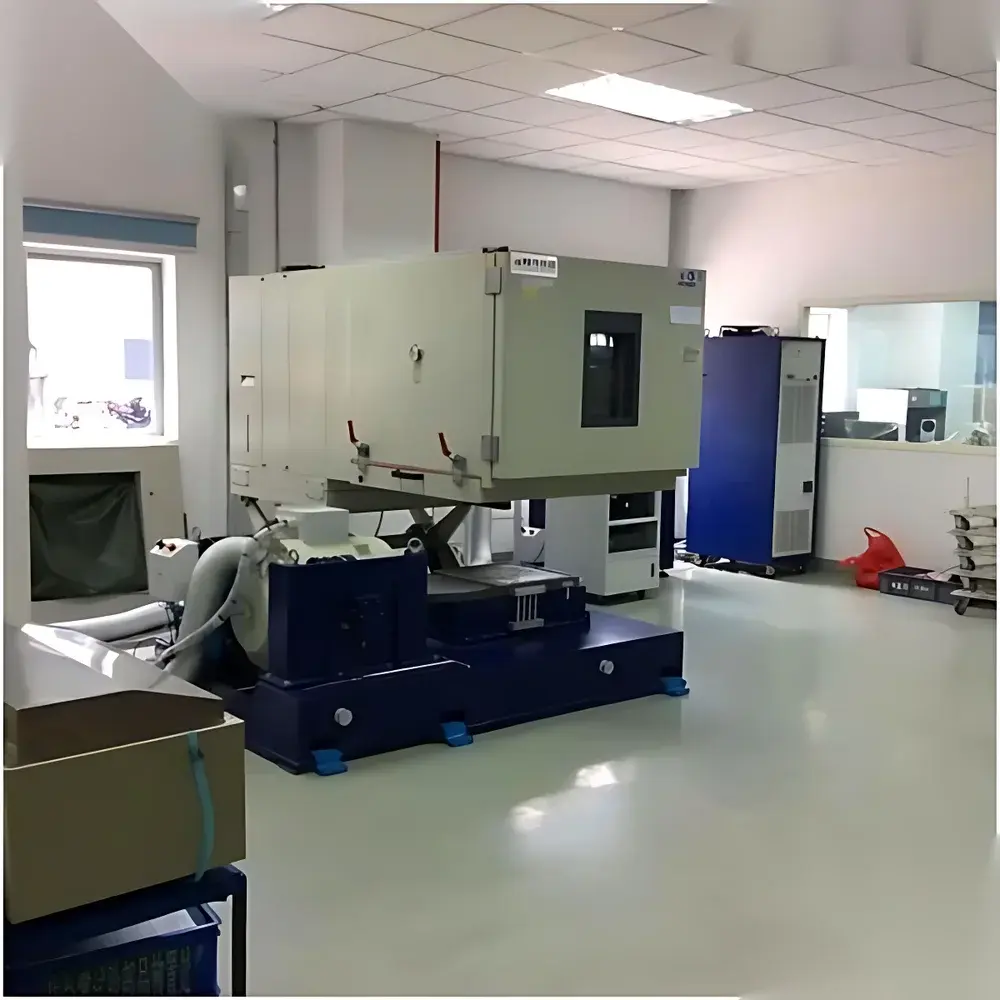
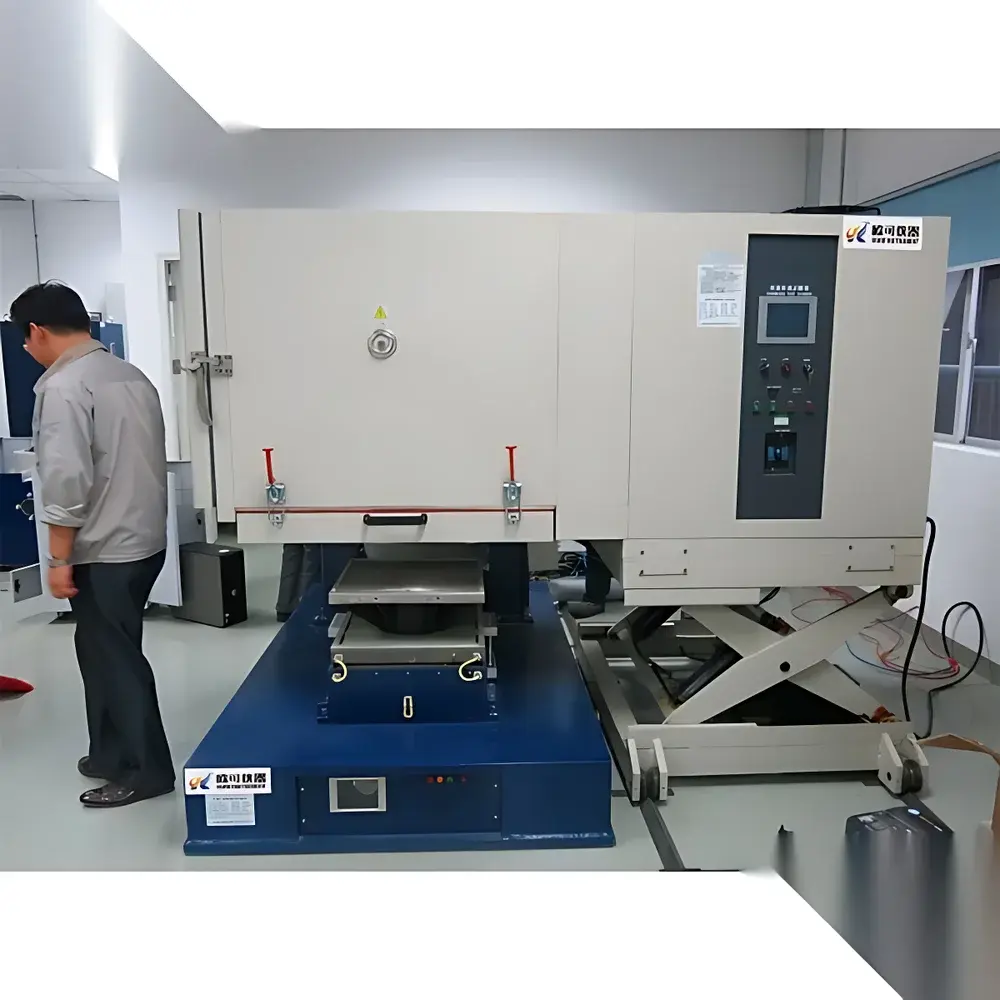
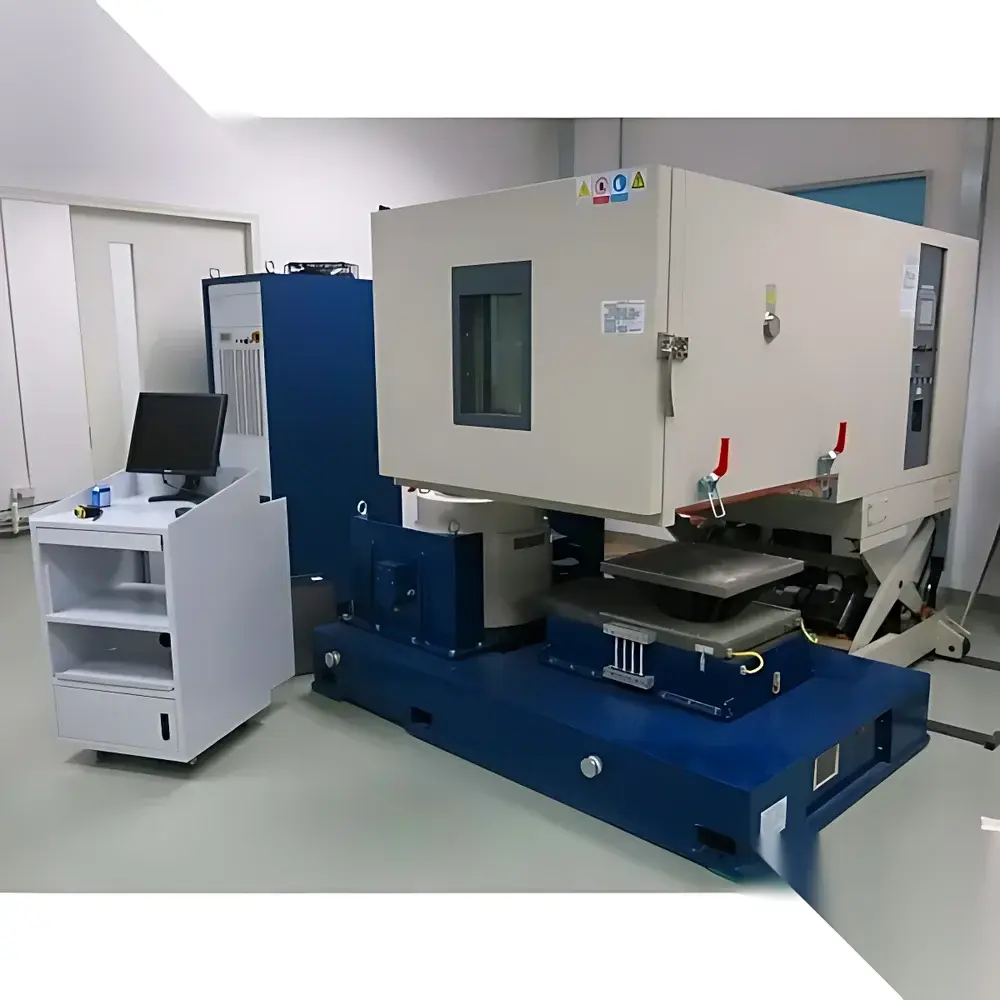
Combined Temperature-Humidity-Vibration Test Chamber
| Key | Brand: Other Brands |
|---|---|
| Origin | Imported |
| Manufacturer Type | Authorized Distributor |
| Load Capacity | 25 / 50 / 75 / 100 kg |
| Table Size | 350 × 350 mm (customizable) |
| Vibration Axis | Vertical, Horizontal, or Dual-Axis (selectable) |
| Frequency Range | 1–600 Hz / 1–3000 Hz / 1–5000 Hz |
| Displacement Peak-to-Peak | 0–5 mm |
| Max Acceleration | <20 g |
| Frequency Resolution | 0.01 Hz |
| Frequency Accuracy | ±0.1 Hz |
| Test Duration | 0–9999 h/min/sec (programmable) |
| Waveform | Sine |
| Power Supply | AC 220 V / 50 Hz or AC 380 V / 50 Hz |
| Compliance | GB/T 2423.10 |
Overview
The Combined Temperature-Humidity-Vibration Test Chamber is an integrated environmental stress screening (ESS) system engineered for concurrent or sequential application of thermal, hygrothermal, and mechanical vibration stresses. It operates on the principle of multi-stress acceleration—simulating real-world transport, storage, and operational conditions where temperature fluctuations, humidity exposure, and mechanical shock/vibration co-occur. Unlike standalone environmental chambers or shakers, this chamber enables synchronized control of all three stress domains within a single test volume, eliminating inter-test variability and enabling high-fidelity replication of field failure modes. Its architecture supports both deterministic (sine sweep, fixed-frequency) and programmable vibration profiles, coupled with precise climatic control per IEC 60068-2 and GB/T 2423 standards. Designed for reliability engineering laboratories, quality assurance departments, and R&D centers in electronics, automotive, aerospace, and medical device manufacturing, the system delivers repeatable, traceable, and auditable test data essential for HALT/HASS qualification, design validation, and conformance testing.
Key Features
- Triple-domain synchronization: Simultaneous real-time control of temperature (−70 °C to +180 °C), relative humidity (10–98% RH), and electrodynamic vibration (1–5000 Hz) within a unified test envelope.
- Dual-axis or vertical/horizontal vibration configuration with four-point synchronous electromagnetic excitation, ensuring uniform acceleration distribution across the 350 × 350 mm stainless-steel table (customizable up to 600 × 600 mm).
- High-resolution frequency control: 0.01 Hz display resolution and ±0.1 Hz accuracy over full range; supports sine sweep, dwell, step-sweep, and programmable multi-segment profiles.
- Advanced amplitude modulation: Continuous (stepless) displacement adjustment from 0 to 5 mm p-p, with automatic transition between constant-displacement and constant-acceleration modes during test execution.
- Robust EMI-hardened control electronics: Integrated shielding, optical isolation, and dedicated anti-interference circuitry ensure stable operation in electromagnetically noisy industrial labs—zero magnetic residue or static charge on the test table surface.
- Modular test sequencing: Unlimited nested test modules combining temperature/humidity ramps, dwell periods, and vibration subroutines—including jump frequencies, logarithmic sweeps, octave-based acceleration profiles, and hybrid sine-plus-random overlays (optional upgrade).
Sample Compatibility & Compliance
The chamber accommodates specimens up to 100 kg (depending on selected configuration) and supports standard mounting interfaces per ISO 5344 and ASTM D999. Internal chamber volume and airflow dynamics are optimized to maintain thermal/humidity uniformity (±1.5 °C, ±3% RH) while minimizing acoustic coupling and modal interference with vibration input. The system complies with GB/T 2423.10 (vibration), GB/T 2423.3 (damp heat), GB/T 2423.1 (cold), and GB/T 2423.2 (dry heat). Optional calibration certificates traceable to NIM (China National Institute of Metrology) and third-party verification per ISO/IEC 17025 are available. Full audit trails—including parameter setpoints, actual chamber readings, vibration spectra, and timestamped event logs—are retained for GLP/GMP-regulated environments.
Software & Data Management
Control and data acquisition are managed via a Windows-based embedded PC running certified real-time OS firmware. The software suite provides full 21 CFR Part 11 compliance options—including electronic signatures, role-based access control, audit trail logging, and data integrity safeguards. Users define complex test sequences using intuitive drag-and-drop logic, with support for unlimited program steps, conditional branching, and external trigger inputs (TTL, RS-485, Ethernet/IP). Real-time waveform visualization (FFT, time-domain, PSD) is rendered alongside environmental parameters. All raw data—including acceleration time histories, temperature/humidity trends, and alarm events—are exported in CSV, MATLAB (.mat), or UFF58 formats. Optional integration with LIMS or MES platforms via OPC UA or RESTful API is supported.
Applications
- Design validation of PCB assemblies under combined thermal cycling and resonant vibration to identify solder joint fatigue mechanisms.
- Automotive ECU qualification per ISO 16750-3, simulating under-hood thermal transients while subjecting units to road-spectrum vibration profiles.
- Accelerated life testing of MEMS sensors, where humidity-induced stiction must be evaluated concurrently with mechanical resonance.
- Package integrity assessment for sterile medical devices—evaluating seal strength degradation under humid storage followed by drop/shock simulation.
- Reliability growth testing of avionics enclosures per DO-160 Section 8 (vibration) and Section 4/5 (temperature/humidity), with synchronized stress application.
- Material compatibility studies—for example, assessing adhesive bond durability at elevated RH while undergoing cyclic flexural loading.
FAQ
Does the system support simultaneous temperature, humidity, and vibration operation?
Yes. All three stress domains operate concurrently with synchronized timing, phase alignment, and closed-loop feedback control.
Can vibration profiles be imported from external sources (e.g., field-collected road data)?
Standard configuration supports sine-based profiles only; optional random vibration module enables import of PSD files (e.g., from accelerometer field recordings) for replication in the chamber.
Is remote monitoring and control possible?
Yes—via secure HTTPS web interface or dedicated client application over LAN/WAN, with configurable notification alerts for alarms or test completion.
What calibration documentation is provided upon delivery?
Factory calibration report covering vibration amplitude/frequency linearity, temperature/humidity uniformity, and system interlock verification. NIST-traceable certificates available as optional add-on.
How is thermal gradient minimized during active vibration?
The chamber employs dual-zone air circulation with vibration-isolated ductwork and PID-controlled heater-cooler banks, maintaining spatial uniformity within specification even at maximum vibration output.



