
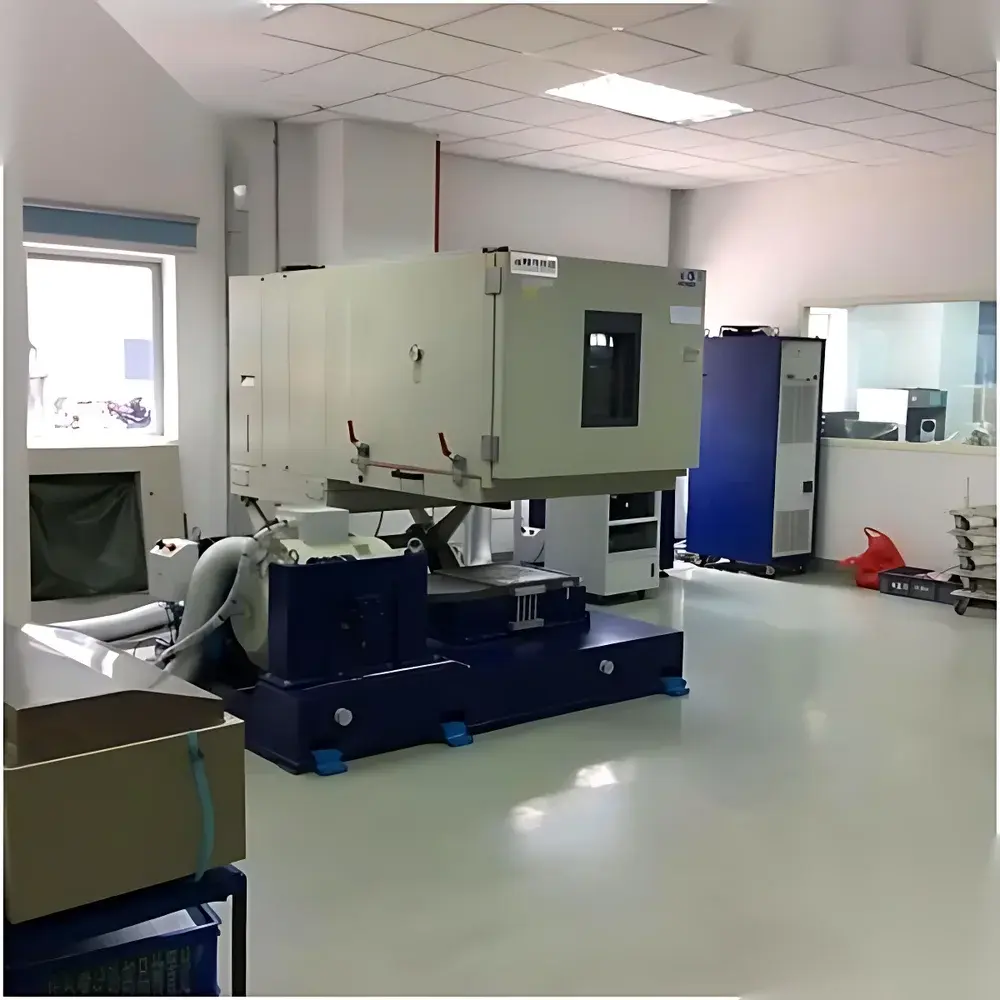
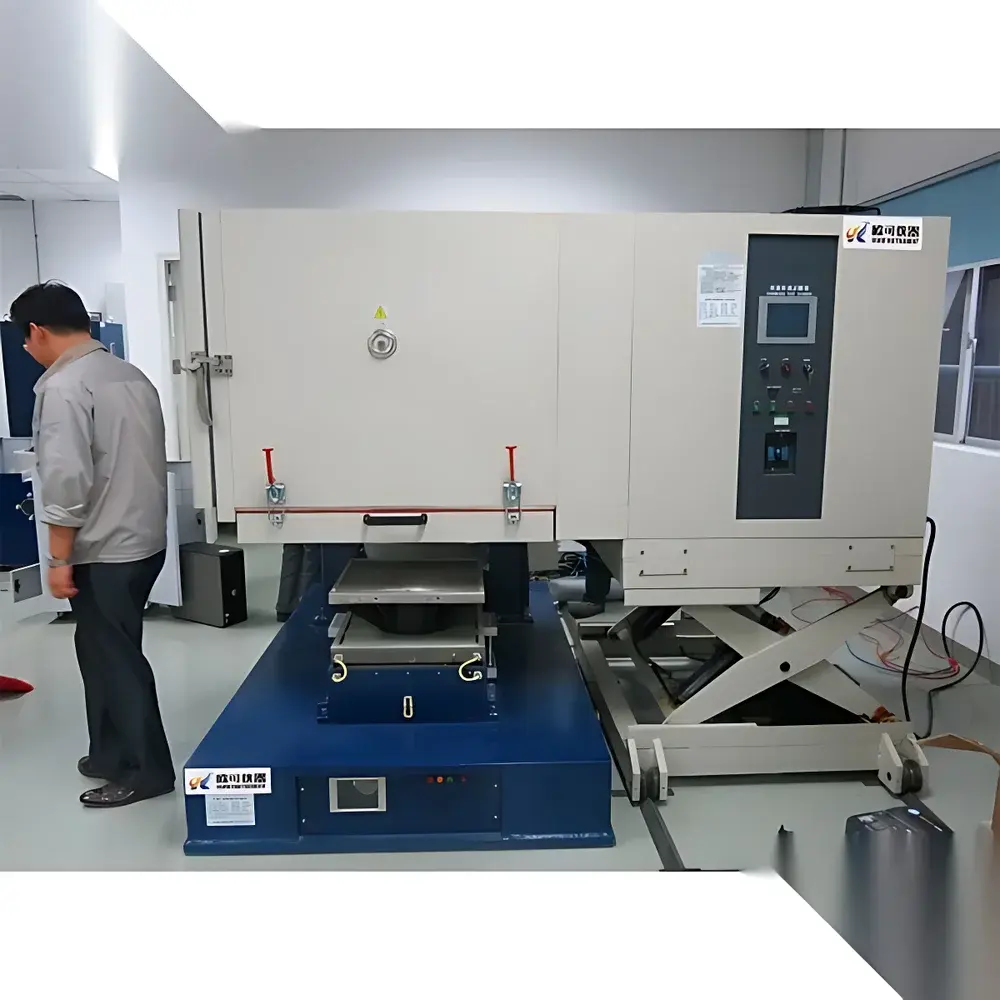
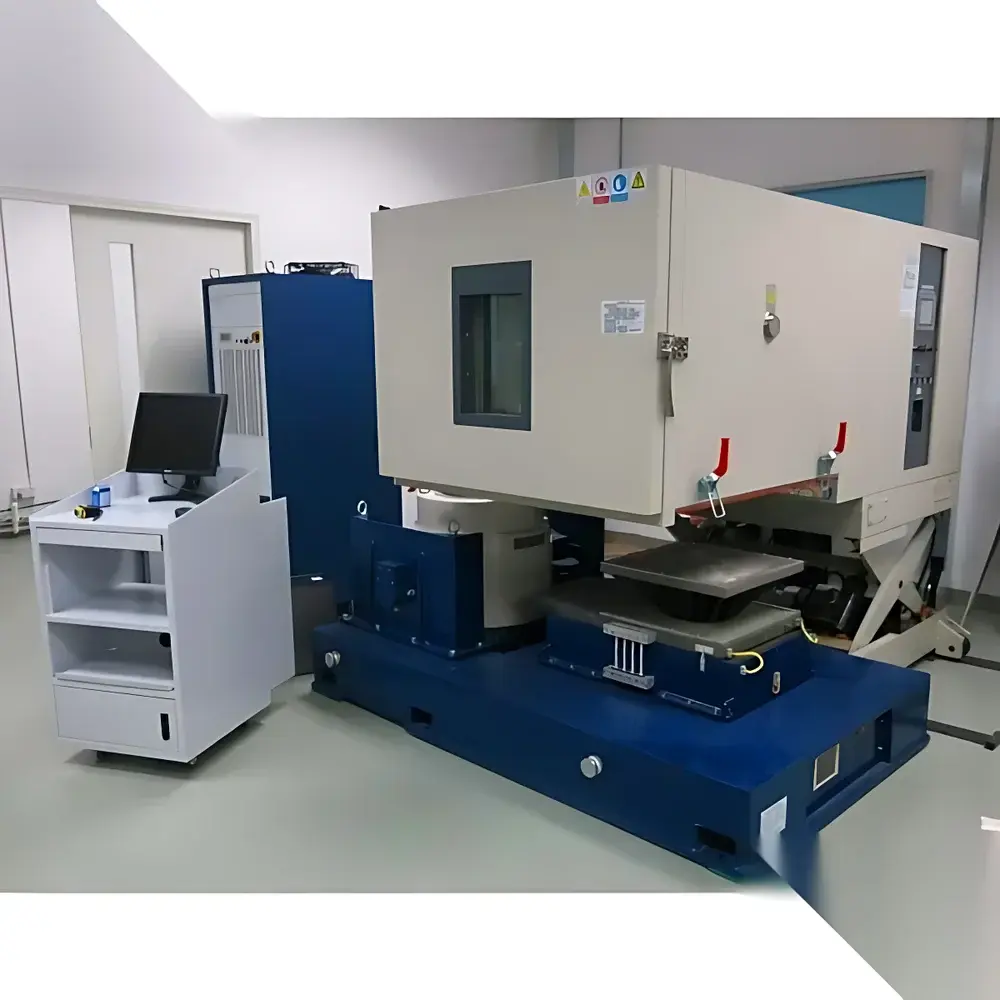
Combined Temperature-Humidity-Vibration Test Chamber
| Brand | Other Brands |
|---|---|
| Origin | Imported |
| Manufacturer Type | General Distributor |
| Price | USD 21,500 (approx.) |
| Vibration Table Size | 350 × 350 mm (customizable) |
| Max Load Capacity | 25 / 50 / 75 / 100 kg |
| Vibration Axis | Vertical, Horizontal, or Dual-Axis (selectable) |
| Frequency Range | 1–600 Hz / 1–3000 Hz / 1–5000 Hz |
| Displacement Amplitude | 0–5 mm peak-to-peak |
| Max Acceleration | <20 g |
| Test Duration | 0–9999 h/min/sec (programmable) |
| Waveform | Sine |
| Frequency Resolution | 0.01 Hz |
| Accuracy | ±0.1 Hz |
| Power Supply | AC 220 V / 50 Hz or AC 380 V / 50 Hz |
Overview
The Combined Temperature-Humidity-Vibration Test Chamber is an integrated environmental simulation system engineered for concurrent or sequential application of thermal, hygric, and mechanical stress stimuli. It operates on the principle of coupled environmental acceleration—simultaneously subjecting test specimens to controlled temperature (−70 °C to +180 °C), relative humidity (10–98% RH), and electrodynamic vibration (sine waveform, programmable frequency sweep or fixed-point excitation). This triaxial stress combination replicates real-world service conditions encountered during transportation, storage, and operational life cycles of electronic assemblies, automotive ECUs, aerospace components, medical devices, and industrial control systems. Unlike sequential chamber testing, this architecture eliminates thermal lag and phase misalignment between stress domains—ensuring true synergistic effect evaluation per IEC 60068-2-64 and MIL-STD-810H Method 514.7.
Key Features
- Triple-stress synchronization: Real-time coordination of climate control (refrigeration/heating/humidification/dehumidification) and vibration actuation via shared PLC-based controller with microsecond-level time alignment.
- Modular vibration system: Electromagnetic shaker with air-bearing support, offering selectable frequency bandwidths (1–600 Hz standard; upgradable to 1–5000 Hz) and programmable displacement (0–5 mm p-p) and acceleration (<20 g) profiles.
- High-fidelity climate chamber: Dual-stage cascade refrigeration, stainless-steel humidification tank with PID-controlled steam generator, and precision dew-point sensing for stable RH control within ±2% RH accuracy over full range.
- Robust mechanical architecture: Reinforced insulated chamber body with anti-resonance base frame; vibration-isolated mounting interface compliant with ISO 10816-1 for transducer calibration integrity.
- Comprehensive safety suite: Multi-layer protection including overtemperature cutoff (dual independent sensors), compressor high-pressure/low-pressure interlock, motor thermal overload detection, ground fault interruption, and automatic power shutdown with audible alarm upon any fault condition.
Sample Compatibility & Compliance
The chamber accommodates samples up to 100 kg on a 350 × 350 mm rigid aluminum table (custom dimensions available). It supports DUTs with external cabling via sealed feedthrough ports (optional). The system complies with core international standards governing combined environmental testing, including IEC 60068-2-64 (vibration), IEC 60068-2-30 (cyclic damp heat), IEC 60068-2-14 (temperature cycling), and MIL-STD-810H Method 514.7 (combined environments). It also meets national metrological verification requirements per GB/T 5170.2 (temperature), GB/T 5170.5 (humidity), and GB/T 2423.10 (combined test procedures). Full traceability documentation—including factory calibration certificates for temperature, humidity, and vibration sensors—is provided with each unit.
Software & Data Management
Equipped with Windows-based control software featuring intuitive graphical programming interface, the system enables creation of multi-step test profiles with conditional branching (e.g., “hold at 85 °C/85% RH for 2 h → initiate 10–500 Hz linear sweep at 5 g RMS → cool to −40 °C while maintaining 30% RH”). All sensor data—including chamber temperature, chamber humidity, table acceleration (m/s²), displacement (mm), and drive current—are logged synchronously at ≥100 Hz sampling rate. Export formats include CSV, Excel, and binary .tdms for post-processing in MATLAB or Python. Audit trail functionality complies with GLP and GMP requirements under FDA 21 CFR Part 11 when configured with user authentication, electronic signatures, and immutable log archiving.
Applications
This chamber serves critical roles across R&D validation, quality assurance, and reliability engineering workflows. Typical use cases include: accelerated life testing of PCBAs under thermal-hygric-vibrational stress to identify solder joint fatigue mechanisms; qualification of EV battery modules per UN ECE R100 and ISO 16750-3; validation of avionics enclosures against DO-160 Section 21 (combined temperature/vibration); screening of MEMS sensors for automotive ADAS systems; and failure mode analysis of medical infusion pumps subjected to hospital transport scenarios. Its ability to replicate cumulative degradation pathways makes it indispensable for HALT/HASS implementation and physics-of-failure modeling.
FAQ
What installation requirements must be met before commissioning?
A level, vibration-isolated concrete floor with minimum load capacity of 1,500 kg/m² is required. Ambient temperature must remain between 15–35 °C; relative humidity ≤85% RH; and no direct solar radiation or strong airflow on the chamber surface. A dedicated grounded power supply (AC 220 V or 380 V, 50 Hz, min. 32 A circuit) and adequate ventilation clearance (≥600 mm rear/side, ≥1000 mm top) are mandatory.
Can the system perform vibration-only tests without climate control?
Yes. Independent operation modes are supported: vibration-only, temperature-only, humidity-only, temperature-humidity, temperature-vibration, humidity-vibration, and full three-domain coupling—all programmable via the same interface.
Is third-party calibration certification available?
Yes. Optional NIST-traceable calibration services are offered for all primary sensors (PT100 temperature probes, capacitive RH sensors, piezoelectric accelerometers), delivered with ISO/IEC 17025-accredited calibration reports.
How is data integrity ensured during long-duration tests?
The embedded controller features dual SD card redundancy and automatic failover logging. Power-loss recovery preserves test state and resumes from last valid checkpoint without data corruption.
Does the system support remote monitoring and control?
Standard Ethernet (TCP/IP) and optional RS-485 Modbus RTU interfaces enable integration into factory MES/SCADA systems. Web-based remote view (read-only) is available via secure HTTPS with TLS 1.2 encryption.



