
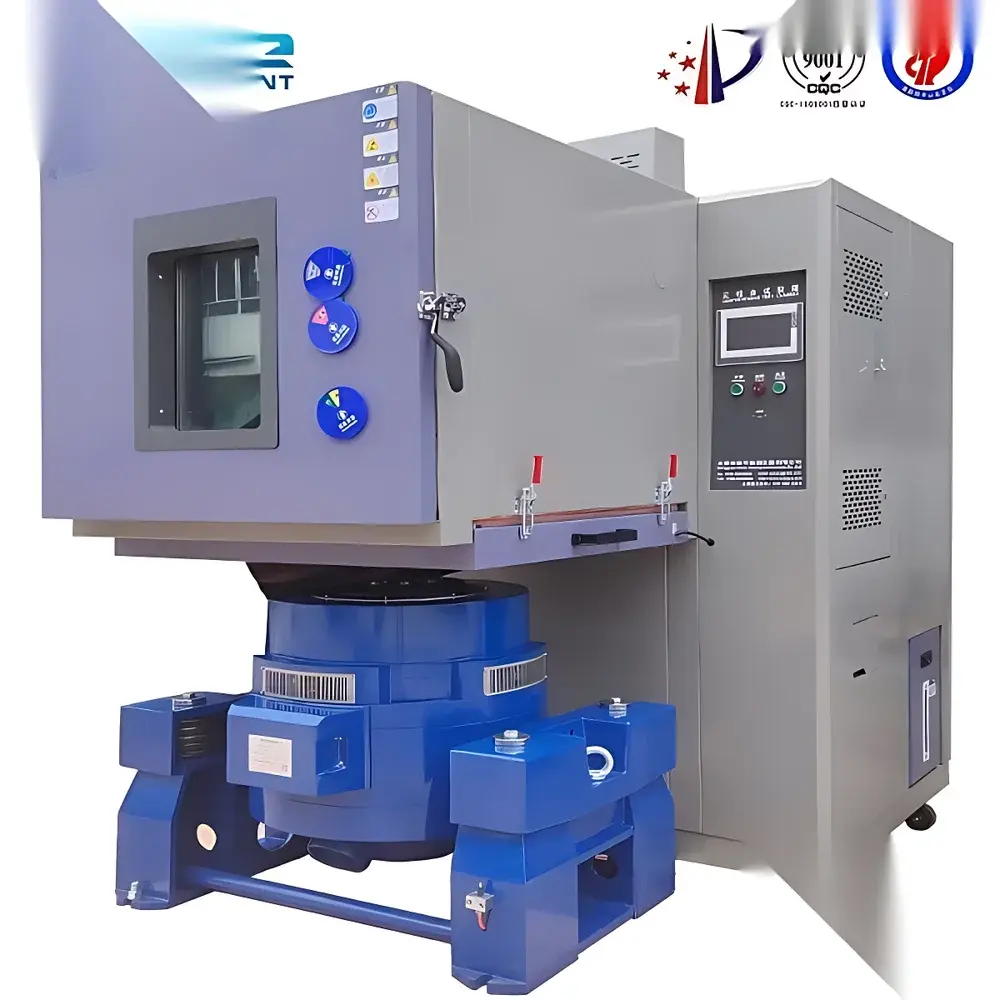
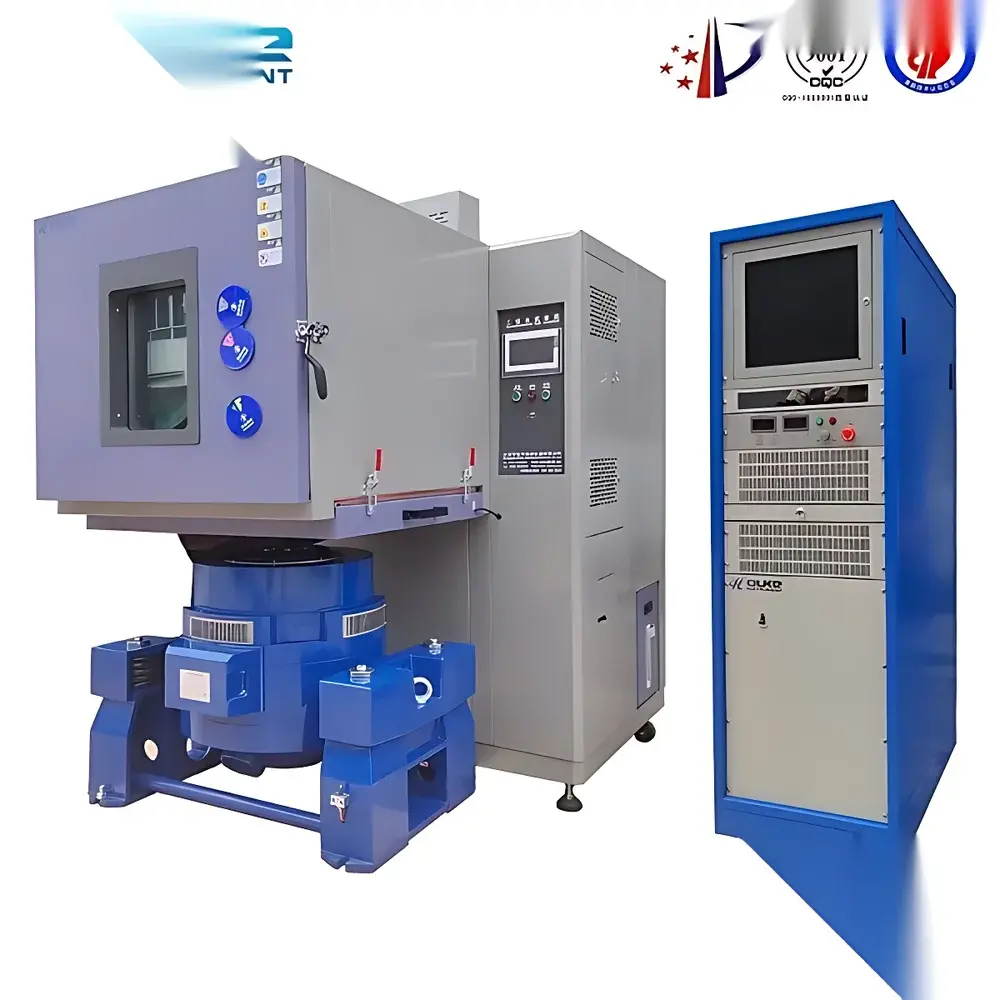
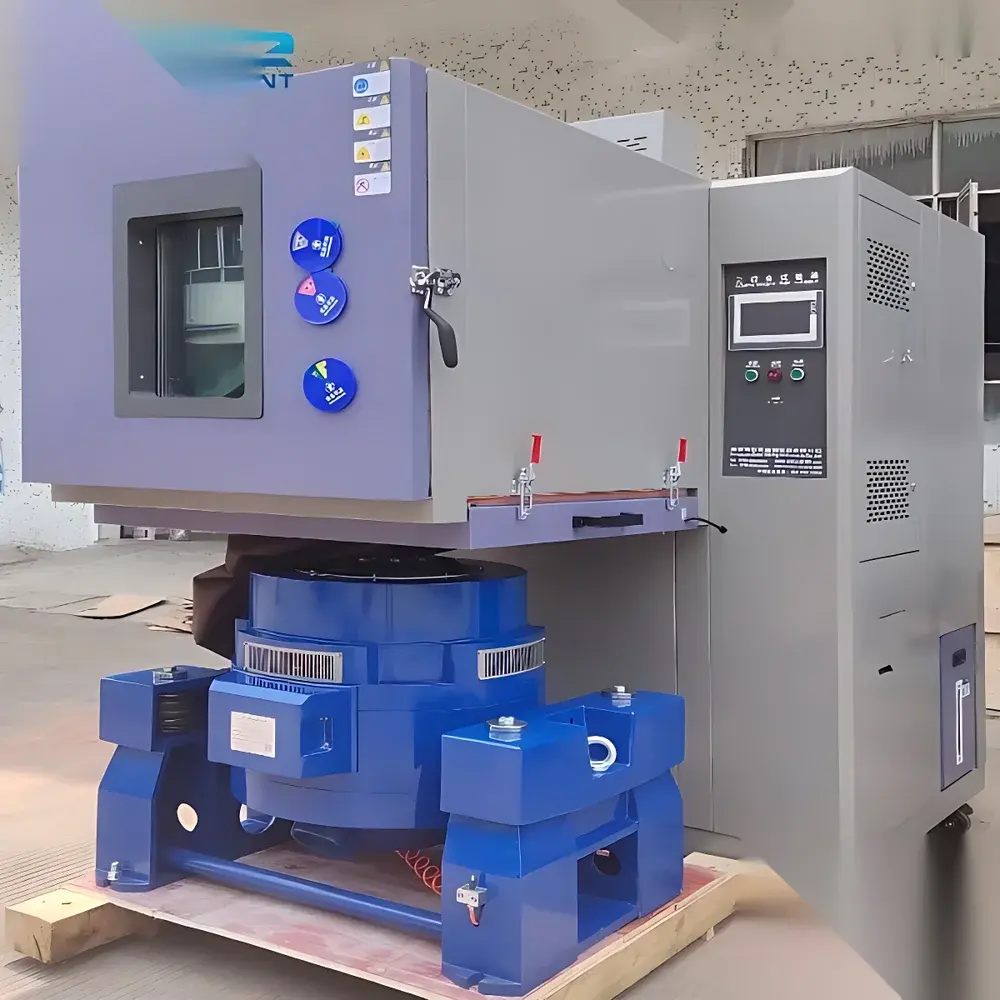
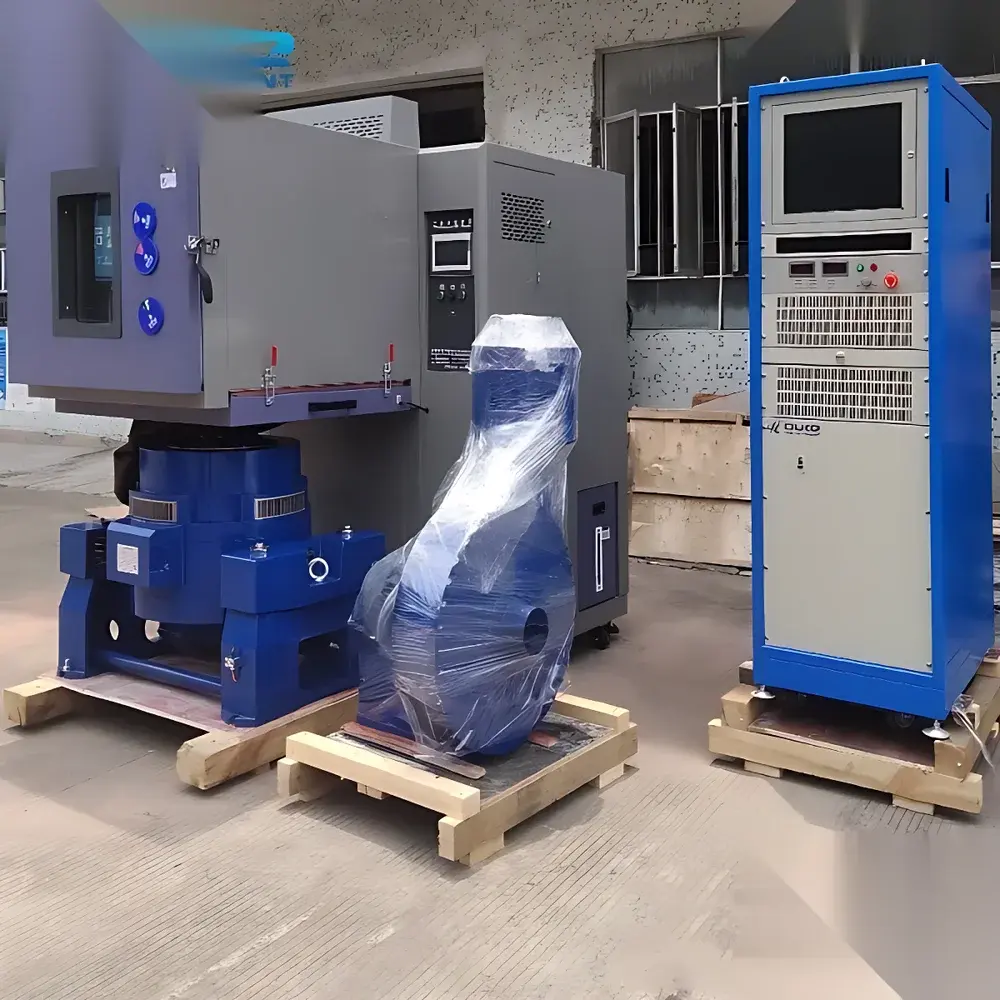
Combined Temperature-Humidity-Vibration Test Chamber – Generic OEM Model
| Key | Temperature Range: -70°C to +150°C |
|---|---|
| Humidity Range | 5–98% RH (standard: 20–98% RH) |
| Temp. Control Accuracy | ±0.5°C |
| Humidity Control Accuracy | ±2.5% RH |
| Temp. Uniformity | ±2.0°C |
| Humidity Uniformity | ±3.0% RH |
| Heating Rate | ~4.0°C/min |
| Cooling Rate | ~1.0°C/min |
| Construction | Interior & Exterior SUS304 Stainless Steel |
| Insulation | High-Density Polyurethane Foam with Ethyl Chloroformate Base |
| Cooling System | Air-Cooled, Single-Stage (to -20°C) or Twin-Stage Compressor (to -70°C) |
| Safety Protections | Fuseless Circuit Breaker, Compressor Overload Protection, Refrigerant HP/LP Cut-off, Over-Temp/Over-Humidity Interlocks |
| Controller | Color LCD Touchscreen with Programmable Temp/Humidity Profiles, RS-232 Interface |
| Vibration Integration | Designed for External Electrodynamic or Hydraulic Shaker Table Coupling (User-Specified) |
Overview
The Combined Temperature-Humidity-Vibration Test Chamber is an engineered environmental simulation system designed to concurrently impose controlled thermal, hygroscopic, and mechanical stress conditions on test specimens. It operates on the principle of integrated environmental stress screening (ESS), where temperature cycling, humidity modulation, and broadband vibration excitation are applied in synchronized or sequential profiles—enabling accelerated reliability assessment of electronic assemblies, aerospace components, automotive ECUs, and military-grade enclosures. Unlike standalone climate chambers or shaker systems, this triaxial test platform supports real-time coupling between the climatic chamber’s internal environment and externally mounted vibration exciters via a rigid, thermally isolated interface plate. The chamber’s structural integrity, thermal inertia management, and humidity condensation control are optimized to maintain profile fidelity under dynamic loading—critical for validating solder joint fatigue, seal integrity, and material creep behavior under combined stress.
Key Features
- Modular architecture with fully independent climate and vibration subsystems—ensures mechanical decoupling while permitting synchronized test sequencing via external PLC or host PC.
- SUS304 stainless steel construction (interior and exterior) provides corrosion resistance, non-outgassing performance, and compatibility with cleanroom and HALT/HASS protocols.
- High-efficiency air-cooled refrigeration system featuring single-stage or twin-stage hermetic compressors—selected based on required low-temperature endpoint (-20°C to -70°C) and thermal recovery time specifications.
- Polyurethane insulation with ethyl chloroformate-based formulation delivers low thermal conductivity (<0.022 W/m·K) and dimensional stability across extended thermal cycling.
- Intelligent touchscreen controller with programmable multi-segment temperature/humidity profiles, real-time data logging, and RS-232 serial communication for SCADA integration and remote monitoring.
- Integrated safety interlock suite compliant with IEC 61000-4-27 and EN 60068-2 series—includes refrigerant pressure monitoring, over-temperature cutoff, humidity saturation detection, and emergency power disconnect.
Sample Compatibility & Compliance
The chamber accommodates standard test specimens up to 600 mm × 600 mm × 600 mm (W×D×H), with optional custom port configurations for sensor feedthroughs, vacuum lines, or electrical harnesses. It supports mounting interfaces compatible with industry-standard electrodynamic shakers (e.g., LDS V875, TIRA TV 50120) and hydraulic exciters (e.g., MTS 370 series), maintaining <±0.5 mm lateral displacement tolerance at the chamber base plate under 50 gpk input. The system meets essential requirements of MIL-STD-810H Method 514.7 (vibration), Method 502.7 (temperature), and Method 507.6 (humidity); ISO 16750-4 (road vehicles); and IEC 60068-2-6 / -14 / -30 / -78. While not certified as a turnkey solution, it is architected to support validation per FDA 21 CFR Part 11 when paired with audit-trail-enabled software and calibrated instrumentation.
Software & Data Management
The embedded controller supports user-defined test profiles with up to 99 segments, each configurable for ramp rate, dwell time, setpoint hold, and humidity saturation control. Logged data—including chamber air temperature, relative humidity, dew point, compressor status, and alarm history—is timestamped and exportable in CSV format. Optional Ethernet or USB connectivity enables integration with third-party test management platforms (e.g., NI TestStand, Keysight PathWave) for automated reporting, statistical process control (SPC), and traceability in GLP/GMP environments. All firmware updates and configuration backups are performed via secure USB media—no cloud dependency or proprietary runtime licensing.
Applications
- Reliability qualification of printed circuit board assemblies (PCBAs) subjected to thermal shock, moisture ingress, and resonant vibration.
- Validation of hermetic seals and gasket performance in avionics enclosures under combined thermal cycling and random vibration spectra (e.g., DO-160 Section 21).
- Accelerated life testing of battery modules for electric vehicles—assessing electrolyte volatility, separator integrity, and thermal runaway propagation under humid, vibrating conditions.
- Material compatibility studies for adhesives, conformal coatings, and potting compounds exposed to condensing humidity and mechanical flexure.
- Pre-compliance screening for automotive electronics per ISO 16750-4 (combined temperature/humidity/vibration load cases).
FAQ
Can this chamber operate independently without a vibration table?
Yes—the climate control system functions autonomously as a high-precision temperature-humidity chamber; vibration integration is optional and requires external shaker hardware and mechanical interface engineering.
What vibration standards can be executed using this system?
When coupled with a qualified shaker and controller, it supports random, sine, shock, and mixed-mode profiles per MIL-STD-810H, ISO 10326, and IEC 60068-2-64—with chamber-induced transmissibility deviations maintained below ±1.5 dB across 5–2000 Hz.
Is calibration documentation provided with shipment?
Factory calibration certificates for temperature and humidity sensors (traceable to NIST or equivalent national metrology institutes) are included; field recalibration intervals are recommended every 12 months or per ISO/IEC 17025 requirements.
Does the system support remote diagnostics or predictive maintenance?
Basic fault logging and compressor runtime counters are available locally; advanced predictive analytics require integration with external condition monitoring software and vibration sensor arrays.
Are custom interior dimensions or viewing windows available?
Yes—custom fabrication options include enlarged workspaces, quartz viewport panels, and EMI-shielded feedthroughs, subject to structural reinforcement and thermal uniformity validation.



