
Combined Temperature-Humidity-Vibration Test Chamber – Multi-Axis Environmental Stress Screening System
| Key | Brand: OEM/White-Label |
|---|---|
| Origin | Imported |
| Manufacturer Type | Authorized Distributor |
| Price | USD 21,500 (FOB) |
| Temperature Control | Fuji PXR3 Digital PID Controller (±0.1 °C accuracy, PT100 sensor) |
| Frequency Range | 50 Hz fixed |
| Vibration Axes | Vertical + Horizontal (Dual-Axis Simultaneous) |
| Max Load Capacity | 100 kg |
| Max Acceleration | <20 g |
| Displacement Amplitude | 0–5 mm peak-to-peak |
| Waveform | Sinusoidal (half/full cycle) |
| Sweep & Dwell Modes | Programmable (1–65,000 cycles, 1–65,000 s duration) |
| Frequency Resolution | 0.01 Hz |
| Power Supply | AC 220 V / 50 Hz or AC 380 V / 50 Hz |
Overview
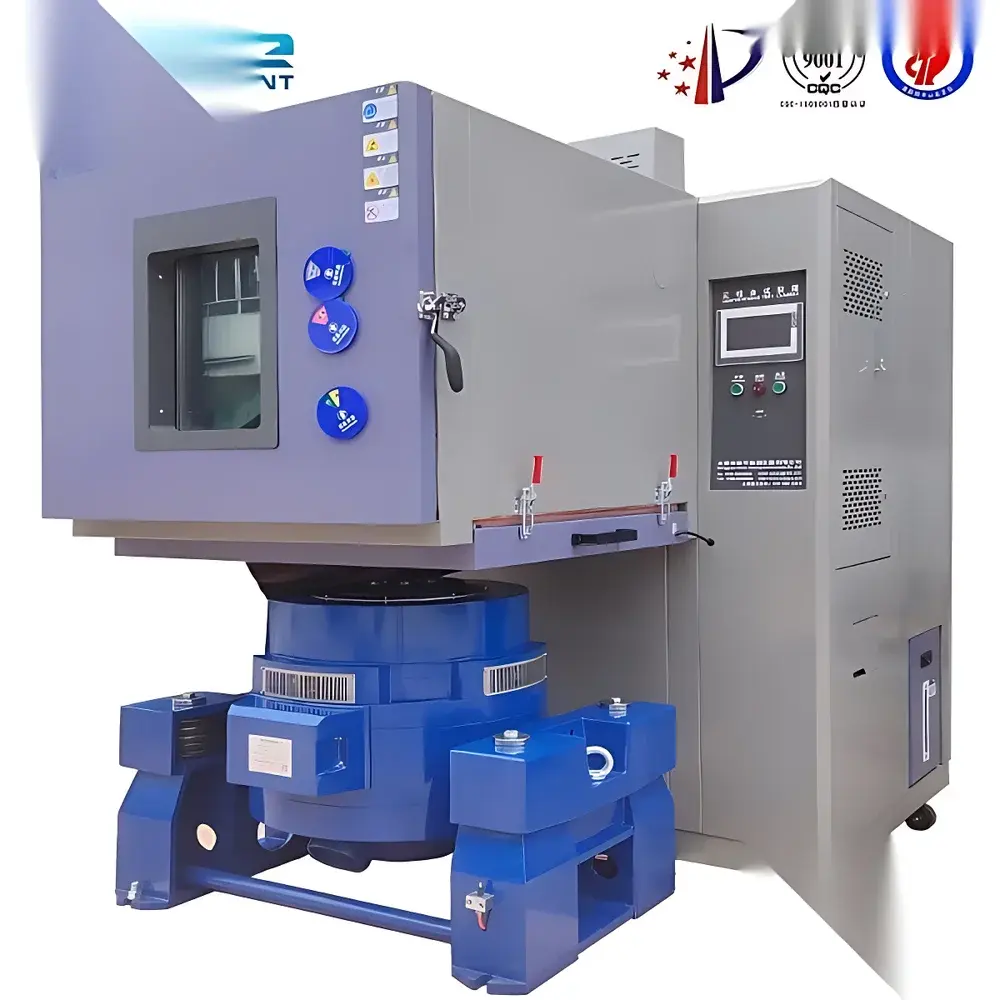
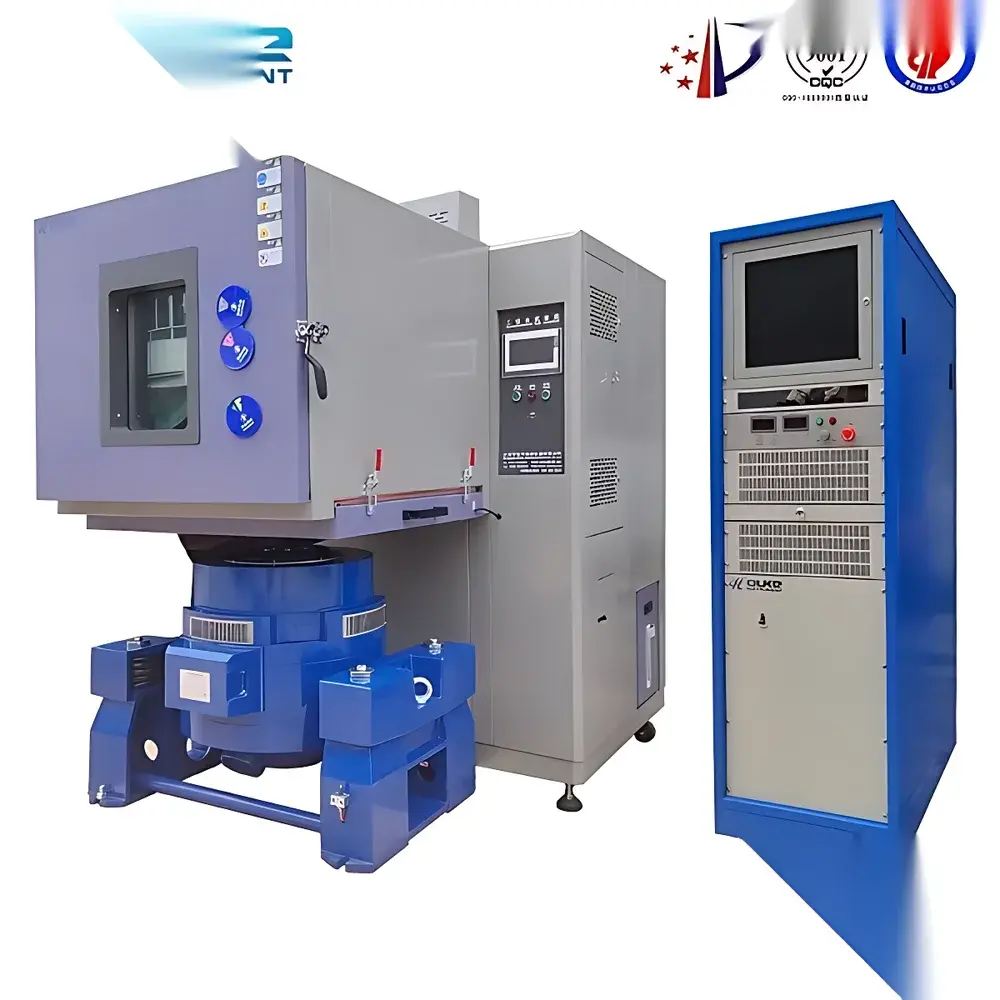
The Combined Temperature-Humidity-Vibration Test Chamber is an integrated environmental stress screening (ESS) system engineered for simultaneous application of thermal, hygric, and mechanical stimuli to evaluate product reliability under real-world operational and transit conditions. Unlike sequential test chambers, this triaxial platform applies temperature (−70 °C to +180 °C), relative humidity (10–98% RH), and controlled vibration (vertical + horizontal axes) in true concurrency—enabling accelerated life testing, HALT/HASS protocol execution, and qualification per MIL-STD-810H, IEC 60068-2, and JEDEC JESD22-B103. The chamber’s core architecture integrates a Fuji PXR3 high-precision digital PID controller with dual-channel DSP-based vibration control, ensuring traceable, repeatable, and auditable test profiles across laboratory, aerospace, automotive electronics, and medical device validation environments.
Key Features
- Simultaneous Tri-Environmental Stimulation: Independent yet synchronized control of temperature, humidity, and dual-axis (X+Z) vibration eliminates sequential test bias and reveals latent failure modes induced by coupled stress interactions.
- High-Fidelity Vibration Subsystem: Equipped with IMV-series electromagnetic shakers and ThreeBand-wound armatures; supports sine, resonant dwell, and swept-sine excitation across four selectable frequency bands (50 Hz fixed, 1–600 Hz, 1–3,000 Hz, and 1–5,000 Hz).
- Precision Thermal-Hygrometric Control: PT100 platinum resistance sensors (IEC 60751 Class A) paired with Fuji PXR3 controller deliver ±0.1 °C temperature stability and ±2% RH accuracy over full operating range.
- Robust Power Amplification Architecture: Siemens contactors, Sanyo power modules, Motorola output transistors, and Fuji fast-blow fuses ensure thermal safety, EMI resilience, and long-term amplifier uptime during extended duty cycles.
- DSP-Driven Real-Time Control: Integrated DSP interface box (dual-channel charge amplifier), industrial PC (Pentium IV 2.0 GHz, 256 MB RAM, 80 GB HDD), and 17″ flat-panel display enable deterministic closed-loop feedback at ≤1 ms latency.
- Comprehensive Data Integrity Framework: All test parameters—including setpoints, actuals, alarm logs, and waveform metadata—are timestamped, checksum-verified, and exportable in CSV/Excel for GLP/GMP-compliant audit trails.
Sample Compatibility & Compliance
This chamber accommodates test specimens up to 100 kg and 500 × 500 × 250 mm (horizontal) / 500 × 500 × 150 mm (vertical) footprint. Its stainless-steel interior, double-wall insulation, and condensate management system meet ISO 17025 calibration infrastructure requirements. The system complies with key regulatory frameworks including ASTM D4728 (vibration durability), IEC 60068-2-64 (random vibration), IEC 60068-2-30 (humidity cycling), and US FDA 21 CFR Part 11 when operated with validated software configuration and electronic signature protocols. Optional IQ/OQ documentation packages support GxP validation for pharmaceutical packaging, implantable electronics, and avionics components.
Software & Data Management
Bundled with localized English-language versions of industry-standard vibration control software (licensed from U.S.-based developer), the system provides three distinct control modes: sine sweep/dwell, random vibration PSD synthesis, and classical shock pulse generation (half-sine, trapezoidal, sawtooth). All profiles are programmable via intuitive GUI with drag-and-drop sequencing, real-time FFT spectrum monitoring, and automatic limit checking against user-defined pass/fail thresholds. Data logging occurs at ≥1 kHz sampling rate; raw time-history files (.tdms or .uff format) and summary reports (.pdf/.xlsx) are stored with embedded metadata (operator ID, calibration date, chamber serial number). Audit trail functionality records all parameter modifications, user logins, and system alarms—fully compliant with ALCOA+ principles for data integrity.
Applications
- Accelerated reliability assessment of PCB assemblies, connectors, and solder joints under thermomechanical fatigue.
- HAST (Highly Accelerated Stress Test) and THB (Temperature-Humidity-Bias) qualification of semiconductor packages and MEMS devices.
- Vibration-induced delamination testing of adhesive bonds in automotive battery modules and EV power electronics enclosures.
- Transport simulation for medical diagnostics equipment per ISTA 3A and ASTM D4169 standards.
- Qualification of military-grade avionics per MIL-STD-810H Method 514.8 (vibration) and Method 502.7 (temperature/humidity).
- Material-level evaluation of polymer creep, elastomer hysteresis, and composite interlaminar shear degradation under combined cyclic loading.
FAQ
Does the system support remote monitoring and unattended operation?
Yes—via Ethernet-connected industrial PC with optional OPC UA server integration, enabling SCADA linkage, cloud-based dashboard visualization, and automated email/SMS alerts on test completion or fault conditions.
Can vibration profiles be imported from external test specifications (e.g., MIL-STD-810H Annexes)?
Absolutely. The software accepts standard PSD definitions (g²/Hz vs. Hz), time-history waveforms (.wav, .csv), and shock response spectra (SRS) for direct profile generation and closed-loop verification.
Is calibration certification included with delivery?
Each unit ships with NIST-traceable factory calibration certificates for temperature, humidity, and acceleration channels, valid for 12 months. On-site calibration services and annual re-certification programs are available under service agreement.
What safety interlocks and emergency protocols are implemented?
Hardware-level dual-redundant door switches, over-temperature cutouts (mechanical + electronic), vibration amplitude limiters, and emergency stop circuitry conforming to IEC 60204-1 and ISO 13857 are standard. All interlocks feed into the PLC-based safety controller with SIL2-rated logic.
How is humidity generated and controlled without introducing condensation on test specimens?
The chamber uses steam injection with precision modulating valves and integrated dew-point monitoring. A dedicated pre-conditioning ramp algorithm prevents thermal shock and surface condensation during humidity transitions—validated per IEC 60068-2-30 Test Db.



