
Combined Temperature-Humidity-Vibration Test System
| Temperature Range | -20 °C to 130 °C |
|---|---|
| Humidity Range | 40–98 % RH |
| Temperature Uniformity | ±2 °C (unloaded) |
| Temperature Fluctuation | ±0.5 °C (unloaded) |
| Humidity Fluctuation | ±2 % RH |
| Heating Rate | -20 °C to 120 °C ≤ 60 min |
| Cooling Rate | Ambient to -20 °C ≤ 45 min (unloaded) |
| Vibration Force (Sine) | 2.94 kN (300 kgf) |
| Frequency Range | 5–2000 Hz |
| Max Acceleration | 980 m/s² (100 g) |
| Max Velocity | 1.1 m/s |
| Max Displacement | 25 mm p-p |
| Moving Mass | 2.7 kg |
| Payload Capacity | 120 kg |
| Table Diameter | 150 mm |
| Vibration Axis | Vertical (Z-axis) |
| Time Setting Range | 0–999 h |
| Compliance | GB/T 2423.1, GB/T 2423.3, GB/T 2423.4, IEC 60068-2-1, IEC 60068-2-3, IEC 60068-2-30 |
Overview
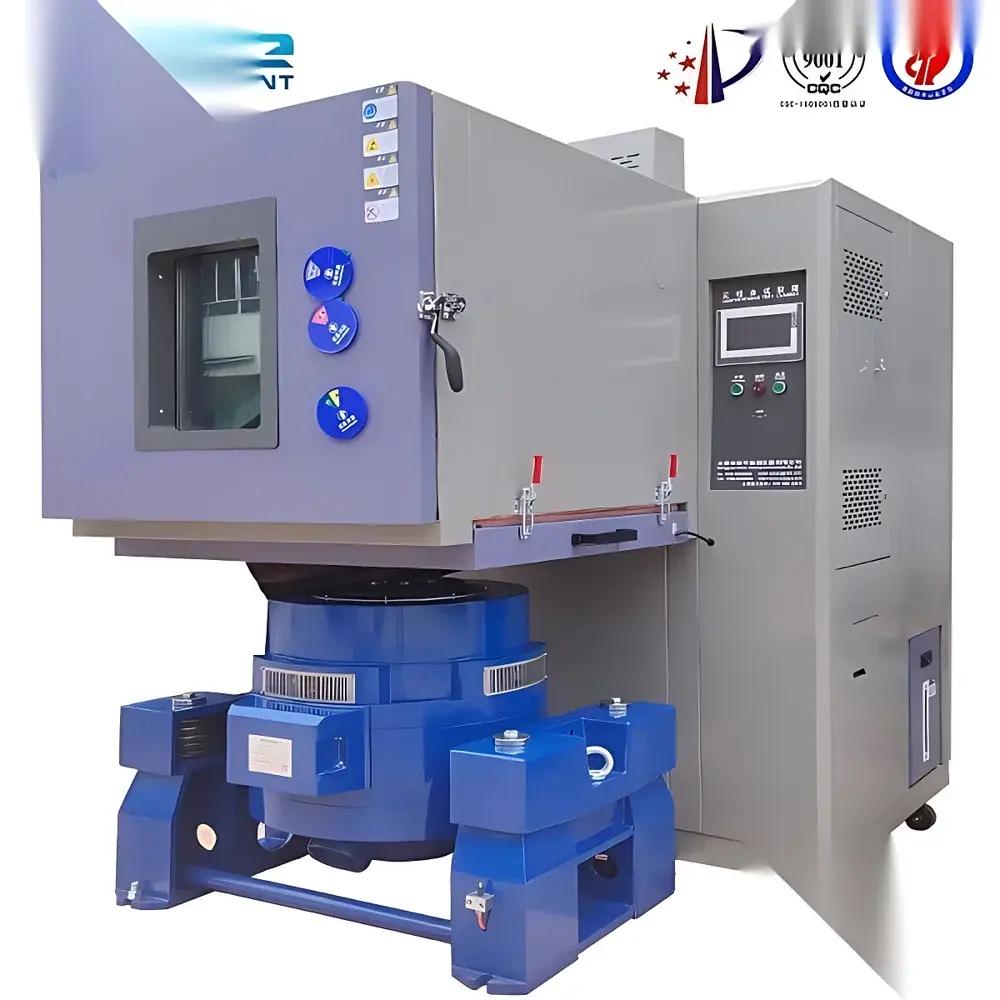
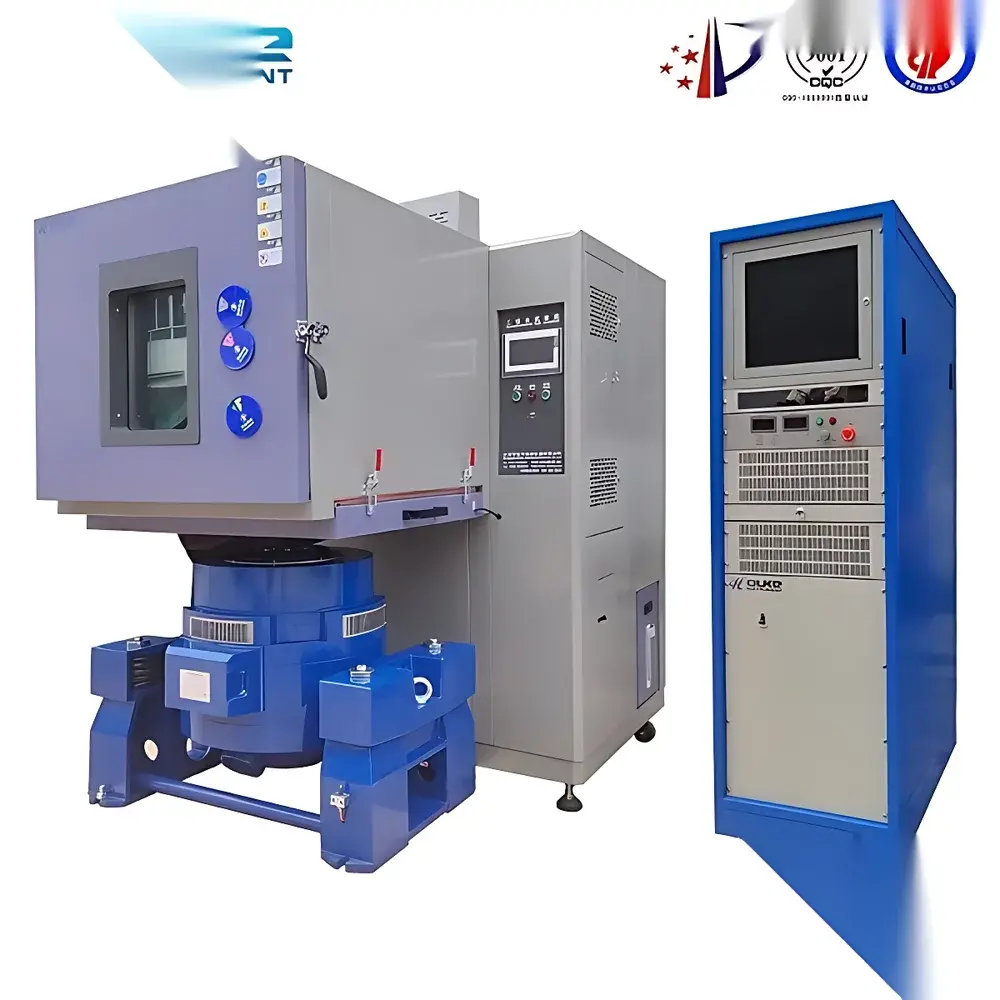
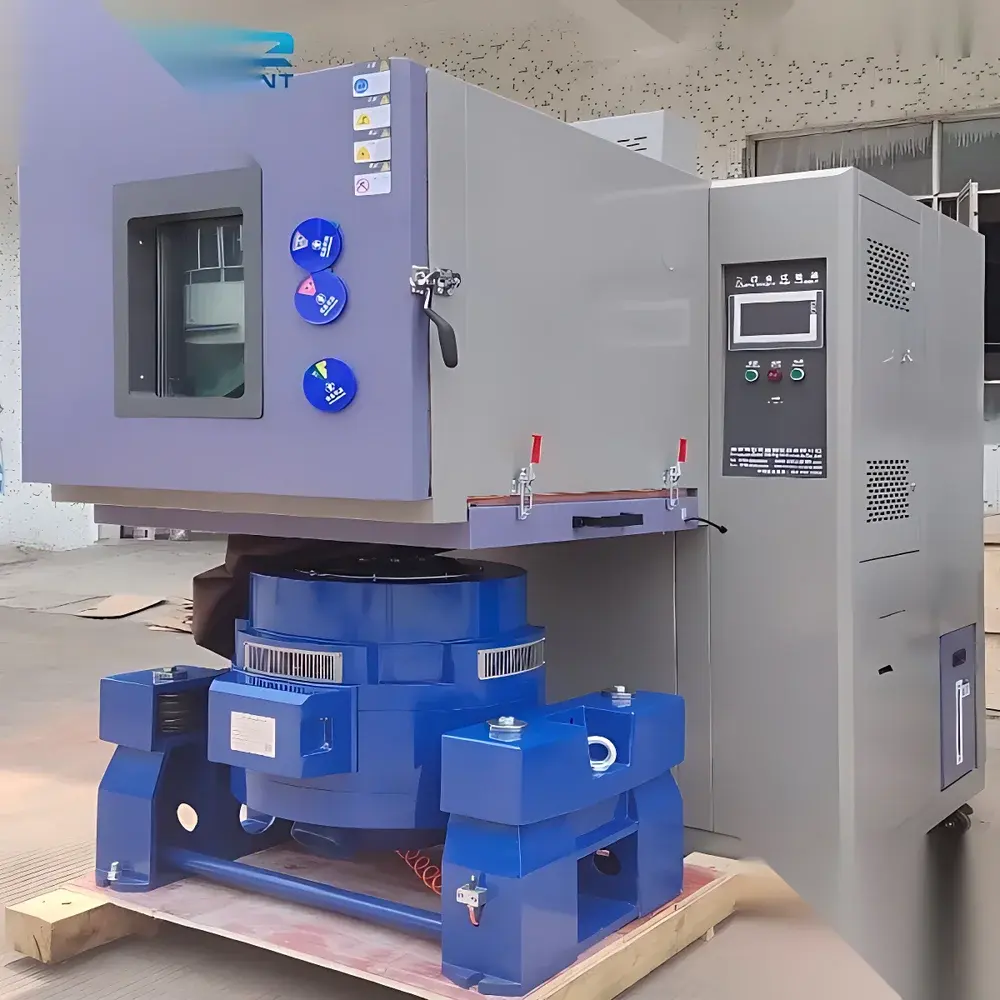
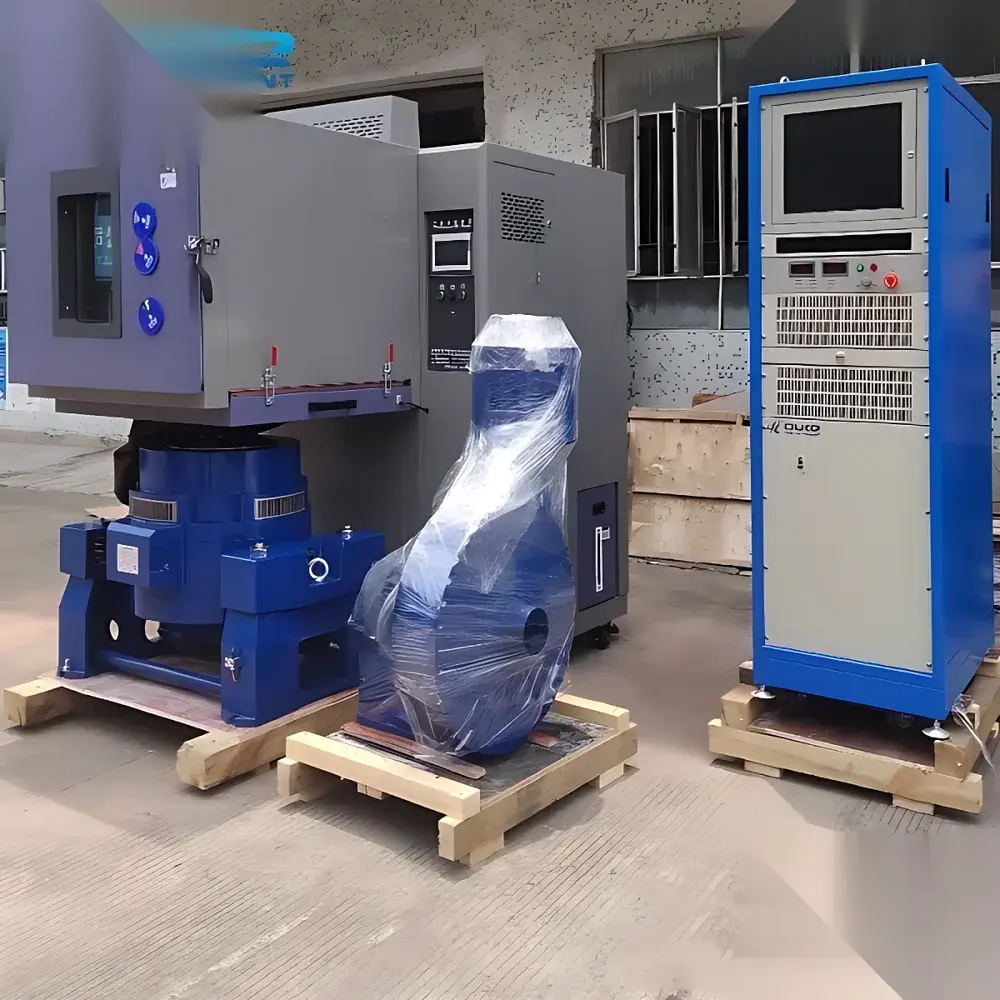
The Combined Temperature-Humidity-Vibration Test System is an integrated environmental simulation platform engineered for rigorous reliability validation of electronic components, electromechanical assemblies, medical devices, packaging systems, and aerospace subassemblies. It simultaneously applies controlled thermal stress (via forced-air convection), humidity modulation (using steam injection and desiccant-assisted drying), and high-fidelity sinusoidal mechanical excitation—enabling replication of real-world operational and transportation environments where temperature cycling, moisture ingress, and resonant vibration co-occur. The system operates on a dual-chamber architecture: a climatic chamber (temperature/humidity) mechanically coupled to a high-performance electromagnetic shaker via a precision-aligned, thermally isolated interface. This configuration ensures minimal cross-interference between environmental parameters and dynamic loading, preserving measurement integrity during combined-stress testing per MIL-STD-810H Method 514.7 and IEC 60068-2-64. The system is not a sequential or time-multiplexed tester; rather, it delivers true concurrent exposure—critical for identifying synergistic failure modes such as condensation-induced short circuits under vibrational fatigue or hygroscopic swelling-induced resonance shift.
Key Features
- Modular climatic chamber with SUS304 stainless steel interior and cold-rolled steel exterior, finished with electrostatic epoxy coating for corrosion resistance and long-term dimensional stability.
- High-efficiency refrigeration system using environmentally compliant R404A/R23 cascade stages, integrated with low-noise axial fans and optimized air duct design for uniform airflow distribution (±2 °C uniformity, unloaded).
- Steam-based humidification system with PID-controlled saturation chamber and condensate management via integrated overflow ports and compressor drip trays—preventing internal water accumulation and external floor contamination.
- Electromagnetic shaker with 2.94 kN force capacity, 5–2000 Hz frequency bandwidth, and programmable sweep profiles (logarithmic/linear), supporting resonance search, dwell-at-resonance, and multi-segment sine tests.
- Motorized XYZ alignment platform enabling precise vertical/horizontal coupling between chamber and shaker: horizontal travel up to 2500 mm, vertical lift up to 1200 mm, load capacity 2000 kg—ensuring repeatable mechanical interface alignment across test campaigns.
- Double-layer waveguide seals (circular and square configurations) fabricated from high-temperature silicone-elastomer composites, rated for continuous operation from -40 °C to +150 °C and >95 % RH—maintaining pressure equilibrium and thermal isolation during active vibration.
- CT-2000/PD-series frequency controller housed in a sealed, EMI-shielded cabinet with 60 % energy reduction versus legacy designs; supports automated sweep sequencing, real-time FFT monitoring, and user-defined breakpoint tables.
Sample Compatibility & Compliance
The system accommodates specimens up to 120 kg mass and 150 mm mounting footprint, with optional blind plates enabling rapid reconfiguration for vertical vibration, horizontal vibration, or standalone climatic cycling. Internal lighting, multi-layer anti-frost observation window, and adjustable sample mounting rails support visual inspection and fixture integration without chamber interruption. All structural and control subsystems comply with CE machinery directive (2006/42/EC), EMC directive (2014/30/EU), and RoHS 2011/65/EU. Test protocols align with internationally recognized standards including GB/T 2423.1 (cold), GB/T 2423.3 (damp heat, cyclic), GB/T 2423.4 (damp heat, two-cycle), IEC 60068-2-1 (cold), IEC 60068-2-3 (damp heat, steady-state), and IEC 60068-2-30 (damp heat, cyclic). For regulated industries, the system supports audit-ready documentation packages compatible with ISO/IEC 17025, GLP, and GMP quality systems—including calibration traceability to NIST or PTB reference standards.
Software & Data Management
The embedded controller features a touchscreen HMI with intuitive menu navigation and context-sensitive help. Test programs are defined via a guided wizard interface supporting multi-step sequences (e.g., “Soak at 85 °C/85 % RH → Ramp to 5 Hz → Sweep 5–2000 Hz @ 10 g → Hold at resonance for 30 min”). Real-time data logging captures temperature, humidity, acceleration, velocity, displacement, and drive current at configurable sampling rates up to 10 kHz. Export formats include CSV, MATLAB (.mat), and PDF test reports with embedded pass/fail criteria overlays. Optional Ethernet/IP and Modbus TCP interfaces enable integration into centralized MES or LIMS platforms. Audit trail functionality records all operator actions, parameter changes, and alarm events with timestamp and user ID—meeting FDA 21 CFR Part 11 requirements when paired with validated electronic signature modules.
Applications
This system serves critical qualification functions across multiple sectors: accelerated life testing of automotive ECUs under thermal-vibrational stress; validation of PCB solder joint integrity during temperature-cycled vibration; evaluation of hermetic seal performance in implantable medical devices exposed to humid vibration; assessment of lithium-ion battery pack structural resilience during transit simulation; and verification of pharmaceutical packaging barrier properties under combined thermal-moisture-vibrational loading. It is routinely deployed in third-party certification labs (e.g., SGS, TÜV Rheinland, UL) for compliance testing against IPC-9592, AEC-Q200, and JEDEC JESD22-B103. Research applications include studying moisture diffusion kinetics in polymer encapsulants under mechanical strain and correlating microcrack propagation rates in ceramic substrates with simultaneous thermal gradient and vibrational amplitude.
FAQ
Can this system perform random vibration while maintaining temperature and humidity?
No—this model is specifically configured for sinusoidal vibration. Random vibration capability requires optional upgrade to a broadband shaker controller and enhanced power amplifier; contact technical support for retrofit feasibility.
What is the maximum specimen height allowable inside the chamber during vertical vibration?
With the standard 150 mm table, maximum clear internal height is 650 mm. Height is reduced by 120 mm when using the horizontal vibration interface plate due to structural reinforcement requirements.
Is calibration certification included with shipment?
Yes—a factory calibration certificate traceable to national metrology institutes is provided. On-site IQ/OQ protocol execution and annual recalibration services are available under separate service agreement.
How is condensation managed at low-temperature vibration interfaces?
Integrated perimeter heating elements within the door frame and waveguide flange prevent frost formation. Condensate is actively drained via gravity-fed channels to external collection points, avoiding recirculation or chamber contamination.
Does the system support remote monitoring via web browser?
Standard Ethernet connectivity enables secure HTTP/HTTPS access to live sensor readings, alarm status, and program progress—no proprietary client software required. Role-based user permissions are configurable.



