
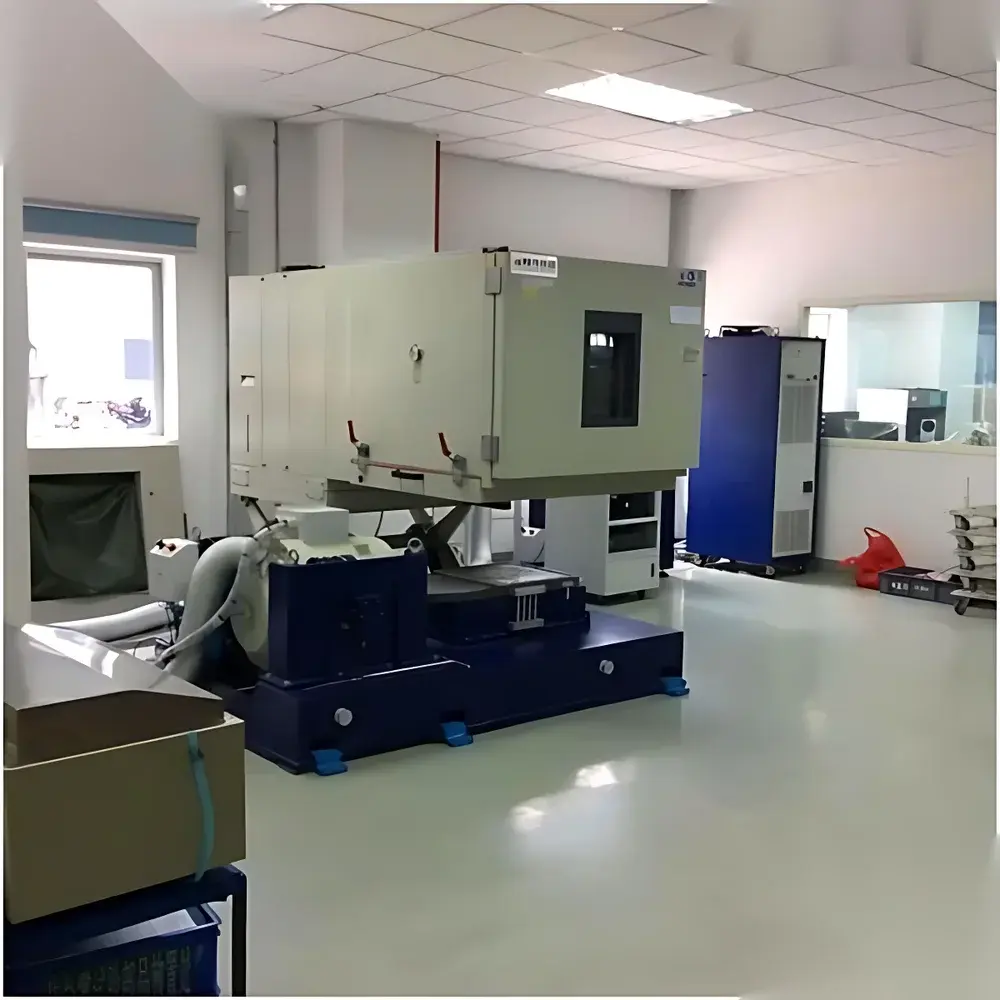
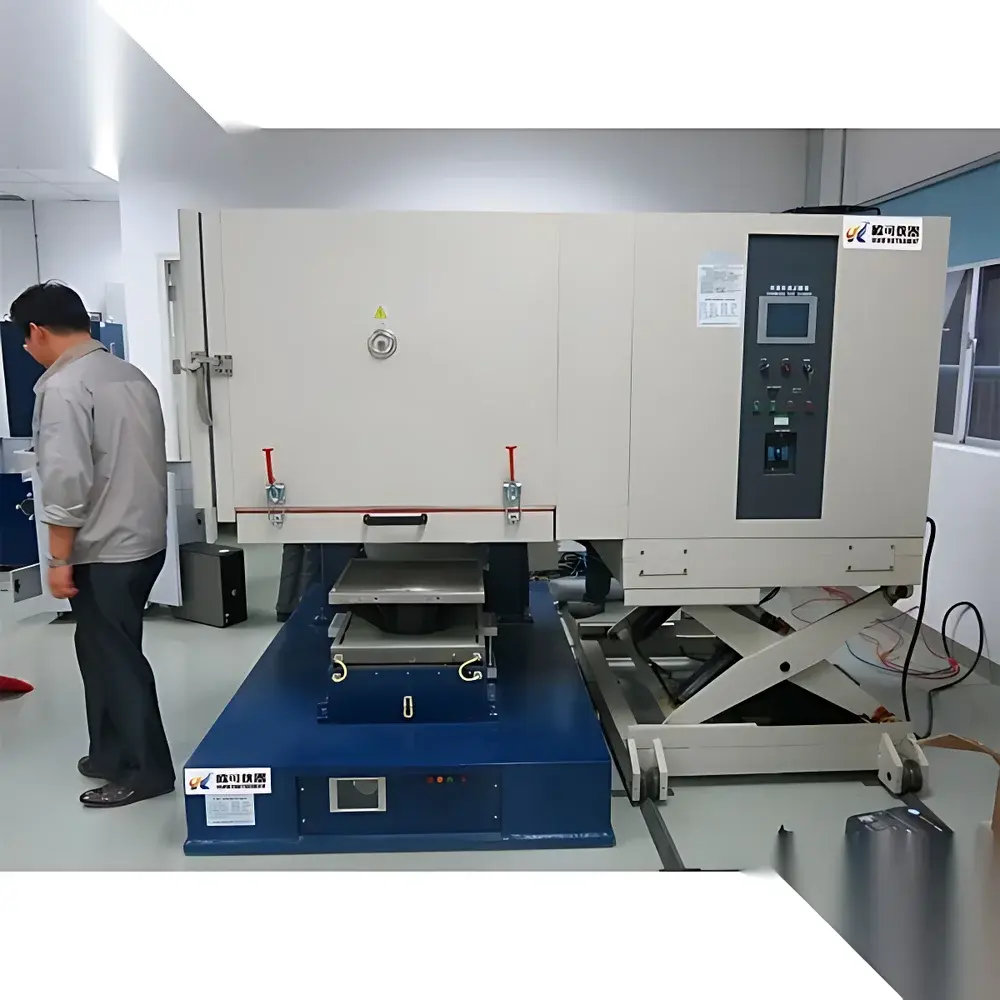
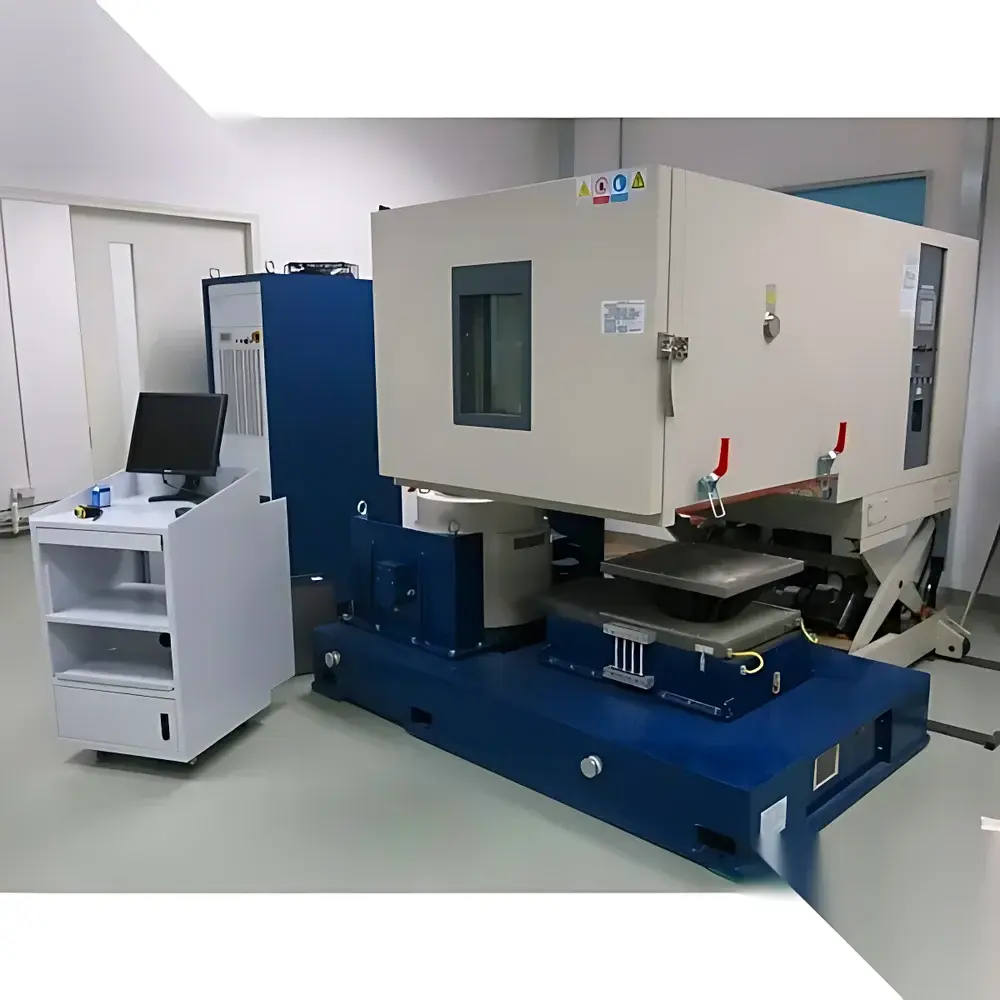
Combined Temperature-Humidity-Vibration Test System
| Key | Temperature Range: -70°C to +150°C |
|---|---|
| Humidity Range | 5–98% RH (standard: 20–98% RH) |
| Temp. Control Accuracy | ±0.5°C |
| Humidity Control Accuracy | ±2.5% RH |
| Temp. Uniformity | ±2.0°C |
| Humidity Uniformity | ±3.0% RH |
| Heating Rate | ~4.0°C/min |
| Cooling Rate | ~1.0°C/min |
| Chamber Interior/Exterior Material | SUS304 Stainless Steel |
| Insulation | High-Density Polyurethane Foam with Closed-Cell Structure |
| Cooling Method | Air-Cooled, Single-Stage or Two-Stage Refrigeration System (selected per low-temp requirement) |
| Safety Protections | Overcurrent Protection, Compressor Overload Protection, Refrigerant HP/LP Cut-off, Over-Temp/Over-Humidity Interlock |
| Controller | Full-Color LCD Touchscreen with Programmable Ramp-Soak Profiles & RS-232 Interface |
| Vibration Integration | Modular Interface for External Electrodynamic or Hydraulic Shaker Systems (user-specified model) |
Overview
The Combined Temperature-Humidity-Vibration Test System is an integrated environmental simulation platform engineered for concurrent application of thermal, hygroscopic, and dynamic mechanical stress conditions. It operates on the principle of multi-domain coupling—precisely synchronizing chamber-based climatic control (via PID-regulated refrigeration, steam humidification, and forced-air convection) with externally mounted vibration excitation systems (e.g., electrodynamic shakers or servo-hydraulic actuators). This triaxial stress combination replicates real-world operational environments encountered during transportation, field deployment, or mission-critical service life cycles—particularly where thermomechanical fatigue, condensation-induced corrosion, or resonance-triggered failure mechanisms are of concern. Designed for compliance-driven test laboratories, the system supports deterministic test execution under defined boundary conditions, enabling repeatable validation against MIL-STD-810H, IEC 60068-2, RTCA DO-160 Section 25, and automotive OEM-specific standards such as GMW 3172 and Ford CETP 00.00-L-467.
Key Features
- Modular architecture with physically isolated vibration interface—ensures mechanical decoupling between shaker baseplate and chamber structural frame while maintaining hermetic integrity across temperature and humidity extremes.
- High-stability dual-sensor feedback loop for temperature and relative humidity, incorporating NIST-traceable Pt100 RTDs and capacitive RH sensors calibrated per ISO/IEC 17025-accredited procedures.
- Intelligent refrigeration management with adaptive compressor staging: single-stage configuration for operation down to –20°C; two-stage cascade system for extended low-temperature capability to –70°C, minimizing thermal lag and improving transient response.
- LCD touchscreen controller featuring intuitive drag-and-drop profile programming, real-time data overlay (temp/humidity/vibration channel sync), and built-in alarm logging with timestamped event history.
- SUS304 stainless steel construction throughout interior and exterior surfaces—resistant to chloride-induced pitting and compatible with cleaning protocols required in aerospace cleanroom-adjacent testing zones.
- Robust safety interlock network compliant with EN 61000-6-2/6-4 and UL 61010-1, including independent hardware cut-offs for over-temperature, over-humidity, refrigerant pressure anomalies, and emergency power disconnection.
Sample Compatibility & Compliance
The system accommodates a wide range of DUT geometries and mass loads through customizable mounting interfaces—including threaded inserts, T-slots, and inertia-matched fixture plates—designed to preserve modal fidelity during vibration input. It meets functional requirements for GLP-compliant test documentation when paired with optional audit-trail-enabled software modules supporting 21 CFR Part 11 electronic signatures. Environmental profiles are executable in accordance with ASTM D4332 (conditioning of plastics), ISO 16750-4 (road vehicles—electrical disturbances), and JEDEC JESD22-A110 (accelerated moisture resistance). Chamber calibration certificates include uncertainty budgets traceable to national metrology institutes (NMI), ensuring measurement validity for third-party certification submissions.
Software & Data Management
Standard firmware includes embedded data acquisition at 10 Hz sampling rate for chamber parameters, with optional high-speed synchronization (up to 1 kHz) via external trigger input for vibration waveform correlation. Export formats include CSV, XML, and binary .tdms for post-processing in MATLAB, Python (NumPy/Pandas), or commercial FEA pre-processors. Optional PC-based software provides automated report generation with configurable templates aligned to internal QA checklists or customer-specific deliverables (e.g., AS9102 First Article Inspection). All configuration changes, setpoint modifications, and alarm events are logged with immutable timestamps and user ID attribution—supporting full traceability during regulatory audits.
Applications
- Aerospace avionics qualification under combined thermal cycling and random vibration spectra per MIL-STD-810H Method 514.7.
- Automotive ECUs subjected to humidity soak followed by swept-sine vibration to assess solder joint reliability under hygrothermal aging.
- Medical device enclosures tested for ingress protection integrity during simultaneous temperature ramping and mechanical shock exposure.
- 5G base station RF modules evaluated for phase stability degradation under humidity-modulated thermal gradients and broadband vibration.
- Defense-grade battery packs undergoing accelerated life testing combining charge/discharge cycles with environmental stress screening (ESS) profiles.
FAQ
What vibration shaker models can be integrated with this system?
The chamber features standardized mechanical and electrical interfaces compatible with major shaker manufacturers including LDS (now part of Brüel & Kjær), TIRA, and MTS. Integration requires coordination of baseplate stiffness, payload capacity, and stroke limitations—detailed compatibility matrices are provided during pre-delivery engineering review.
Is remote monitoring supported?
Yes—optional Ethernet/IP or Modbus TCP gateway enables secure remote access to real-time chamber status, alarm states, and historical trend data via authenticated web interface or SCADA integration.
Can the system perform HALT or HASS testing?
While not a dedicated HALT chamber, its programmable ramp rates, wide operating envelope, and precise synchronization capability make it suitable for step-stress screening protocols when used with appropriate vibration controllers and failure detection logic.
What maintenance intervals are recommended for the refrigeration system?
Compressor oil analysis and refrigerant purity checks are advised every 1,500 operating hours; full system evacuation and recharge recommended every 5 years or per OEM service bulletin—documentation aligns with ISO 5149 refrigeration safety standards.
Are custom chamber dimensions available?
Yes—standard internal volumes range from 150 L to 1,500 L; non-standard configurations (e.g., tall-profile or narrow-depth variants) are engineered on request, subject to structural integrity verification and thermal uniformity validation.



