
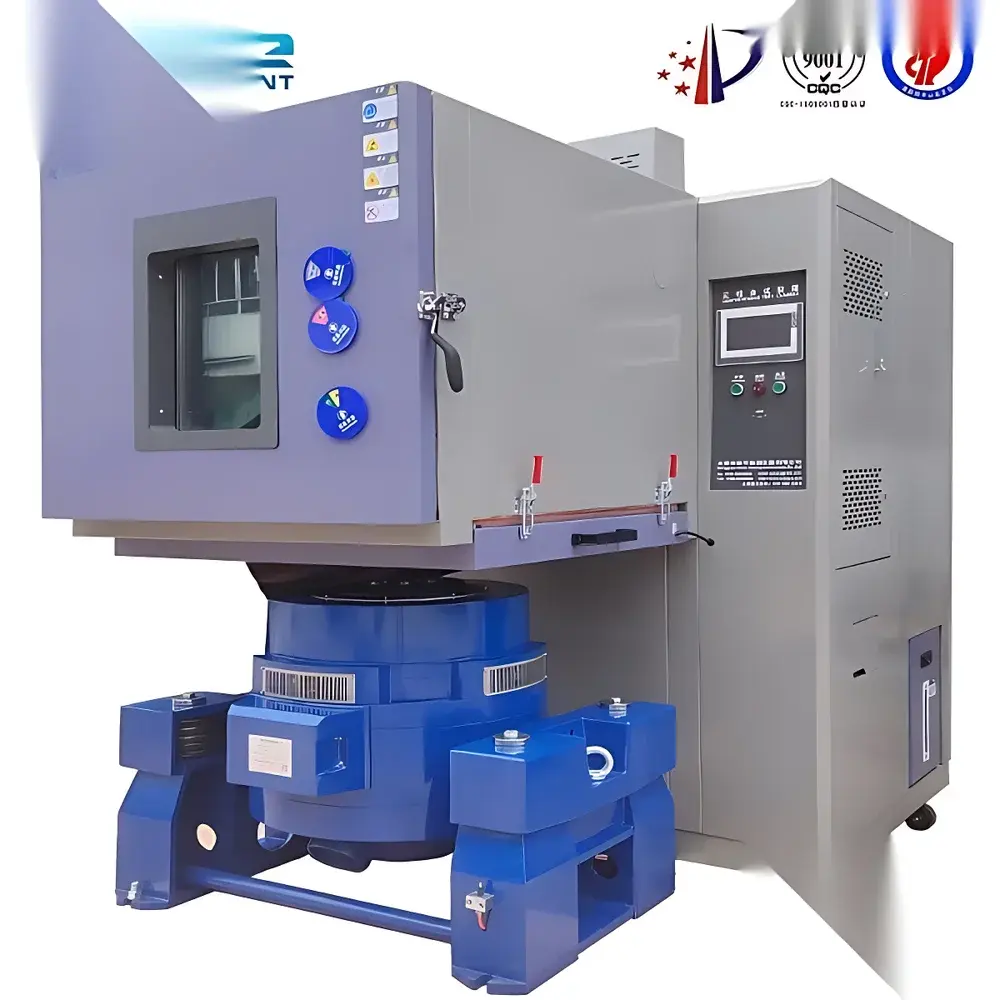
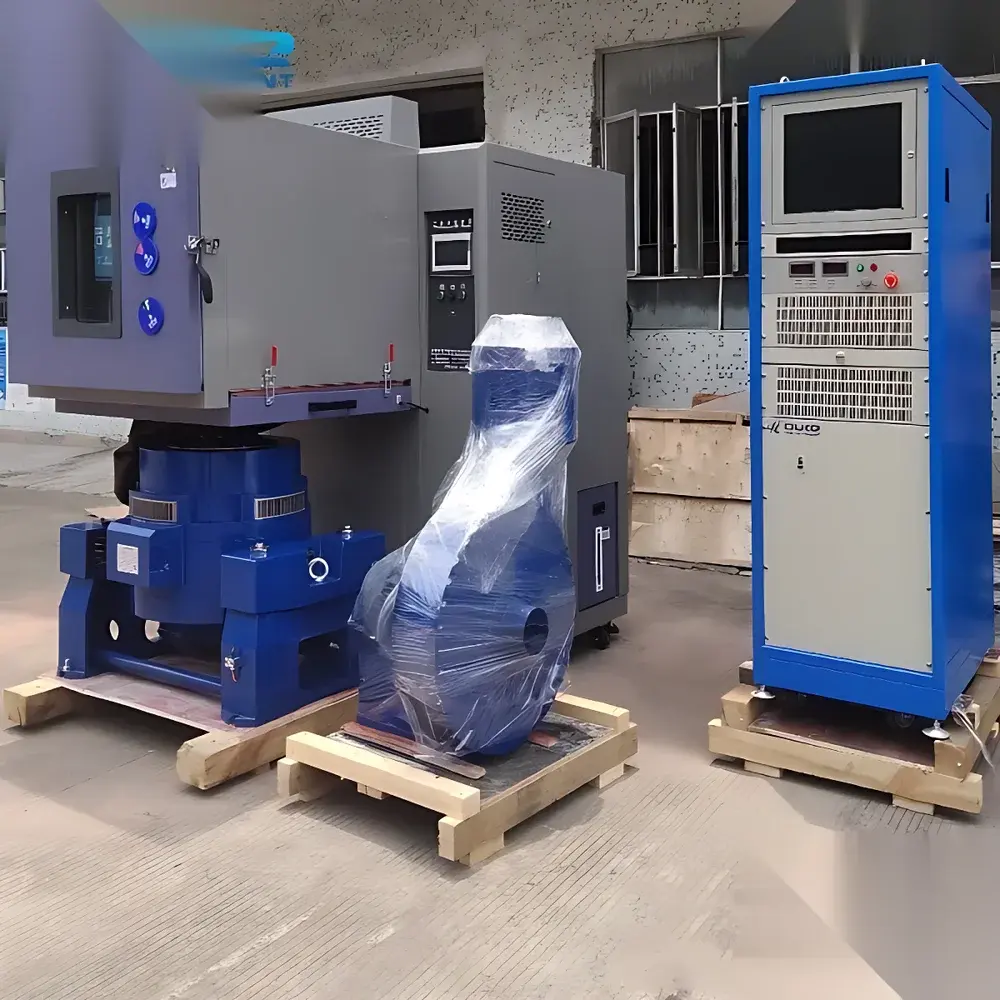
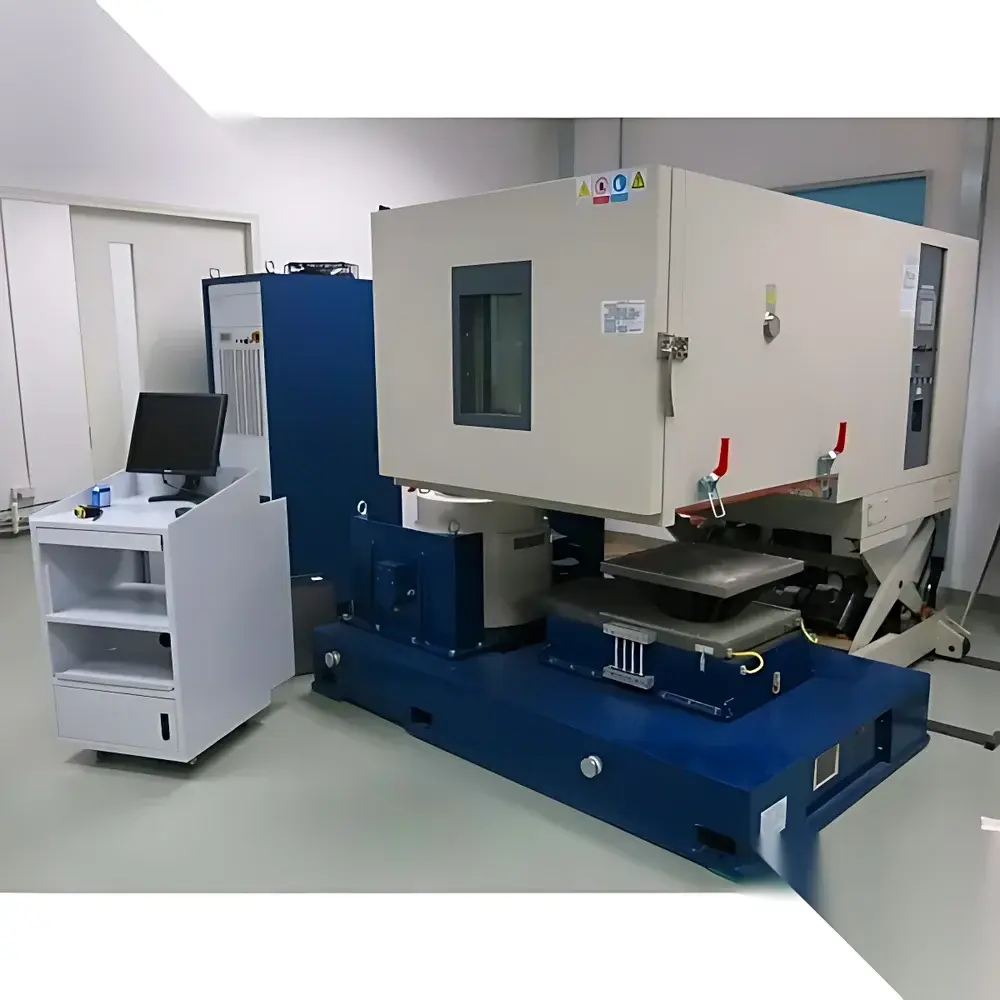
Combined Temperature-Humidity-Vibration Test System
| Brand | Other Brands |
|---|---|
| Origin | Imported |
| Manufacturer Type | Authorized Distributor |
| Price | USD 21,000 (FOB) |
| Table Size | 350 × 350 mm (customizable) |
| Frequency Range | 1–600 Hz / 1–3000 Hz / 1–5000 Hz |
| Peak-to-Peak Amplitude | 0–5 mm |
| Max Acceleration | <20 g |
| Load Capacity | 25 kg / 50 kg / 75 kg / 100 kg |
| Vibration Direction | Vertical, Horizontal, or Dual-Axis (selectable) |
| Waveform | Sinusoidal |
| Frequency Resolution | 0.01 Hz |
| Frequency Accuracy | ±0.1 Hz |
| Test Duration | 0–9999 h/min/sec (programmable) |
| Power Supply | AC 220 V / 50 Hz or AC 380 V / 50 Hz |
Overview
The Combined Temperature-Humidity-Vibration Test System is an integrated environmental reliability testing platform engineered for concurrent simulation of thermal stress, humidity exposure, and mechanical vibration—enabling accelerated life-cycle validation of electronic components, automotive modules, precision instruments, and consumer products. Unlike sequential chamber-and-shaker setups, this system implements synchronized control of temperature (-70 °C to +180 °C), relative humidity (10–98% RH), and electrodynamic vibration excitation within a single test envelope. Its core architecture adheres to the physical principles of forced sinusoidal oscillation under controlled thermohygrometric conditions, ensuring reproducible mechanical fatigue assessment under realistic field-relevant environmental loads. Designed for compliance-driven R&D and quality assurance workflows, it supports deterministic stress profiling aligned with IEC 60068-2, MIL-STD-810H, and GB/T 2423.10–2019 standards for combined environmental testing.
Key Features
- Four-point synchronous electromagnetic excitation ensures uniform acceleration distribution across the 350 × 350 mm stainless-steel test table—minimizing modal distortion and edge attenuation during high-frequency sweeps.
- Real-time amplitude prediction algorithm embedded in the controller enables rapid, repeatable amplitude calibration without external laser vibrometers—reducing setup time by up to 40% versus conventional systems.
- Programmable multi-segment timing logic supports complex test profiles: e.g., 30 min at −40 °C/10% RH + 5 g vertical sine sweep (10–500 Hz) followed by 2 h at +85 °C/85% RH + 10 Hz fixed-frequency dwell.
- Electromagnetic interference (EMI)-hardened control electronics—including shielded signal paths, opto-isolated I/O, and ferrite-core power filtering—eliminate measurement drift in high-noise lab environments (e.g., adjacent RF chambers or motor drive cabinets).
- Non-magnetic, static-dissipative table surface prevents electrostatic discharge (ESD) damage to sensitive semiconductors and avoids magnetic coupling with Hall-effect sensors or MEMS accelerometers under test.
- Stepless amplitude adjustment (0–5 mm p-p) and frequency resolution down to 0.01 Hz support fine-grained resonance tracking and harmonic suppression verification per ISO 10816-3.
Sample Compatibility & Compliance
The system accommodates test specimens up to 100 kg (depending on selected configuration) with mechanical interface options including threaded inserts (M6/M8), T-slots, and vacuum chucks for low-mass optical assemblies. It meets structural integrity requirements for mounting PCBs, ECUs, battery packs, and medical device enclosures. All thermal-humidity-vibration test protocols are traceable to national and international standards including GB/T 2423.10 (China), IEC 60068-2-64 (vibration), IEC 60068-2-30 (humidity cycling), and ASTM D4728 (random vibration of packaged goods). The control firmware supports audit-ready logging compliant with GLP and GMP documentation frameworks, with timestamped parameter records stored in CSV/Excel format for FDA 21 CFR Part 11–aligned review.
Software & Data Management
The proprietary Windows-based control software provides dual-mode operation: manual real-time adjustment and automated script execution via XML-based test definition files. Live monitoring includes synchronized plots of acceleration (g), displacement (mm p-p), temperature (°C), and RH (%), with overlay-triggered alarms for out-of-tolerance events. Raw data streams are sampled at ≥10 kHz and archived with metadata (operator ID, calibration certificate ID, ambient lab conditions). Export functions include IEEE 1584-compliant .tdms files for MATLAB/Simulink import and PDF report generation with digital signatures, revision history, and pass/fail annotations per user-defined acceptance criteria.
Applications
- Automotive: Validation of ADAS camera housings under thermal shock + road-spectrum vibration (SAE J2380).
- Aerospace: Screening of avionics boxes for resonance-induced solder joint failure during ascent thermal transients.
- Consumer Electronics: Drop-survivability correlation of smartphone flex cables subjected to humidity-swelling + 200 Hz resonance.
- Industrial IoT: Long-duration burn-in of wireless sensor nodes operating at 70 °C/95% RH while exposed to pump-induced 60 Hz harmonics.
- Medical Devices: Verification of infusion pump motor mounts under sterilization-cycle temperature ramps plus transport vibration profiles.
FAQ
Does the system support random vibration profiles in combination with temperature/humidity?
Yes—optional random vibration module (IEC 60068-2-64 Class 2) can be integrated with full cross-coupling control logic for PSD-based testing under climatic stress.
Can test data be exported for third-party analysis tools such as DIAdem or Python Pandas?
All acquired datasets export natively to CSV, HDF5, and TDMS formats—ensuring direct compatibility with National Instruments, MathWorks, and open-source analytical stacks.
Is remote monitoring and control available over Ethernet or industrial protocols?
Standard Ethernet/IP and Modbus TCP interfaces enable integration into factory MES systems; optional OPC UA server license supports IIoT deployment.
What calibration documentation is provided with shipment?
Each unit ships with NIST-traceable calibration certificates for vibration amplitude (laser interferometer verified), temperature uniformity (12-point mapping), and humidity accuracy (chilled mirror hygrometer reference).
How is thermal gradient managed during high-acceleration vibration to prevent condensation on cold samples?
The chamber employs dew-point-controlled dehumidification and programmable ramp-rate limiting (≤3 °C/min) to suppress interfacial moisture formation during dynamic thermal transitions.



