
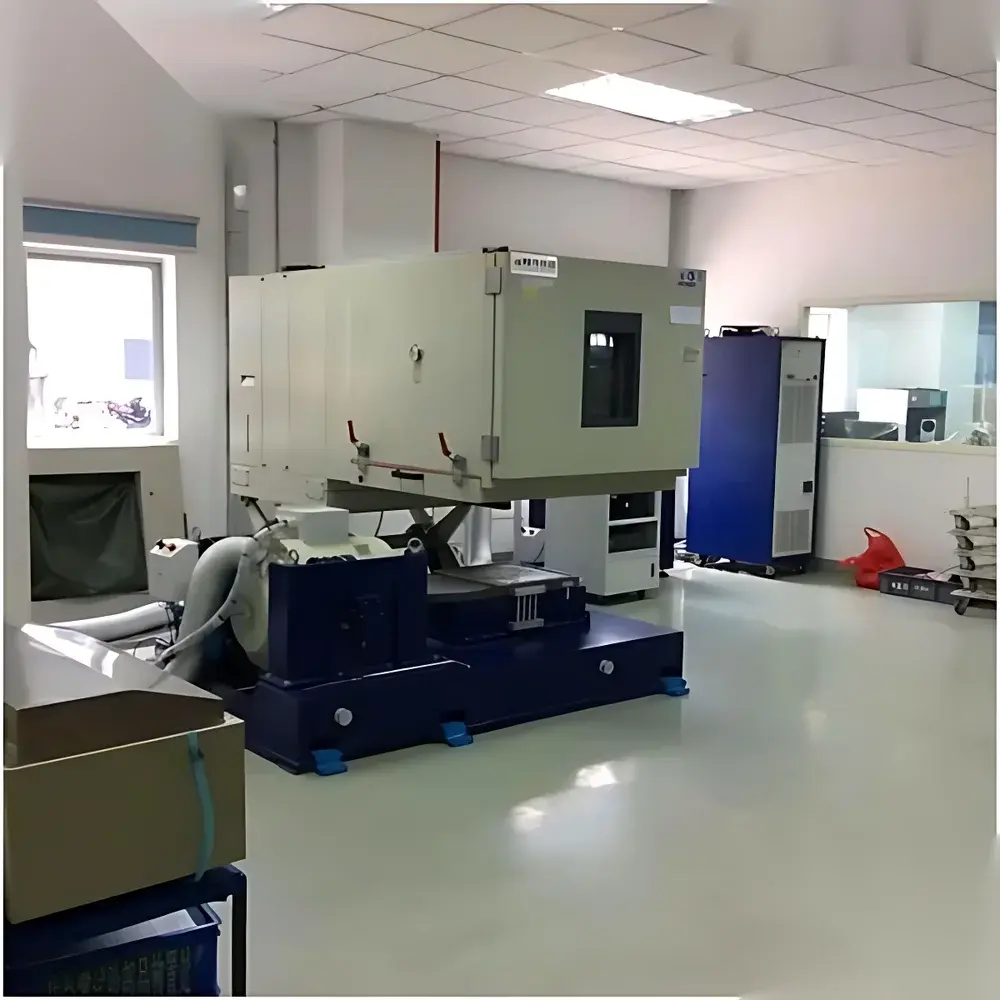
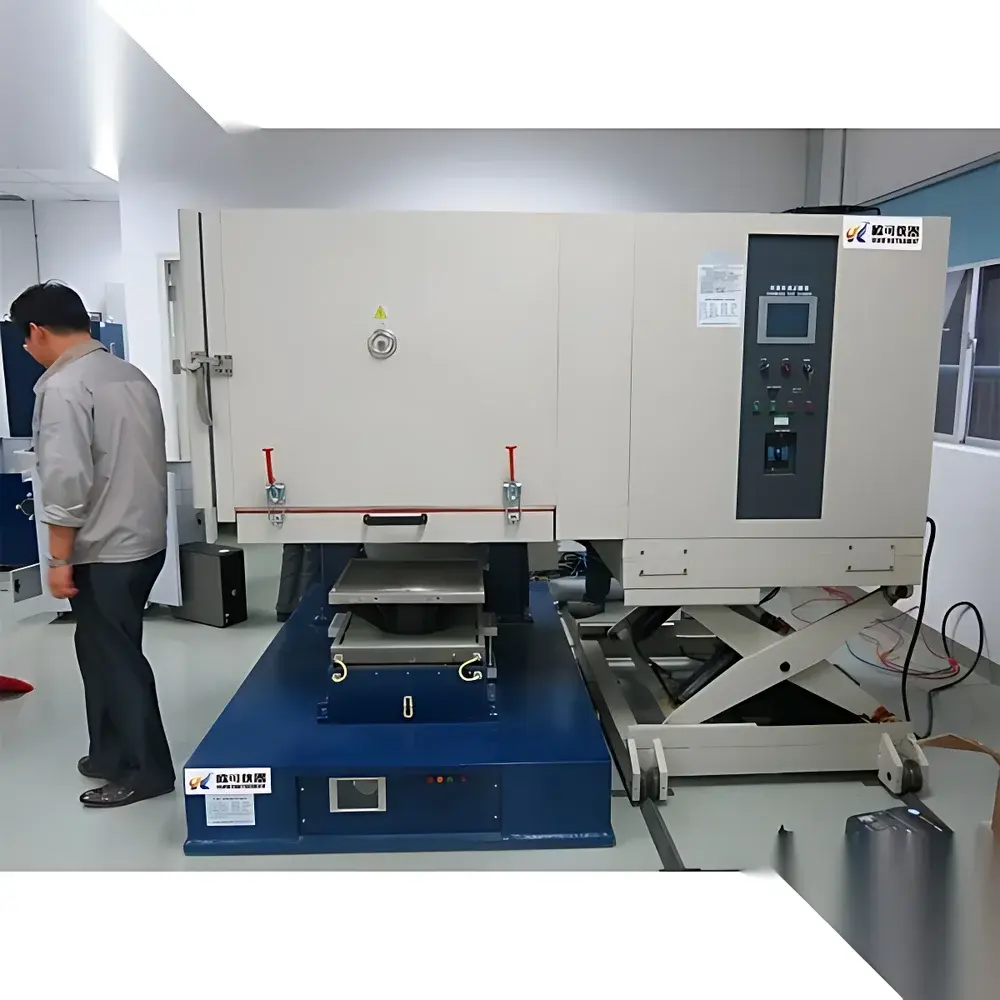
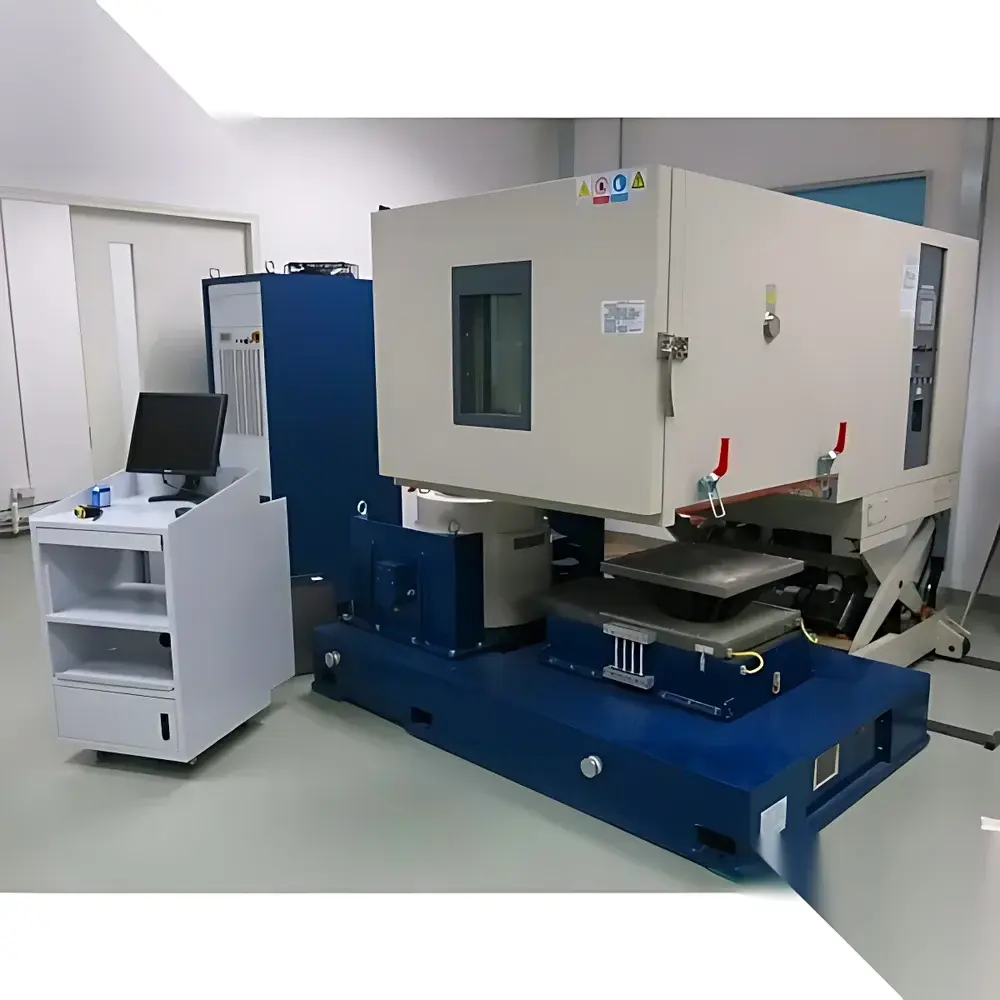
Combined Temperature-Humidity-Vibration Test System
| Brand | Other Brands |
|---|---|
| Origin | Imported |
| Manufacturer Type | Authorized Distributor |
| Price | USD 21,500 (FOB) |
| Thrust Range | 2–5,000 kgf (optional up to 10,000 kgf) |
| Frequency Response | DC–2,000 Hz (optional up to 20,000 Hz) |
| Maximum Velocity | 1.8–2.3 m/s |
| Maximum Payload | 80–400 kg (configurable) |
| Voice Coil Mass | 9–18 kg |
| Rated Thrust | 400–1,000 kgf |
| Frequency Range | 2–2,500 Hz or 2–3,000 Hz |
| Peak Acceleration | 44–66.6 g |
| Maximum Displacement | 30–75 mm |
| Voice Coil Diameter | 150–260 mm |
| Air Supply Requirement | 6–8 kgf/cm² |
Overview
The Combined Temperature-Humidity-Vibration Test System is an integrated environmental simulation platform engineered for concurrent or sequential exposure of test specimens to controlled thermal, hygrothermal, and mechanical vibration stressors. It operates on the principle of electrodynamic excitation—utilizing high-fidelity voice coil actuators coupled with precision temperature/humidity chambers—to replicate real-world operational and transportation environments. This system enables rigorous reliability validation per MIL-STD-810H, IEC 60068-2-6 / -2-64 / -2-30, ASTM D4728, and ISO 16750-3 protocols. Unlike standalone vibration shakers or climate chambers, this triaxial combined test solution eliminates sequential testing artifacts and captures synergistic failure modes—such as condensation-induced corrosion under cyclic acceleration or thermal expansion mismatch during resonant excitation—that cannot be identified in isolated stress tests.
Key Features
- Triple-stress integration: Simultaneous control of temperature (−70 °C to +180 °C), relative humidity (10–98% RH), and broadband electrodynamic vibration (DC–3,000 Hz)
- Modular actuator architecture: Interchangeable shaker tables with rated thrusts from 400 to 1,000 kgf and peak accelerations up to 66.6 g, optimized for payload ranges from 80 kg to 400 kg
- Rigid voice coil design: High-strength aluminum or steel-reinforced coils (150–260 mm diameter) ensure flat frequency response, minimal harmonic distortion, and long-term mechanical stability
- Passive isolation base: Dual-stage support using pneumatic air springs and hydraulic dampers eliminates need for structural anchoring while maintaining >95% vibration transmission loss to building infrastructure
- Cast-steel structural frame: Side and base plates manufactured from stress-relieved cast steel provide low modal resonance, high torsional rigidity, and dimensional stability across thermal cycling
- High-fidelity controller: Real-time closed-loop feedback with ≥10 kHz sampling rate, supporting sine, random, shock, swept-sine, and transient profile execution with IEEE 1451.4 TEDS-compliant transducer support
Sample Compatibility & Compliance
The system accommodates electronic assemblies, automotive ECUs, aerospace avionics modules, medical device enclosures, and industrial control units up to 400 kg and 1,200 × 1,000 × 900 mm (W × D × H). Chamber interior features stainless-steel construction, non-outgassing insulation, and condensate management systems compliant with ISO 14644-1 Class 8 cleanroom requirements. All vibration profiles adhere to GR-63-CORE (Telcordia), DO-160G Section 8, and JEDEC JESD22-B103 for mechanical shock. Full audit trail logging—including setpoint deviations, alarm events, and calibration metadata—is maintained in accordance with FDA 21 CFR Part 11 and GLP/GMP documentation standards.
Software & Data Management
Control and analysis are performed via a Windows-based engineering workstation running certified test software compliant with IEC 61508 SIL2. The interface supports multi-axis synchronization, real-time FFT spectral monitoring, and automated pass/fail evaluation against user-defined acceptance thresholds. Raw time-history data (acceleration, temperature, humidity) is stored in HDF5 format with embedded metadata tags for traceability. Export options include MATLAB .mat, CSV, and UFF58 formats. Software includes built-in report generators compliant with ISO/IEC 17025 accreditation requirements, including uncertainty budgeting per GUM (JCGM 100:2008).
Applications
- Transportation simulation: Replicating road-induced vibrations during cold-soak or hot-humidity storage to assess solder joint fatigue in automotive ADAS modules
- Aerospace qualification: Concurrent thermal cycling and random vibration per RTCA DO-160G to validate flight-critical sensor housings
- Consumer electronics validation: Accelerated life testing of battery packs under humid heat and resonant-frequency dwell to identify delamination risks
- Industrial IoT gateway certification: Long-duration fatigue testing at 55 °C / 85% RH with broadband random vibration (20–2,000 Hz, 1.5 g2/Hz PSD) to verify structural integrity
- Failure mode isolation: Correlating microcrack initiation in PCB substrates observed via X-ray CT with specific phase relationships between thermal gradient and axial acceleration
FAQ
Does this system support real-time data streaming to external DAQ systems?
Yes—via TCP/IP socket interface with configurable packet structure and sub-millisecond timestamp resolution.
Can the chamber maintain humidity control during high-g random vibration?
Yes—using active dew-point modulation and chamber pressure compensation; validated per IEC 60068-2-30 Test Db.
Is third-party calibration certification included with delivery?
Standard delivery includes NIST-traceable calibration certificates for temperature, humidity, and acceleration sensors, with optional UKAS accreditation.
What is the maximum allowable specimen center-of-gravity height above the shaker table?
For payloads ≤250 kg: ≤300 mm; for payloads 250–400 kg: ≤200 mm—verified via modal analysis to prevent overturning moment exceedance.
How is thermal gradient uniformity maintained across the vibration table surface?
Through dual-zone chamber wall heating/cooling, forced-air circulation with turbulence-dampened ducting, and embedded thermocouple grid monitoring (±0.5 °C tolerance over 90% of working volume).



