
Combined Temperature-Humidity-Vibration Test System
| Brand | Other brands |
|---|---|
| Origin | Imported |
| Manufacturer Type | General distributor |
| Price | USD 14,000 (approx. based on ¥100,000 at 1:7.1 exchange rate) |
| Frequency Range | 5–3000 Hz |
| Rated Sinusoidal Force | 14.2 kN |
| Rated Random Force (RMS) | 14.2 kN |
| Max Acceleration | 784 m/s² |
| Max Velocity | 2.00 m/s |
| Max Displacement (p-p) | 51 mm |
| Payload Capacity | 300 kg |
| Refrigeration | Twin-stage or cascade low-temperature circuit with Tecumseh (France) hermetic compressors |
| Humidity Control Range | 20–98% RH |
| Temperature Range | −70°C to +180°C (typical, system-dependent) |
| Vibration Table Diameter | Ø280 mm |
| Table Moving Mass | 18 kg |
| Amplifier Output Power | 20 kVA |
| System Weight | ~2,000 kg (total) |
Overview
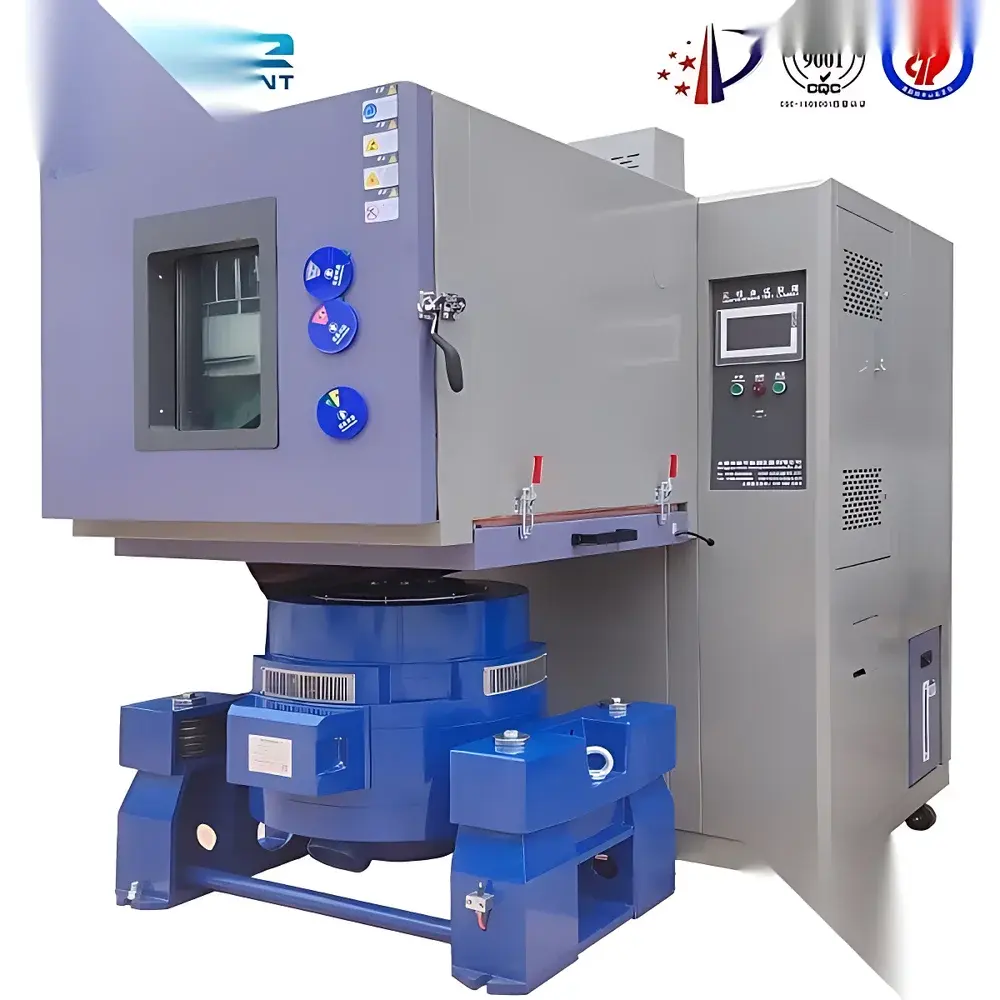
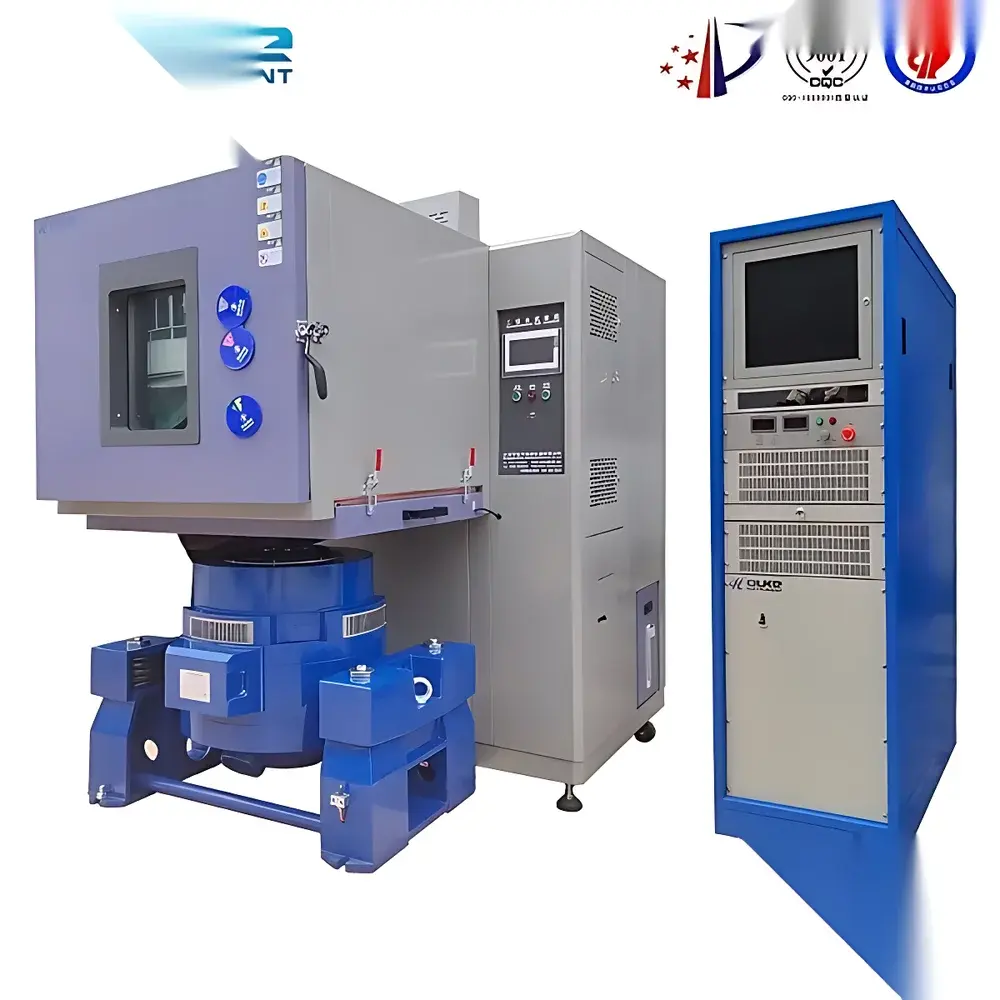
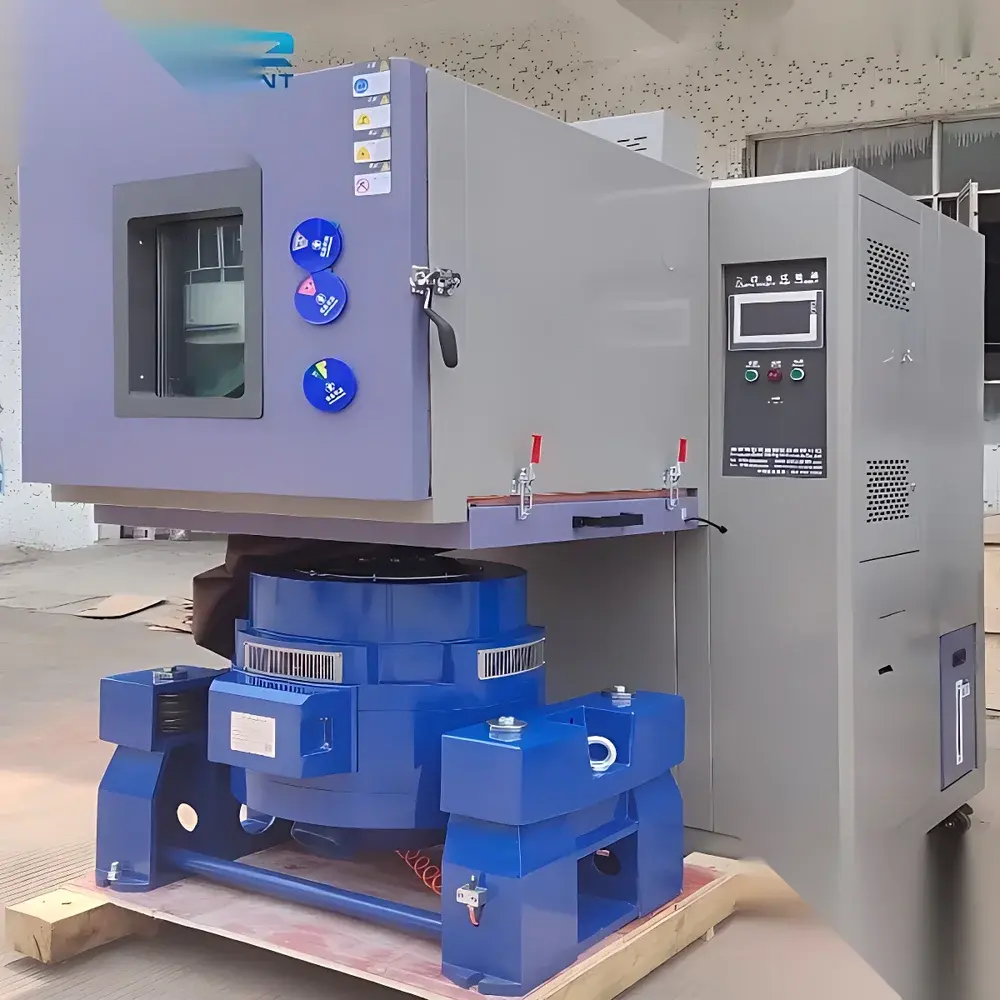
The Combined Temperature-Humidity-Vibration Test System is an integrated environmental simulation platform engineered for simultaneous application of thermal cycling, controlled humidity, and mechanical vibration stress. It operates on the principle of multi-stress synergy—replicating real-world service conditions where electronic components, automotive ECUs, aerospace avionics, and military-grade assemblies are subjected to concurrent climatic and dynamic loading. Unlike sequential testing, this system enables true accelerated life testing (ALT) and HALT/HASS protocols by applying temperature gradients (−70°C to +180°C), humidity profiles (20–98% RH), and broadband vibration (5–3000 Hz) within a single, sealed test chamber. The architecture conforms to fundamental requirements of IEC 60068-2-64 (random vibration), IEC 60068-2-1/2 (cold/heat), IEC 60068-2-30 (damp heat cyclic), and MIL-STD-810H Method 514.8, supporting both qualification and reliability growth testing under GLP-compliant laboratory practices.
Key Features
- Triple-stress integration: Independent yet synchronized control of temperature, humidity, and electrodynamic vibration—no mechanical decoupling required during operation.
- Vibration subsystem: Equipped with a high-force shaker featuring a 14.2 kN sinusoidal and RMS capability, stainless-steel armature assembly (Tobishima), and low-noise forced-air cooling; compliant with ISO 5344 mounting interface standards.
- Dual-circuit refrigeration: Cascade or two-stage low-temperature system using Tecumseh hermetic compressors, Parker Hannifin (Alico) dryers, and Castel solenoid valves—ensuring stable sub-zero performance down to −70°C.
- Uniform environmental distribution: Multi-wing centrifugal blower (Sanyo Denki) with top-down air supply and bottom return path; laminar flow design validated per ASTM E145 Class A uniformity criteria (±1.5°C, ±3% RH across 75% working volume).
- Structural integrity: A3 steel outer casing with powder-coated finish; SUS304 mirror-finish inner chamber insulated with ultra-fine glass wool (thermal conductivity ≤0.036 W/m·K); dual-layer high-tension silicone gasket sealing at door interface.
- Modular vibration table deployment: Retractable rail-mounted shaker base allows physical isolation of the vibration actuator when only climate testing is performed—reducing cross-contamination risk and extending bearing service life.
Sample Compatibility & Compliance
The system accommodates DUTs up to 300 kg mass and 280 mm diameter mounting footprint. Standard configurations support IPC-J-STD-020 moisture sensitivity level (MSL) preconditioning, JEDEC JESD22-A104 thermal cycling, and SAE J2412 automotive vibration-humidity profiles. All hardware—including pressure transducers, PT100 RTDs, and piezoelectric accelerometers (CGJ-1 equivalent)—are calibrated traceable to NIST or national metrology institutes. Data acquisition and control firmware comply with FDA 21 CFR Part 11 requirements for electronic records and signatures when configured with audit-trail-enabled software options. Full documentation packages meet ISO/IEC 17025 accreditation prerequisites for third-party test labs.
Software & Data Management
Control is executed via a dedicated DSP-based vibration controller interfaced with an industrial PC (Intel Pentium IV 2.0 GHz, 256 MB RAM, 60 GB HDD). The system ships with licensed U.S.-developed software modules for sine sweep, random PSD generation (up to 8,192 lines resolution), classical shock synthesis (half-sine, trapezoidal, sawtooth), and real-time fatigue damage spectrum analysis. Environmental parameters are managed through a separate PID-based climate controller with programmable ramp rates (0.5–10°C/min), dwell steps, and humidity soak logic. All test logs—including time-history acceleration, chamber thermohygrometric traces, and amplifier status flags—are timestamped, encrypted, and exportable in CSV, MATLAB .mat, or universal ASAM MDF4 formats. Optional add-ons include remote monitoring via HTTPS-secured web interface and automated report generation aligned with IEEE 1670 templates.
Applications
This system serves critical validation workflows across regulated industries: evaluating solder joint integrity in PCBAs under combined thermal-mechanical stress; verifying sealant performance in EV battery enclosures during humidity-vibration exposure; assessing optical alignment stability in satellite payload assemblies; qualifying MEMS inertial sensors for drone navigation systems; and performing failure mode identification in medical imaging subsystems prior to ISO 13485 certification. It is routinely deployed in Tier-1 automotive supplier labs (e.g., Bosch, Continental), defense prime contractor facilities (Lockheed Martin, Raytheon), and academic reliability research centers conducting physics-of-failure modeling.
FAQ
What standards does this system support out-of-the-box?
It natively executes test profiles defined in IEC 60068-2-1, -2, -14, -30, -64, MIL-STD-810H Methods 502.6, 507.6, and 514.8. Custom profile import (via .csv or .xml) enables compliance with proprietary OEM specifications.
Can the vibration and climate subsystems operate independently?
Yes—both subsystems feature fully isolated control loops and safety interlocks. Climate-only or vibration-only modes are selectable without hardware reconfiguration.
Is remote diagnostics and calibration verification supported?
Standard Ethernet (TCP/IP) connectivity enables remote firmware updates, real-time parameter monitoring, and automated calibration certificate generation per ISO/IEC 17025 Annex A.2.
What maintenance intervals are recommended for the refrigeration system?
Compressor oil analysis and dryer replacement every 24 months; full refrigerant circuit leak check and pressure decay validation annually—per ASHRAE Guideline 3-2021.
Does the system include GLP/GMP audit trail functionality?
When equipped with optional 21 CFR Part 11-compliant software license, it provides user-level access control, electronic signature capture, immutable event logs, and change history for all setpoints and test sequences.



