
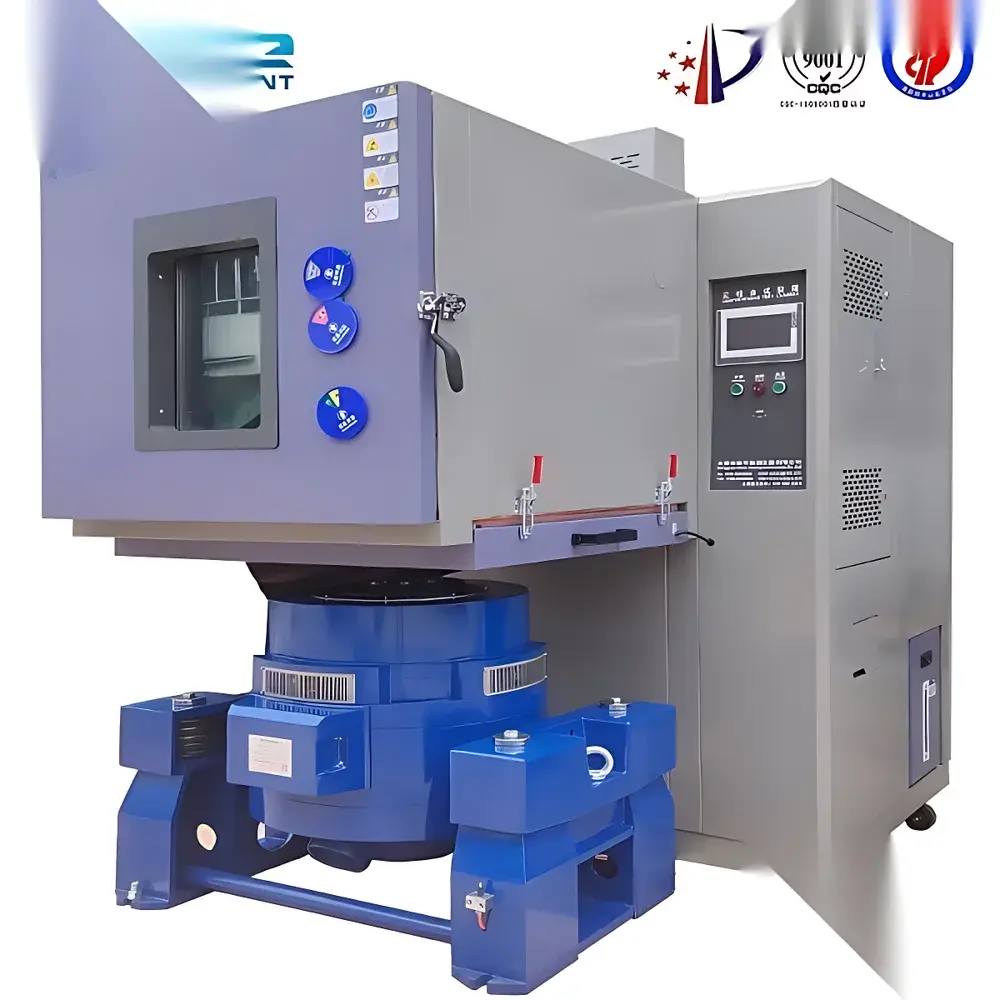
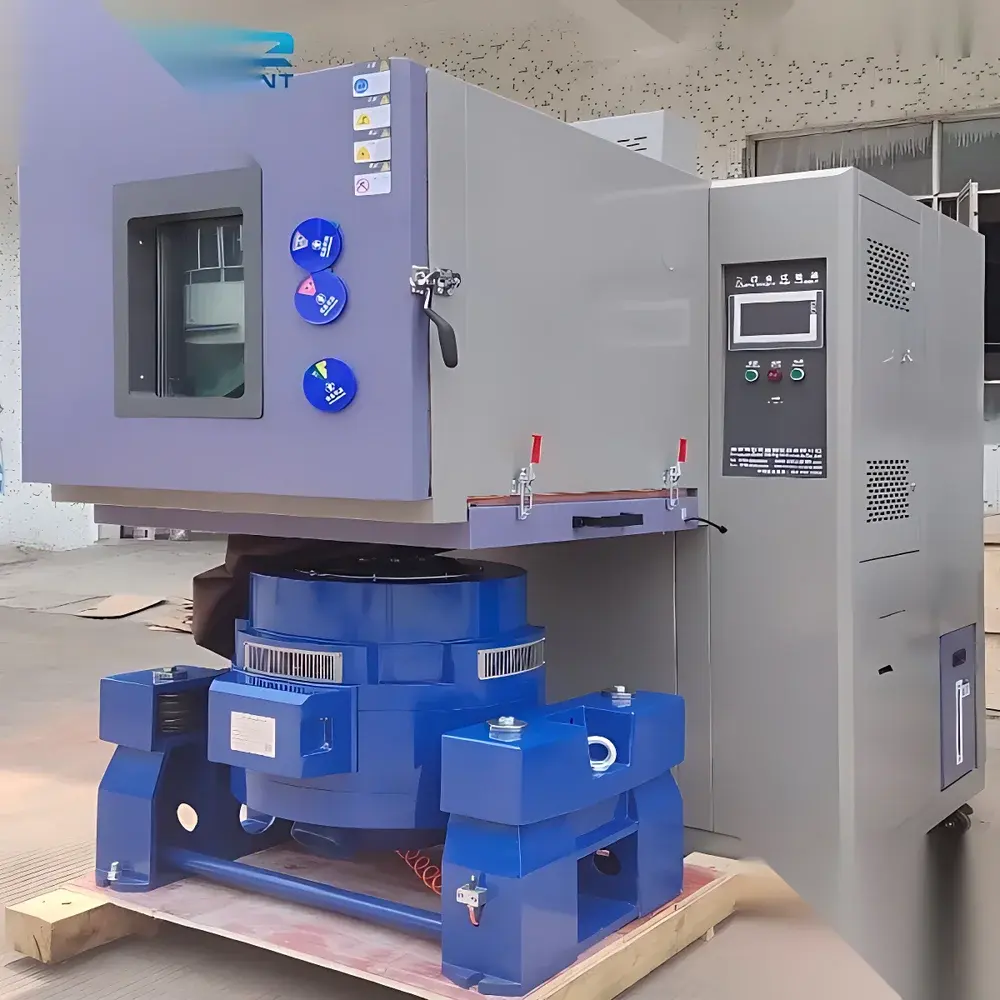
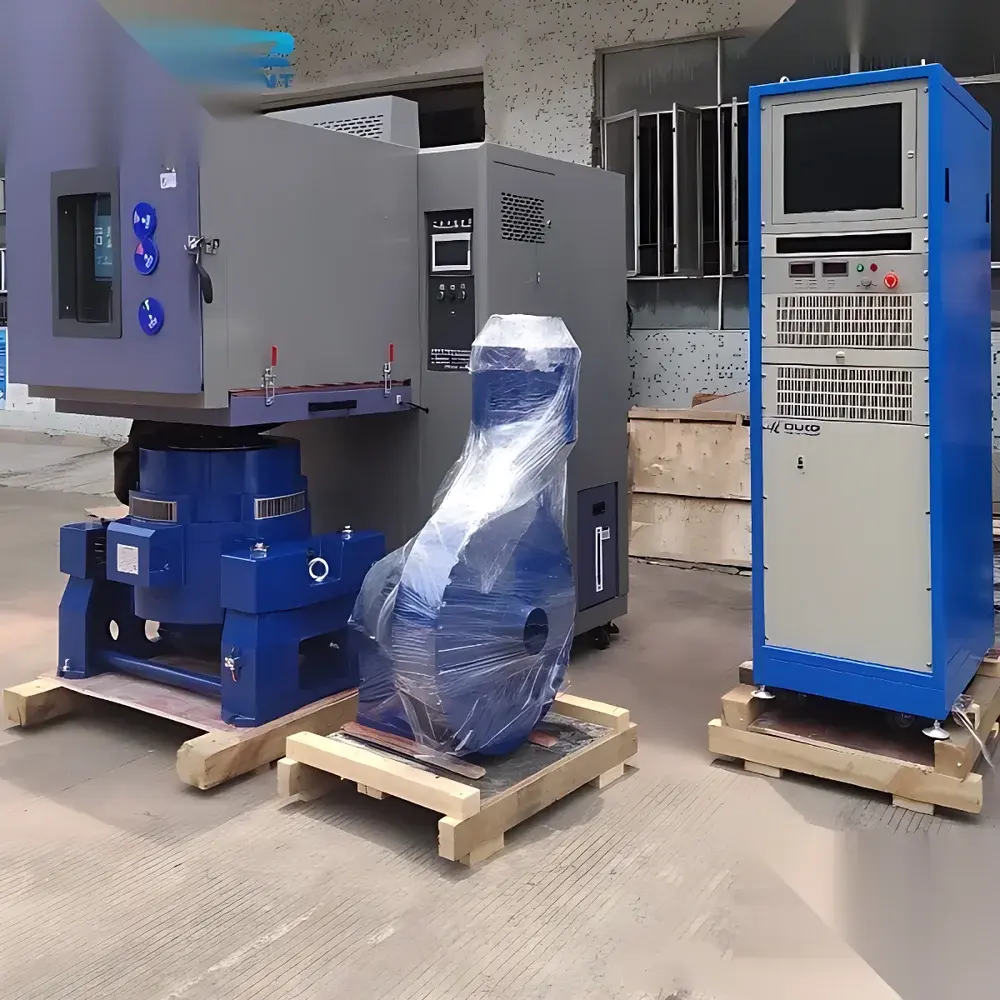
Combined Temperature-Humidity-Vibration Test System for Automotive Components
| Brand | OEM / Custom-Built |
|---|---|
| Origin | Imported |
| Manufacturer Type | Authorized Distributor |
| Price | USD 21,500 (FOB) |
| Frequency Range | 1–5000 Hz |
| Max. Acceleration | 20 g |
| Max. Displacement (p-p) | 0–5 mm |
| Vibration Axes | Vertical + Horizontal |
| Waveform | Sinusoidal |
| Programmable Segments | Up to 15 segments per profile |
| Sweep Modes | Linear & Logarithmic |
| Compliance | ASTM D4728, ISO 16750-3, SAE J1211, GB/T 28046.3, IEC 60068-2-6 & -2-64 |
| Control Interface | PC-based Real-Time Controller with Ethernet/USB Connectivity |
| Test Table Dimensions (L×W) | 50 × 50 cm (customizable) |
| Max. Load Capacity | 100 kg |
| Power Supply | 220 V ±20%, 5 A, 2.2 kVA |
Overview
The Combined Temperature-Humidity-Vibration Test System for Automotive Components is an integrated environmental stress screening platform engineered to replicate the cumulative mechanical and climatic stresses experienced by automotive parts during transportation, storage, and real-world operation. It simultaneously applies controlled temperature (−70°C to +180°C), relative humidity (10–98% RH), and broadband electrodynamic vibration (1–5000 Hz) within a single test chamber—enabling accelerated life testing (ALT) and failure mode analysis under synergistic stress conditions. Unlike sequential or standalone environmental chambers, this system adheres to the fundamental principle of combined stress testing defined in ISO 16750-3 and SAE J1211: simultaneous exposure ensures realistic degradation mechanisms—such as solder joint fatigue, polymer creep, condensation-induced corrosion, and connector fretting wear—are activated and observable within compressed test durations. Its architecture integrates a high-fidelity shaker table with closed-loop acceleration/displacement feedback, coupled to a dual-refrigeration humidity chamber featuring stainless-steel insulated walls and PID-controlled steam/humidification systems.
Key Features
- Simultaneous three-stress application: precise coordination of thermal cycling, humidity control, and multi-axis vibration in real time
- Electrodynamic shaker with 20 g peak acceleration capability and 5 mm p-p displacement limit, supporting sine, swept-sine, and programmable random profiles
- Frequency resolution down to 0.01 Hz with digital signal processing (DSP)-based controller; repeatability ±0.1 Hz across full 1–5000 Hz range
- Programmable test profiles: up to 15 independent frequency-time segments per cycle; configurable sweep rates (linear/log), octave tracking, and dwell functions
- Vertical + horizontal dual-axis vibration capability via orthogonal actuator mounting—enabling compliance with ISO 16750-3 Annex B (multi-directional road simulation)
- Temperature-humidity chamber equipped with direct-expansion refrigeration, steam humidification, and desiccant drying; meets IEC 60068-2-1/-2/-3 stability requirements (±0.5°C, ±2% RH)
- Real-time monitoring and closed-loop control via industrial-grade PC interface with Ethernet/USB connectivity; supports remote diagnostics and firmware updates
- Ruggedized structural design: reinforced steel frame, anti-resonant base isolation, and vibration-damped chamber mounting to ensure measurement integrity during high-g operation
Sample Compatibility & Compliance
This system accommodates automotive subassemblies up to 100 kg—including ECUs, sensors, lighting modules, infotainment units, brake calipers, and powertrain components—mounted on a customizable 50 × 50 cm aluminum test table (standard; optional sizes available). The chamber interior features non-corrosive 304 stainless steel construction, removable shelves, and cable/port access sleeves compliant with MIL-STD-810H and GB/T 28046.3. All operational modes meet regulatory validation requirements for automotive qualification: test profiles are fully traceable and audit-ready for ISO/TS 16949, IATF 16949, and APQP Stage 3 verification. Data logs include timestamped temperature, humidity, acceleration (X/Y/Z), and chamber pressure—structured to support FDA 21 CFR Part 11-compliant electronic records when paired with validated software extensions.
Software & Data Management
The embedded control software provides intuitive profile creation, live waveform visualization, and automated pass/fail evaluation against user-defined thresholds (e.g., resonance detection, amplitude drift >5%). Raw sensor data (accelerometer, PT100, capacitive RH) is streamed at 10 kHz and stored in IEEE-compliant .tdms format, compatible with MATLAB, Python (SciPy), and LabVIEW for post-test spectral analysis (FFT, PSD, Kurtosis). Audit trails record operator ID, parameter changes, calibration events, and emergency stops—supporting GLP/GMP-aligned documentation workflows. Optional add-ons include vibration transducer calibration modules (traceable to NIST standards) and report generators compliant with AIAG CQI-9 heat-treat and vibration process validation templates.
Applications
- Accelerated reliability validation of ADAS radar housings under thermal-humidity-vibration coupling
- Fatigue life assessment of EV battery module fasteners subjected to road-induced harmonic excitation
- Humidity-induced delamination testing of automotive PCBs with concurrent 10–2000 Hz sinusoidal shake
- Qualification of headlamp assemblies per ECE R112 thermal shock + vibration endurance protocols
- Pre-production screening of HVAC actuators using SAE J1211-compliant multi-axis road profile replication
- Root cause analysis of intermittent electrical faults in instrument clusters triggered by condensation + resonant vibration
FAQ
Does the system support random vibration testing in addition to sine and swept-sine modes?
No—this configuration is optimized for deterministic waveforms (sine, swept-sine, programmable step-sine) per ISO 16750-3 and automotive OEM specifications requiring repeatable resonance tracking. Random vibration capability requires optional upgrade to a 6-DOF hydraulic shaker module.
Is humidity control active during vibration operation?
Yes—chamber humidity remains actively regulated throughout vibration cycles via closed-loop steam injection and chilled-mirror RH sensing, maintaining setpoint stability within ±2% RH even at 5000 Hz table resonance.
Can the system be calibrated to national metrology standards?
Yes—full system calibration (temperature, humidity, acceleration) is performed pre-shipment using NIST-traceable reference instruments; calibration certificates and uncertainty budgets are provided with each unit.
What safety interlocks are implemented during combined stress operation?
Hardware-enforced interlocks include over-temperature cutoff (dual thermocouple redundancy), shaker over-acceleration shutdown (<20 ms response), chamber door open/vibration inhibit, and emergency power-off with mechanical latch release.
Is remote monitoring supported without local PC presence?
Yes—the embedded controller includes embedded web server functionality; authorized users can view real-time chamber status, download logs, and initiate predefined profiles via secure HTTPS interface from any network-connected device.



