
Combined Temperature-Humidity-Vibration Test System – Custom Quotation Model
| Key | Brand: OEM/Third-Party Manufacturer |
|---|---|
| Origin | Imported |
| Supplier Type | Authorized Distributor |
| Frequency Range | 5–3000 Hz |
| Max Acceleration | 980 m/s² (100 g, unloaded) |
| Max Velocity | 1.85 m/s |
| Peak-to-Peak Displacement | 51 mm |
| Max Payload | 300 kg |
| Moving Mass | 22 kg |
| Continuous Operation Duration | 20 h |
| Ambient Operating Conditions | 0–40 °C, ≤90% RH (at 25 °C) |
| Compliance | GB/T 13310-2007, GB/T 2423.10-2008, GJB 150.3–1986, GJB 150.16–1986, GJB 360A–1996 (Methods 204, 213, 214), IEC 60068-2-6 |
Overview
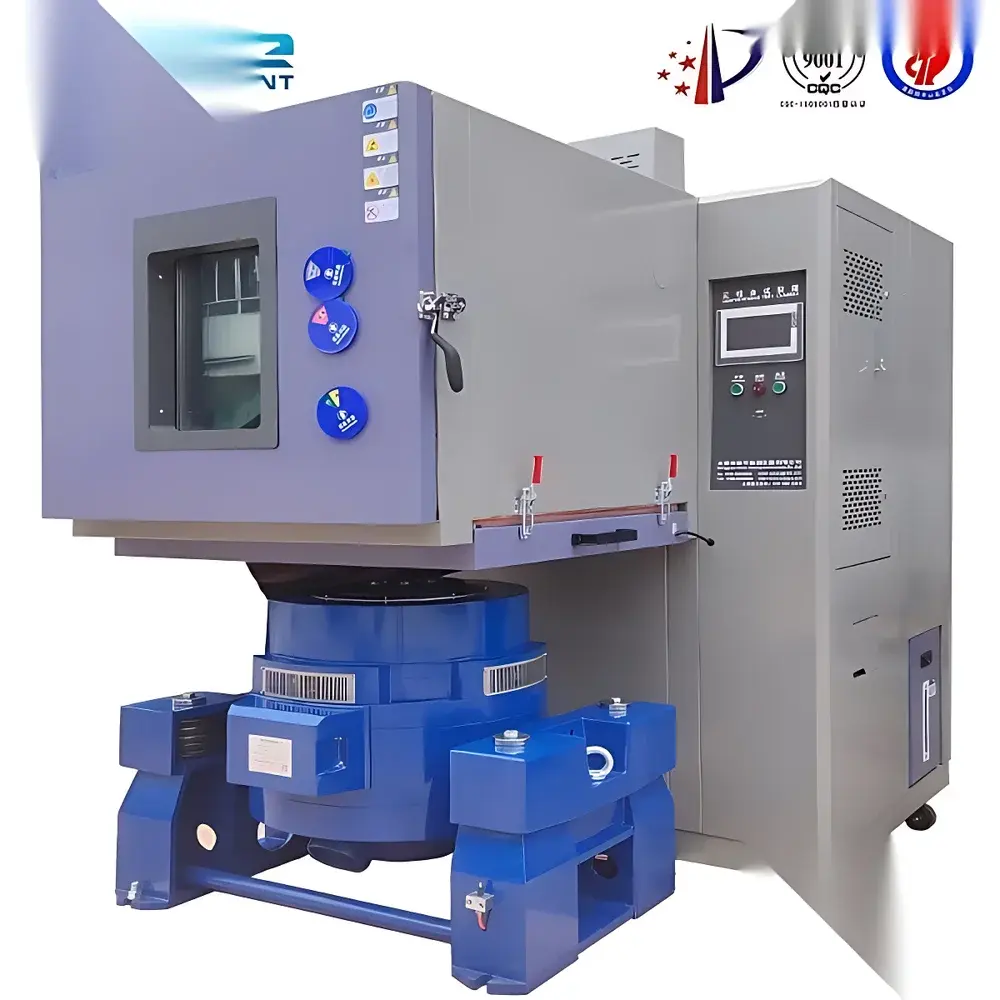
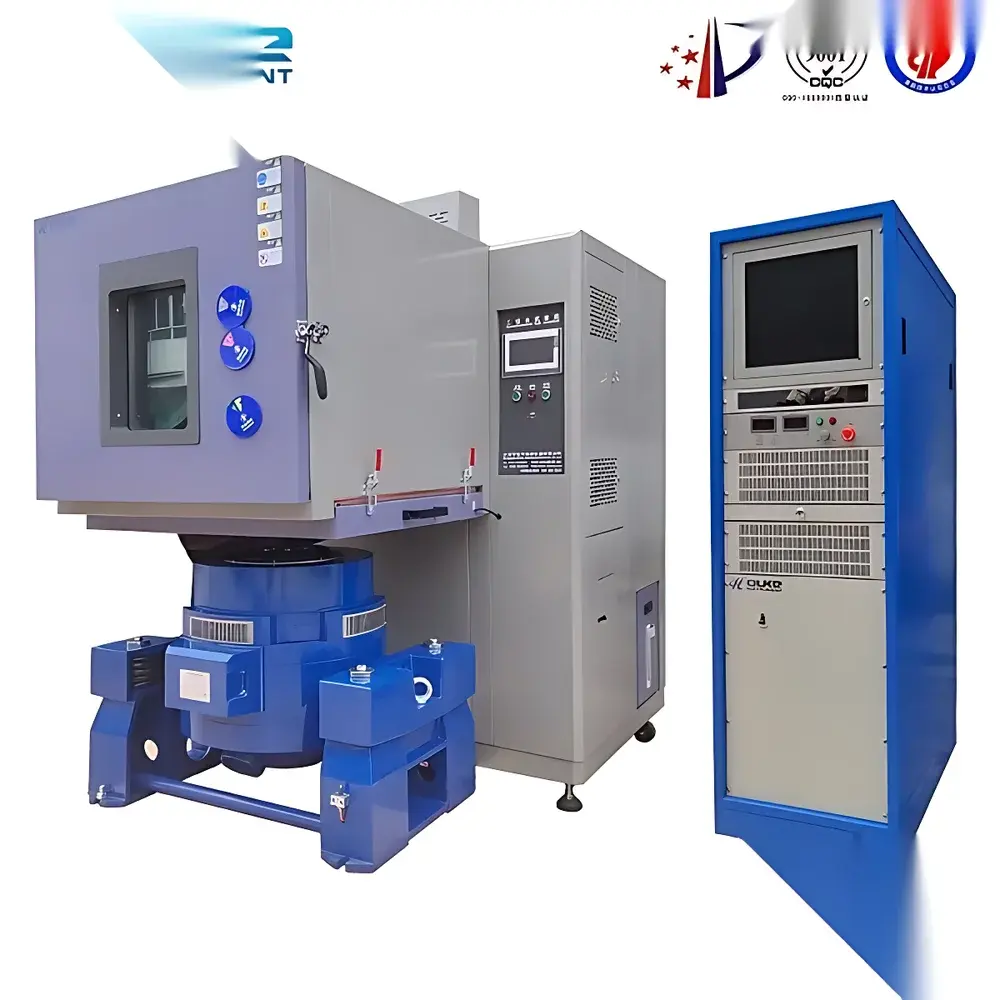
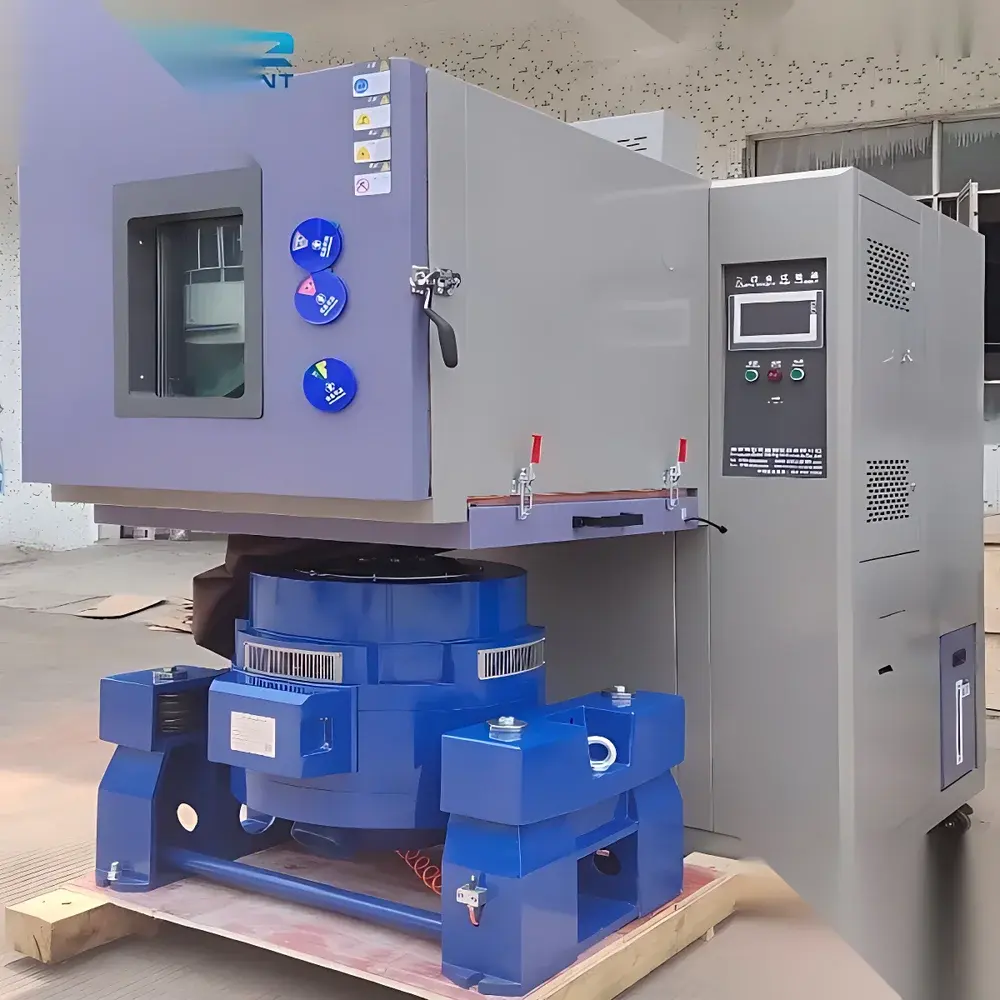
The Combined Temperature-Humidity-Vibration Test System is an integrated environmental reliability test platform engineered for simultaneous exposure of test specimens to controlled thermal, hygric, and dynamic mechanical stress conditions. It combines a high-performance electrodynamic shaker with a precision-engineered climatic chamber—capable of independent or synchronized operation—to replicate real-world service environments encountered by aerospace components, automotive electronics, defense systems, and industrial control units. The system operates on the principle of electromagnetic force generation via dual-magnetic-circuit actuation, delivering high-fidelity acceleration waveforms across a broad frequency spectrum (5–3000 Hz). Its core architecture supports rigorous qualification testing per MIL-STD-810, RTCA DO-160, and IEC 60068-2 series standards, enabling deterministic sinusoidal, random, shock (half-sine, terminal-peak sawtooth), and swept-sine vibration profiles while maintaining stable temperature (−70 °C to +180 °C) and humidity (10–98% RH) control.
Key Features
- Dual-Magnetic-Circuit Shaker Design: Minimized magnetic flux leakage and compact structural footprint ensure high power density and thermal stability during extended duty cycles.
- Advanced Motion Support System: Rocker-arm guidance combined with axial air-spring suspension delivers exceptional lateral load resistance and waveform fidelity—even at full rated payload (300 kg) and maximum displacement (51 mm p-p).
- High-Integrity Voice Coil Assembly: Precision-wound copper coils using aerospace-grade insulation materials and optimized thermal management provide long-term operational reliability under high-acceleration regimes.
- Center-Load Air Bearing Structure: Patented pneumatic centering mechanism enhances low-frequency response (<10 Hz) and improves load distribution uniformity across the shaker table surface.
- Bi-Axial Rotational Mounting Frame: Ear-mounted gimbal structure enables rapid 90° vertical/horizontal orientation switching without realignment; integrated isolation springs and linear guides suppress cross-axis coupling and external floor-borne interference.
- Modular Table Extension & Fixture Interface: Supports standardized auxiliary tables and custom-engineered fixtures compliant with amplitude uniformity (±1.5 dB), transverse motion (<15% axial), and modal neutrality requirements per ISO 10816-3 and ASTM E1492.
Sample Compatibility & Compliance
This system accommodates test articles up to 300 kg mass and dimensions compatible with standard 600 × 600 mm shaker tables (expandable via bolted auxiliary platforms). It meets all mechanical and environmental interface requirements defined in GB/T 2423.10-2008 (vibration), GB/T 13310-2007 (electrodynamic shaker performance), and GJB 360A-1996 (Method 204: sinusoidal; Method 213: classical shock; Method 214: random vibration). Full compliance includes IEC 60068-2-6 (vibration), IEC 60068-2-30 (damp heat cyclic), and IEC 60068-2-14 (temperature cycling). All control algorithms and data acquisition pathways are architected to support GLP/GMP audit readiness, including time-stamped event logging, user-access-level permissions, and electronic signature capability aligned with FDA 21 CFR Part 11 principles.
Software & Data Management
The system integrates with industry-standard real-time control software supporting closed-loop feedback compensation, multi-axis synchronization, and spectral shaping for random vibration synthesis. Data acquisition operates at ≥100 kS/s per channel with 24-bit resolution and anti-alias filtering. Export formats include UFF58, MATLAB (.mat), CSV, and ASAM MDF4—ensuring seamless interoperability with FEA validation workflows and enterprise LIMS platforms. Built-in diagnostic tools monitor coil temperature, amplifier output, chamber dew point deviation, and shaker armature centering status—generating automated health reports compliant with ISO/IEC 17025 calibration traceability frameworks.
Applications
- Aerospace avionics qualification per RTCA DO-160 Section 8 (Vibration) and Section 10 (Temperature/Humidity).
- Automotive ECUs subjected to combined thermal cycling and road-spectrum random vibration (SAE J2380).
- Defense electronics undergoing MIL-STD-810H Method 514.8 (Vibration) and Method 507.6 (Humidity).
- Medical device packaging validation per ISO 11607-2 accelerated aging protocols with mechanical stress overlay.
- Industrial IoT sensor modules tested under extended 20-hour continuous duty cycles at elevated temperature/humidity and resonant excitation.
FAQ
What standards does this system fully support for combined environmental testing?
It complies with GB/T 2423.10-2008, GJB 150.3/150.16-1986, GJB 360A-1996 (Methods 204, 213, 214), IEC 60068-2-6/-2-30/-2-14, and aligns with test plan requirements for MIL-STD-810H and RTCA DO-160G.
Can the system perform random vibration while maintaining precise humidity control?
Yes—integrated PID-controlled humidification and dehumidification subsystems operate synchronously with real-time vibration profile execution, with humidity stability maintained within ±3% RH during active shaking.
Is third-party calibration and IQ/OQ documentation available?
Yes—factory-certified calibration certificates traceable to NIST standards are provided; Installation Qualification (IQ) and Operational Qualification (OQ) protocols follow ISO/IEC 17025 and ASTM E2500 guidelines.
What options exist for fixture design and modal analysis support?
Custom fixture engineering services include finite element modal simulation, transmissibility mapping, and experimental modal analysis (EMA) using integrated laser vibrometry interfaces.
Does the system support remote monitoring and alarm escalation?
Yes—web-based HMI enables secure remote access via TLS 1.2; configurable SNMP traps and email alerts notify designated personnel upon parameter deviation, safety interlock activation, or scheduled maintenance windows.



