
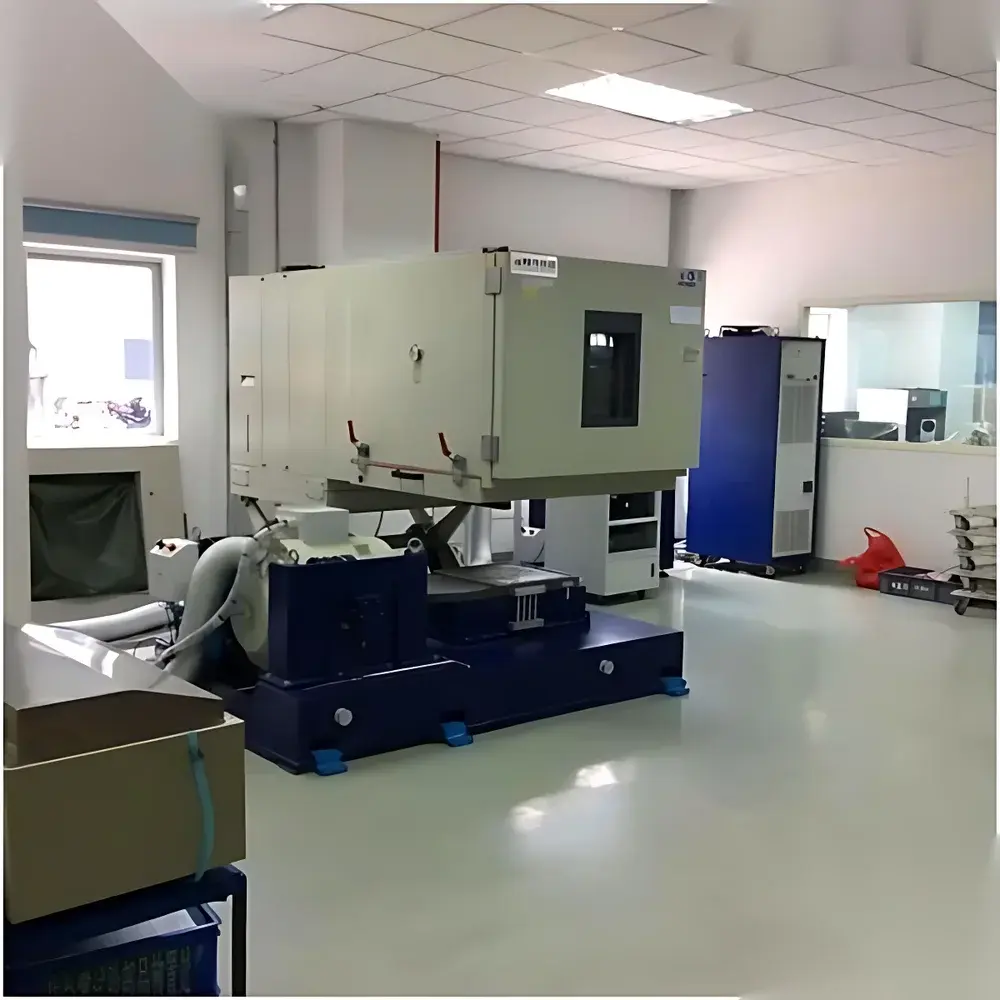
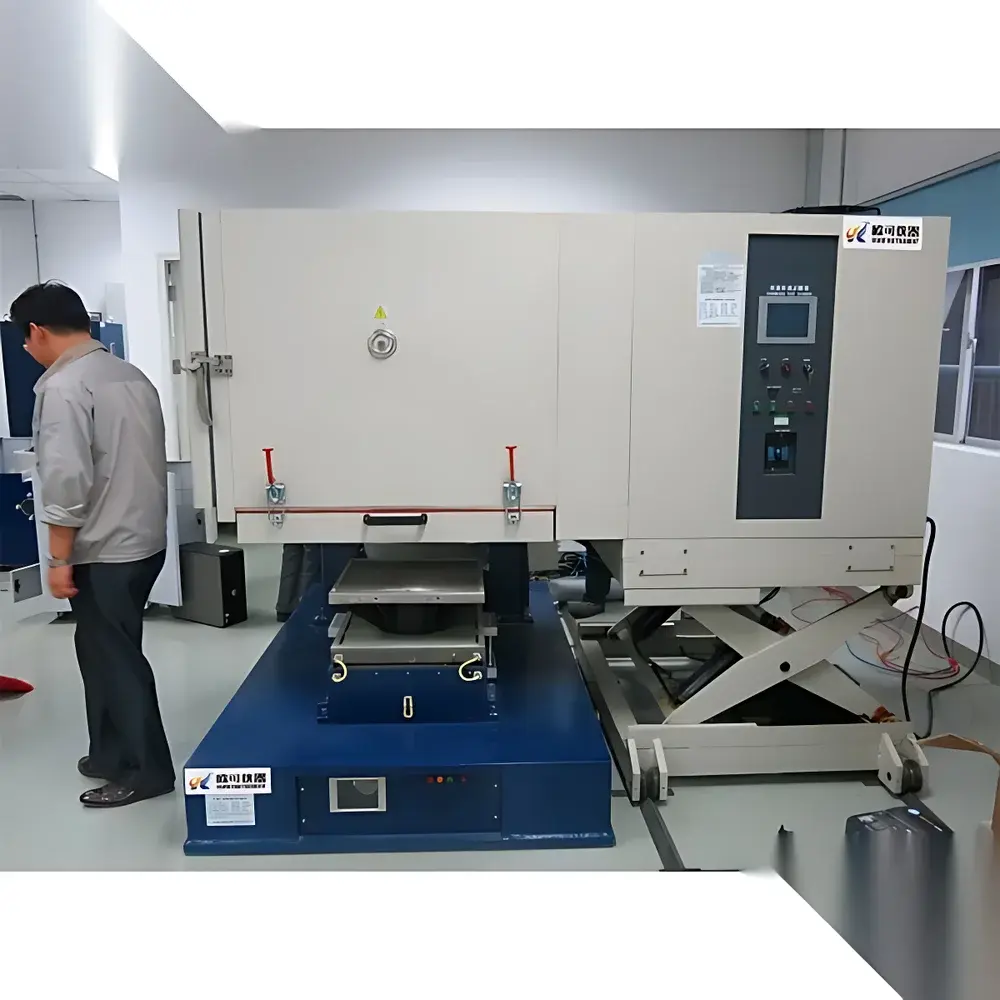
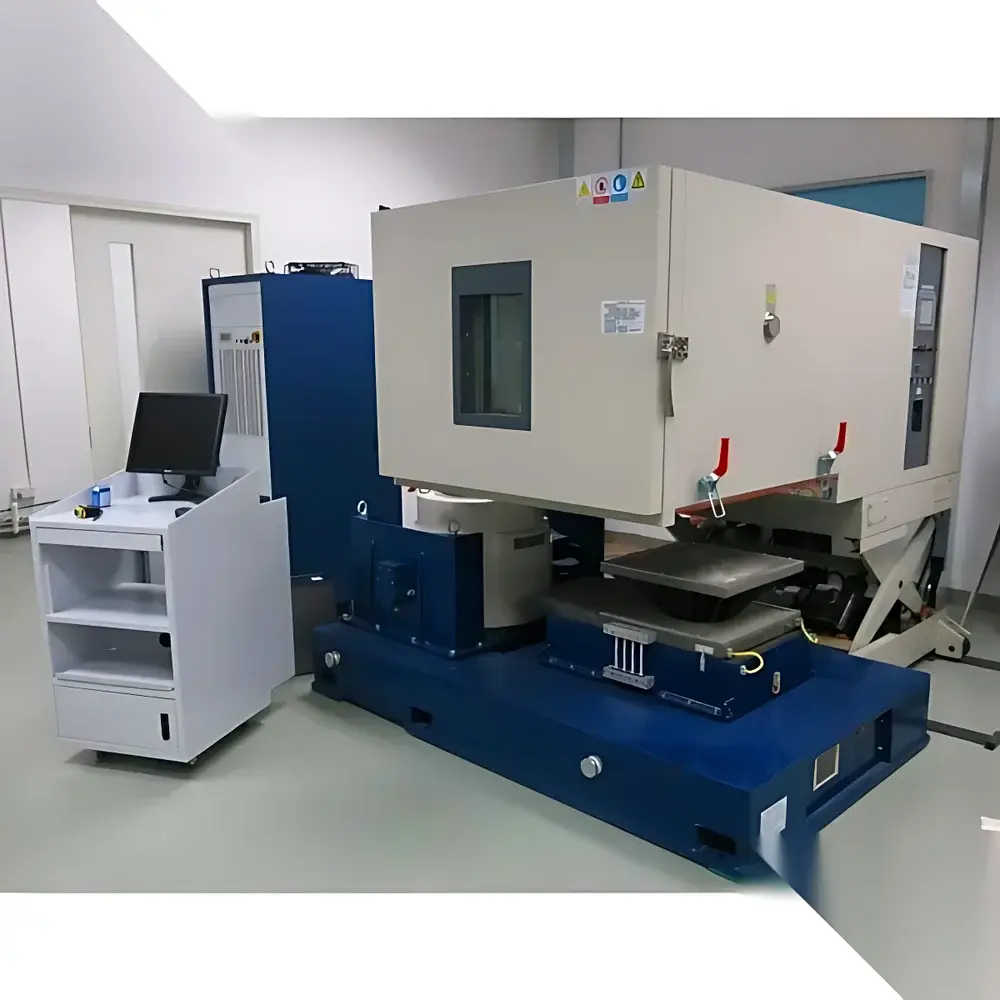
Combined Temperature-Humidity-Vibration Test System (Electromagnetic Shaker Type)
| Temperature Range | -20 °C to +130 °C |
|---|---|
| Humidity Range | 40–98% RH |
| Temperature Uniformity | ±2 °C (unloaded) |
| Temperature Fluctuation | ±0.5 °C (unloaded) |
| Temperature Deviation | ≤±2 °C |
| Humidity Fluctuation | ±2% RH |
| Humidity Deviation | ≤±2% RH |
| Heating Rate | -20 °C to +120 °C ≤ 60 min (unloaded) |
| Cooling Rate | Ambient to -20 °C ≤ 45 min (unloaded) |
| Vibration Mode | Sinusoidal |
| Frequency Range | 5–2000 Hz |
| Max. Acceleration | 980 m/s² (100 g) |
| Max. Velocity | 1.1 m/s |
| Max. Displacement | 25 mm p-p |
| Force Capacity | 2.94 kN (300 kgf) |
| Effective Moving Mass | 2.7 kg |
| Max. Payload | 120 kg |
| Table Diameter | 150 mm |
| Vibration Axis | Vertical (Z-axis) |
| Test Duration Setting | 0–999 hours |
| Power Efficiency | 60% reduction vs. conventional controllers |
Overview
The Combined Temperature-Humidity-Vibration Test System (Electromagnetic Shaker Type) is an integrated environmental reliability testing platform engineered for simultaneous application of thermal, hygrothermal, and mechanical sinusoidal vibration stress. It operates on the principle of electromagnetic excitation—where a voice-coil actuator generates controlled inertial forces in accordance with ISO 10816-1, IEC 60068-2-6, and MIL-STD-810H methodologies—to replicate real-world dynamic loading conditions during manufacturing, logistics, and end-use environments. Unlike single-stress test chambers, this system enables synchronized exposure to temperature extremes (-20 °C to +130 °C), controlled humidity (40–98% RH), and high-fidelity sinusoidal vibration (5–2000 Hz), thereby accelerating failure mode identification in electronic components, medical devices, automotive ECUs, aerospace subassemblies, and packaged consumer goods. Its structural integrity derives from monolithic base-frame construction with optimized isolation damping, minimizing parasitic resonance and ensuring traceable, repeatable test profiles across qualification and production validation cycles.
Key Features
- Electromagnetic shaker architecture delivering high force density (2.94 kN), wide frequency bandwidth (5–2000 Hz), and precise acceleration control up to 100 g (980 m/s²)
- Integrated climatic chamber with independent refrigeration/heating/humidification subsystems meeting IEC 60068-3-5 and ASTM E145 Class B uniformity requirements
- Vertical-axis vibration table (150 mm diameter) with 25 mm p-p displacement capability and 120 kg maximum payload capacity
- CT-2000/PD-series sealed frequency controller enabling programmable sweep, dwell, and resonance search functions with intuitive GUI navigation
- Energy-optimized design reducing power consumption by 60% compared to legacy analog controllers, compliant with ISO 50001 energy management principles
- Modular separation of shaker head and control cabinet ensures electrical safety, EMC compliance (IEC 61000-6-4), and simplified maintenance access
- Low-noise operation (<72 dB(A) at 1 m) achieved through precision-balanced moving coil assembly and acoustic shielding of drive electronics
Sample Compatibility & Compliance
This system accommodates rigid and semi-rigid specimens—including PCB assemblies, MEMS sensors, battery modules, sterile packaging trays, and handheld instrumentation—within its 150 mm table aperture and 120 kg load limit. Specimen mounting follows ISO 10816-3 guidelines for transducer placement and mass distribution. Environmental profiles comply with regulatory test standards including IEC 60068-2-1 (cold), IEC 60068-2-2 (dry heat), IEC 60068-2-30 (damp heat cyclic), and IEC 60068-2-6 (vibration). For pharmaceutical and medical device applications, humidity control accuracy (±2% RH) and temperature stability (±0.5 °C fluctuation) support GLP-compliant stability studies per ICH Q1A(R2). Full audit trail logging, user-access controls, and electronic signature readiness align with FDA 21 CFR Part 11 requirements when paired with validated software configurations.
Software & Data Management
The embedded CT-2000/PD controller supports both manual parameter entry and automated profile sequencing via touch-enabled interface. Predefined test templates include resonant frequency search, logarithmic sine sweep, fixed-frequency dwell, and multi-step combined stress programs. Real-time waveform monitoring displays acceleration, velocity, displacement, and thermal/hygrometric parameters synchronously with time-stamped data export in CSV and TDMS formats. Optional PC-based software extends functionality to spectral analysis (FFT), pass/fail threshold mapping, and report generation conforming to ISO/IEC 17025 documentation standards. All test logs retain immutable timestamps, operator IDs, calibration status flags, and environmental chamber setpoint deviations—enabling full traceability for internal audits or regulatory submissions.
Applications
- Qualification testing of avionics enclosures under combined thermal cycling and flight-spectrum vibration per DO-160 Section 8
- Reliability screening of lithium-ion battery packs subjected to thermal shock and mechanical fatigue per UL 1642 and UN 38.3
- Structural integrity verification of surgical instrument housings during sterilization-cycle simulation and transport vibration
- Package integrity assessment for pharmaceutical blister packs exposed to warehouse humidity gradients and palletized truck vibration
- Resonance mapping of MEMS accelerometers and gyroscopes across operational temperature ranges
- Design validation of automotive infotainment modules per ISO 16750-4 (mechanical loads) and ISO 16750-2 (environmental conditions)
FAQ
What standards does this system meet for combined environmental stress testing?
It conforms to IEC 60068-2-64 (random vibration), IEC 60068-2-6 (sinusoidal vibration), IEC 60068-2-1/2/30 (temperature/humidity), and MIL-STD-810H Method 514.7 and 507.6 for combined temperature-vibration profiles.
Can the system perform resonance dwell tests at variable temperatures?
Yes—the controller allows coupling of temperature setpoints with frequency-specific dwell segments, enabling thermal-dependent resonance tracking per ASTM D4728 Annex A2.
Is remote monitoring and data export supported?
Standard Ethernet connectivity enables real-time SCADA integration; data exports include time-synchronized environmental and vibration channels in machine-readable formats for LIMS or MES ingestion.
What maintenance intervals are recommended for the electromagnetic shaker?
Annual inspection of suspension springs, coil alignment, and cooling airflow paths is advised; no routine lubrication is required due to brushless voice-coil design.
Does the system support GMP/GLP-compliant audit trails?
When configured with optional 21 CFR Part 11-compliant software, it provides electronic signatures, role-based access, and immutable log archiving for regulated industries.



