
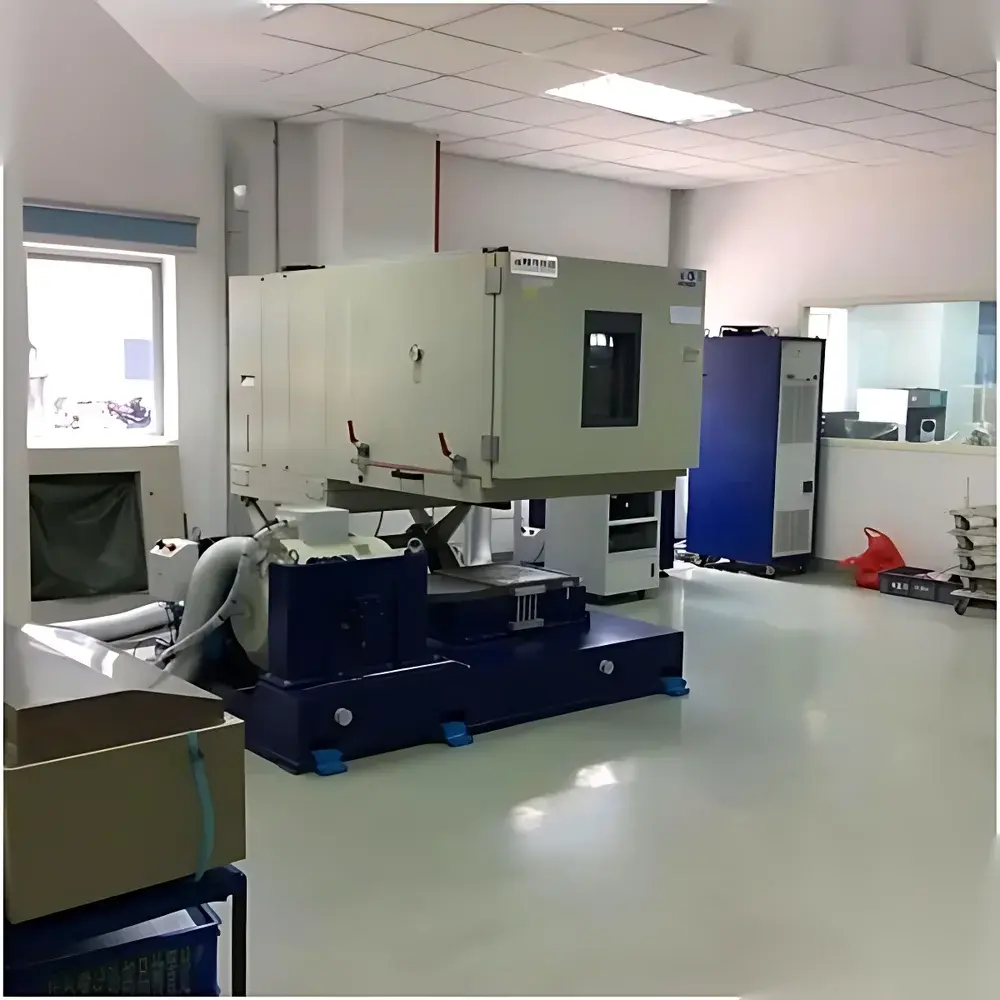
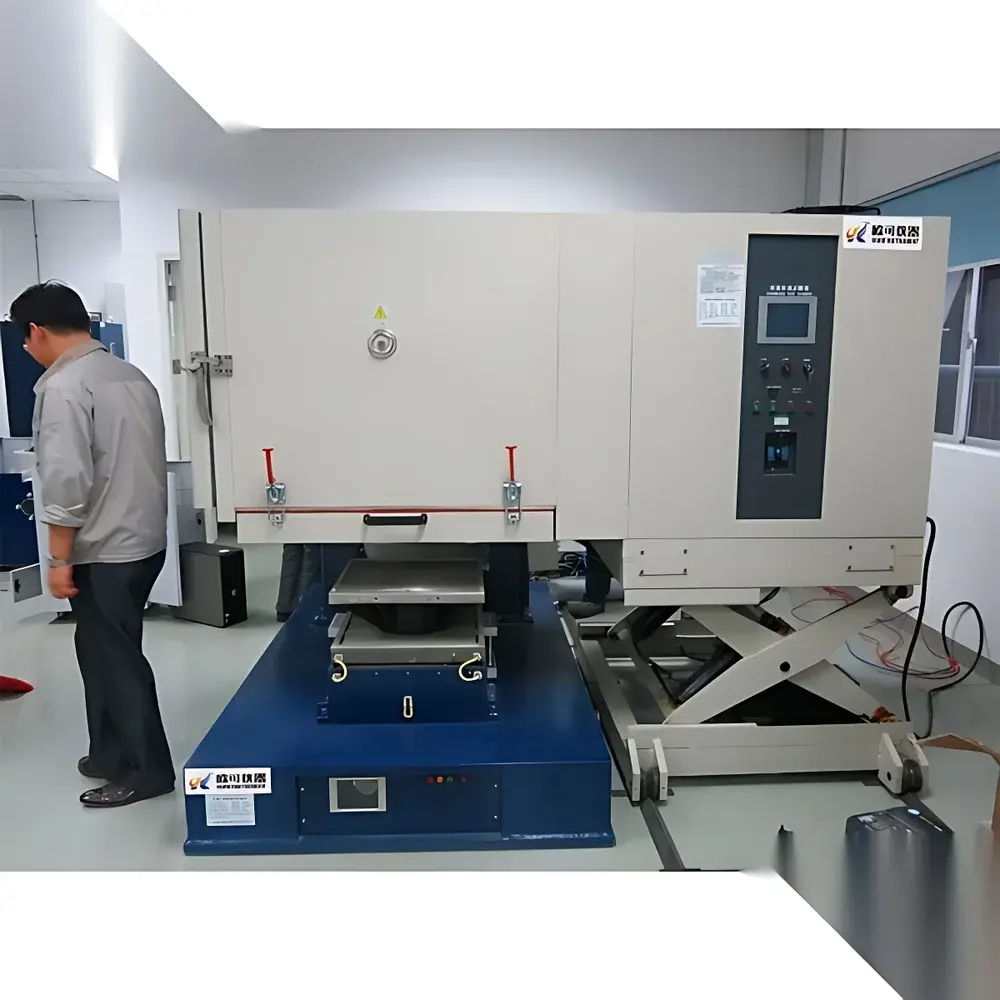
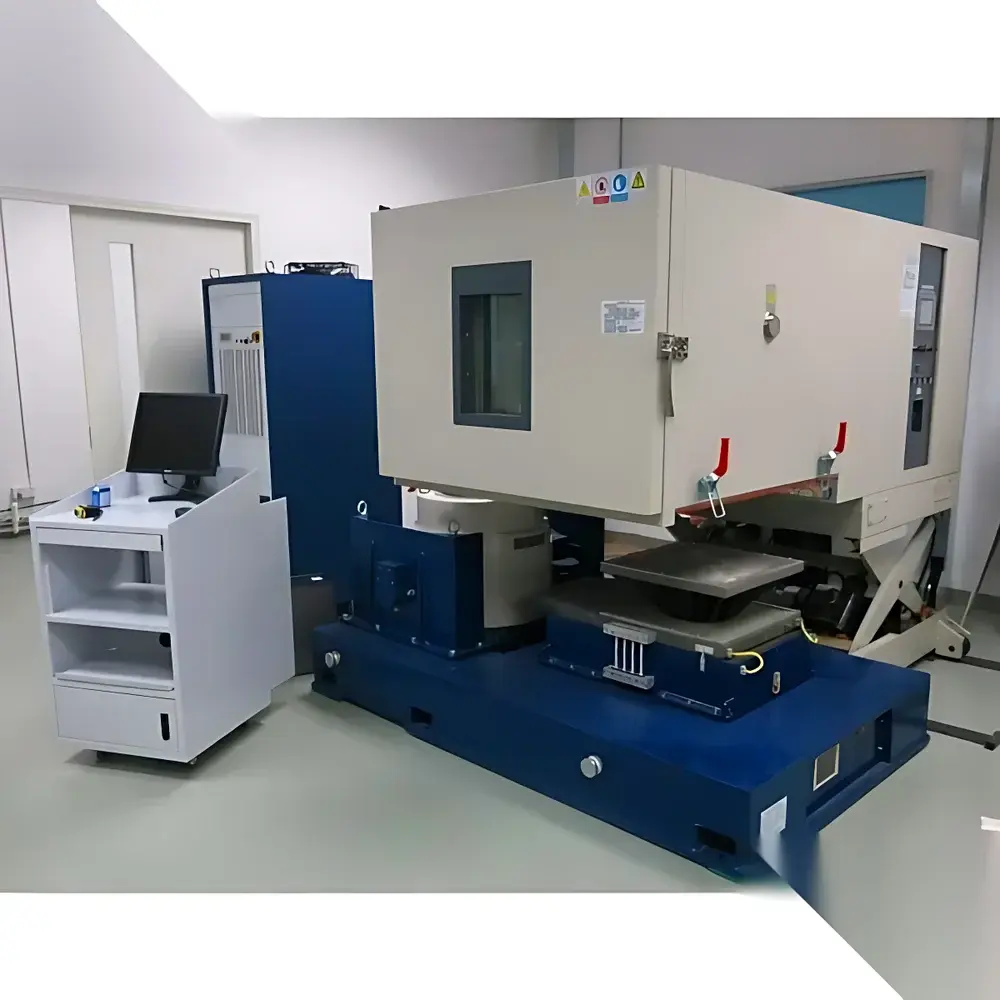
Combined Temperature-Humidity-Vibration Test System – Multi-Environmental Reliability Testing Platform
| Brand | OEM / Custom-Built System |
|---|---|
| Origin | Imported |
| Manufacturer Type | Authorized Distributor |
| Price | USD 21,500 (FOB) |
| Temperature Range | −70 °C to +200 °C |
| Humidity Range | 30–98 % RH |
| Climate Chamber Volume | 225–800 L |
| Vibration Force Capacity | 980 N to 49 kN |
| Frequency Range | 2–2500 Hz |
| Max. Acceleration | 100 g (980 m/s²) |
| Max. Displacement | ±12.5 mm (25 mm pk–pk) |
| Max. Load Mass | 190 kg |
| Max. Velocity | 1.5 m/s |
| Armature Mass | 6 kg |
| Waveform Distortion | <5 % THD |
| Leakage Flux | <10 Gauss at 10 cm from coil surface |
| Dimensions (L×W×H) | 800×600×710 mm |
| System Weight | 700 kg |
Overview
The Combined Temperature-Humidity-Vibration Test System is an integrated environmental reliability test platform engineered for simultaneous application of thermal cycling, humidity conditioning, and mechanical vibration—enabling rigorous validation of electronic assemblies, aerospace components, automotive ECUs, and military-grade hardware under real-world multi-stress conditions. Based on the Couette flow principle for electromagnetic excitation and Peltier/steam-compression hybrid climate control, the system delivers synchronized, traceable, and repeatable stress profiles across three physical domains. Its architecture conforms to the fundamental requirements of multi-axis coupled testing defined in MIL-STD-810H Method 514.8 (Vibration), Method 502.7 (Low Temperature), Method 501.7 (High Temperature), and Method 507.6 (Humidity), making it suitable for qualification testing in regulated industries requiring GLP/GMP-aligned audit trails.
Key Features
- Triple-domain synchronization: Real-time coordination of temperature ramping (−70 °C to +200 °C), humidity modulation (30–98 % RH), and broadband electrodynamic vibration (2–2500 Hz) via a unified master controller.
- High-force electromagnetic shaker: 6 kg armature mass with 49 kN peak force capacity; low magnetic leakage (<10 Gauss at 10 cm) ensures EMI compatibility during sensitive sensor calibration.
- Modular climate chamber: Stainless-steel insulated enclosure with dual-stage refrigeration and steam humidification; volume configurable from 225 L to 800 L to accommodate DUTs up to 190 kg.
- Advanced waveform fidelity: <5 % total harmonic distortion across sinusoidal, random, shock, and SRS profiles; supports multi-segment sweep, dwell, and resonance dwell protocols per ISO 10816-3 and ASTM D4728.
- Robust mechanical integration: Vertical vibration table (±12.5 mm pk–pk displacement) and optional horizontal slip table (H680 series) enable 6-DOF simulation when paired with auxiliary fixtures.
- Comprehensive safety architecture: Includes over-temperature cutoff, over-humidity limiter, vibration over-acceleration shutdown, and real-time charge-type accelerometer feedback for closed-loop amplitude control.
Sample Compatibility & Compliance
This system accommodates samples ranging from PCB subassemblies and battery modules to full-scale avionics enclosures. All mechanical interfaces comply with ISO 13373-2 mounting standards for transducer placement, while climate chamber seals meet IEC 60068-2-1 (cold), IEC 60068-2-2 (dry heat), and IEC 60068-2-30 (damp heat cyclic) requirements. The vibration subsystem satisfies IEEE 344 seismic qualification criteria for nuclear instrumentation and adheres to EN 60068-2-64 for random vibration testing. Full compliance documentation—including calibration certificates traceable to NIST, CE marking per EMC Directive 2014/30/EU, and RoHS 2011/65/EU declarations—is supplied with each unit.
Software & Data Management
Control and analysis are performed using a Windows-based Vibration & Environmental Test Suite (VETS) software suite compliant with FDA 21 CFR Part 11 for electronic records and signatures. The software provides password-protected user roles, automated test report generation (PDF/CSV), raw data export with time-synchronized temperature/humidity/vibration channels, and built-in pass/fail evaluation against user-defined thresholds. Audit trail logs record all parameter changes, operator logins, and system alarms with timestamp and user ID—supporting ISO/IEC 17025 laboratory accreditation requirements. Optional MATLAB® and LabVIEW™ drivers enable custom algorithm integration for fatigue life prediction and modal coupling analysis.
Applications
- Accelerated life testing of EV battery packs under thermal-vibrational stress coupling.
- Qualification of flight-critical sensors per DO-160G Section 8 (vibration) and Section 4/5 (temperature/humidity).
- Reliability screening of 5G base station RF front-end modules subjected to thermal shock + random vibration.
- Validation of medical imaging device structural integrity during transport simulation (ISTA 3A/3E).
- Material-level characterization of adhesive bondlines under combined hygrothermal-mechanical loading per ASTM D897.
FAQ
Does this system support real-time data streaming to external DAQ systems?
Yes—via Ethernet TCP/IP and USB 2.0 interfaces, supporting IEEE 1451.4 TEDS-compliant transducers and third-party acquisition hardware.
Can the climate chamber be operated independently of the vibration system?
Yes—the thermal-humidity and vibration subsystems feature independent power and control circuits, enabling standalone operation for individual environmental or mechanical qualification tests.
What calibration standards apply to the integrated accelerometers and climate sensors?
Charge-mode accelerometers are calibrated per ISO 16063-21; temperature/humidity sensors are certified to ISO/IEC 17025 by an ILAC-MRA accredited lab, with annual recalibration recommended.
Is remote monitoring and alarm notification supported?
Yes—through optional SNMP v3 integration and email/SMS alert configuration triggered by predefined fault conditions (e.g., chamber door open, coolant pressure loss, amplifier thermal shutdown).
How is mechanical isolation achieved between the shaker and climate chamber?
A pneumatic passive isolation system with adjustable air springs decouples the vibration table from the chamber structure, minimizing energy transfer and ensuring measurement integrity per ISO 10816-1 guidelines.



