
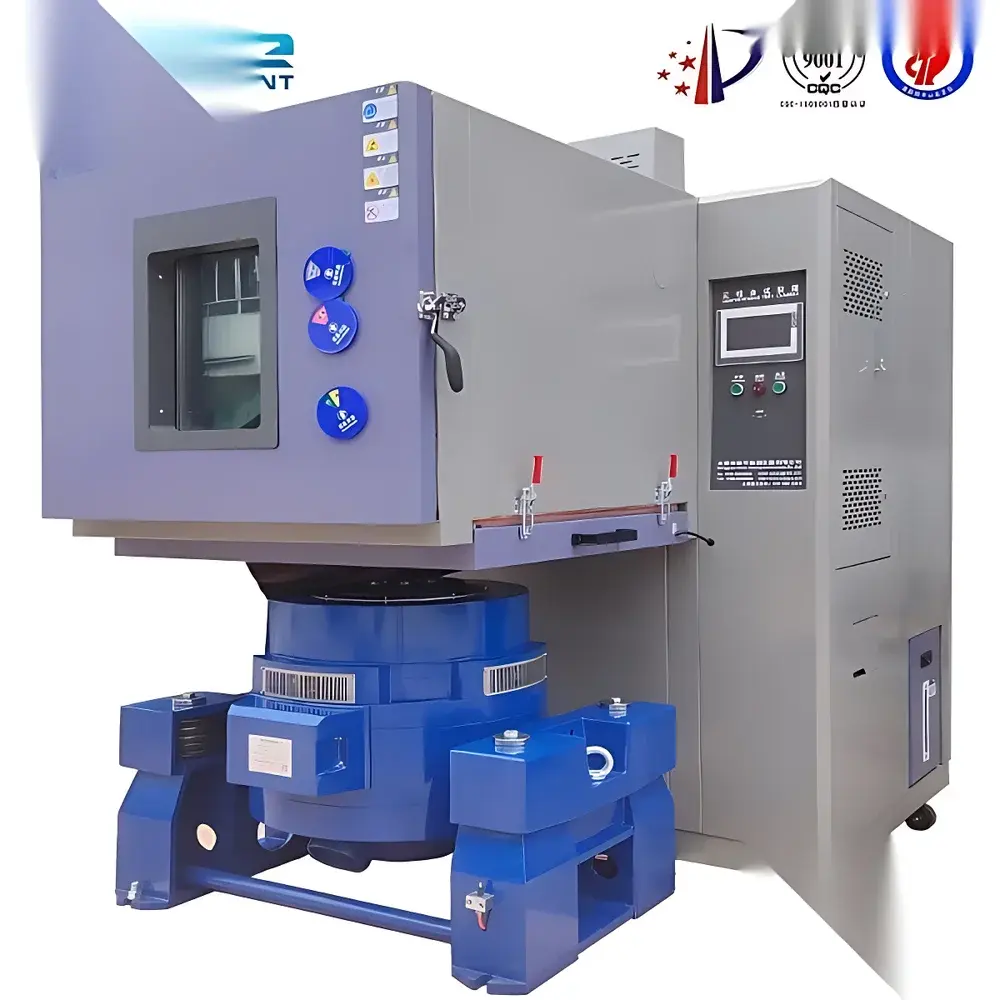
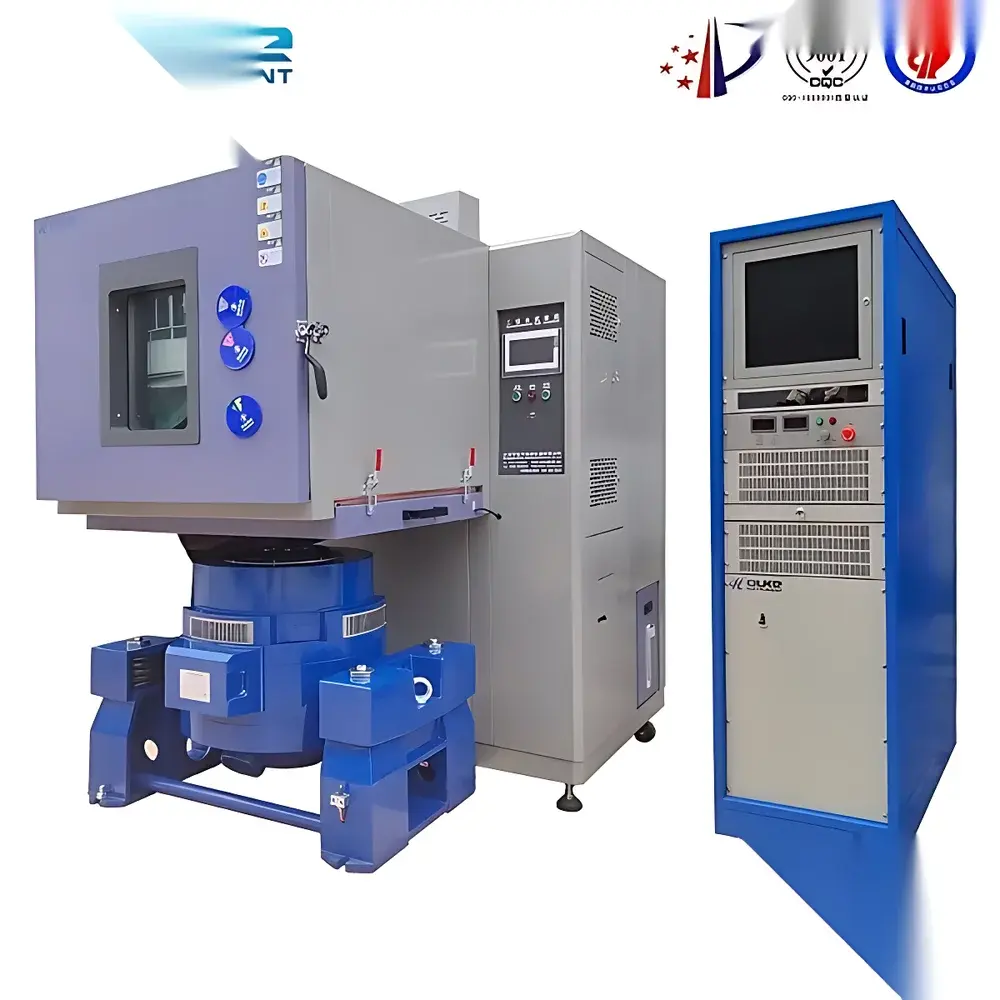
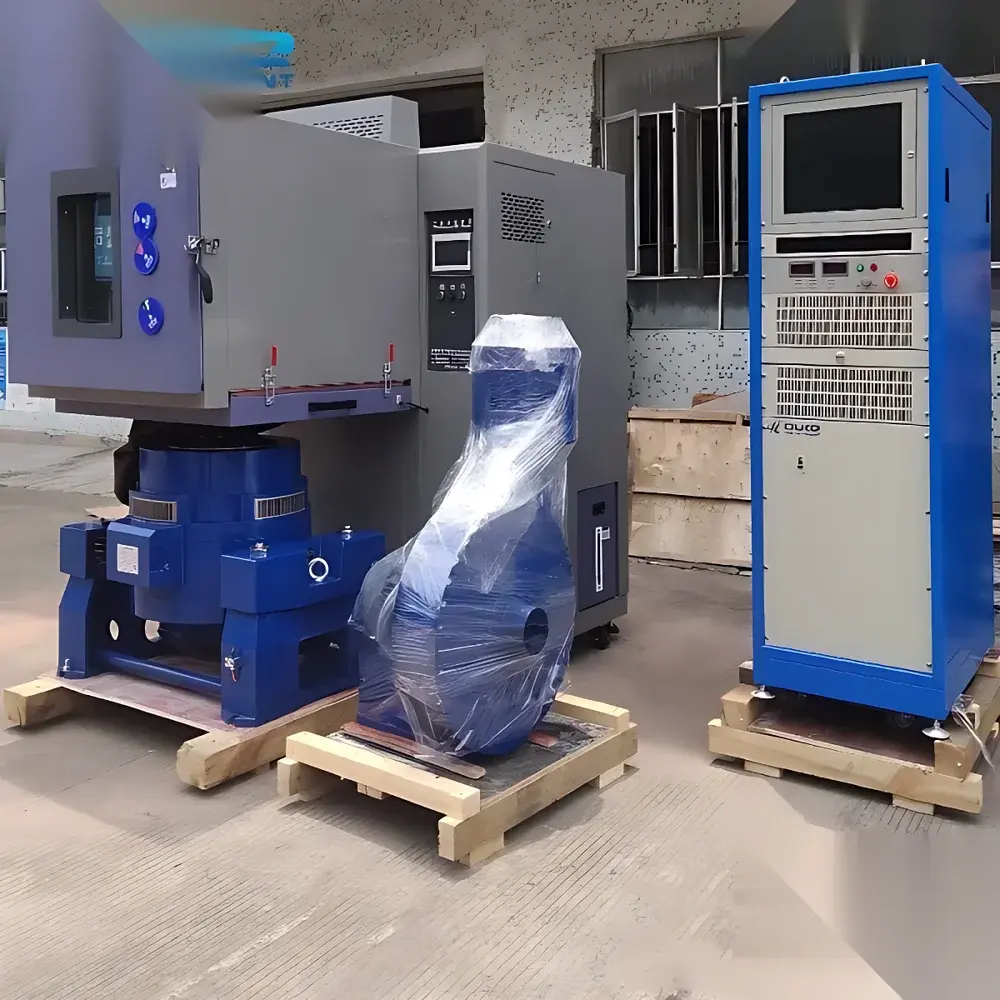
Combined Temperature-Humidity-Vibration Test System – Multi-Environmental Simulation Chamber for Transport Packaging and Electronics Reliability Testing
| Key Features | Sinusoidal vibration |
|---|---|
| Frequency range | 1–200 Hz |
| Max acceleration | 10 g (peak) |
| Max displacement | 0–5 mm p-p |
| Test table size | 450 × 450 × 46 mm |
| Payload capacity | 40 kg |
| Power supply | 220 V ±10%, 2.2 kW |
| Frequency resolution | ±1 Hz |
| Compliance | ASTM D999, ISO 8767, ISTA 3A/3E, GB/T 4857.7, GB/T 4857.10 |
Overview
The Combined Temperature-Humidity-Vibration Test System is an integrated environmental simulation platform engineered for rigorous reliability assessment of electronic components, consumer appliances, and transport packaging under concurrent thermal, humidity, and mechanical stress conditions. Unlike standalone vibration shakers or climate chambers, this tri-environmental chamber implements synchronized control of temperature (−70 °C to +180 °C), relative humidity (10–98% RH), and sinusoidal mechanical excitation—enabling replication of real-world logistics environments where thermal cycling, moisture ingress, and road-induced resonance co-occur. The system operates on the principle of electromagnetic inertial excitation, delivering controlled vertical-axis sinusoidal motion per ISO 2041 and ASTM D4728. Its core architecture supports both fixed-frequency endurance testing and programmable frequency sweeps—critical for identifying resonant modes, fatigue thresholds, and interface failures that emerge only under coupled stress conditions.
Key Features
- Triple-stress synchronization: Independent yet coordinated control of temperature, humidity, and vibration—ensuring temporal alignment of all stimuli within ±0.5 s tolerance.
- Digital frequency controller with real-time PID feedback loop, enabling stable amplitude maintenance across load variations up to 40 kg without manual recalibration.
- Magnesium alloy vibration table (450 × 450 × 46 mm) providing inherent electromagnetic interference (EMI) shielding—essential for testing sensitive PCB assemblies and sensor modules during active vibration.
- Programmable sweep profiles: Linear/logarithmic frequency sweeps between user-defined upper/lower limits (1–200 Hz), with dwell time, rate, and direction fully configurable.
- Time-based test termination: Precision timer resolution down to 1 second, supporting compliance with ISTA 3-series and ASTM D999 duration requirements.
- Robust structural isolation: Base-mounted anti-vibration mounts and reinforced chamber frame minimize energy transmission to facility infrastructure.
- EMI-hardened control electronics: Integrated filtering and galvanic isolation protect against noise coupling from high-current actuator drivers.
Sample Compatibility & Compliance
The system accommodates a broad range of sample geometries through its universal mounting grid and adjustable clamping fixtures—supporting packages from small IC trays (≤100 mm) to full-size appliance cartons (up to 450 mm footprint). It meets mandatory test protocol requirements for Class II and III medical devices per IEC 60601-1 Annex DD (transport vibration), automotive ECUs per ISO 16750-3, and consumer electronics per JEDEC JESD22-B103C. All vibration profiles are traceable to national metrology standards via onboard accelerometer calibration ports. Humidity control adheres to ISO 17025-accredited dew point sensor validation, while thermal uniformity conforms to IEC 60068-3-5 (±2 °C across work volume).
Software & Data Management
Equipped with Windows-based test sequencing software compliant with FDA 21 CFR Part 11, the system provides audit-trail-enabled operation logs, electronic signatures, and role-based access control. Real-time waveform visualization includes FFT spectrum analysis, time-domain overlay, and RMS acceleration trending. Export formats include CSV, MATLAB .mat, and PDF-certified reports containing timestamped environmental setpoints, measured responses, and pass/fail status per selected standard clause. Data integrity is preserved via cyclic redundancy check (CRC)-protected storage and automatic backup to network-attached storage (NAS) upon test completion.
Applications
- Transport simulation for e-commerce packaging: Validating stack stability, cushioning performance, and seal integrity under combined shock/vibration/humidity exposure.
- Design verification of printed circuit board assemblies: Detecting solder joint microcracks, connector fretting, and capacitor delamination induced by resonant frequencies amplified at elevated temperatures.
- Quality assurance for white goods: Assessing compressor mount durability, door hinge fatigue, and control panel display adhesion under accelerated aging + vibration stress.
- GMP-compliant validation of sterile barrier systems: Confirming pouch seal strength retention after simulated distribution cycles involving condensation and mechanical agitation.
- Research into thermo-mechanical degradation mechanisms: Correlating Arrhenius-based thermal aging rates with vibration-induced wear progression in polymer housings and elastomeric gaskets.
FAQ
Does this system support random vibration profiles in addition to sinusoidal excitation?
No—this model is optimized exclusively for sinusoidal (fixed and swept) vibration per ASTM D999 and ISO 8767. Random vibration capability requires a separate electrodynamic shaker with broadband power amplifier and dedicated controller.
Can humidity and temperature be controlled independently while vibration is active?
Yes—full decoupled control is maintained during simultaneous operation; humidity generation uses steam injection with condensate recovery, while cooling employs cascade refrigeration independent of vibration actuator thermal load.
Is third-party calibration documentation included with shipment?
Each unit ships with a NIST-traceable calibration certificate covering temperature uniformity, humidity accuracy, and accelerometer sensitivity—valid for 12 months from commissioning date.
What safety interlocks prevent hazardous operation during combined stress testing?
Hardware-level interlocks monitor chamber overtemperature, excessive vibration amplitude (>10.5 g), door latch status, and coolant pressure; all trigger immediate shutdown with latched fault indication until manual reset.
How is data synchronization achieved between environmental sensors and vibration acquisition channels?
All analog inputs (thermocouples, RH sensors, accelerometers) feed into a common 100 kHz sampling chassis with GPS-synchronized timestamps, ensuring sub-millisecond alignment across all parameter streams.



