
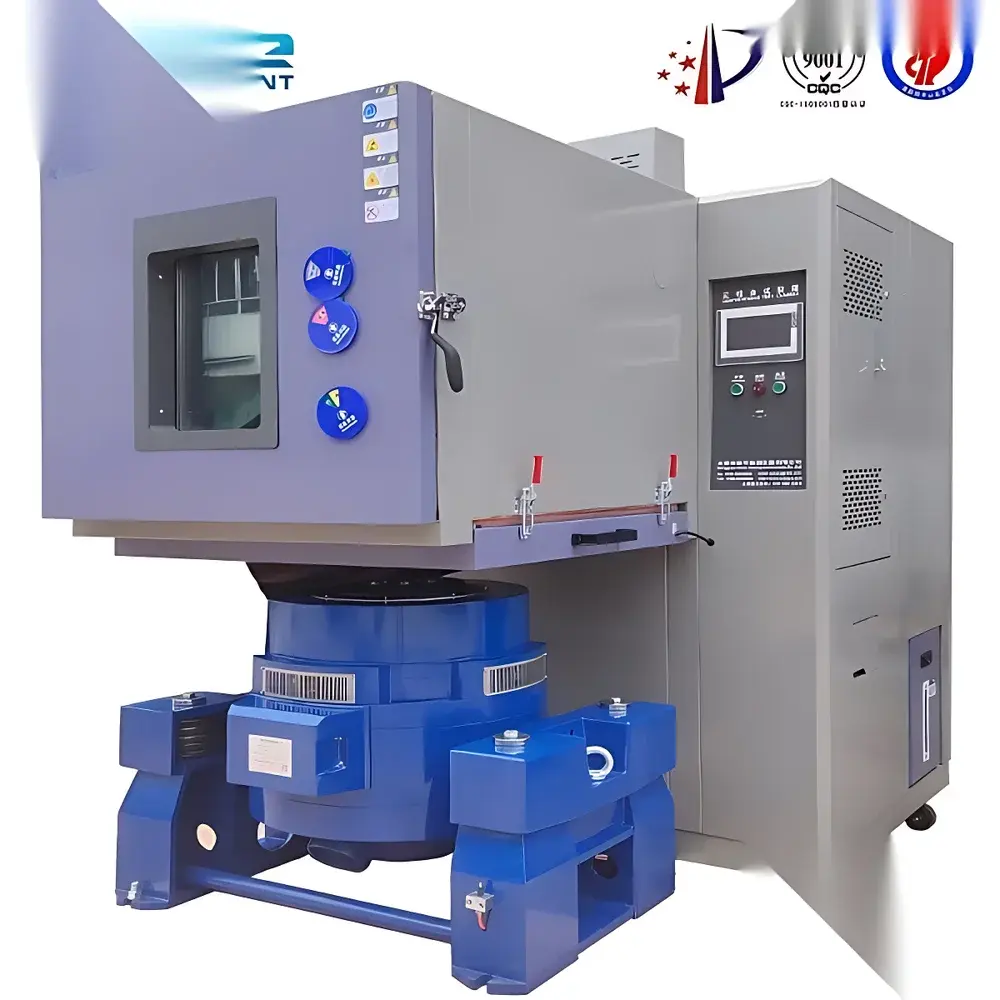
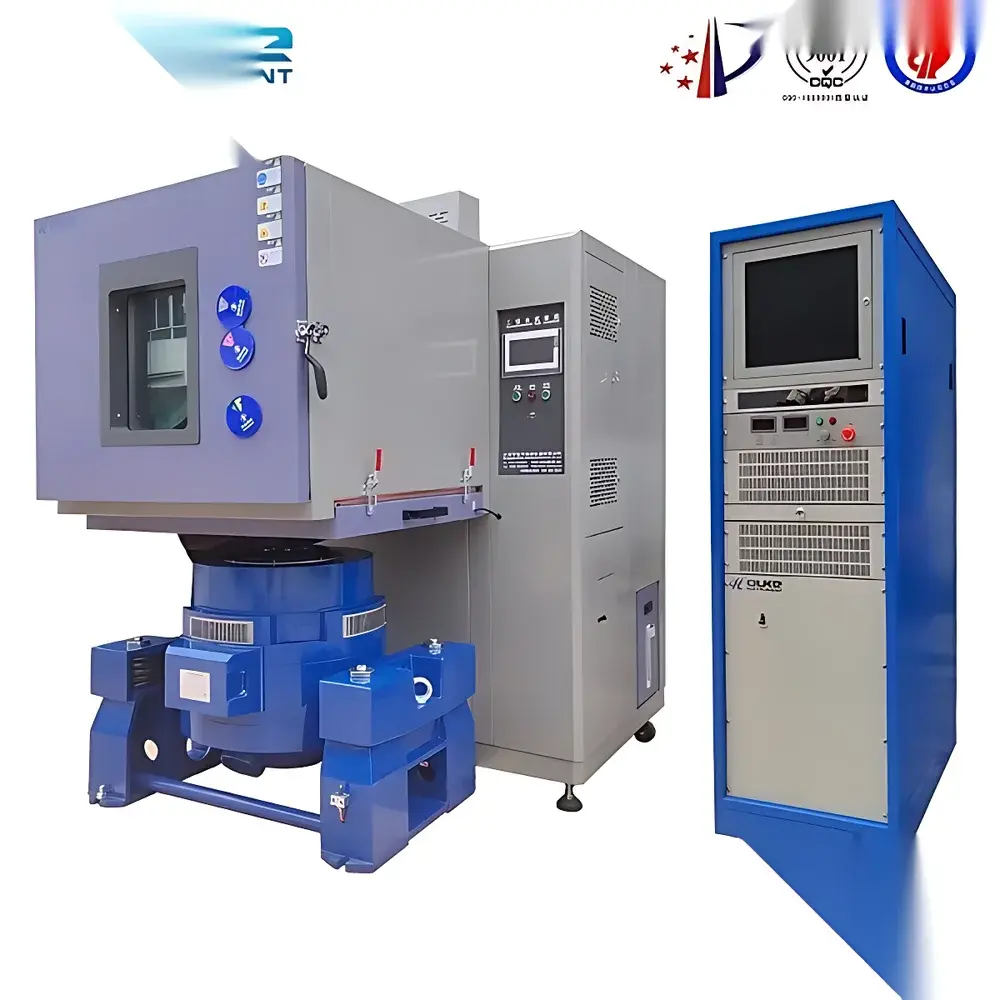
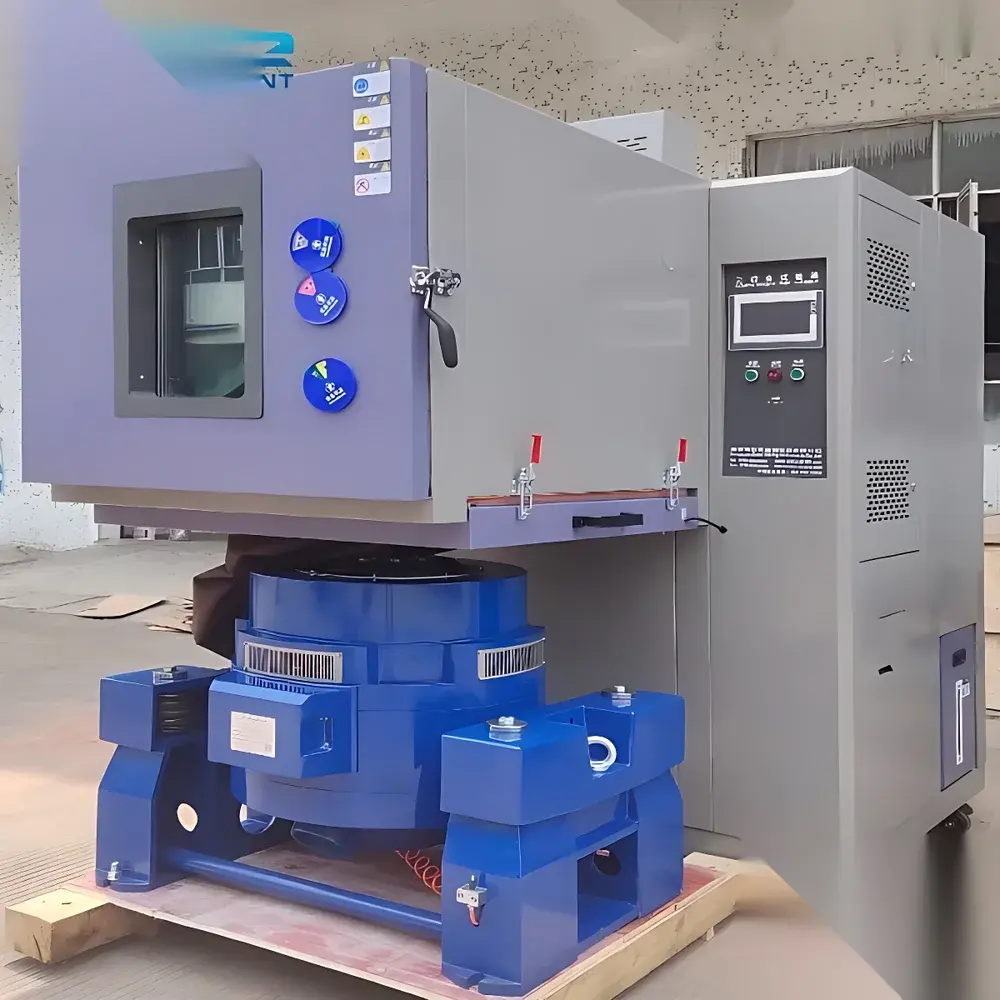
Combined Temperature-Humidity-Vibration Test System – Multi-Environmental Stress Screening Chamber
| Key | Temperature Range: -70 °C to +200 °C |
|---|---|
| Humidity Range | 30–98% RH |
| Climate Chamber Volume | 225–800 L |
| Vibration Force | 980 N to 49 kN |
| Frequency Range | 2–2500 Hz |
| Max Acceleration | 100 g (980 m/s²) |
| Max Displacement | 25 mm (pk-pk) |
| Max Velocity | 1.5 m/s |
| Moving Mass | 6 kg |
| Payload Capacity | 190 kg |
| Distortion | <5% THD |
| Residual Magnetic Field | <10 Gauss (at 10 cm from armature) |
| Dimensions (L×W×H) | 800×600×710 mm |
| Weight | 700 kg |
| Compliance | GB/T 2423.1, GB/T 2423.2, GB/T 2423.3, GJB 150.3, GJB 150.4, IEC 60068-2-3 (Test Ca), IEC 60068-2-30 |
Overview
The Combined Temperature-Humidity-Vibration Test System is an integrated environmental stress screening (ESS) platform engineered for simultaneous or sequential application of thermal, hygroscopic, and mechanical dynamic loads. It operates on the principle of coupled multi-stress exposure—where temperature and humidity are precisely controlled within a sealed climate chamber while high-fidelity electrodynamic vibration is applied via a force-controlled shaker system mounted directly to the chamber’s structural interface. This architecture enables realistic replication of field-induced degradation mechanisms in electronic assemblies, aerospace components, automotive ECUs, and medical device enclosures. Unlike sequential testing approaches, true tri-environmental correlation ensures accelerated failure modes—including solder joint fatigue, conformal coating delamination, and moisture-assisted creep—are captured with high reproducibility under ISO/IEC 17025-aligned test conditions.
Key Features
- Modular dual-circuit design: Independent refrigeration/humidification subsystems with PID-controlled cascade regulation ensure ±0.5 °C temperature stability and ±2% RH uniformity across the working volume.
- High-force electrodynamic shaker with low-inertia moving coil (6 kg armature mass) and optimized magnetic circuit delivering linear force output up to 49 kN peak, validated per ISO 5347-12 calibration protocols.
- Real-time closed-loop vibration control using digital signal processing (DSP) architecture, supporting sine, random, shock, and mixed-mode profiles with programmable sweep rates, dwell times, and amplitude spectra.
- Integrated safety interlocks including over-temperature cut-off, humidity saturation lockout, vibration over-acceleration shutdown, and emergency stop with hardware-decoupled relay logic compliant with IEC 61508 SIL2 requirements.
- Structurally reinforced chamber baseplate with kinematic mounting interface to minimize modal coupling between climate and vibration subsystems—critical for maintaining spectral integrity above 500 Hz.
- Front-access service panels, removable insulation modules, and standardized flange interfaces enable rapid maintenance, sensor retrofitting, and custom fixture integration without chamber disassembly.
Sample Compatibility & Compliance
This system accommodates DUTs ranging from PCB subassemblies (up to 190 kg mass) to full-size avionics racks, with horizontal and vertical slip-table configurations supporting both uniaxial and orthogonal excitation paths. All operational parameters adhere strictly to international qualification standards: thermal cycling per GB/T 2423.1 (cold) and GB/T 2423.2 (dry heat); damp heat testing per GB/T 2423.3 and IEC 60068-2-30; sinusoidal vibration per GB/T 2423.10 (Test Fc) and MIL-STD-810H Method 514.8. Full traceability is maintained through NIST-traceable temperature/humidity sensors and metrologically certified accelerometers, with audit-ready calibration certificates issued per ISO/IEC 17025 requirements. The system architecture supports GLP/GMP validation documentation packages, including IQ/OQ/PQ protocols and 21 CFR Part 11-compliant electronic signatures for regulated industries.
Software & Data Management
Control and data acquisition are managed via a real-time deterministic OS running dedicated firmware with synchronized sampling across all domains (thermal, humidity, acceleration, displacement). The software suite provides dual-mode operation: guided wizard-based test setup for routine qualification runs, and scriptable engineering mode for complex multi-step stress profiles (e.g., ramp-hold-sweep sequences with conditional triggers). Raw time-series data (16-bit resolution, up to 50 kHz/channel) is stored in HDF5 format with embedded metadata (test ID, operator, calibration expiry, environmental setpoints). Export options include CSV, MATLAB .mat, and universal UFF58 formats. Built-in FFT analyzers, PSD estimators, and transmissibility calculators support in-situ diagnostics. Audit trails record all parameter changes, user logins, and alarm events with immutable timestamps—fully compliant with FDA 21 CFR Part 11 and EU Annex 11 requirements.
Applications
- Reliability qualification of automotive ADAS modules under combined thermal cycling and road-spectrum vibration.
- Moisture diffusion analysis in conformally coated military-grade electronics during high-humidity soak followed by resonant frequency tracking.
- Package integrity validation of sterile medical devices subjected to warehouse transport simulation (vibration + ambient humidity + temperature ramp).
- Failure mode identification in power semiconductor stacks exposed to thermal shock while undergoing harmonic resonance scanning.
- Accelerated life testing of battery management systems (BMS) under variable SOC conditions synchronized with mechanical shock pulses.
- Material compatibility assessment of elastomeric seals and adhesives under sustained humid aging combined with cyclic flexural loading.
FAQ
What standards does this system fully satisfy for military qualification testing?
It meets all technical requirements of GJB 150.3 (high-temperature), GJB 150.4 (low-temperature), and MIL-STD-810H Method 514.8 for vibration—verified via third-party certification reports available upon request.
Can the system perform random vibration while maintaining constant humidity at 85% RH?
Yes—its independent humidity generation and closed-loop vapor pressure control allow stable RH maintenance during broadband random excitation up to 2000 Hz, with no measurable drift beyond ±1.5% RH.
Is remote monitoring and control supported for 24/7 unattended operation?
The system includes OPC UA server integration, TLS-encrypted web interface, and SNMP v3 alerts—enabling secure remote supervision, alarm notification, and real-time waveform streaming via enterprise IT infrastructure.
What is the maximum payload for horizontal slip-table operation at 100 Hz?
At 100 Hz, the system sustains 190 kg payload with ≤3% amplitude error and <5% harmonic distortion, verified per ISO 5347-12 linearity tests.
How frequently must calibration be performed to maintain compliance with ISO/IEC 17025?
Temperature/humidity sensors require annual recalibration; shaker force transducers and accelerometers must be verified every 6 months using accredited metrology labs—certificates are auto-linked to test records in the software audit trail.
Related Products



