
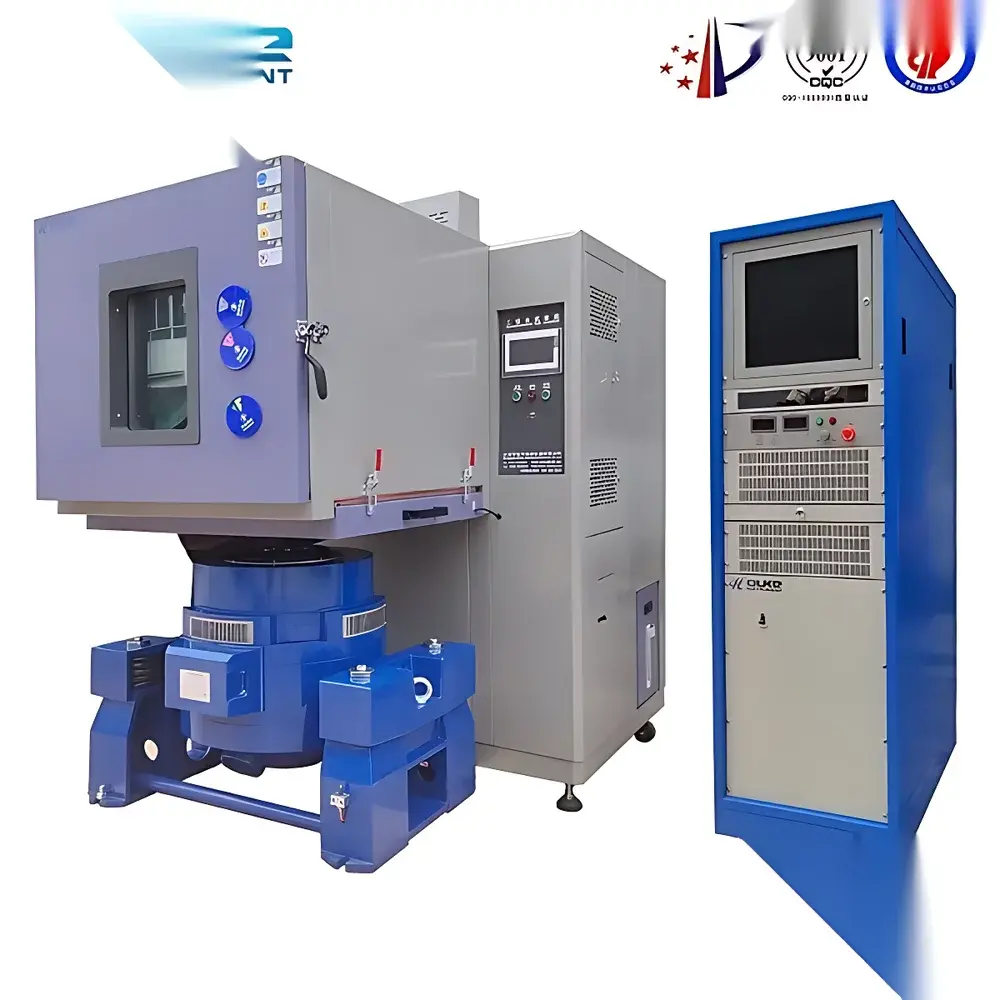
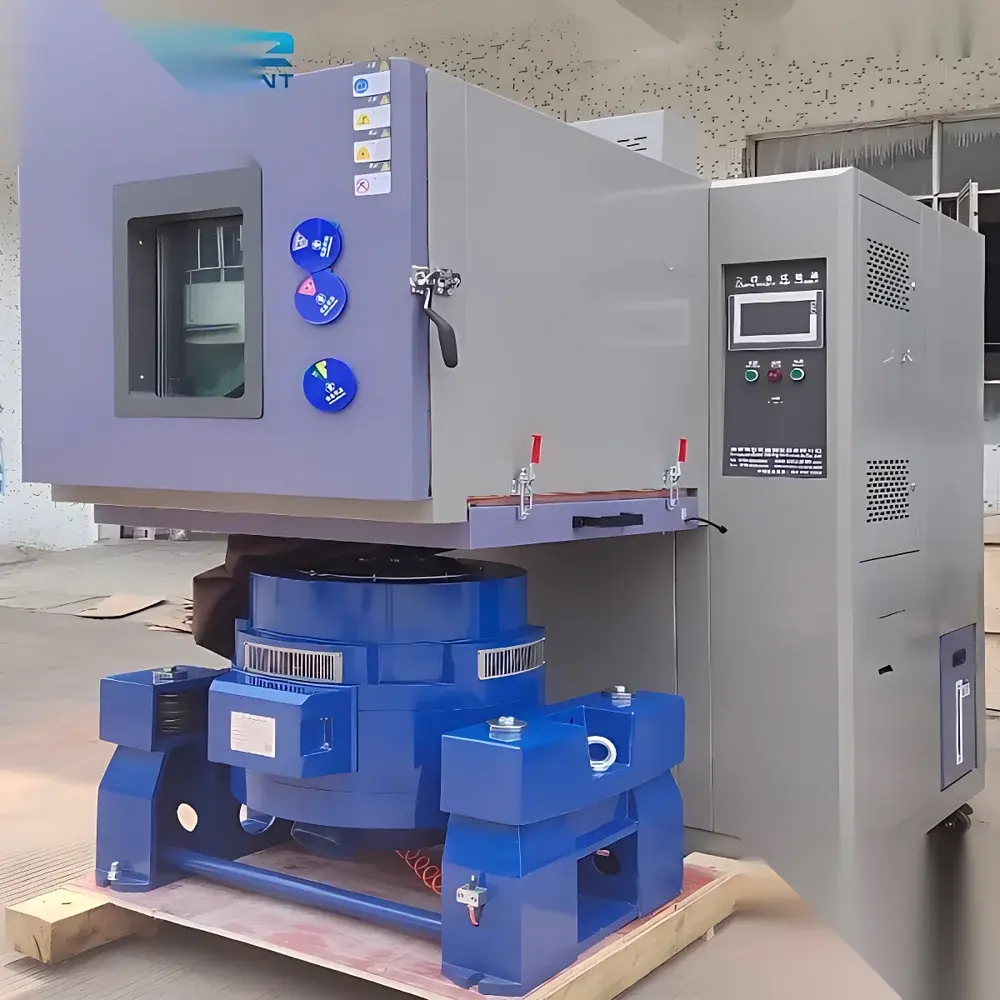
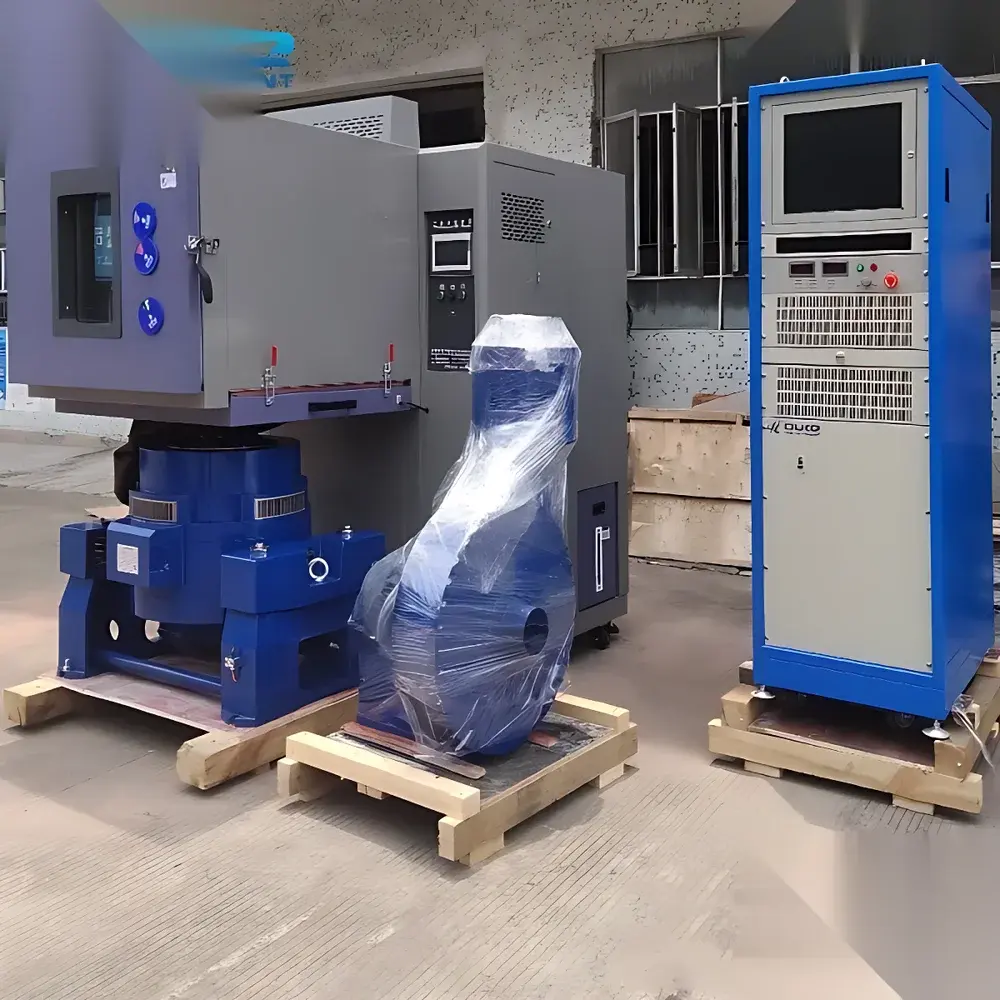
Combined Temperature-Humidity-Vibration Test System – OK-ES Series
| Key | Brand: Other Brands |
|---|---|
| Origin | Imported |
| Manufacturer Type | Authorized Distributor |
| Price | USD 21,500 (FOB) |
| Frequency Range | 1–5000 Hz |
| Max. Acceleration | 20 g |
| Vibration Amplitude | 0–5 mm p-p |
| Sweep Duration | 1 sec – 30 days |
| Programmable Segments | 15 segments, each with user-defined frequency & dwell time |
| Vibration Axes | Vertical + Horizontal |
| Waveform | Sinusoidal |
| Control Mode | Full PC-based digital control with real-time feedback |
| Power Supply | 220 V ±20%, 5 A, 2.2 kW |
| Table Surface | 50 × 50 cm (customizable) |
| Max. Load Capacity | 100 kg |
| Operating Temperature Range | –70°C to +180°C (integrated chamber) |
| Humidity Range | 10–98% RH (non-condensing) |
| Compliance | ASTM D4728, ISO 16750-3, IEC 60068-2-64, MIL-STD-810H Method 514.8 |
Overview
The OK-ES Series Combined Temperature-Humidity-Vibration Test System is an integrated environmental simulation platform engineered for rigorous reliability validation of electronic components, automotive ECUs, aerospace subsystems, and transport-packaged goods. It synchronously applies controlled thermal stress (–70°C to +180°C), regulated humidity (10–98% RH, non-condensing), and high-fidelity mechanical vibration (1–5000 Hz, up to 20 g, 0–5 mm p-p) within a single test enclosure—eliminating sequential testing artifacts and enabling true multi-stress correlation. The system operates on a dual-loop architecture: the climatic chamber employs cascade refrigeration and PID-controlled steam humidification, while the electrodynamic shaker utilizes closed-loop acceleration feedback with real-time waveform synthesis. This architecture ensures traceable, repeatable, and standards-compliant exposure profiles required for qualification per IEC 60068-2-64 (vibration), IEC 60068-2-30 (damp heat cyclic), and ISO 16750-3 (road vehicle environmental conditions).
Key Features
- Simultaneous triple-stress application: temperature, humidity, and vibration—no manual transfer or re-fixturing required
- Dual-axis electrodynamic shaker (vertical + horizontal) with active force cancellation and thermal compensation for stable performance across full climatic range
- Full PC-based control system with deterministic real-time OS, supporting sinusoidal, swept-sine, random, and programmable profile generation
- 15-segment programmable mode: each segment independently configurable for frequency, amplitude, acceleration, dwell time, and sweep rate (logarithmic or linear)
- Advanced sweep functions including octave-based (1/3, 1/6, 1/12), resonant dwell, and harmonic tracking modes compliant with MIL-STD-810H Method 514.8
- Integrated data acquisition with synchronized timestamping across all channels (temperature, RH, acceleration, displacement, velocity)
- Robust structural design: stainless steel inner chamber, insulated double-wall construction, and reinforced shaker mounting frame rated for continuous 720-hour operation
Sample Compatibility & Compliance
The OK-ES system accommodates test specimens up to 100 kg and 50 × 50 cm footprint, with optional custom table extensions and fixture interfaces (e.g., ISO 5344, DIN 45672). It supports standard compliance testing per ASTM D4728 (vibration of packaged products), ISO 16750-3 (electrical/electronic equipment in road vehicles), IEC 60068-2-64 (vibration response testing), and IEC 60068-2-30 (damp heat, cyclic). All operational parameters—including temperature ramp rates (1–10°C/min), humidity transition times, and vibration spectral density—are fully logged and exportable in CSV/Excel format for audit readiness. The system architecture meets GLP/GMP documentation requirements, with optional 21 CFR Part 11-compliant software modules available for electronic signature, audit trail, and user access control.
Software & Data Management
The proprietary OK-TestSuite v4.2 software provides intuitive graphical configuration of multi-domain test profiles, live waveform visualization (FFT, PSD, time history), and automated pass/fail evaluation against user-defined thresholds. Data is stored in a relational SQLite database with immutable timestamps and SHA-256 checksum integrity verification. Export options include IEEE 1584-compliant .tdms files, MATLAB-compatible .mat, and PDF-certified test reports with embedded metadata (operator ID, calibration status, environmental chamber log, shaker transducer serial numbers). Remote monitoring via secure HTTPS interface enables cross-site collaboration without compromising network security.
Applications
- Qualification of automotive ADAS sensors under combined thermal cycling and road-spectrum vibration
- Reliability screening of battery management systems (BMS) exposed to humid tropical conditions and chassis-induced resonance
- Validation of avionics enclosures per DO-160 Section 21 (vibration) and Section 10 (humidity)
- Package integrity assessment for medical device shipments per ISTA 3A and ASTM D6344
- Failure mode analysis of PCB assemblies subjected to resonant frequency excitation at elevated temperature
- Accelerated life testing of MEMS accelerometers and gyroscopes under thermo-mechanical stress coupling
FAQ
What standards does this system support out-of-the-box?
The OK-ES Series natively supports test profiles defined in IEC 60068-2-64, ISO 16750-3, MIL-STD-810H Method 514.8, and ASTM D4728. Pre-loaded templates are included for common automotive, aerospace, and packaging protocols.
Can the system perform random vibration while maintaining constant temperature and humidity?
Yes. The controller synchronizes all three domains in real time; random PSD profiles can be executed concurrently with static or ramped climatic conditions, with closed-loop regulation maintained across all axes.
Is third-party calibration certification included?
Each unit ships with NIST-traceable calibration certificates for temperature, humidity, and acceleration sensors, valid for 12 months from shipment. Optional annual recalibration services with ISO/IEC 17025-accredited lab reporting are available.
What is the maximum continuous runtime without maintenance?
The system has been validated for uninterrupted operation over 720 hours (30 days) under full-load conditions, per internal endurance protocol OK-ES-TP-007, with no degradation in amplitude linearity or thermal uniformity.
How is data integrity ensured during long-duration tests?
All sensor data streams are buffered locally on industrial-grade SSD storage with automatic failover to redundant backup media. Timestamps are synchronized to GPS-disciplined UTC via integrated PTP (IEEE 1588) hardware clock.



