
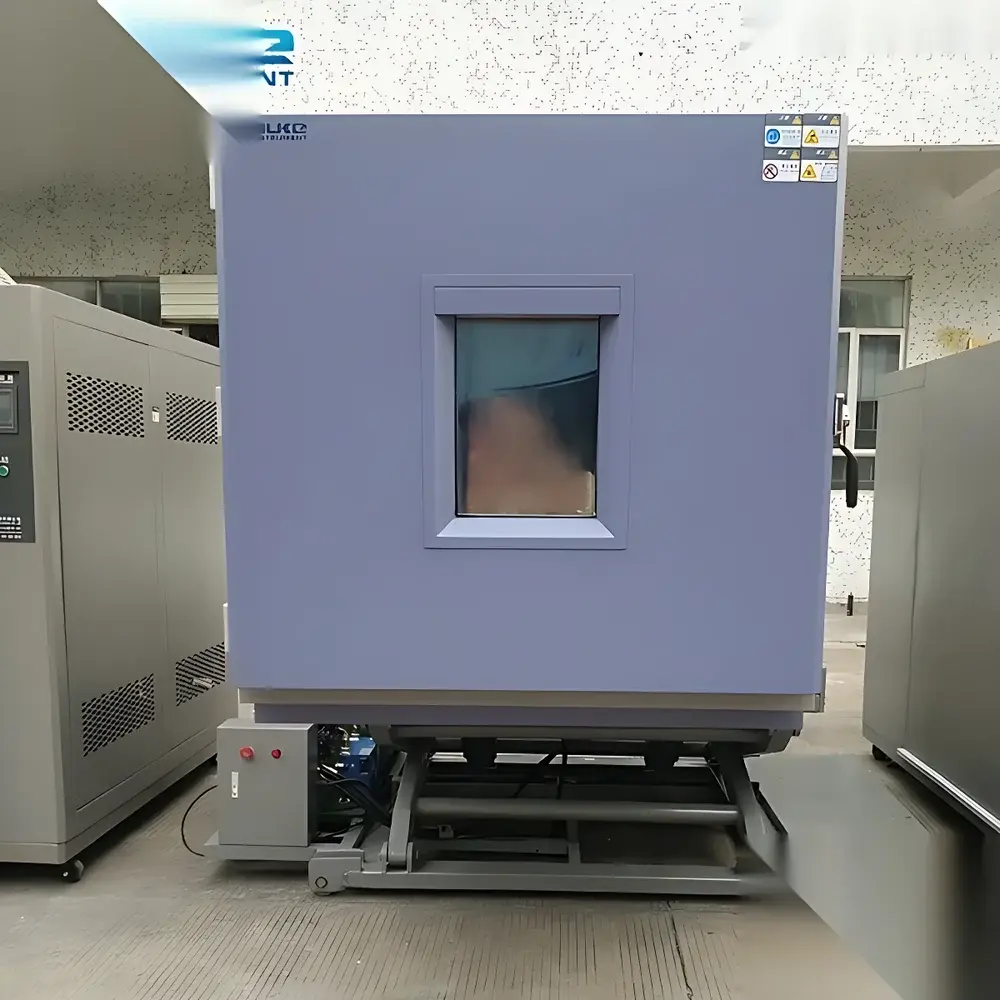
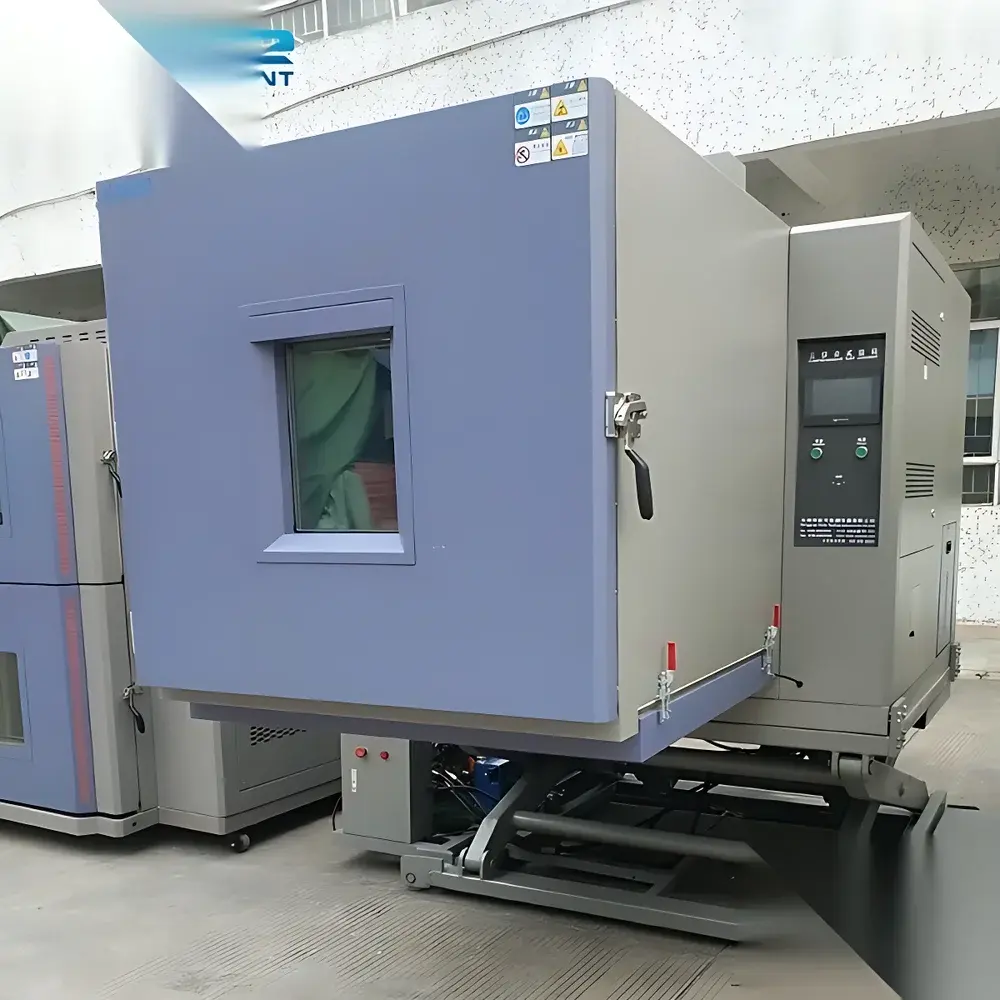
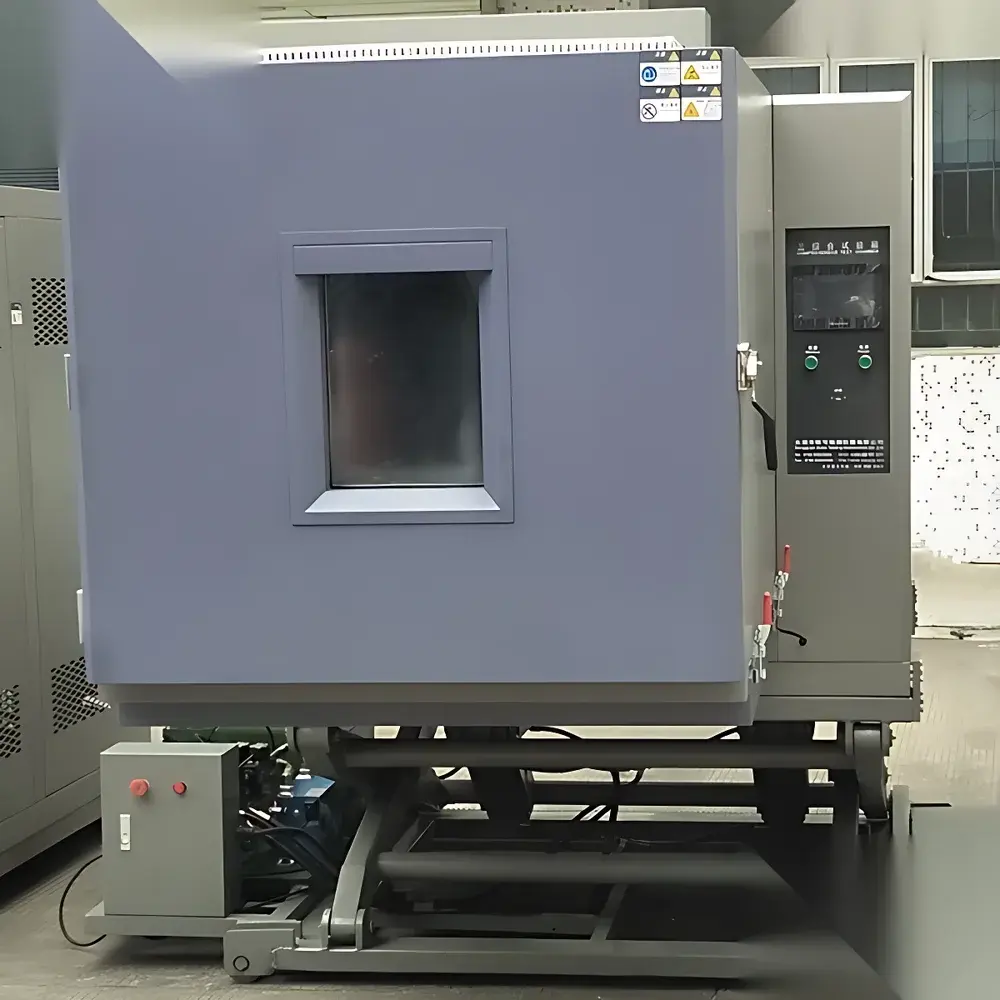
Combined Temperature-Humidity-Vibration Test System OK-ZTH-225 by OEM Manufacturer
| Key | Model OK-ZTH-225 |
|---|
Overview
The OK-ZTH-225 Combined Temperature-Humidity-Vibration Test System is an integrated environmental simulation platform engineered for concurrent or sequential exposure of test specimens to controlled thermal, hygrothermal, and mechanical vibration stressors. Unlike standalone vibration shakers or climate chambers, this tri-combined system enables synchronized operation across all three domains—critical for replicating real-world logistics conditions where temperature cycling, humidity variation, and road-induced vibration co-occur during overland or maritime transport. Its core vibration actuator employs electromagnetic excitation with a rigid moving-coil architecture, delivering high-force output across a broad frequency spectrum (1–600 Hz standard; optional 1–5000 Hz extension). The system operates on the principle of electrodynamic force generation (F = B·L·I), ensuring linear response, minimal harmonic distortion, and repeatable acceleration profiles per ISO 10816 and IEC 60068-2-6 (Fc) requirements.
Key Features
- Tri-environmental integration: Simultaneous control of temperature (−70°C to +180°C), relative humidity (10%–98% RH), and vibration (1–600 Hz, 25.4 mm p-p max amplitude) within a single chamber enclosure.
- High-stability vibration table: 1.0 × 1.0 m stainless steel table surface with reinforced structural support, rated for 50 kg payload under full spectral sweep conditions.
- Precision speed regulation: DC variable-speed drive with digital encoder feedback, enabling resolution of ±0.1 rpm and programmable dwell/sweep modes per MIL-STD-810H Method 514.7.
- Robust thermal-humidity subsystem: Twin-stage refrigeration with PID-controlled steam humidification and desiccant dehumidification, meeting IEC 60068-3-5 and ASTM E1820 stability criteria (±0.5°C, ±2% RH).
- Modular configuration options: Available in vertical-only, horizontal-only, or 2-axis (vertical + horizontal) vibration configurations; computer-integrated models include Ethernet-enabled controller with real-time waveform monitoring and closed-loop acceleration feedback.
- Compliance-ready architecture: Pre-configured test profiles aligned with ISTA 3A, 3E, 3H; ASTM D4169; EN 15552; and US Department of Transportation FMCSA cargo securement guidelines.
Sample Compatibility & Compliance
The OK-ZTH-225 accommodates packaged goods, electronic assemblies, automotive components, medical device packaging, and consumer product shipments up to 50 kg and 1.0 m footprint. Specimen mounting utilizes standardized T-slot table patterns compatible with universal fixture plates and inertia mass adapters. All operational parameters—including acceleration spectra, dwell durations, temperature ramp rates, and humidity transition profiles—are traceable to NIST-calibrated sensors and documented per GLP-compliant audit trails. The system satisfies regulatory expectations for validation documentation under FDA 21 CFR Part 11 (when equipped with computerized data acquisition), ISO/IEC 17025 calibration intervals, and EU Machinery Directive 2006/42/EC safety certification. Environmental compliance includes RoHS 2011/65/EU and REACH SVHC screening for internal materials.
Software & Data Management
Equipped with Windows-based control software (v5.2+), the system supports multi-channel real-time acquisition of acceleration (m/s²), temperature (°C), and relative humidity (%RH) at up to 10 kHz sampling rate. Data logging conforms to IEEE 1159-compliant time-series format with embedded metadata (test ID, operator, timestamp, calibration certificate ID). Export options include CSV, MATLAB .mat, and PDF-certified reports featuring spectral density plots (PSD), shock response spectra (SRS), and pass/fail overlays against reference standards. Audit trail functionality records all parameter modifications, user logins, and system events with SHA-256 hashing—meeting ALCOA+ principles for data integrity in regulated industries.
Applications
- Transportation simulation: Replication of truck, rail, and container ship vibration signatures per ISTA 3 series and ASTM D4169 Cycle A–D protocols.
- Packaging validation: Assessment of corrugated box compression resistance, foam cushioning performance, and blister pack seal integrity under combined thermal-mechanical stress.
- Electronics reliability: Screening for solder joint fatigue, connector fretting corrosion, and MEMS sensor drift induced by coupled thermal cycling and resonant excitation.
- Automotive component testing: Evaluation of infotainment modules, lighting assemblies, and ADAS housings under climatic-vibrational synergy per LV-124 and GMW14872.
- Medical device packaging: Verification of sterile barrier system integrity (per ISO 11607-1) and functional performance of implantable electronics post-simulated distribution.
FAQ
What standards does the OK-ZTH-225 directly support out-of-the-box?
Preloaded test templates cover ISTA 3A/3E/3H, ASTM D4169, EN 15552, IEC 60068-2-6 (Fc), and GB/T 2423.10. Custom profile creation is enabled via script-based waveform editor.
Is remote monitoring and control available?
Yes—Ethernet/IP interface supports secure remote access via TLS 1.2 encrypted connection; optional OPC UA server module enables integration into MES/SCADA environments.
How is system calibration maintained?
Annual third-party calibration includes accelerometer sensitivity verification (per ISO 16063-21), temperature/humidity sensor traceability to NIST SRM, and vibration table modal analysis using impact hammer and laser Doppler vibrometry.
Can the system perform random vibration testing?
Standard configuration supports sine, swept-sine, and fixed-frequency modes. Random vibration capability (PSD synthesis) is available as an optional firmware upgrade compliant with MIL-STD-810H Annex G.
What safety interlocks are implemented?
Dual-channel emergency stop circuitry, door position sensing with forced-break contacts, overtemperature/overhumidity cut-off, and vibration amplitude limiter activated upon table resonance detection.



