


COMECAUSE IN-DK2 Portable Headspace Gas Analyzer for Food, Pharmaceutical & Electronics Packaging
| Brand | COMECAUSE |
|---|---|
| Model | IN-DK2 |
| Origin | Shandong, China |
| Manufacturer Type | Direct Manufacturer |
| Gas Detection | O₂ (0–30% vol, resolution 0.01% vol, accuracy ≤±0.2% in 0–50%, ≤±2% in 50–100%), CO₂ (0–100% vol, resolution 0.01% vol, accuracy ≤±2% in 0–50%, ≤±3% in 50–100%) |
| Sensor Types | Electrochemical (O₂), NDIR Infrared (CO₂) |
| Sample Volume | <5 mL (O₂), <15 mL (CO₂) |
| Response Time | ≤15 s (O₂), ≤20 s (CO₂) |
| Pressure Range | 700–1500 mbar (abs.) |
| Sampling Method | Integrated diaphragm pump with sterile piercing needle |
| Data Storage | 2000 records (circular buffer) |
| Battery | 6800 mAh Li-ion, operating time >12 h |
| Dimensions | 180 × 106 × 80 mm |
| Weight | 450 g |
| Operating Temperature | 0–40 °C |
| Calibration | Two-point (zero/span) with certified gas standards |
| Compliance Reference | JJG 365–2008 (Chinese metrological verification regulation for electrochemical oxygen analyzers) |
Overview
The COMECAUSE IN-DK2 Portable Headspace Gas Analyzer is an engineered solution for non-destructive, on-site quantification of residual oxygen (O₂) and carbon dioxide (CO₂) concentrations within sealed primary packaging. Designed for real-time process control in regulated manufacturing environments, it operates on the principle of controlled headspace sampling via sterile needle puncture—preserving package integrity while extracting representative gas volumes for rapid electrochemical (O₂) and non-dispersive infrared (NDIR) absorption (CO₂) detection. Unlike laboratory-based GC or benchtop analyzers requiring sample destruction and extended turnaround, the IN-DK2 delivers traceable, repeatable measurements in under 20 seconds per test. Its architecture supports direct integration into quality assurance workflows aligned with Good Manufacturing Practice (GMP), Hazard Analysis and Critical Control Point (HACCP), and ISO 22000 frameworks—particularly where headspace gas composition directly impacts product shelf life, sterility maintenance, or chemical stability.
Key Features
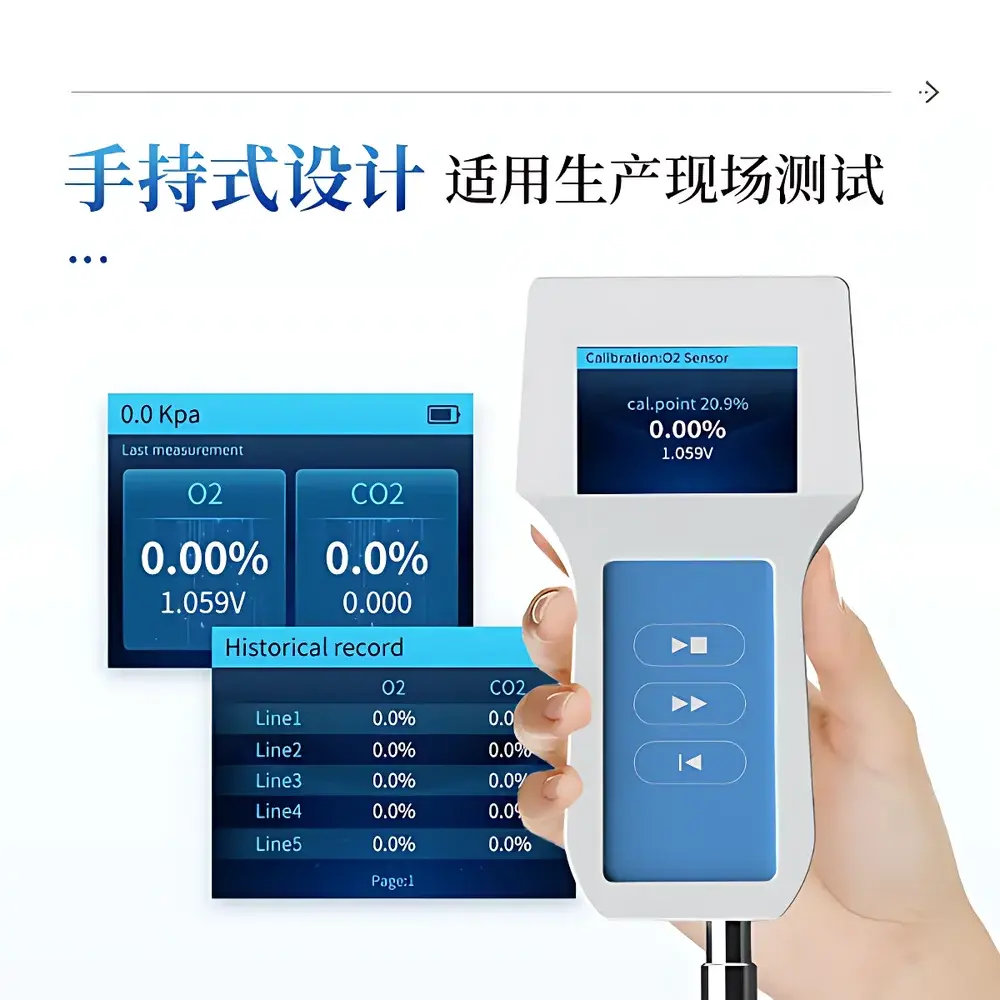
- Handheld ergonomic design (450 g) enabling single-operator use on production lines, warehouse aisles, or cold-chain logistics checkpoints.
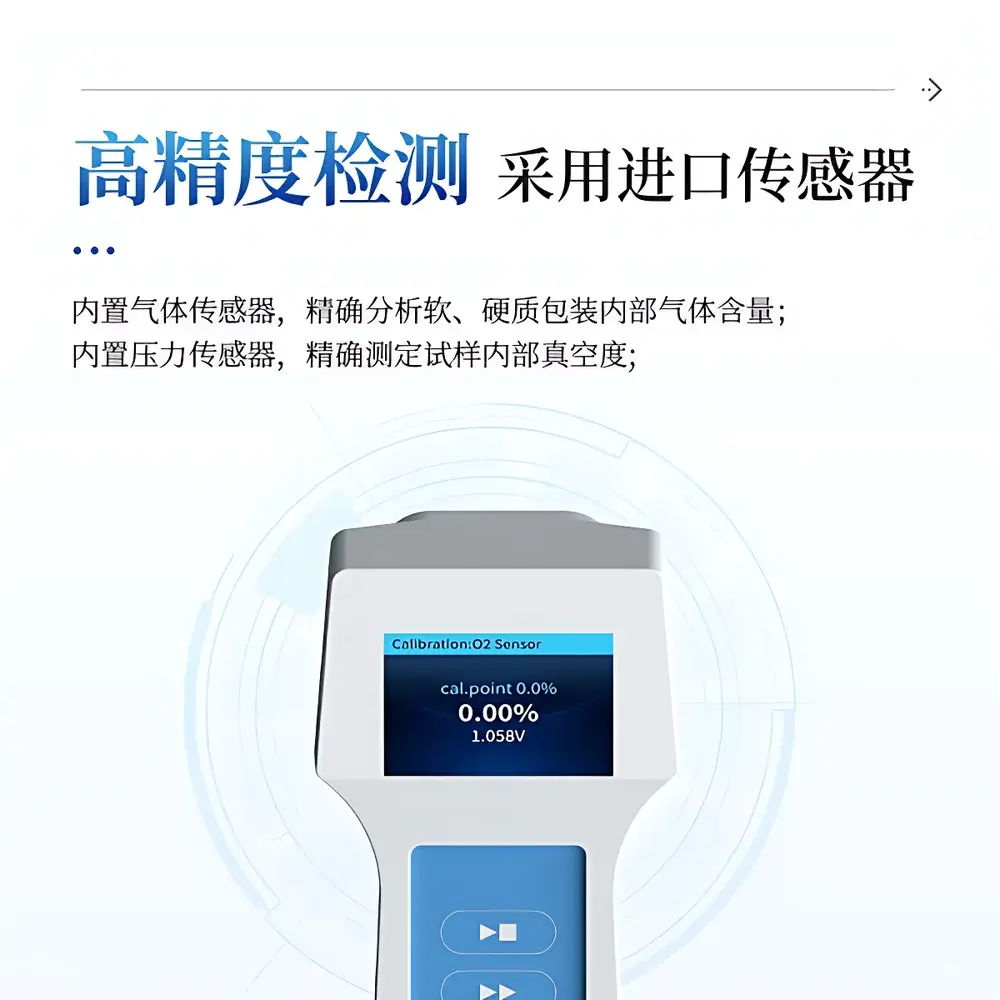
- Integrated dual-sensor module: high-stability electrochemical O₂ sensor (2-year typical lifetime in ambient air) and long-life NDIR CO₂ sensor (>15 years), both sourced from globally certified component suppliers.
- Sterile, quick-connect sampling needle with protective sleeve ensures consistent penetration depth and minimizes contamination risk across vial stoppers, aluminum caps, laminated pouches, and Tyvek®-sealed trays.
- Onboard pressure transducer (700–1500 mbar abs.) enables simultaneous assessment of internal headspace pressure—critical for evaluating modified atmosphere packaging (MAP) integrity and nitrogen flush efficacy.
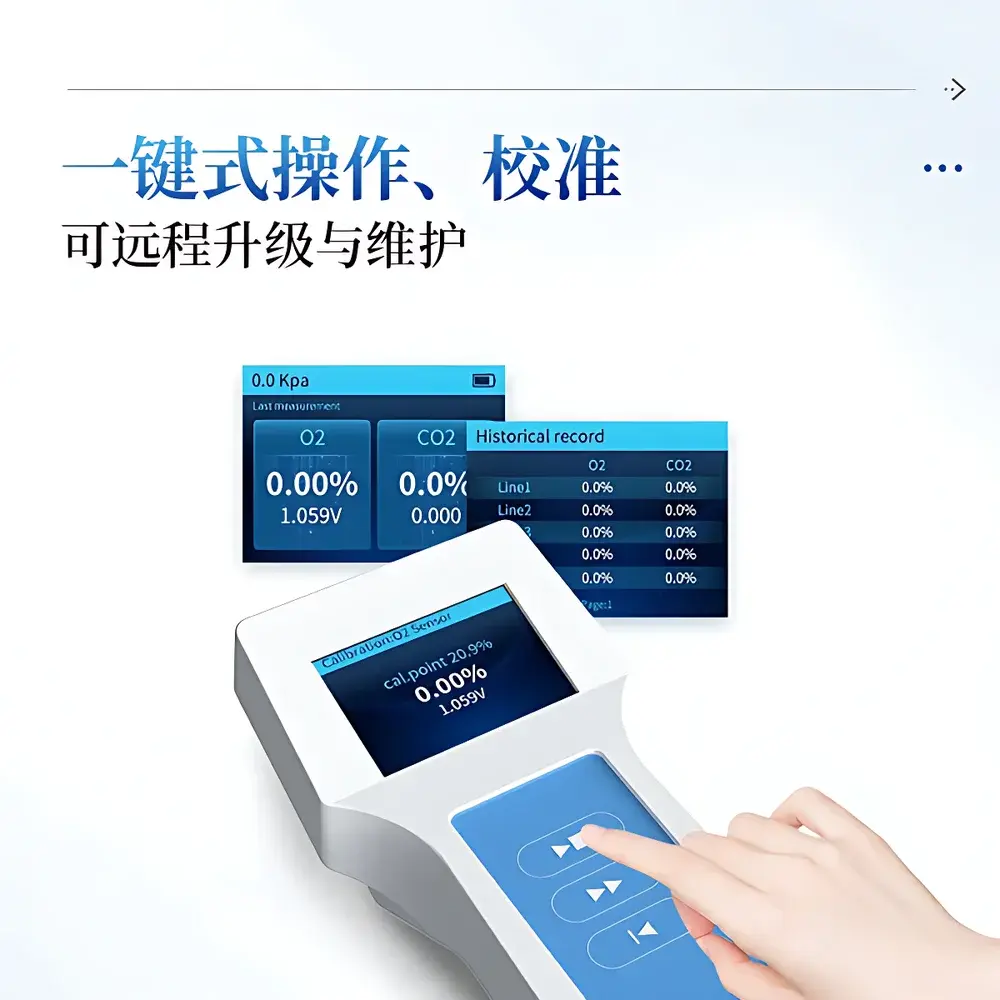
- Intuitive touchscreen interface with one-touch calibration, auto-zero function, and real-time trend logging; firmware supports remote over-the-air (OTA) updates via USB connection.
- Built-in data management: 2000-test circular memory with timestamp, operator ID, and environmental metadata; exportable via USB 2.0 to CSV-compatible platforms for audit trail generation.
- Dual-language support (English/Chinese) and adaptive UI scaling ensure seamless operation across multinational facilities and multilingual QA teams.
Sample Compatibility & Compliance
The IN-DK2 accommodates a broad spectrum of rigid and flexible packaging formats without modification: glass vials (e.g., 2R–30R serum bottles), aluminum-sealed cans, PET/PP bottles (carbonated and still beverages), retort pouches, vacuum-sealed trays, and foil-laminated sachets used for pharmaceuticals, dairy powders, coffee, and medical device barrier packaging. It complies with JJG 365–2008 for electrochemical O₂ measurement validation and meets functional equivalency requirements for ASTM F2476 (Standard Test Method for Determining Oxygen Transmission Rate Through Plastic Film and Sheeting Using a Coulometric Sensor) when paired with validated sampling protocols. While not FDA 21 CFR Part 11–certified out-of-the-box, its audit-ready data logs—including calibration history, operator inputs, and environmental conditions—support GLP/GMP documentation during regulatory inspections.
Software & Data Management
Data capture occurs at instrument level with embedded timestamping, user-defined batch IDs, and automatic storage of raw sensor outputs alongside calculated %vol values. The USB interface allows secure transfer to LIMS or ERP systems; no proprietary software is required—standard spreadsheet applications suffice for trend analysis. Each record includes contextual parameters: ambient temperature (0–40 °C operational range), absolute pressure, sampling duration, and sensor health status. Optional CSV report templates are available for integration with statistical process control (SPC) dashboards. Firmware updates preserve all historical calibration coefficients and maintain traceability per ISO/IEC 17025 clause 7.7.
Applications
- Pharmaceutical & Biologics: Quantitative O₂ monitoring in lyophilized drug vials and pre-filled syringes to verify inert gas overlay integrity and prevent oxidation of sensitive monoclonal antibodies or mRNA formulations.
- Food & Beverage: Real-time CO₂/O₂ ratio verification in MAP-packed cheeses, ready-to-eat meals, and craft beer bottles—ensuring flavor retention and microbial inhibition per Codex Alimentarius guidelines.
- Electronics Packaging: Validation of low-O₂ (<100 ppm), low-humidity atmospheres inside dry-packaged semiconductor wafers and MEMS devices to prevent intermetallic corrosion and solder joint degradation.
- Medical Devices: Confirmation of nitrogen-purged headspace in Class II/III sterile barrier systems (e.g., ISO 11607-compliant pouches) prior to sterilization cycle release.
FAQ
Does the IN-DK2 require external gas standards for routine calibration?
Yes—two-point calibration (zero gas and span gas) is mandatory before first use and after sensor replacement. Certified O₂ (e.g., 0.5% in N₂) and CO₂ (e.g., 10% in air) standards meeting ISO 6142 specifications are recommended.
Can the instrument measure gas mixtures beyond O₂ and CO₂?
No—the IN-DK2 is optimized exclusively for O₂ and CO₂ quantification. It does not support N₂, H₂O vapor, or hydrocarbon detection.
What is the minimum headspace volume required for reliable measurement?
A minimum of 3 mL free headspace is advised for O₂; 10 mL for CO₂. Smaller volumes may yield statistically non-representative results due to diffusion kinetics and sensor response dynamics.
Is needle reuse permitted between samples?
Needles are designed for single-use per ISO 13485 Annex B guidance. Reuse risks cross-contamination, seal compromise, and calibration drift—especially in sterile or high-value biopharma applications.
How is measurement uncertainty reported?
Uncertainty is derived per GUM (JCGM 100:2008) using combined contributions from sensor accuracy, pressure transducer tolerance, temperature coefficient, and sampling volume repeatability—typically ±0.3% vol for O₂ at 1% level and ±2.5% vol for CO₂ at 95% level.




