



COMECAUSE IN-DM High-Configuration Rice Appearance Quality Analyzer
| Brand | COMECAUSE |
|---|---|
| Origin | Shandong, China |
| Manufacturer Type | Direct Manufacturer |
| Country of Origin | China |
| Model | IN-DM (High-Configuration) |
| Price | USD 2,680 (approx. ¥19,000) |
| Optical Resolution | 4800 × 9600 dpi |
| Scan Area (Transmissive) | 30 cm × 20 cm |
| Minimum Pixel Size | 0.0053 mm × 0.0026 mm |
| Measurement Accuracy (Length) | ≤ ±0.05 mm |
| Length-to-Width Ratio Error | ≤ ±0.05 |
| Repeatability Error (Morphometrics) | ≤ ±0.02 |
| Error (Head Rice Rate / Broken Rice Rate) | ≤ ±1.0% |
| Repeatability Error (Head/Broken Rates) | ≤ ±0.25% |
| Grain Counting Accuracy | ≥ 99% (≥ 100% after manual correction) |
| Compatible Grain Size Range | 0.25–20 mm |
| Operating Temperature | 10–30 °C |
| Relative Humidity | ≤ 85% RH |
| Power Supply | 220 V ±10%, 50 Hz |
Overview
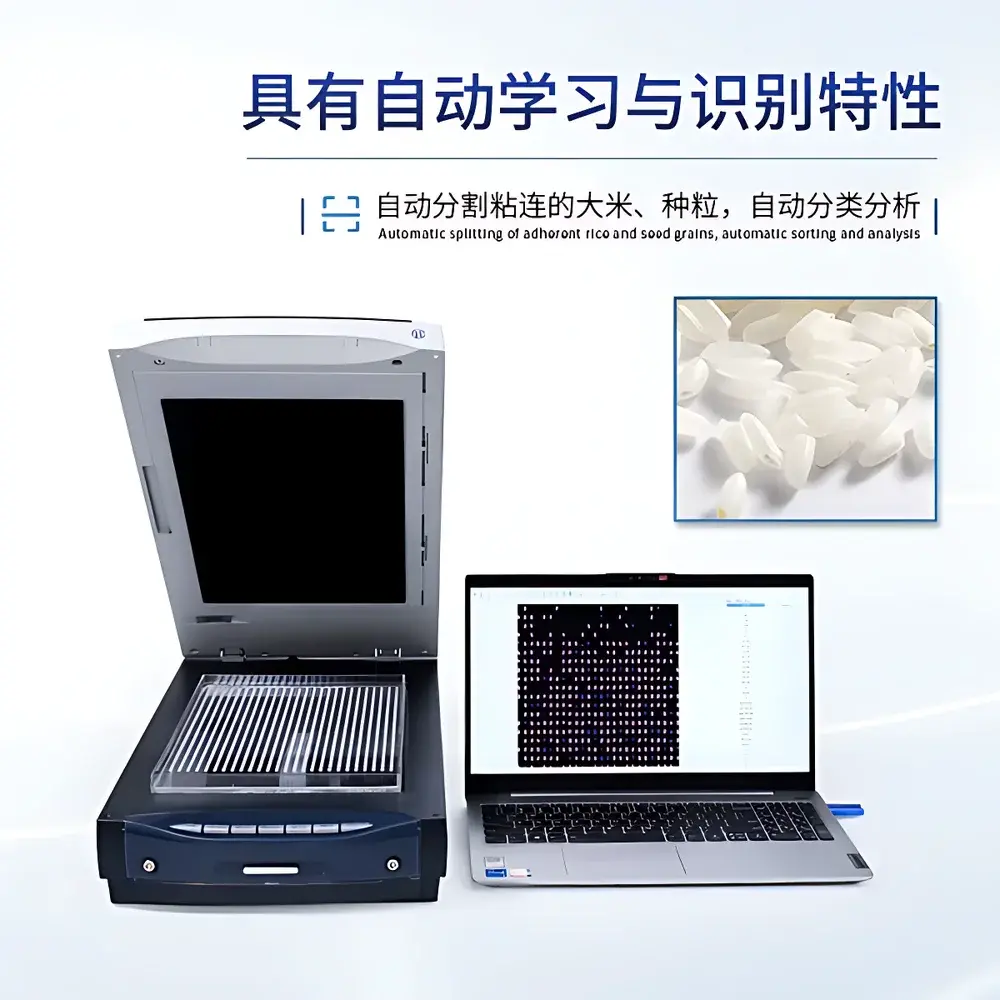
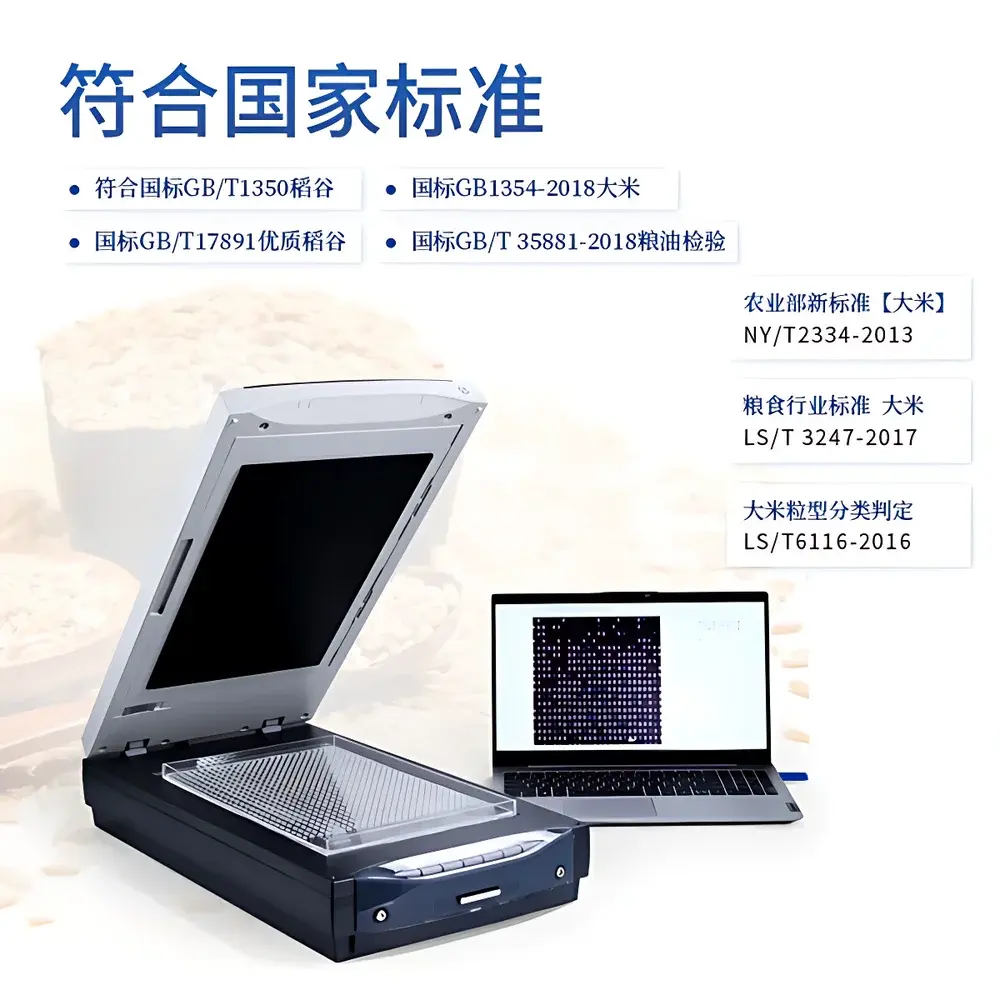
The COMECAUSE IN-DM High-Configuration Rice Appearance Quality Analyzer is a dedicated image-based metrology system engineered for objective, high-throughput assessment of morphological and optical quality parameters in paddy rice, milled rice, brown rice, glutinous rice, black rice, and related cereal grains. It operates on the principle of high-resolution transmissive color scanning combined with adaptive digital image segmentation, feature extraction, and standardized metric computation—fully aligned with Chinese national and agricultural industry standards including GB/T 1350, GB/T 17891, GB 1354–2018, NY/T 2334–2013, LS/T 6116–2016, LS/T 3247–2017, and GB/T 35881–2018. Unlike subjective visual grading or manual counting methods, the IN-DM eliminates inter-operator variability by automating pixel-level analysis of individual kernels across batches of up to several hundred grains per scan. Its dual-source illumination ensures uniform contrast for translucent, opaque, and pigmented samples—including detection of chalkiness, yellowing, blackening, translucency grade, and surface defects such as cracks or discoloration.
Key Features
- High-fidelity A4+ transmissive scanning platform with 4800 × 9600 dpi optical resolution and sub-5.3 µm pixel pitch, enabling precise geometric quantification at kernel and sub-kernel levels.
- Automated multi-parameter morphometric analysis per grain: area, length, width, length-to-width ratio, equivalent diameter, roundness, and aspect ratio—with traceable measurement uncertainty (length error ≤ ±0.05 mm; repeatability ≤ ±0.02).
- Comprehensive compliance-driven quality index computation: chalky grain rate/degree, head rice rate, broken rice rate (including small broken fraction), translucency grade (per GB 1354–2018), yellow-grain content, whiteness index, yellowness index (b*), foreign matter ratio, varietal purity assessment, immature grain count, fissure rate, black rice coverage ratio, embryo viability estimation (brown rice germ rate), and glutinous rice “yin-mi” ratio.
- Intelligent kernel separation algorithm for agglomerated or touching grains—leveraging gradient-based watershed segmentation and machine learning-assisted boundary refinement.
- Integrated RS232 interface for real-time mass data ingestion from analytical balances and barcode scanners, supporting GLP-aligned sample tracking and metadata linkage.
- Cloud-enabled architecture with encrypted data synchronization, remote result access, and version-controlled software updates via secure web portal.
Sample Compatibility & Compliance
The IN-DM supports quantitative analysis of diverse rice types—including indica, japonica, aromatic, glutinous, black, red, and parboiled varieties—as well as processed fractions (e.g., bran, broken fragments, hulls). Its validated measurement protocols conform to statutory requirements under China’s National Grain and Oils Quality Supervision and Inspection System. All reported metrics—including percentage-based ratios (e.g., chalkiness %, head rice %) and count-based distributions (e.g., grain count per size bin)—are computed using algorithms independently verified against reference datasets from provincial grain quality monitoring centers. The system satisfies traceability and audit readiness requirements for laboratories operating under GB/T 27025–2019 (equivalent to ISO/IEC 17025) and supports optional 21 CFR Part 11-compliant electronic signatures when deployed with validated software lock and user role management.
Software & Data Management
The analyzer runs on Windows-based COMECAUSE GrainVision™ v4.x software—a modular application featuring calibrated image preprocessing, configurable region-of-interest masking, batch processing queues, and customizable reporting templates. All raw images, segmented masks, measurement logs, and statistical summaries are stored in ACID-compliant SQLite databases with SHA-256 hash integrity verification. Export options include ISO-standard CSV/Excel (.xlsx) files with embedded metadata (timestamp, operator ID, instrument SN, calibration status), annotated JPEG/PNG overlays showing classification boundaries and metric labels, and binned distribution charts (e.g., length histogram, area scatter plot, whiteness vs. chalkiness correlation matrix). Screen recording functionality captures full workflow sessions—including parameter adjustments and manual corrections—for internal training or regulatory review.
Applications
This instrument serves quality control laboratories in rice breeding programs, grain procurement centers, milling facilities, food safety inspection agencies, and academic research units focused on cereal postharvest physiology. Typical use cases include: varietal fingerprinting based on morphotype clustering; rapid screening of mutant lines for chalkiness or fissuring phenotypes; validation of drying/storage protocols on kernel integrity; certification testing for premium-grade rice labeling (e.g., “Japonica Extra Grade”); and routine surveillance of imported rice lots for adulteration or misdeclaration. Its capacity to process >200 grains per minute—while retaining single-kernel resolution—makes it suitable for both R&D-scale experiments and daily throughput demands exceeding 500 samples per shift.
FAQ
Does the IN-DM require periodic recalibration?
Yes—optical alignment and grayscale response are verified using NIST-traceable ceramic calibration tiles before each daily session; full system validation is recommended every 90 days or after hardware maintenance.
Can the software export data directly to LIMS platforms?
Yes—via configurable ODBC drivers and RESTful API endpoints supporting HL7/FHIR-compatible metadata schemas.
Is offline operation supported?
Yes—the core analysis engine functions without internet connectivity; cloud sync occurs only upon user-initiated upload or scheduled background sync.
What sample preparation is required?
Grains must be cleaned of dust and debris, then uniformly dispersed on the scanner glass using supplied graded spreaders (short-, medium-, long-, and ultra-long-grain variants); no staining, coating, or mounting is needed.
How is measurement uncertainty documented for accreditation purposes?
Each report includes embedded uncertainty budgets derived from pixel resolution limits, illumination stability tests, and inter-laboratory reproducibility studies published in Journal of Cereal Science (2022, Vol. 105, 103487).





