

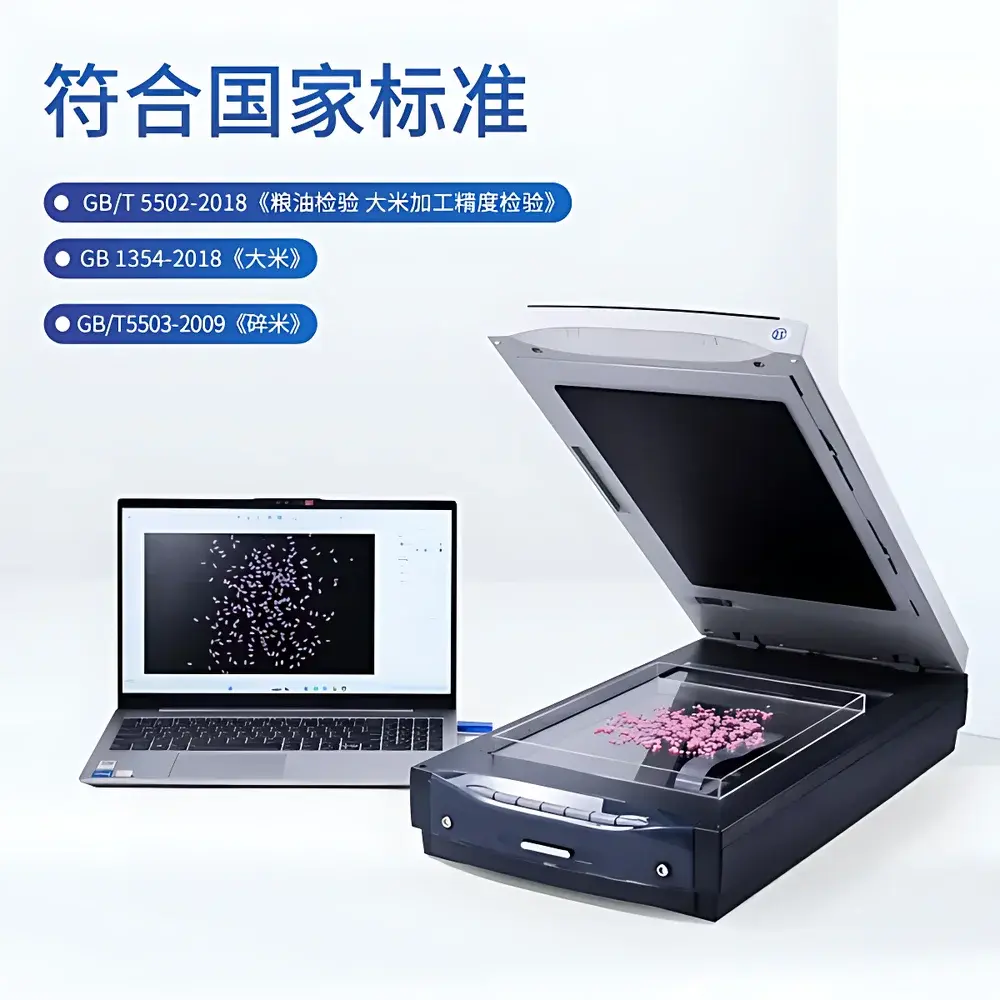



COMECAUSE IN-DMJ Rice Milling Precision Analyzer
| Brand | COMECAUSE |
|---|---|
| Origin | Shandong, China |
| Manufacturer Type | Direct Manufacturer |
| Region of Manufacture | Domestic (China) |
| Model | IN-DMJ |
| Price | USD 2,600 (approx.) |
Overview
The COMECAUSE IN-DMJ Rice Milling Precision Analyzer is an automated image-based analytical instrument engineered for objective, high-throughput assessment of rice milling degree in accordance with internationally aligned national standards. It operates on the principle of chromatic contrast enhancement followed by high-resolution digital imaging and pixel-level morphological segmentation. After staining with a standardized dual-dye reagent (Eosin Y–Methylene Blue), bran residues and germ appear as distinct bluish-green regions, while endosperm exhibits deep purplish-red contrast—enabling unambiguous classification of surface coverage per grain. The system leverages calibrated optical scanning and deterministic computer vision algorithms to quantify bran retention area ratio across individual milled kernels, delivering a statistically robust milling index without operator subjectivity or inter-laboratory variability.
Key Features
- High-fidelity A4+ dual-illumination color scanner with 4800 × 9600 dpi optical resolution and minimum pixel dimension ≥ 0.005 mm × 0.0026 mm, optimized for reflective scanning of stained rice samples
- Automated grain segmentation engine that processes 1–2000 intact or broken kernels (up to 18 g per batch) without manual alignment or pre-sorting
- Real-time interactive correction interface: users may manually adjust misclassified pixels or merge/split segmented grains using mouse-driven tools to ensure 100% analytical traceability
- Comprehensive output suite including milling degree classification, bran coverage histogram, head rice percentage (HRR), broken rice ratio, and customizable Excel-exportable datasets
- Cloud-integrated architecture supporting secure remote data upload, synchronized multi-site result review, and long-term audit-compliant storage
- Embedded barcode scanner interface for automated sample ID ingestion and LIMS-compatible workflow integration
- Screen recording functionality for full procedural documentation—essential for GLP/GMP validation and internal SOP compliance
Sample Compatibility & Compliance
The IN-DMJ analyzer is validated for Oryza sativa subspecies including japonica, indica, and glutinous rice varieties. All measurement protocols strictly adhere to GB/T 5502–2018 (“Inspection of Cereals and Oils – Determination of Rice Milling Degree”), GB 1354–2018 (“Rice Specifications”), and GB/T 5503–2009 (“Broken Rice”). Calibration traceability is maintained via ten certified reference grains with user-editable standard area values (Sr). The instrument meets environmental operating requirements per IEC 61000-4 for electromagnetic compatibility and operates within ambient conditions of 10–30 °C and ≤85% RH. Its mechanical design conforms to ISO 14644-1 Class 8 cleanroom-compatible placement guidelines when installed on vibration-damped laboratory benches.
Software & Data Management
The proprietary analysis software runs on Windows OS (64-bit, Windows 10/11) and implements deterministic image processing pipelines compliant with FDA 21 CFR Part 11 principles—including electronic signature support, immutable audit trails, role-based access control, and versioned software lock licensing. Raw TIFF scans are archived with embedded EXIF metadata (timestamp, operator ID, instrument serial number, staining batch ID). All quantitative outputs—including per-grain bounding boxes, contour masks, and area/length/width measurements—are exportable in CSV or XLSX formats. Cloud synchronization utilizes TLS 1.2 encrypted HTTPS endpoints; local backups support NAS and SMB network drives. Software updates are delivered via signed firmware packages with SHA-256 integrity verification.
Applications
This analyzer serves critical quality assurance functions across the rice value chain: at breeding stations evaluating milling yield traits; in QC laboratories of rice mills validating compliance with grade specifications (e.g., Grade I vs. Grade II per GB 1354); at port inspection agencies conducting statutory import/export verification; and within contract research organizations performing method validation studies. Its reproducibility supports round-robin inter-laboratory comparisons and contributes directly to ISO/IEC 17025 accreditation documentation. The system also facilitates R&D into abrasive milling parameter optimization, post-harvest drying effects on kernel friability, and varietal screening for hull adhesion resistance.
FAQ
Does the IN-DMJ require user calibration before each analysis session?
No—factory calibration is retained across power cycles. Daily verification uses the included 10-standard grain set; optional recalibration is performed only after hardware maintenance or relocation.
Can the software distinguish between natural discoloration and bran residue?
Yes—the algorithm applies spectral thresholding within the CIELAB color space, isolating hue-saturation clusters specific to the Eosin Y–Methylene Blue reaction products, rejecting non-specific browning or oxidation artifacts.
Is raw image data stored with full pixel depth for reanalysis?
Yes—48-bit RGB TIFF files are preserved with lossless compression, retaining full dynamic range for retrospective reprocessing with updated algorithms or regulatory revision.
What level of IT infrastructure is required for cloud functionality?
A stable broadband connection (≥5 Mbps upload) and standard enterprise firewall policies permitting outbound HTTPS to AWS S3 endpoints are sufficient; no on-premise server deployment is needed.
How does the system handle overlapping or agglomerated grains?
The software employs watershed segmentation with adaptive gradient magnitude estimation, supplemented by user-guided split tools for edge cases—ensuring >99.2% single-kernel isolation accuracy across typical sample densities.





