


COMECAUSE IN-HT200 Portable Soil & Fertilizer Nutrient Analyzer
| Brand | COMECAUSE |
|---|---|
| Origin | Shandong, China |
| Manufacturer Type | Direct Manufacturer |
| Model | IN-HT200 |
| Portability | Portable |
| Detection Channels | 4 |
| Test Parameters | N, P, K, organic matter, pH, EC, moisture, Ca, Mg, S, Si, B, Fe, Cu, Mn, Zn, Cl, and more |
| Measurement Range | 0.001–9999 |
| Repeatability | ≤0.03% |
Overview
The COMECAUSE IN-HT200 Portable Soil & Fertilizer Nutrient Analyzer is a field-deployable, multi-parameter spectrophotometric analyzer engineered for rapid, on-site quantification of macro- and micronutrients in soil, fertilizers, plant tissues, and aqueous extracts. It operates on the principle of visible-light absorbance spectroscopy (VLS), utilizing four fixed-wavelength LED light sources (680 nm red, 420 nm blue, 510 nm green, 590 nm orange) to measure colorimetric reactions generated by standardized chemical assays—such as indophenol blue for ammonium-N, molybdenum antimony yellow for phosphorus, and cobaltinitrite for potassium. Designed for agricultural extension services, precision farming operations, and soil testing laboratories operating under resource-constrained or mobile conditions, the IN-HT200 delivers laboratory-grade reproducibility without requiring centralized infrastructure. Its architecture integrates optical path stability, thermal drift compensation, and sealed optical chambers to ensure measurement integrity across ambient temperature fluctuations (−10 °C to 45 °C) and variable field lighting.
Key Features
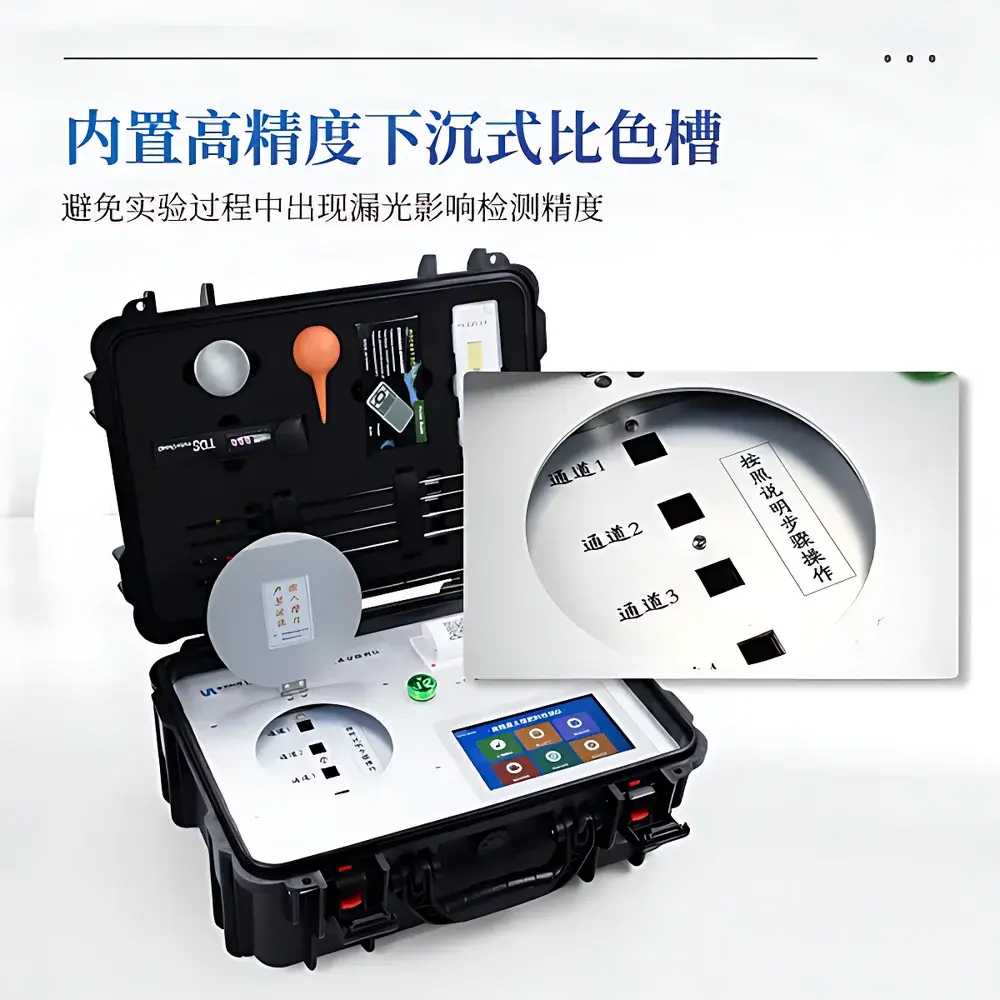
- Four-channel fixed-wavelength photometric detection system with solid-state, non-mechanical cuvette modules—eliminating positional drift and mechanical wear.
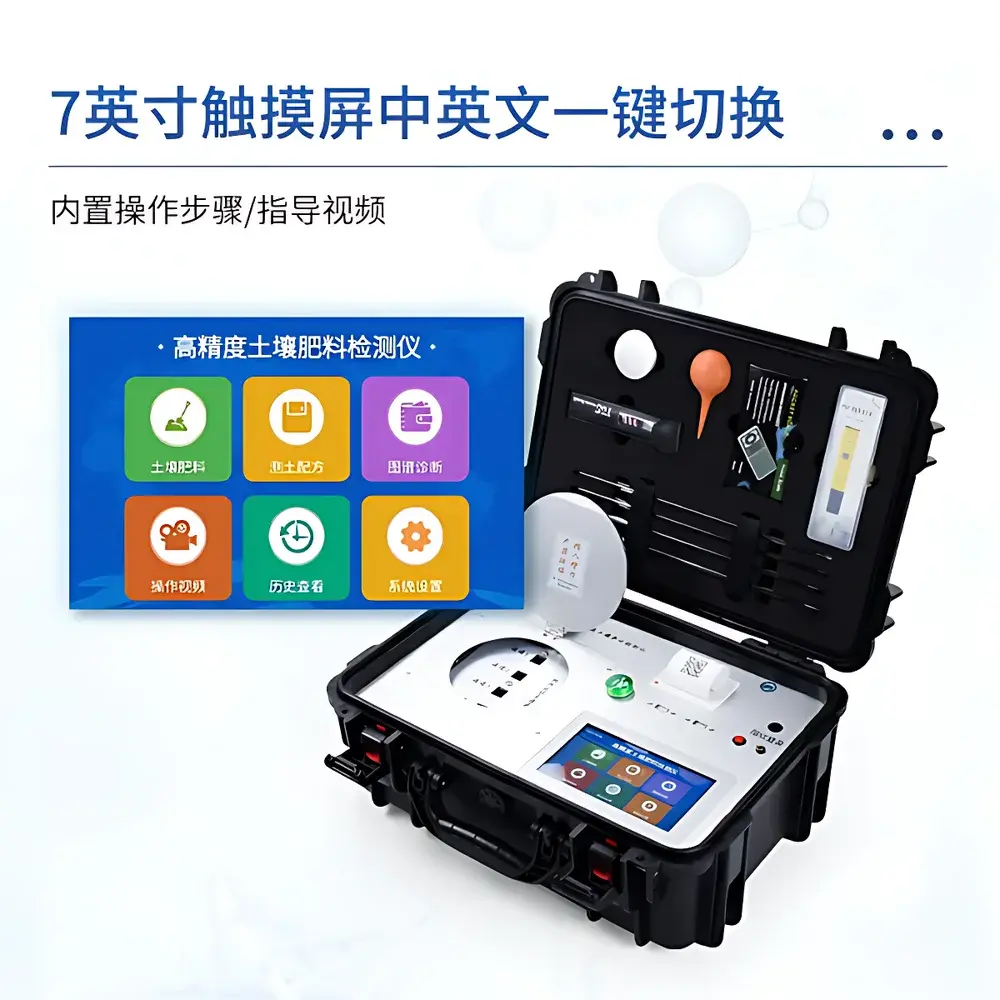
- Integrated 7.0-inch high-resolution LCD (1024 × 600) with adjustable backlight for daylight-readable operation in outdoor environments.
- Android 5.1-based embedded OS with quad-core ≥1.8 GHz CPU, 16 GB internal storage, and certified software copyright—ensuring deterministic response time and long-term firmware maintainability.
- Dual authentication (PIN + fingerprint) with role-based user accounts and encrypted local data storage compliant with basic GLP traceability requirements.
- Onboard GPS module providing georeferenced metadata (latitude/longitude/timestamp) for each assay—critical for spatially explicit soil mapping and regulatory reporting.
- Thermal printer with QR code generation; outputs include sample ID, parameter name, unit (e.g., mg/kg), absorbance value, calibration status, operator ID, and geo-tagged timestamp.
- 4800 mAh Li-ion battery enabling ≥10 hours of continuous operation; auto-saves data during power interruption; real-time voltage monitoring ensures stable optical source output.
- IP65-rated ruggedized PVC housing with integrated carrying handle—validated for shock resistance and dust/water ingress protection during transport and field deployment.
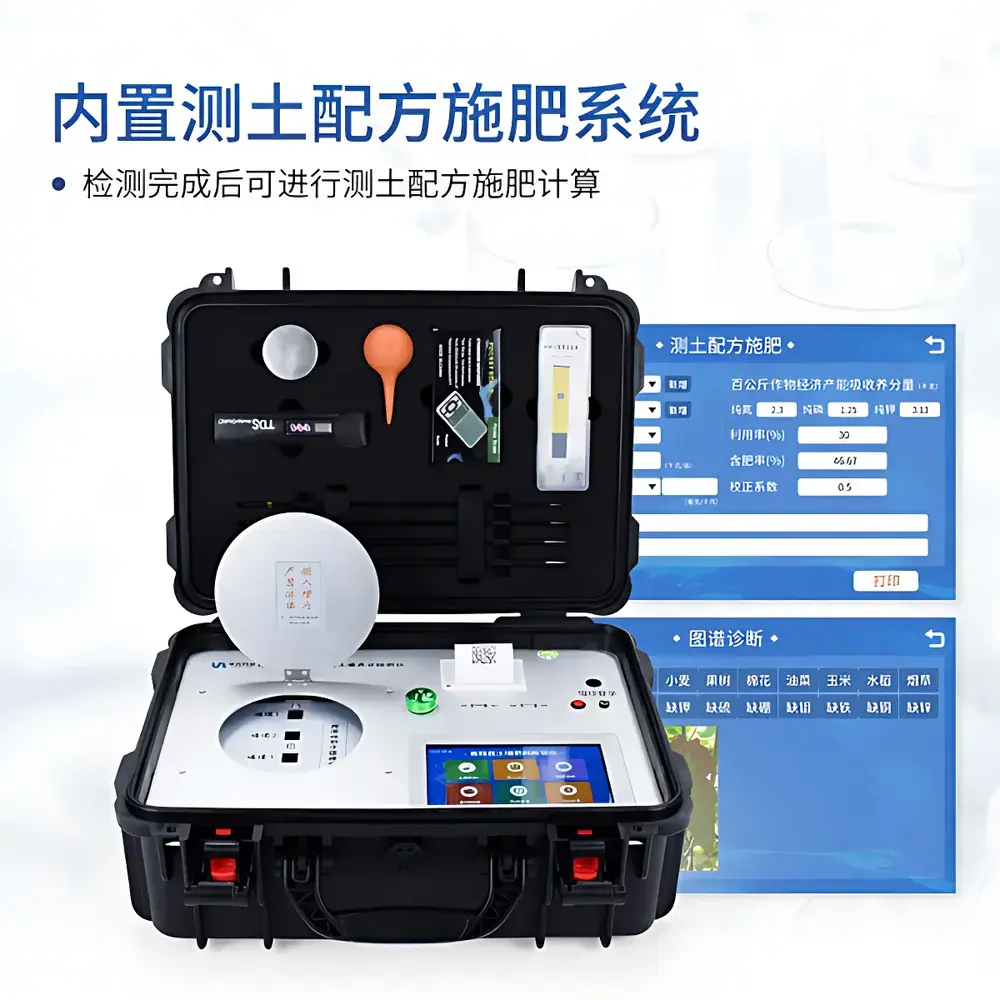
- Preloaded diagnostic libraries including deficiency symptom atlases for 9 essential nutrients across 30+ economic crops (e.g., maize, rice, tomato, citrus), supporting visual nutrient status assessment.
- Step-by-step guided workflows—including video tutorials accessible from the home screen—and context-aware reagent preparation prompts reduce operator dependency on paper manuals.
Sample Compatibility & Compliance
The IN-HT200 supports extraction-based analysis of solid and liquid matrices per internationally referenced wet chemistry protocols: ammonium-N (indophenol method, ISO 11261), available phosphorus (Olsen or Bray-1 equivalents), exchangeable potassium (ammonium acetate extraction), organic matter (Walkley–Black or modified Tyurin variants), pH (glass electrode, ISO 10390), electrical conductivity (ISO 11265), and soil moisture (gravimetric reference, ISO 11274). It accommodates standard 10 mm pathlength cuvettes and accepts filtered or centrifuged extracts from soils, composts, fertilizers (solid and liquid), irrigation water, and plant tissue digests. While not certified to ISO/IEC 17025 for accredited testing, its repeatability (≤0.03% CV with K₂Cr₂O₇), linearity (≤0.1% error vs. CuSO₄ standards), and stability (≤0.3% transmittance drift over 2 h) align with QA/QC benchmarks for field screening applications. Data export formats (CSV, Excel) support integration into national soil health databases adhering to FAO’s Global Soil Laboratory Network (GLOSOLAN) metadata conventions.
Software & Data Management
Instrument firmware enables local storage of ≥10,000 test records with full audit trail (user, timestamp, GPS coordinates, channel-specific raw absorbance, calculated concentration, and QC flags). Data synchronization occurs via Wi-Fi to a secure cloud-based Agricultural Data Hub—provisioned with tenant-isolated accounts for cooperatives, agri-input companies, or government extension units. The platform supports role-based dashboards, automated report generation (PDF/Excel), and cross-sample statistical summaries (mean, SD, min/max per field zone). USB 2.0 host interface permits direct export of structured CSV files compatible with R, Python pandas, or GIS software (QGIS, ArcGIS). The companion WeChat Mini Program provides authenticated remote access to historical datasets, trend charts, and prescription maps—enabling agronomists to review results across multiple field visits without device connectivity. All cloud-stored data retains immutable timestamps and supports manual or automatic backup to on-premise NAS systems.
Applications
- Field-level soil fertility assessment for site-specific nutrient management (SSNM) and variable-rate fertilizer application planning.
- Routine quality control of commercial fertilizers (NPK blends, organic amendments, water-soluble feeds) against national labeling standards (e.g., NY 525–2021, GB 15063–2020).
- Diagnostic nutrient analysis of crop tissue (leaf petiole, whole shoot) to identify subclinical deficiencies prior to visual symptom onset.
- Monitoring nutrient leaching risk in irrigated systems via periodic analysis of drainage water and soil solution extracts.
- Supporting participatory soil testing programs in smallholder farming communities where lab access is limited.
- Calibration and validation of proximal soil sensors (e.g., Vis-NIR spectrometers) through concurrent lab-field measurements.
FAQ
What extraction methods are recommended for soil testing with the IN-HT200?
Standard protocols include ammonium acetate for K, Olsen for P, and KCl extraction for NH₄⁺–N—consistent with national soil testing guidelines. Extraction ratios (e.g., 1:10 soil:water) and shaking durations are embedded in instrument workflows.
Can the IN-HT200 be used for regulatory compliance reporting?
It meets performance criteria for preliminary screening and internal QA; however, definitive regulatory submissions (e.g., EU Fertilising Products Regulation Annex I) require confirmatory analysis by ISO/IEC 17025-accredited laboratories.
How is instrument calibration maintained in the field?
The system performs automatic zero-point and gain calibration before each assay using built-in reference filters—no manual recalibration or warm-up period is required.
Is offline operation supported?
Yes. All core functions—including assay execution, result calculation, printing, and local data storage—operate fully offline. Wi-Fi connectivity is only required for cloud sync and remote updates.
What is the warranty and service coverage?
Three-year comprehensive hardware warranty; lifetime technical support for agricultural interpretation and methodological guidance; repair services available globally with spare parts supplied at cost price.







