


COMECAUSE IN-HT300 Research-Grade Soil & Fertilizer Nutrient Analyzer
| Brand | COMECAUSE |
|---|---|
| Origin | Shandong, China |
| Manufacturer Type | Direct Manufacturer |
| Country of Origin | China |
| Model | IN-HT300 |
| Instrument Type | Portable |
| Detection Principle | Colorimetric Chemistry |
| Number of Detection Channels | 4 |
| Test Parameters | Nitrogen (N), Phosphorus (P), Potassium (K), Organic Matter, pH, EC, Moisture, and >40 Macro-/Micronutrients & Heavy Metals in Soil, Fertilizer, Plant Tissue, and Water |
| Measurement Range | 0.001–9999 (unitless absorbance-derived concentration scale) |
| Repeatability | ≤0.03% (as CV, measured with potassium dichromate solution) |
Overview
The COMECAUSE IN-HT300 is a field-deployable, research-grade soil and fertilizer nutrient analyzer engineered for precision agricultural diagnostics and environmental monitoring. It operates on validated colorimetric chemistry principles—leveraging standardized wet-chemical extraction followed by spectrophotometric quantification at four discrete optical wavelengths (680 nm red, 420 nm blue, 510 nm green, and 590 nm orange). Each wavelength is matched to specific chromogenic reactions for target analytes, including ammonium-N, available P (via molybdenum blue), exchangeable K (via sodium tetraphenylborate), organic matter (via dichromate oxidation), and heavy metals (e.g., Cd, Pb, As via complexometric or chelation-based assays). Unlike laboratory-bound ICP-OES or AAS systems, the IN-HT300 delivers quantitative, trace-level results in situ without sample shipment delays—enabling real-time decision support for soil health assessment, fertilizer optimization, and crop nutritional status evaluation. Its design adheres to foundational analytical rigor: all optical paths are fixed, thermally stabilized, and housed within a light-tight,下沉式 (submerged-style) cuvette chamber to eliminate stray-light interference—a critical requirement for reproducible absorbance measurements under variable ambient lighting conditions.
Key Features
- Four-channel fixed-wavelength photometric system with independently calibrated LED sources (lifespan ≥100,000 hours; wavelength tolerance ±2 nm for red/blue/green; ±4 nm for orange)
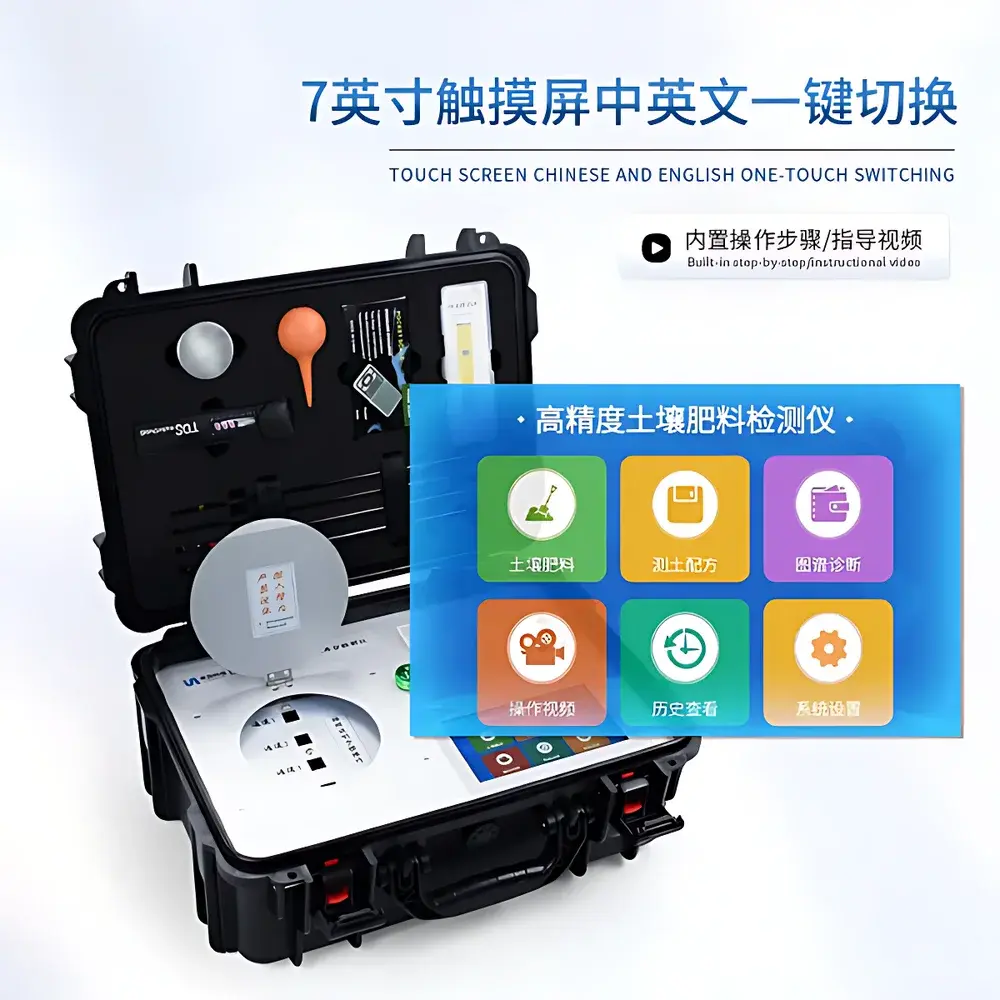
- Integrated Android 5.1 operating system with quad-core CPU (≥1.8 GHz), 16 GB internal storage, and 7.0-inch high-resolution LCD (1024 × 600) with adjustable backlight for outdoor visibility
- Dual-user authentication: password + fingerprint login with multi-account support for role-based data access control
- Onboard GPS geotagging (WGS84 coordinates) synchronized with each measurement record to enable spatially referenced soil mapping
- Thermal direct-printer module producing tamper-evident reports containing analyte name, unit (e.g., mg/kg), absorbance value, calibration ID, timestamp, operator ID, and QR-coded metadata
- Real-time internal voltage monitoring and auto-save functionality with power-loss recovery to prevent data corruption during field interruptions
- IP65-rated ruggedized PVC housing with ergonomic carry case—designed for sustained operation across temperature ranges from −10°C to 50°C and relative humidity up to 95% non-condensing
- Self-guided workflow: step-by-step on-screen instructions for sample preparation, reagent addition, and reaction timing—eliminating dependency on external manuals
Sample Compatibility & Compliance
The IN-HT300 supports standardized extraction protocols aligned with widely adopted agronomic methods—including ISO 11260 (available phosphorus), ISO 14235 (organic carbon), ASTM D5084 (saturated paste EC), and Chinese national standards NY/T 1121 series for soil testing. It accommodates heterogeneous matrices: air-dried or fresh soil (0–100% moisture), granular/liquid fertilizers, plant tissue digests, and aqueous extracts. Detection accuracy meets regulatory thresholds for field-level screening: total N, P, K error ≤1%; organic matter error ≤2%; micronutrients (Fe, Zn, Cu, Mn, B) error ≤5%; heavy metals (Cd, Pb, As, Cr, Hg) error ≤10%. While not intended as a replacement for certified reference laboratories for regulatory compliance reporting (e.g., EPA Method 6010D or ISO/IEC 17025), its performance is validated against NIST-traceable standards and suitable for GLP-aligned field surveys, extension service programs, and pre-screening prior to confirmatory lab analysis.
Software & Data Management
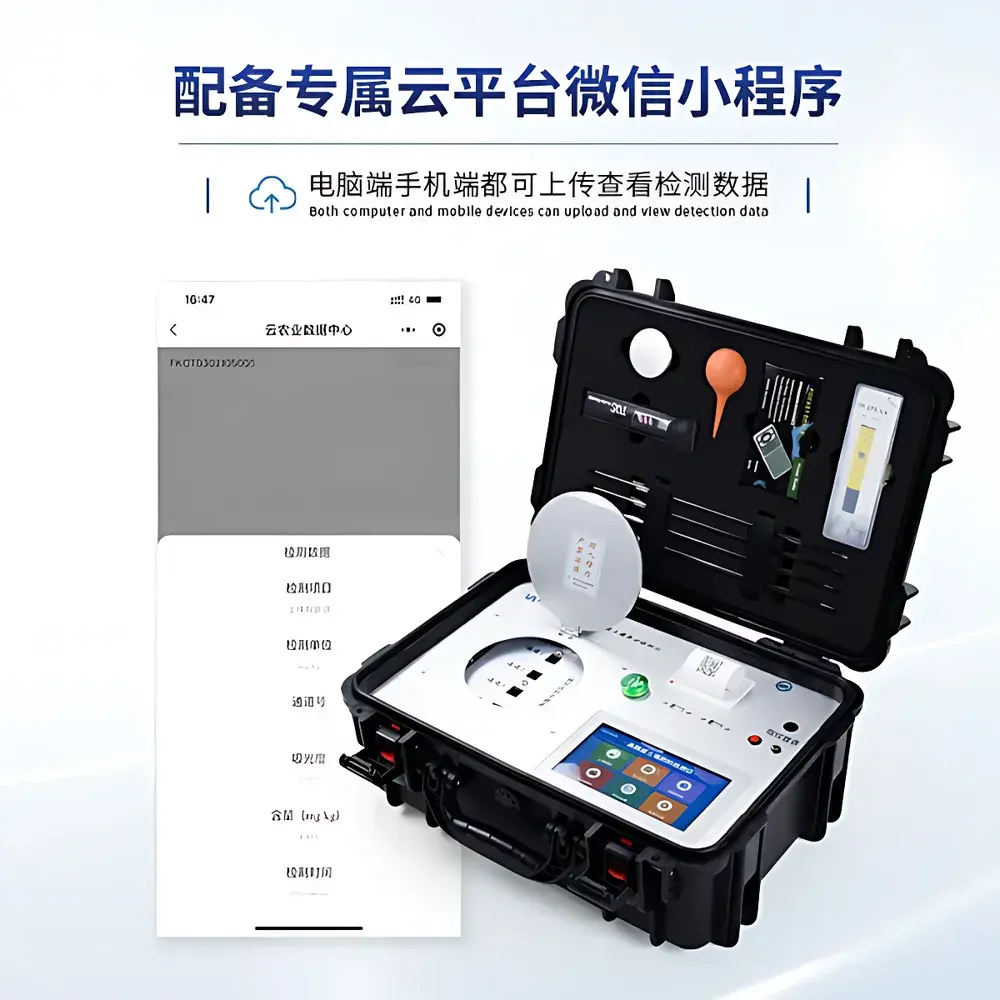
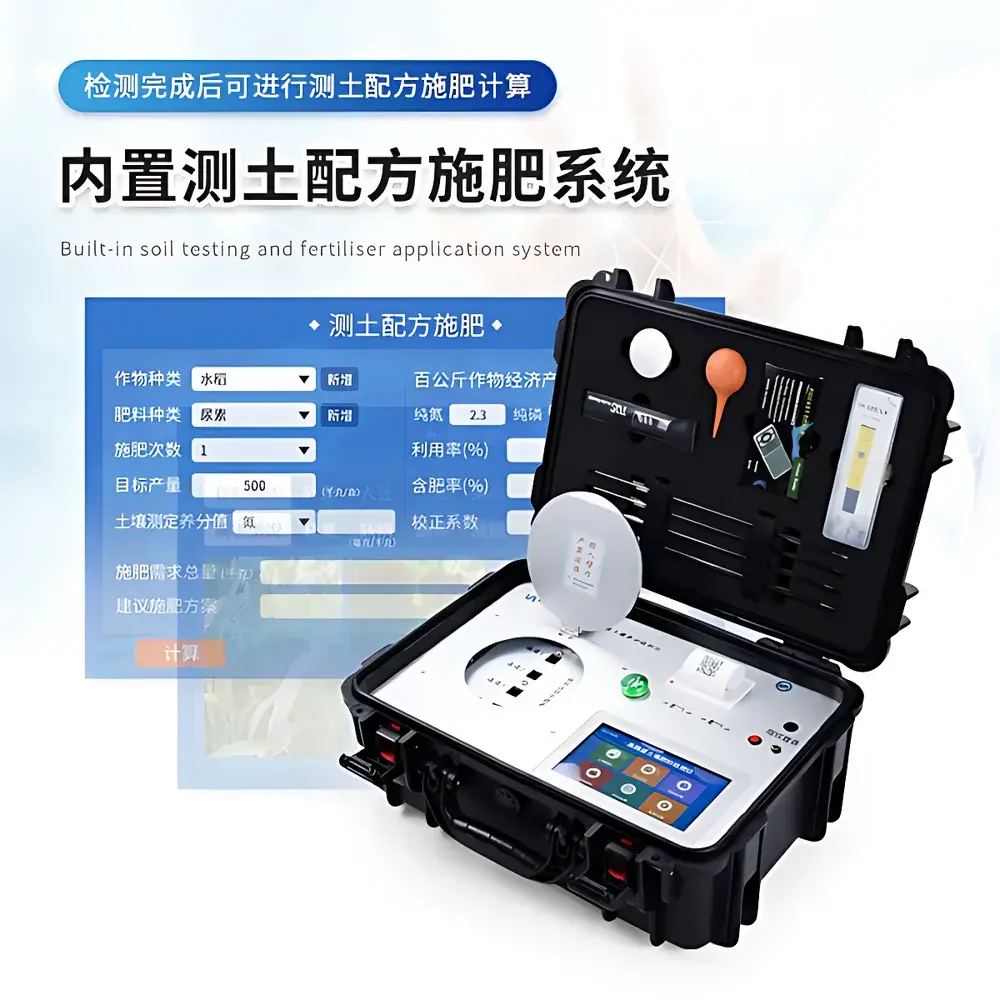
Data integrity is maintained through time-stamped, GPS-anchored records stored locally and optionally synced via Wi-Fi to a secure cloud-based Agricultural Data Hub. The platform supports 21 CFR Part 11-compliant audit trails—including user login history, parameter modification logs, and print event timestamps. Export options include CSV and Excel-compatible tables, with automatic assignment of unique sample IDs tied to geographic coordinates. A dedicated mobile web application (accessible via WeChat Mini Program) allows remote access to historical datasets, trend visualization, and cross-field comparative analytics. The onboard “Soil Testing & Fertilizer Recommendation Engine” applies empirically derived crop-specific nutrient uptake coefficients (covering >120 economically significant species) and regional yield targets to generate prescription-grade fertilizer recommendations—outputting dosage (kg/ha), nutrient form (e.g., urea vs. ammonium nitrate), and application timing guidance—all printable on demand.
Applications
- High-frequency soil fertility monitoring across farm plots, enabling dynamic adjustment of variable-rate application maps
- Rapid verification of fertilizer composition and adulteration screening at distribution points or cooperatives
- Diagnostic nutrient deficiency/sufficiency assessment using integrated visual symptom atlas for 9 essential elements (N, P, K, Ca, Mg, S, Fe, Zn, B) with leaf-image correlation logic
- Environmental risk assessment: field-level screening for heavy metal accumulation in peri-urban or industrial-adjacent farmland
- Extension agent training and participatory action research—supporting farmer-led soil health literacy initiatives
- Long-term soil digital archiving: building longitudinal datasets for tracking organic matter trends, salinization progression, or pH drift over multiple cropping cycles
FAQ
What extraction methods does the IN-HT300 require for soil testing?
Standardized aqueous or acid-extraction protocols are embedded in the instrument’s guided workflow—no external method development is needed. Users follow on-screen prompts for reagent volumes, shaking duration, filtration, and incubation times per analyte group.
Can the device be used for regulatory reporting under EU or US frameworks?
It is designed for field screening and decision support—not for legally defensible compliance reporting. Confirmatory analysis in an ISO/IEC 17025-accredited laboratory remains required for official submissions.
How is calibration maintained during extended field use?
The system performs automatic zero-point and gain calibration before each test sequence using built-in reference filters—no manual recalibration or warm-up period is required.
Is cloud data storage encrypted and compliant with GDPR or CCPA?
Yes. All transmitted data is TLS 1.2 encrypted in transit and AES-256 encrypted at rest. Account-level permissions and anonymization options support jurisdictional privacy requirements.
What is the battery life under continuous operation?
The 4800 mAh Li-ion battery provides ≥10 hours of active measurement time (including printing and GPS logging) at 25°C, with state-of-charge monitoring displayed in real time.
Related Products







